How Lead Intelligence Runs Your Real Estate Business While You Sleep

Quick Answer
What is lead intelligence in real estate and how does it work?
Lead intelligence is the automated tracking and analysis of a prospect's behavior — page visits, message sentiment, engagement frequency, and timing — so a real estate agent knows which leads to prioritize and what to say before making contact. Instead of responding to every inquiry in the same way, an agent with lead intelligence sees a ranked, context-rich view of their pipeline the moment they open their CRM. Systems like Pinova combine behavioral signals with AI-driven conversation to keep leads warm overnight, surface high-intent buyers automatically, and present agents with a ready-to-act briefing each morning.
Key Takeaways
- Leads contacted within 5 minutes are 21x more likely to qualify than leads reached after 30 minutes, per the MIT Lead Response Management Study by Dr. James Oldroyd — yet the average real estate agent takes over 15 hours to respond, per Inman's 2025 survey.
- 80% of property inquiries are submitted outside standard business hours, according to Zillow's 2024 Consumer Housing Trends Report, meaning after-hours automation is not optional — it is where the majority of lead volume lives.
- 50% of all sales happen after the fifth follow-up touch, per InsideSales.com, yet 48% of agents never attempt a second call — handing closed deals to competitors who simply persist.
- 78% of buyers work with the first agent who responds to their inquiry, regardless of price, reviews, or brand — making response speed the single highest-leverage variable in lead conversion.
- NAR data shows 64% of buyers and sellers hire an agent they've used before or found through a referral, which means the leads already in your CRM — kept warm by automated follow-up — are statistically your highest-probability future business.
Sarah Jenkins, an independent agent in Austin, woke up one morning in January 2025 to three missed calls and seven unanswered WhatsApp messages — all from leads who had submitted inquiries between 9 PM and midnight. By 8 AM, when she finally saw them, two of those leads had already booked showings with a competing brokerage. At an average commission of $1,000 per transaction, she had lost roughly $2,000 while she slept — not because her marketing failed, but because no system was running her business while she wasn't.
This article breaks down how AI-powered lead intelligence — built around a daily briefing, real-time intent signals, automated follow-up, and a structured action feed — eliminates the overnight gap that costs agents deals every week. By the end, you'll understand exactly how each component works, what to look for in a platform, and what happens to your pipeline when the system is running at 2 AM instead of waiting for you at 9.
- The Daily Briefing: Your Morning Window Into the Pulse of Your Entire Business
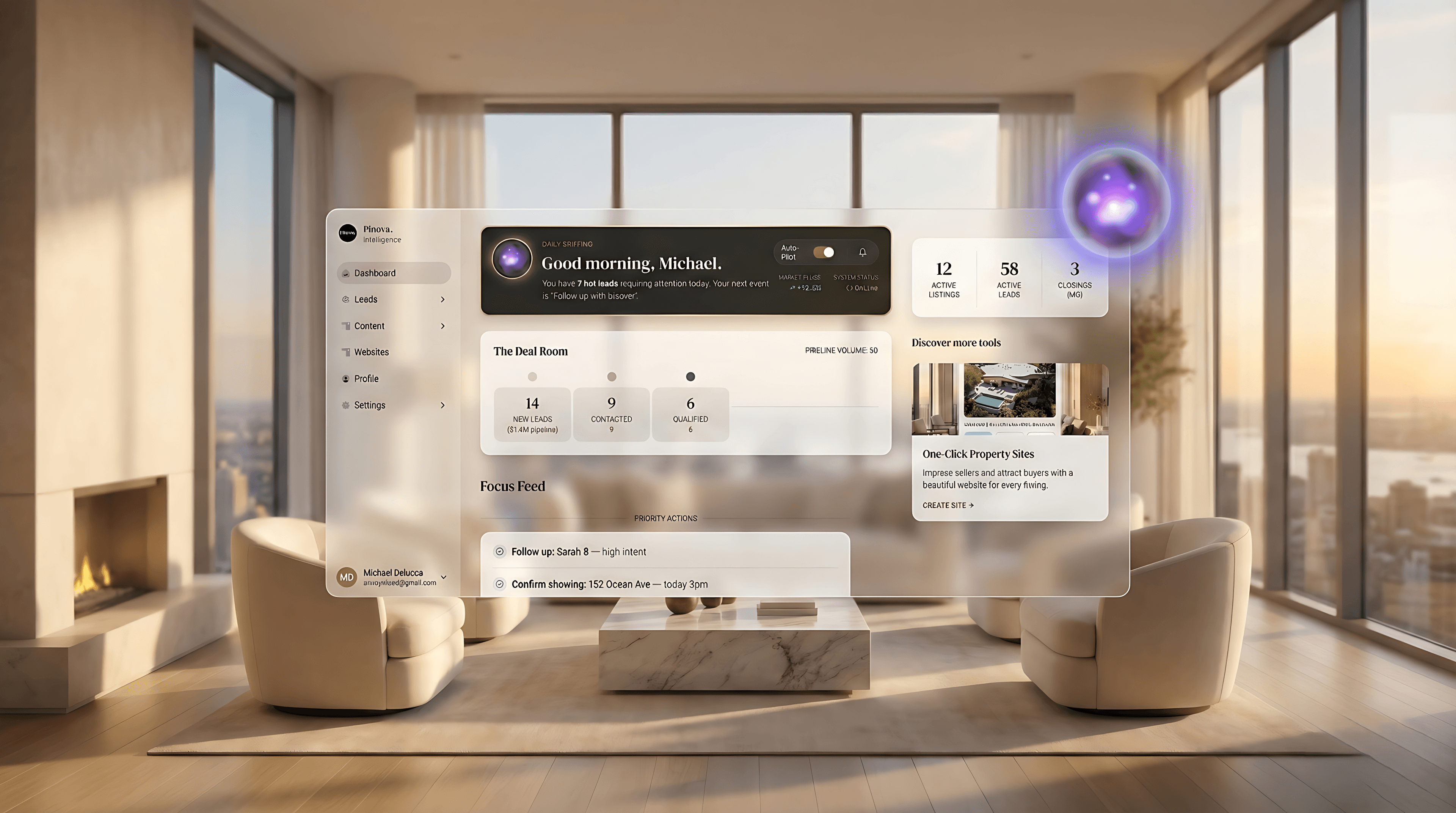
The single most expensive habit in real estate is starting your day by triaging a chaotic inbox. When you spend the first 45 minutes of your morning sorting messages, re-reading old conversations, and trying to remember which lead needs what, you are not building a business — you are playing catch-up. A daily briefing, generated automatically before you log in, eliminates that entirely.
Stat: The average real estate agent takes 917 minutes — over 15 hours — to respond to a new lead inquiry. — Inman Real Estate Technology Survey, 2025
A well-structured briefing does three things: it summarizes overnight activity (new leads, messages received, pages visited), it flags behavioral signals that indicate a shift in intent (a buyer who viewed a property six times at 11 PM, a seller who returned to your valuation tool after two weeks of silence), and it surfaces a ranked list of who needs your attention first. It does not show you everything — it shows you what matters.
The practical difference is measurable. Instead of spending an hour figuring out your day, you spend five minutes reading a briefing and begin your first call by 8:15. Over a five-day week, you recover roughly four hours of productive selling time — the equivalent of an extra showing day every single week, simply from restructuring how you start your mornings.
- Lead Room: Where Every Lead Is Understood Before You Even Touch Your Phone
The conventional CRM treats every incoming lead the same way: a name, a number, and a timestamp. That's not intelligence — it's a waiting room. A lead room built on behavioral analysis does something fundamentally different: it classifies intent from the moment the lead arrives, then updates that classification continuously as the person acts.
Stat: 80% of property inquiries are submitted outside standard business hours — evenings and weekends account for the majority of lead volume. — Zillow Consumer Housing Trends Report, 2024
When a lead enters the system, the platform reads the context: which page they came from, what they typed, what they clicked, how long they spent on each listing, and whether they've visited before. A buyer who submits a generic contact form after browsing three budget-range listings is classified differently than a buyer who fills out a showing request after viewing the same property four times in 48 hours. These two people require entirely different responses — and an intelligent lead room surfaces that difference before you ever pick up the phone.
The compounding benefit arrives over time. By the morning, many leads in a well-run system have already completed the early discovery phase through automated conversation — they've communicated their timeline, explained their situation, and shared their preferences. You enter those conversations already in the middle, not scrambling to introduce yourself. A solo agent operating this way can realistically manage the lead volume that previously required a full inside-sales team.
- How Momentum Becomes Measurable: The Deal Room
Pipeline visibility is the difference between running a business and running on instinct. Most agents cannot answer — without checking multiple apps — how many active leads they have, which ones moved in the past 48 hours, or where the nearest likely conversion sits. That uncertainty creates anxiety, and anxiety creates reactive behavior: calling the wrong person at the wrong time, chasing cold leads while warm ones sit ignored.
Stat: 50% of all sales happen after the fifth follow-up touch — yet 48% of agents never attempt a second call after the first inquiry goes unanswered. — InsideSales.com Lead Response Study
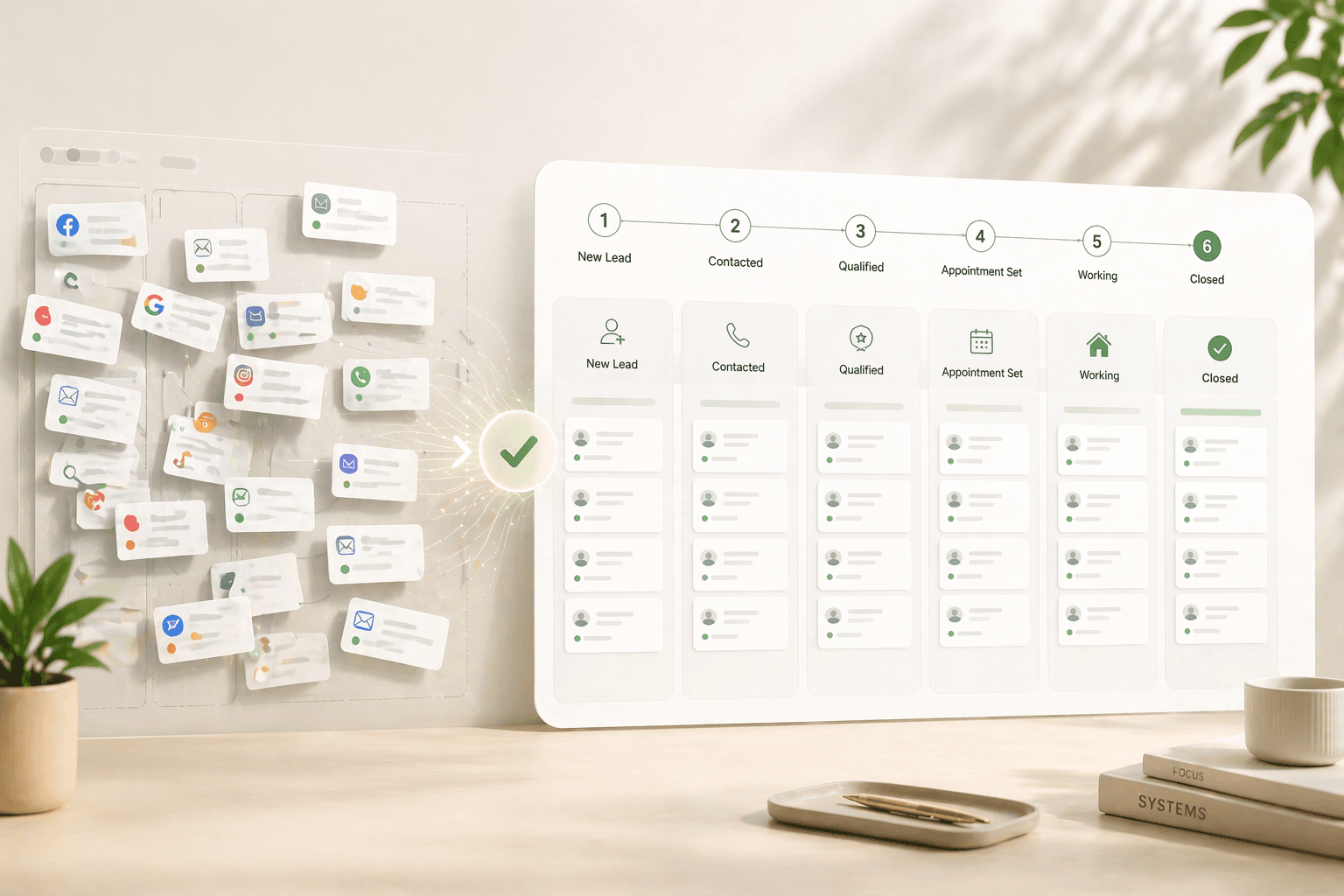
A deal room built for real estate shows pipeline movement — not static stages. It reflects which deals progressed overnight (a message replied, a listing revisited, a showing confirmed), which require intervention (a lead who went quiet after three days of engagement), and which are generating AI-driven momentum without your involvement. The total pipeline value is visible at a glance, so you can prioritize client-facing time toward the conversations most likely to close.
The practical result is that your highest-value hour of the day — the focused, high-energy hour most agents spend on morning admin — gets redirected entirely toward warm conversations. You are not digging for information. The system has already surfaced it.
- The Focus Feed: Your AI-Generated Action List
A task list you build manually is only as good as your memory. You forget who you promised to call. You lose track of which buyer viewed a property last Thursday. You don't notice that a seller just opened your market report for the third time this week. Human memory is unreliable by design — we encode and discard based on recency and salience, not strategic importance.
A focus feed is the machine's answer to that limitation. It scans every lead's behavior across every channel — messages, page visits, email opens, showing history — and generates a prioritized action list based on actual signals. Not what you might want to do today, but what the data says matters most. A lead who showed sudden interest overnight gets surfaced first. A buyer who returned to the same listing three times in 48 hours appears before a lead who hasn't engaged in two weeks. A seller who opened your market analysis and then visited your contact page is flagged as ready for a call.
Stat: The RAIN Group found it takes an average of 8 touchpoints to get a meeting with a new prospect — meaning agents who quit after one or two attempts are losing the deal to whoever stays consistent. — RAIN Group Sales Research
The psychological shift this creates matters as much as the tactical one. When your action list is generated by evidence rather than anxiety, you stop second-guessing yourself. You stop wasting time on leads who aren't ready simply because they're the ones you remember. You work on the right conversations at the right time — and that changes not just your conversion rate, but how you experience your own working day.
- Auto-Pilot: The Quiet Engine Working Behind Every Lead While You Sleep

The math is unambiguous: responding to a lead within 5 minutes makes you 21x more likely to qualify them than waiting 30 minutes, per the MIT Lead Response Management Study. And 78% of buyers work with the first agent who responds. But the average agent takes over 15 hours. That gap is where deals die — and it's entirely structural, not personal. You cannot respond at midnight. You cannot message someone while you're in a showing. No amount of hustle closes a 15-hour response window.
Stat: Automated responses within one minute of lead submission can boost conversion rates by up to 391% compared to waiting 30 minutes. — RubixOne Real Estate Lead Response Analysis, 2025
Pinova's Auto-Pilot mode is the mechanism that closes this gap. When a lead arrives at 11:30 PM, Auto-Pilot sends an immediate, context-aware message — not a generic auto-reply, but a response shaped by what the lead did: which listing they viewed, what they asked, and where they are in their apparent journey. A casual browser gets a warm acknowledgment and a question. A lead who asked about availability gets a direct answer and a scheduling prompt. A repeat visitor who viewed the same property four times gets a message that specifically references that listing.
The system maintains this intelligence as conversations develop. When a lead hesitates, the tone adjusts to build confidence rather than push. When urgency signals appear — repeated views, specific questions about timelines or financing — Auto-Pilot's responses become more proactive. It never sounds automated because it is responding to actual behavior, not a pre-written script that fires on a timer.
What this creates is a fundamentally different starting position for each day. Leads don't cool off overnight. Conversations don't die because you missed a message. By the time you open your system in the morning, Auto-Pilot has already kept doors open that would have closed — and the leads on the other side of those doors are measurably warmer than they would have been without it.
Key Statistics: Lead Intelligence & Response Speed in Real Estate
| Key Statistic / Finding | Source & Year |
|---|---|
| Leads contacted within 5 minutes are 21x more likely to qualify than leads reached after 30 minutes | MIT Lead Response Management Study, Dr. James Oldroyd |
| 78% of buyers work with the first agent who responds to their inquiry | Icenhower Consulting / RubixOne Real Estate Lead Response Analysis, 2025 |
| The average real estate agent takes 917 minutes (over 15 hours) to respond to a new lead | Inman Real Estate Technology Survey, 2025 |
| 80% of property inquiries are submitted outside standard business hours | Zillow Consumer Housing Trends Report, 2024 |
| Automated responses within 1 minute of inquiry boost conversion rates by up to 391% | RubixOne Real Estate Lead Response Analysis, 2025 |
| 50% of all sales happen after the fifth follow-up touch | InsideSales.com Lead Response Study |
| 48% of real estate agents never attempt a second call after an initial unanswered inquiry | Espresso Agent Industry Analysis |
| 64% of buyers and sellers hire an agent they've used before or found through a personal referral | National Association of Realtors, 2024 Profile of Home Buyers and Sellers |
| AI-assisted lead qualification produces 40% more leads converting to appointments vs. manual processes | National Apartment Association Industry Pulse Report, December 2024 |
| It takes an average of 8 touchpoints to secure a meeting with a new prospect | RAIN Group Sales Research |
| Contact rates drop by 80% after the first 5 minutes following inquiry submission | InsideSales.com / MIT Lead Response Management Study |
| 96% of buyers use online tools to search for properties, requiring agents to have a 24/7 digital presence | NAR 2024 Profile of Home Buyers and Sellers |
Frequently Asked Questions
What is lead intelligence in real estate and how is it different from a regular CRM?
A standard CRM stores contact information and lets you log notes manually. Lead intelligence goes further — it tracks a prospect's real-time behavior (page visits, message sentiment, time-on-site, repeat property views) and uses those signals to rank leads by intent, surface the right action at the right time, and trigger automated follow-up when you're unavailable. The practical difference is that a CRM requires you to update it; a lead intelligence platform updates itself.
How much does slow lead response actually cost a real estate agent?
The MIT Lead Response Management Study found that leads contacted within 5 minutes are 21x more likely to qualify than those reached after 30 minutes. Given that 78% of buyers work with the first agent who responds, each hour of delay dramatically compresses your odds of converting any given inquiry. In commission terms, if your average transaction nets $1,000 and your response lag loses even two leads per month to faster competitors, that's over $25,000 in annual revenue tied directly to response speed.
What happens to real estate leads that come in after business hours?
Zillow's 2024 Consumer Housing Trends Report found that 80% of property inquiries are submitted outside standard business hours — evenings, weekends, and late nights. Without automation, those leads sit until the next morning, by which point interest has cooled and competitors who responded immediately have already made contact. AI-driven auto-pilot systems acknowledge these leads within seconds, begin the discovery conversation, and deliver a warm, context-rich lead to the agent the following morning rather than a cold form submission.
How many follow-up attempts does it typically take to convert a real estate lead?
According to InsideSales.com, 50% of all sales happen after the fifth follow-up touch. The RAIN Group puts the average number of touchpoints needed just to secure a first meeting at 8. Despite this, 48% of agents never attempt a second call after an inquiry goes unanswered. The agents who convert at the highest rates are not necessarily the best salespeople — they are the most persistent, and persistence at scale requires a system, not willpower.
What behavioral signals indicate a real estate lead is ready to move forward?
High-intent signals include: viewing the same property more than three times in 48 hours, returning to a valuation or market report page unprompted, switching from browsing multiple listings to repeatedly viewing one specific property, asking specific questions about timelines or financing rather than general questions about neighborhoods, and submitting a showing request or contact form after a period of silent browsing. Each of these signals a narrowing of focus — a lead moving from exploration to decision.
Can AI replace the personal relationship-building that real estate requires?
No — and the best systems don't try to. AI handles the volume work: immediate acknowledgment, discovery questions, behavioral tracking, follow-up sequencing, and briefing generation. The human agent handles the judgment calls: reading emotion, navigating objections, building trust over the course of a relationship, and closing. A study of over 300,000 agent calls found that top-quartile agents (ranked by sales skills) close at twice the rate of average performers — technology gives those agents more qualified conversations to have, not fewer.
What is a real estate daily briefing and what should it include?
A daily briefing is an automatically generated summary of your pipeline's overnight activity, delivered before you start your workday. A well-built briefing covers: new leads and their source, leads that showed behavioral changes (increased engagement, new property views, message replies), follow-up tasks flagged by the AI based on urgency, and a prioritized list of who to contact first. The goal is to eliminate morning inbox triage — you open the briefing, see exactly who needs attention, and begin your first call within minutes rather than after an hour of sorting.
How do I know which leads in my CRM are worth prioritizing today?
Prioritize leads who showed behavioral changes in the past 24–48 hours over leads who haven't engaged recently, regardless of how long they've been in your pipeline. Specific triggers: a lead who revisited a property page, a past client who opened a market update email and then clicked through to a listing, a prospect who asked a specific question about financing or timeline (which signals closer readiness than questions about general market conditions). NAR data shows 64% of buyers eventually work with an agent they've used before — which means the cold leads in your existing database, kept warm by regular automated value delivery, represent a substantial share of your future business.
📚 Related Reading
- How to Create a High-Converting Real Estate Funnel: Built Entirely on AI
- What are Quick Property Pages and How They Enhance the Real Estate Website: From Static Page to Intelligent Property Experience
- Why Property Pages are Becoming so Popular Among Real Estate Buyers and Sellers
- The 5-Minute Pipeline Audit: See Exactly Where You Are Losing Deals Right Now
Amaan Sheikh
— Co-Founder & CEOAmaan Sheikh is the co-founder and CEO of Pinova. He sets the product direction, builds the partnerships, and personally works with every founding partner. His focus is making enterprise-grade real estate technology accessible to ambitious agents and teams — without the enterprise price tag.