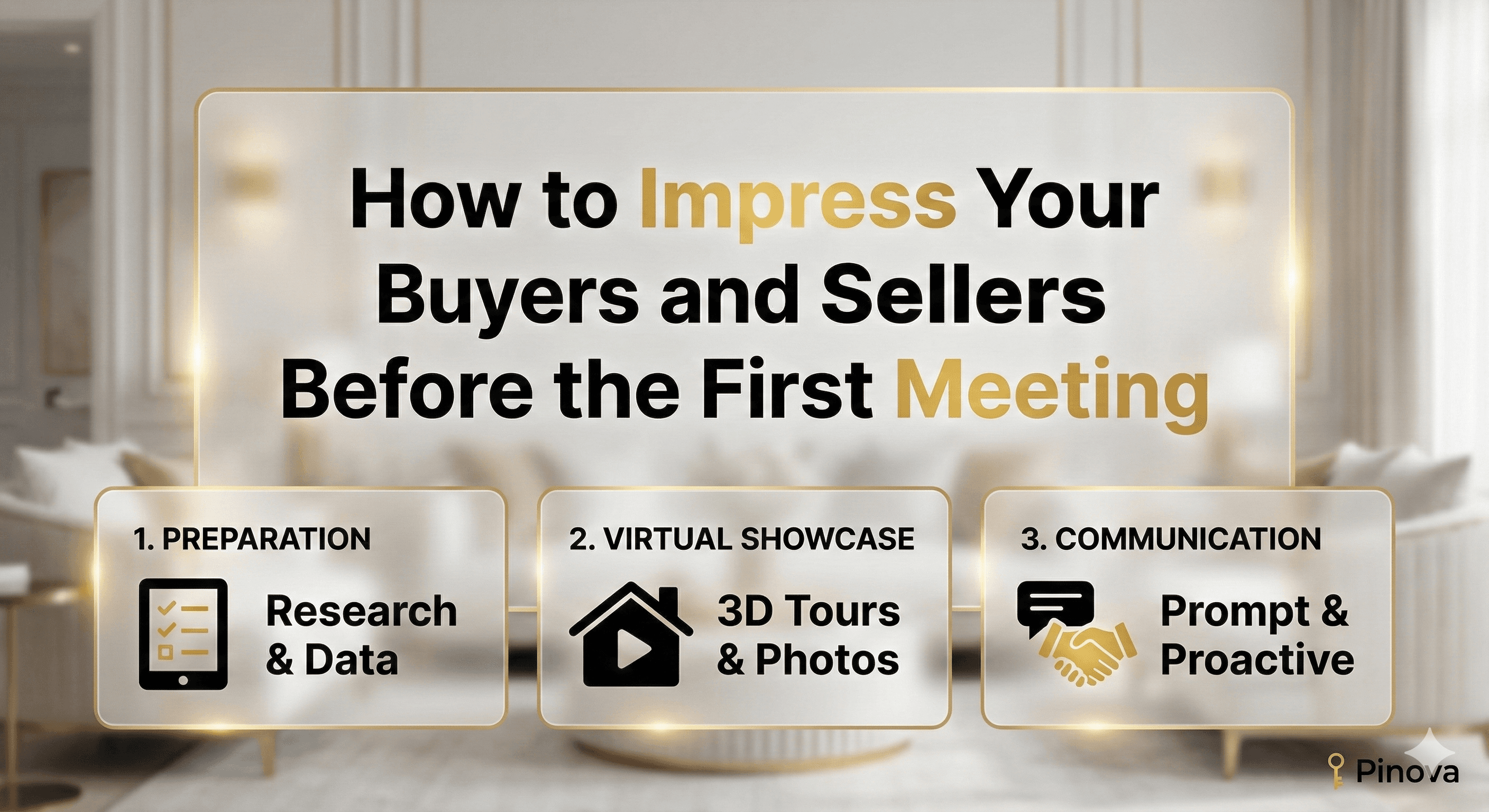
How to Impress Buyers and Sellers Before the First Meeting

Quick Answer
How do you impress a seller before the first listing appointment?
Most sellers have already decided how they feel about you before you arrive. The agents who win listings send something impressive the moment a seller reaches out — a polished sample property page, an instant intelligent response, and a structured follow-up sequence — so the appointment becomes a confirmation rather than a first impression. Preparation data gathered before the meeting, such as what links the seller clicked and what questions they asked, lets you walk in already knowing their concerns.
Key Takeaways
- Zillow's 2025 Consumer Housing Trends Report found that 59% of sellers hire the first agent they speak with — meaning whoever creates the strongest pre-contact impression wins before any competitor even gets a call.
- The average real estate agent takes 47 hours to respond to a new lead, per ServiceBell 2023. Agents who respond within 60 seconds convert 55% more leads to appointments, per NAR lead response research.
- Leads contacted within 5 minutes are 21x more likely to enter the sales process than those contacted after 30 minutes, per Dr. James Oldroyd's Lead Response Management Study, published in Harvard Business Review.
- 78% of sellers are more likely to hire agents who offer high-resolution photography, and 75% favor agents who provide virtual tours or interactive floor plans, per Zillow's 2025 Consumer Housing Trends Report.
- Only 27% of real estate leads are ever contacted at all, according to ServiceBell 2023 — meaning the bar for simply showing up professionally and promptly is far lower than most agents assume.
Sarah Jenkins, a seller in Austin, reached out to three agents on a Tuesday evening. The first replied the next morning with a phone call. The second sent a generic WhatsApp message with her number. The third responded within four minutes with a polished property page from a recent listing, a brief intelligent message gathering her timeline and goals, and a structured follow-up the following morning. By Thursday, Sarah had already mentally selected her agent — before any of them had walked through her door. The third agent won a $2.2 million listing appointment before saying a single word in person.
This article shows you exactly what that third agent did differently: the pre-listing touchpoints, the response systems, the presentation materials, and the behavioral data that turns a first inquiry into a done deal before you arrive. Every tactic here can be implemented in your workflow starting today.
Why Sellers Have Already Judged You Before You Walk Through the Door
The listing appointment is no longer where your first impression happens — it is where your pre-existing impression is confirmed or contradicted. Zillow's 2025 Consumer Housing Trends Report found that 59% of sellers hire the first agent they speak with. That figure is not about loyalty. It is about digital momentum: sellers form a working opinion based on your response speed, your online materials, and how organized your initial outreach feels. Whoever gets in front of them first with the strongest professional signal wins — before any competitor gets a callback.
The data on how sellers find agents reinforces this. According to the same Zillow report, 36% of home sellers now find their agents online — more than double the 15% who did so in 2018. That means your digital footprint and the first 10 minutes of contact now carry more weight than your listing track record. A seller who discovers you through Instagram, your website, or a property portal will have already absorbed your brand before picking up the phone.
Stat: 59% of sellers hire the first agent they speak with — and 36% now find their agent online before making any contact. — Zillow 2025 Consumer Housing Trends Report
The consequence of ignoring this is straightforward: if your first touchpoint after a seller inquiry is a generic phone call or a simple text, you have already lost ground to any competitor who sent something impressive, fast. Sellers compare responses. The agent who demonstrates value before asking for the listing is the agent who gets it.
Why Traditional Listing Presentations No Longer Impress Sellers
For decades, a listing presentation meant sitting at a seller's dining table, walking through comps, explaining your marketing plan, and handing over printed materials. That model worked when sellers had limited access to market data and no way to compare agents before meeting them. Neither of those conditions exists anymore.
Today's seller has already browsed property portals, checked agent reviews on Google and Redfin, watched listing videos, and compared how different agents present their active listings online — all before picking up the phone. The NAR 2024 Profile of Home Buyers and Sellers confirms that sellers rank marketing capability as their top priority when choosing an agent, above price recommendation and above experience. They want to see how you actually handle a listing, not hear you describe it.
Traditional agents have two tools to influence pre-appointment perception: their static online profile and their response speed. Both are typically weak. Most agent websites are generic brokerage templates. And per ServiceBell 2023, the average real estate agent takes 47 hours to respond to a new lead — while 82% of consumers expect a response within 10 minutes. The gap between what sellers expect and what most agents deliver is the opening you exploit.
Stat: The average real estate agent takes 47 hours to respond to a new inquiry. 82% of consumers expect a response within 10 minutes. — ServiceBell 2023
The seller who contacts three agents and hears back from one of them in under 5 minutes — with a polished, structured response — has already made a mental shortlist that does not include the other two. The presentation you deliver at the kitchen table matters. But by the time you sit down, it is mostly ratification work.
Why AI-Generated Property Pages Work as a Pre-Listing Showcase
The most powerful thing you can show a seller in the first hour of contact is not a PDF brochure or a credentials sheet. It is a live example of how their home would look under your representation. Sending a seller a polished property page from a recent listing does something no verbal pitch can replicate: it lets them project themselves into the outcome. They see the photography, the layout, the mobile experience — and they imagine their home in that same frame.
Zillow's 2025 data confirms why this works. 78% of sellers said they are more likely to hire agents who offer high-resolution photography, and 75% favor agents providing virtual tours or interactive floor plans. A sample property page demonstrates both capabilities in a single link — no explanation needed. You are not telling the seller you are good at marketing. You are showing them a live example of it.
The contrast with a traditional response is stark. Most agents reply to a seller inquiry with a phone call or a text like "Thanks for reaching out, I'd love to connect." A seller who receives that alongside a link to a beautifully designed, mobile-ready property showcase has already made a comparison. The agent who sent the link feels like a different category of professional — not because of experience or price, but because of what they demonstrated without being asked.
The Core Distinction:
Traditional agents describe how they market homes.
Agents who send sample property pages prove it, before the conversation begins.
How Follow-Up Speed Makes You Feel "Organized and On Top of Everything"
Response time is the single most measurable signal of professionalism a seller receives before the listing appointment. If your communication is slow or inconsistent, sellers do not assume you were busy. They assume your marketing and negotiation will be handled the same way. The research on this is unambiguous: Dr. James Oldroyd's Lead Response Management Study, published in Harvard Business Review, found that leads contacted within 5 minutes are 21x more likely to enter the sales process than those contacted after 30 minutes. Each additional hour of delay cuts your contact success roughly in half.
For a solo agent without a full administrative team, maintaining that speed 24 hours a day is impossible through manual effort alone. The practical answer is an intelligent system that responds instantly on your behalf — gathering seller details, answering common questions, sharing your sample property page — so the seller is engaged within minutes, whether you are in a showing, asleep, or with another client. From the seller's perspective, you feel attentive and organized at every hour. From your perspective, you wake up to a qualified, warmed-up lead with notes already compiled.
Stat: Leads contacted within 5 minutes are 21x more likely to enter the sales process compared to those contacted after 30 minutes. — Dr. James Oldroyd, MIT Lead Response Management Study (Harvard Business Review)
The structured follow-up sequence matters as much as the initial response. A seller who hears from you immediately and then receives a thoughtful check-in the next morning — not a generic drip message, but a message that references their specific question or property detail — walks into the listing appointment already trusting your operational competence. Sellers who feel ignored between inquiry and appointment often cancel or go silent. Those who feel consistently attended to arrive ready to sign.
How Behavioral Analytics Make You the Most Prepared Agent in the Room
The standard listing presentation covers comps, pricing strategy, and marketing plan. Every agent the seller speaks to will cover those three things. What genuinely differentiates a top-performing agent is preparation that goes beyond data — knowing the seller's specific concerns, emotional motivators, and decision-making timeline before they state them in the room.
Behavioral signals reveal this. Before your appointment, you can know which links the seller clicked in your follow-up messages, how many times they viewed your sample property page, what questions they asked the AI assistant, and what time of day they tend to engage. A seller who revisits your property page three times at 11pm is not casually browsing — they are actively comparing you. A seller who asks multiple questions about marketing timeline is signaling anxiety about days on market. None of this context requires the seller to state it explicitly. It is readable from their behavior.
What sellers say when you walk in already knowing their concerns:
- ✓ "You actually understood what I was worried about."
- ✓ "You were more prepared than anyone else I spoke to."
- ✓ "It felt like you had already been thinking about my property specifically."
- ✓ "You clearly operate at a completely different level."
Agents who walk in armed with behavioral intelligence do not need to guess what objections to address. They anticipate them. That preparation reads as confidence and competence — and it is a significant reason why sellers choose them over agents with longer track records but less situational awareness.
Why Automated Pre-Listing Nurturing Converts More Sellers
Most agents believe conversion happens at the listing appointment. In reality, it happens in the hours and days before it — in the quiet window when the seller is evaluating whether to keep the appointment at all. Sellers who feel consistently attended to during this window show up ready to commit. Those who feel ignored between first inquiry and scheduled meeting often go cold or accept a competing agent who responded faster.
The mechanics of effective pre-listing nurturing are specific. The moment a seller reaches out, the system should: respond intelligently within minutes, gather their motivation and timeline through natural conversation, share your sample property page without prompting, and send a structured follow-up within 12–24 hours that references something specific from the initial conversation. By the time you speak to the seller personally, they have already interacted with your brand, seen your marketing work, and experienced your organizational process. The appointment becomes a continuation, not a cold introduction.
The numbers behind this dynamic are clear. According to ServiceBell 2023, only 27% of real estate leads are ever contacted at all, and it typically takes eight or more touches to convert a lead, per RAIN Group. Most agents make an average of 1.3 call attempts before moving on. A structured nurturing sequence that reliably completes 5–8 touches — intelligently timed across the pre-appointment window — represents a capability that the overwhelming majority of competing agents simply do not have.
How Pinova Builds Your Pre-Listing System Automatically
Pinova's pre-listing workflow automates each of the steps described above. When a seller inquiry arrives, the AI responds immediately in your brand's tone, gathering their property details, motivation, and timeline through natural conversation. It then sends a direct link to a polished property page generated from one of your active or recent listings — demonstrating your marketing standard without any manual effort on your part. Over the following 24–72 hours, Pinova handles structured follow-up messages that reference what the seller has shared, keeps the conversation warm during your off-hours, and compiles a pre-appointment briefing that surfaces which links the seller clicked, how many times they revisited your materials, and what concerns emerged in their messages. You walk into the listing appointment with context that took zero manual preparation to collect.
The Pre-Listing → Appointment → Close Journey, Step by Step
Here is what the seller experiences when your pre-listing system is running correctly:
1. Seller Reaches Out — Immediate Intelligent Response
Within minutes: a warm, professional reply that asks smart qualifying questions without feeling like a form. The seller's initial interest is captured while it is at peak intensity.
What the seller feels: "This agent is organized. They were ready for me."
2. Sample Property Page Is Shared
The seller opens a beautifully formatted listing microsite. It loads cleanly on mobile, scrolls smoothly, and looks like something a premium team produced. They begin imagining their home in the same frame.
What the seller feels: "This is how my listing would look. I want this."
3. Structured Follow-Up Arrives
Not a generic drip message — a follow-up that acknowledges what the seller shared, answers a question they asked, or provides relevant market context for their property type. It feels personal because it references their specific situation.
What the seller feels: "They were paying attention. This is different."
4. You Receive a Pre-Appointment Briefing
Before you enter the home: their stated motivation, their timeline, their engagement patterns (which links they clicked, when they revisited your materials), and any concerns that surfaced in the conversation. You arrive knowing more about this seller than the agents they spoke to for an hour.
You walk in prepared. They walk in impressed before you open your mouth.
5. The Listing Presentation Becomes a Confirmation
Your materials look polished. Your insights address their actual concerns. Your process has already demonstrated what you promised. The seller is not choosing between you and two other agents — they are confirming what they already decided during the pre-listing window.
The listing appointment becomes the closing, not the sales call.
How to Continue Impressing Sellers After You Win the Listing
The NAR 2024 Profile of Home Buyers and Sellers found that 87% of sellers say they would definitely or probably recommend their agent to others — but only for agents who delivered on their pre-listing promise throughout the full transaction. Winning the listing is the threshold. Delivering a post-listing experience that matches your pre-listing professional signal is what generates referrals.
Once the listing is live, the most common seller frustration is feeling uninformed. Sellers want to know who is looking at their property, how engaged buyers are, and whether anything is changing in buyer behavior. Agents who provide clear, specific updates rather than vague reassurances create a qualitatively different client experience. Instead of "traffic seems okay," you deliver:
"Your listing received 48 page views yesterday, with 12 buyers returning more than once."
"Three buyers spent more than four minutes on your photo gallery — the longest engagement we've seen this week."
"One buyer revisited the property page at 10:47pm and saved it. We're tracking their behavior."
This level of specificity converts you from agent to advisor. Sellers who receive this kind of communication don't just use you again — they refer you enthusiastically, because the experience feels like nothing they have had from any previous agent. That referral behavior is what the NAR data confirms: 66% of sellers find their agent through a referral or prior relationship. Building that referral pipeline starts with the pre-listing experience.
Key Statistics: Seller Behavior and Agent Selection
| Key Statistic / Finding | Source & Year |
|---|---|
| 59% of sellers hire the first agent they speak with | Zillow 2025 Consumer Housing Trends Report |
| 36% of home sellers now find their agent online, up from 15% in 2018 | Zillow 2025 Consumer Housing Trends Report |
| 78% of sellers are more likely to hire agents who offer high-resolution photography | Zillow 2025 Consumer Housing Trends Report |
| 75% of sellers favor agents who provide virtual tours or interactive floor plans | Zillow 2025 Consumer Housing Trends Report |
| Leads contacted within 5 minutes are 21x more likely to enter the sales process than those contacted after 30 minutes | Dr. James Oldroyd, MIT Lead Response Management Study |
| The average real estate agent takes 47 hours to respond to a new lead | ServiceBell 2023 |
| Only 27% of real estate leads are ever contacted at all | ServiceBell 2023 |
| 82% of consumers expect a response within 10 minutes of an inquiry | ServiceBell 2023 |
| Agents who respond within 60 seconds convert 55% more leads to appointments than agents responding after 5 minutes | NAR Lead Response Research |
| It typically takes 8 or more touches to convert a lead | RAIN Group |
| On average, agents make only 1.3 call attempts before abandoning a lead | Forbes |
| 66% of sellers chose their agent through a referral or prior relationship | NAR Profile of Home Buyers and Sellers 2024 |
| 87% of sellers say they would definitely or probably recommend their agent | NAR Profile of Home Buyers and Sellers 2024 |
| Agent-assisted homes sold for a median of $435,000 vs $380,000 for FSBO, a $55,000 gap | NAR Profile of Home Buyers and Sellers 2024 |
Frequently Asked Questions
What should I send a seller immediately after they reach out?
The most effective first response contains three elements: an intelligent reply that acknowledges their specific situation and asks one or two qualifying questions, a link to a sample property page from one of your recent listings, and a clear indication of your next step (such as scheduling a call or sending a CMA). Sellers who receive a polished property page in the first few minutes of contact experience your marketing capability rather than just hearing about it. This single action differentiates you from the majority of agents who reply with a call or a generic text.
How quickly do I need to respond to a seller inquiry to win the listing?
Dr. James Oldroyd's Lead Response Management Study found that leads contacted within 5 minutes are 21x more likely to enter the sales process than those reached after 30 minutes. For real estate specifically, NAR research shows that agents responding within 60 seconds convert 55% more leads to appointments. The average agent takes 47 hours to respond, per ServiceBell 2023 — so even a 15-minute response places you significantly ahead of most competitors. Under 5 minutes is the target; anything beyond 30 minutes carries meaningful risk of losing the lead to a faster agent.
What do sellers value most when choosing a listing agent?
According to NAR's 2024 Profile of Home Buyers and Sellers, sellers prioritize three things: the agent's ability to market the home effectively, competitive pricing, and selling within a set timeframe. Reputation and honesty follow closely. Zillow's 2025 Consumer Housing Trends Report adds specificity: 78% of sellers are more likely to hire agents who offer high-resolution photography, and 75% favor those who provide virtual tours. In practice, sellers want to see evidence of marketing skill before the appointment, not just a description of it.
How many agents do most sellers interview before choosing one?
Zillow's 2025 research found that 59% of sellers hire the first agent they speak with. NAR data has historically shown that 80% of sellers contact only one agent. This means the agent who creates the strongest and fastest first impression typically wins — not through competition with other agents at the listing table, but by establishing clear preference before any other agent has a meaningful conversation.
What is a pre-listing nurturing sequence and why does it matter?
A pre-listing nurturing sequence is a series of structured touchpoints between a seller's first inquiry and their listing appointment — typically covering 3–8 interactions over 1–5 days. Its purpose is to keep the seller engaged, demonstrate your professionalism, and gather information that makes your appointment more effective. RAIN Group research shows it takes 8 or more touches to convert a lead. Most agents make 1.3 attempts before giving up. A structured sequence that runs automatically means you complete this touchpoint volume without manual effort, placing you far ahead of competing agents in perceived attentiveness.
What behavioral signals should I track before a listing appointment?
The most useful pre-appointment signals are: how many times the seller revisited your sample property page or follow-up messages; what time of day they engage (a seller reviewing materials at 11pm is highly motivated); which specific questions they asked the AI assistant; and how quickly they reply to your messages. A seller who revisits your materials multiple times and asks detailed questions about your marketing process is signaling readiness to commit. A seller who has gone quiet after initial contact may need a different follow-up approach. Behavioral data lets you tailor the appointment conversation rather than delivering a generic pitch.
How do I impress sellers after winning the listing?
Post-listing seller communication should be specific and data-driven, not vague. Instead of "traffic is looking good," provide precise updates: how many unique views the property page received, which buyers returned multiple times, and what engagement patterns suggest about buyer interest. NAR's 2024 data shows that 87% of sellers say they would recommend their agent — but this outcome is tied directly to the communication experience throughout the transaction, not just the sale result. Sellers who receive clear, quantified updates feel in control of the process and are significantly more likely to refer you.
Can a solo agent realistically deliver a luxury-level pre-listing experience?
Yes — provided the right system is handling the repetitive, time-sensitive elements. The components that sellers associate with a premium experience (immediate responses, consistent follow-up, polished marketing materials, behavioral insights before the meeting) are all automatable. A solo agent with an AI-powered workflow can deliver a pre-listing experience that previously required a full administrative team. The constraint is not effort but the presence or absence of systems that work independently while the agent is unavailable.
Ayushman Singh
— Co-Founder & Chief Brand & Marketing OfficerAyushman Singh is the co-founder and Chief Brand & Marketing Officer of Pinova. He shapes the narrative, builds the brand, and tells the stories the industry doesn't want to hear. He believes the real estate system was designed to extract from agents, not empower them — and he's building the counter-narrative.