Why Property Pages Are Replacing Traditional Listing Sites for Buyers and Sellers

Quick Answer
What is a property page in real estate and why does it convert better than a standard listing?
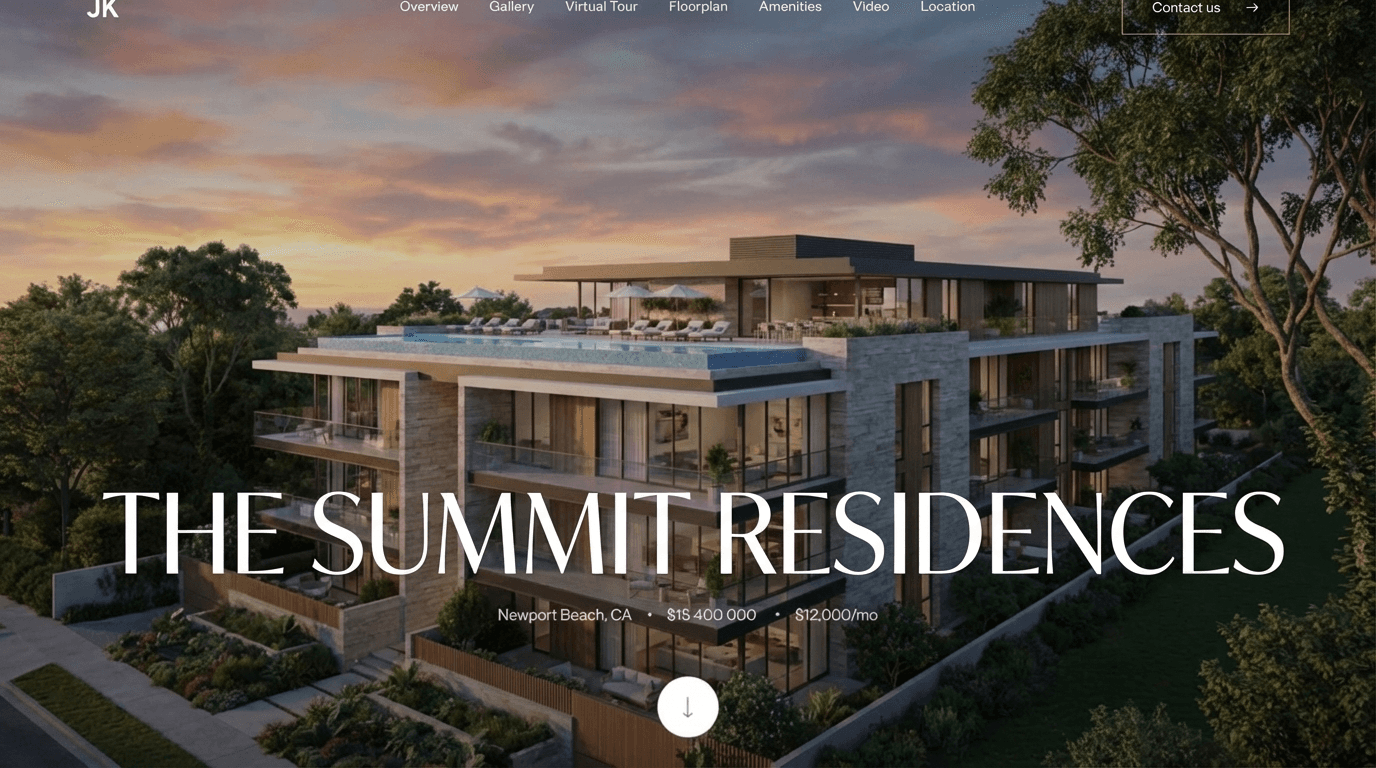
A property page is a dedicated, standalone webpage built for a single listing — no competing properties, no navigation menus, no IDX feed distractions. It presents one home through a narrative scroll: photos, description, neighbourhood context, floor plan, and a lead capture or chat interface. Property pages convert better than standard listing pages because they match how buyers actually behave in 2025: 85% of home buyers cite photos as the most critical factor in deciding which homes to view (NAR), and mobile accounts for over 60% of real estate searches (Placester/NAR). A focused, fast-loading, visually rich single-property experience — built for mobile and shareable via messaging apps — removes the friction that causes buyers to bounce from cluttered IDX feeds.
Key Takeaways
- 85% of home buyers say listing photos are the most critical factor in deciding which homes to view in person, per NAR research — making visual presentation the primary conversion lever before any agent conversation begins.
- Listings with professional photos sell 32% faster and receive 61% more online views than those without, per a Redfin analysis of over 100,000 listings — the same visual quality advantage applies to how a property page presents its imagery.
- A page load delay from 1 to 3 seconds increases bounce probability by 32%; at 5 seconds, 53% of mobile visitors abandon the page entirely, per Google Core Web Vitals research — IDX feeds that load slowly destroy the first impression a listing creates.
- Over 60% of real estate searches now start on mobile devices (NAR/Placester data, 2024), making mobile-first, scroll-based property pages structurally better suited to how buyers discover homes than desktop-designed IDX portals.
- Video content on property listings generates 403% more inquiries than listings without it (NAR, 2024) — property pages built to embed video, virtual tours, and 3D walkthroughs natively outperform static listing feeds that treat these as afterthoughts.
Paige Nelson, a listing agent in Boston, spent three hours in November 2024 preparing a new $2.2 million apartment for market. She hired a photographer, wrote a detailed description, uploaded everything to her IDX site, and shared the listing link through WhatsApp with twelve interested buyers. Of the twelve, four clicked the link. Two clicked once and left within 10 seconds. One clicked from her iPhone and spent 45 seconds watching the page load before giving up. One came back the next day — on a desktop — and booked a showing. The property sat on market for 28 days. The listing page had the right information. The experience it created was wrong.
This article explains exactly why dedicated property pages — fast, focused, mobile-first, narrative-driven — are replacing traditional IDX listings and portal pages as the primary vehicle for property marketing. You will understand the structural reasons why old-format listing pages lose buyers before the conversation begins, what a property page does differently at each point of friction, and why the shift from static template to AI-generated property experience represents a fundamental change in how listings convert.
The slow death of traditional listing pages
For years, agents relied on IDX websites to present listings. These platforms pulled MLS data into searchable databases that buyers could filter by price, bedroom count, and location. At the time, this felt like a breakthrough: every agent suddenly had a "search tool" on their site. But what looked like an advantage produced a hidden problem. IDX sites all looked identical. The descriptions came from MLS feeds, written to specification rather than emotion. The pages were overloaded with compliance data, structured for database logic rather than buyer experience. And crucially, they were built for desktop browsers in an era when real estate search is overwhelmingly mobile.
The numbers make the failure concrete. Over 60% of real estate searches now begin on mobile devices, per 2024 data from Placester and NAR. The average mobile website takes 8.6 seconds to load. Google research shows that as load time extends from 1 to 3 seconds, bounce probability increases 32%; at 5 seconds, 53% of mobile visitors abandon the page entirely. An IDX page that takes 4 seconds to load on a phone is not a slow website — it is a broken first impression. The buyer who shares a link over WhatsApp and waits four seconds while a cluttered portal page assembles itself has already shifted their attention elsewhere.
Stat: 85% of home buyers cite listing photos as the most critical factor when evaluating a property online, per NAR research — and a buyer who hits a slow-loading, cluttered IDX page never gets to assess those photos. — National Association of Realtors, photoup.net compilation of NAR data, 2025
The portal problem compounds this. When Zillow, Redfin, and similar platforms emerged with faster load times, better mobile UX, and smoother search interfaces, agent IDX sites quickly lost their competitive advantage. Buyers did not fall in love with agent IDX pages — they used them out of necessity, then abandoned them for portals with superior design. What remained was an agent site that generated almost no leads from its own listing pages, while driving buyers to portals where other agents captured the inquiry. The listing agent became the source of inventory for a competitor's lead machine.
The final blow came from messaging behavior. Modern buyers do not email a listing link — they text it. They share it on WhatsApp, Instagram DMs, and iMessage. When a link generates a poor preview thumbnail and a slow-loading, cluttered page, the share fails before it begins. The recipient does not explore the home; they close the tab and move on. Traditional listing pages were never built for a share-first, mobile-first discovery pattern, and that mismatch now costs agents measurable opportunities at every stage of the funnel.
The rise of dedicated property pages: from templates to intelligent experiences
Single-property websites have existed for years in luxury real estate. A $4 million beachfront villa warranted a custom microsite: large photos, drone footage, an architect's narrative, a floor plan, and neighborhood context built into a bespoke page. These pages worked because they treated the home as a story worth telling, not a database record worth displaying. But building them required a designer, a developer, a copywriter, and several days of coordination — a cost structure that made them viable only for the top 1% of listings.
The breakthrough that changed this was AI's ability to generate the full page from a property's raw data in seconds. Instead of requiring a team to craft the narrative, the system reads the property details — location, size, configuration, features, price — and produces a structured, emotionally resonant experience: a description that opens with lifestyle rather than square footage, neighborhood context that names real nearby places, a section order that matches how buyers scan rather than how MLS databases organize. The result is a page that feels handcrafted but was built in minutes.
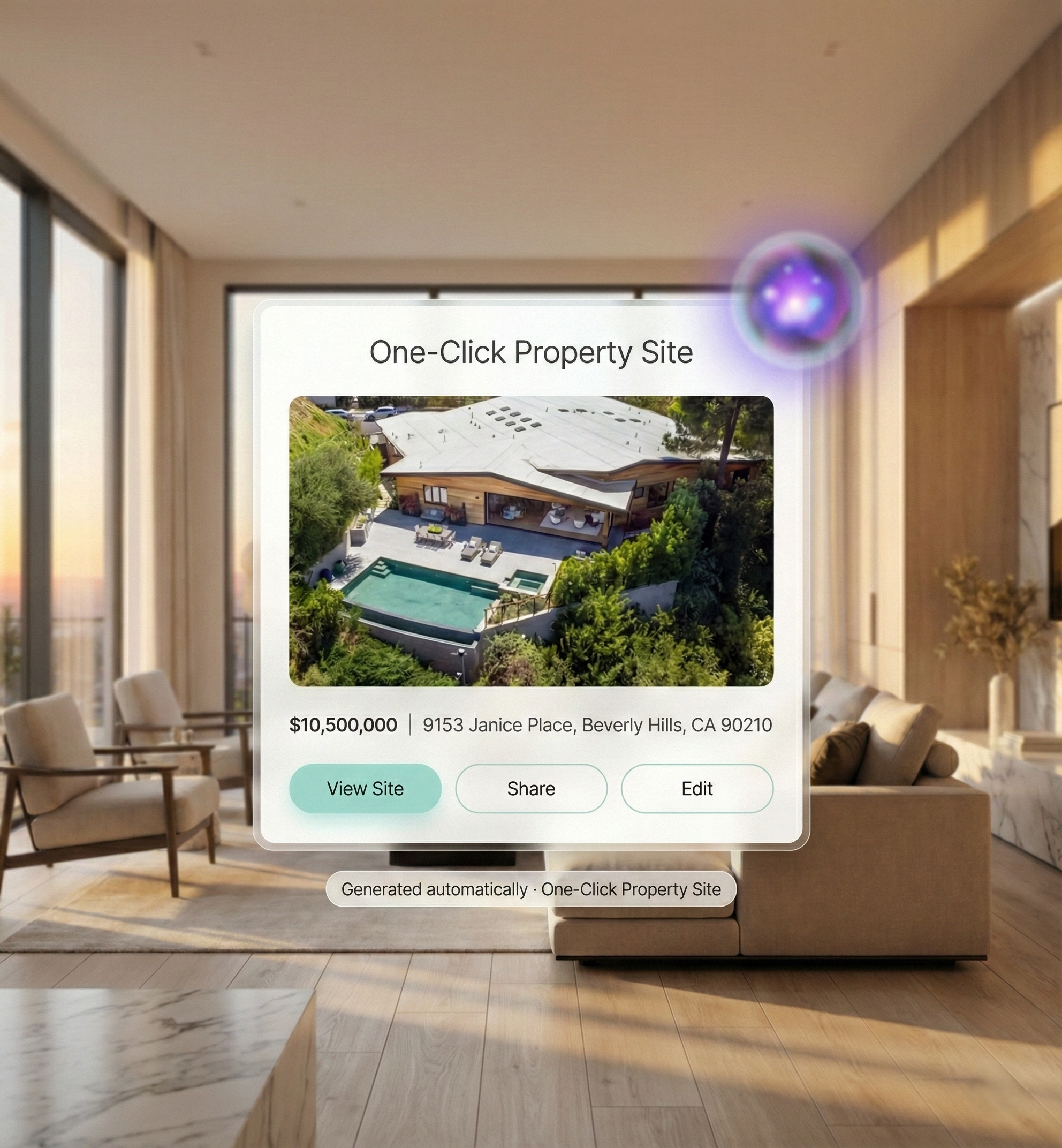
This democratization matters enormously. A $300,000 apartment in Austin and a $4 million penthouse in Seattle can both have a property page that gives the buyer the same quality of focused, immersive experience. The gap that previously existed between mass-market listings (IDX template, MLS copy) and premium listings (custom microsite, professional copywriting) collapses when AI generates the content layer for every listing. Every agent, regardless of market tier or technical skill, can now offer buyers a property experience that feels professionally crafted.
Property listings with video content generate 403% more inquiries than those without, according to NAR 2024 data. AI-generated property pages built with video embedding, virtual tour integration, and 3D walkthrough support natively accommodate these formats — where a standard IDX page treats them as optional add-ons in a sidebar, a property page centers them as the primary experience. The architecture matches the content that most drives buyer action.
Why property pages convert at a different level
Conversion is the outcome of removing friction between a buyer's desire and their next action. Property pages convert better than IDX feeds for five specific, measurable reasons — not because of aesthetics, but because of structure.
Speed. A dedicated property page has one job: load this home, fast. It carries no IDX search infrastructure, no portal sidebar widgets, no competing listing thumbnails. Pages that load within 2 seconds have an average bounce rate of 9%; pages that reach 5 seconds see that bounce rate climb to 38%, per Google Core Web Vitals data. The concentrated architecture of a single-property page makes sub-2-second load times achievable for listings that would render slowly inside an IDX framework.
Focus. A property page presents exactly one home. There are no competing listings pulling attention sideways, no "similar properties" carousel offering the buyer an exit before they form a connection, no navigation menu offering fifteen other pages to visit instead. The focused environment extends time-on-page and deepens engagement. Buyers who spend more time with a listing are more likely to request a showing — and showing request rate is directly tied to time-on-page across portal analytics data from Redfin and Zillow.
Narrative structure. A standard MLS page organizes information by field: bedrooms, bathrooms, square footage, year built. A property page organizes information by experience: what the home feels like to arrive at, what the kitchen does for a family's morning, what the neighborhood offers on a Saturday afternoon. This narrative structure matters because 70% of buyers form an opinion about a property within the first 60 seconds of viewing its photos and description, per WorldMetrics 2025 data. In 60 seconds, a story lands differently than a data table.
Conversational lead capture. A property page can embed a real-time chat interface that engages the visitor at the moment of peak interest — while they are looking at the home, rather than after they have left and cooled. A buyer who wants to know if the apartment allows pets, or whether a specific school catchment applies, can get an answer in 30 seconds rather than submitting a form and waiting hours. That immediacy converts visitors into identified leads at a meaningfully higher rate than passive contact forms.
Shareability. Listings with professional photography receive 61% more online views than those without, per Redfin's analysis of over 100,000 listings. A property page extends that advantage into social sharing: when a buyer sends a link via WhatsApp, the link preview shows a clean, high-resolution thumbnail and a title that names the specific property. The recipient understands what they are about to see before they tap. That preview quality directly affects click-through rate — and a link that generates five shares from one buyer but previews poorly converts less than one that previews beautifully and generates two shares.
The art of sharing in a messaging-first real estate world
Real estate discovery is now fundamentally a messaging behavior. Buyers do not browse home searches in isolation — they share what they find. A couple considering a move splits the research: one browses listings late at night and forwards the interesting ones by text. A daughter evaluating a home on behalf of her parents sends the link for a second opinion. A relocated professional shares three options with a colleague who knows the new city. Each share is a secondary viewing opportunity that the listing agent did not earn through advertising — it came from the primary buyer's willingness to vouch for the page.
Traditional listing URLs fail at this behavior in two observable ways. First, the link preview is weak: a generic thumbnail, sometimes pulled from an unrelated page element, with no compelling title. The recipient sees nothing that communicates "this is worth your 60 seconds." Second, when the recipient does click, the page that loads is the full agent website or IDX feed — not the specific property. The buyer who received the link must now search again for the listing inside a portal they have never navigated. Friction at both steps kills the share's conversion potential.
A dedicated property page solves both problems by design. The link's Open Graph metadata — the title, description, and image that populate a WhatsApp or iMessage preview — is set specifically for the listing. The recipient sees the property address, a professional main photo, and a short description before they tap. When they do tap, they arrive exactly at the property page, not a navigation layer. No confusion, no searching. The experience begins the moment the link loads.
Every share that converts to a viewing is exposure that compounds without additional ad spend. An agent who lists 20 properties per year and builds a share-optimized property page for each one is effectively running a distributed content strategy: buyers, their families, and their networks are becoming voluntary distributors of the listing. That reach cannot be purchased — it has to be earned by making the page worth sharing.
How property pages transform advertising
The success of a digital ad is determined by two things: the click-through rate, and what happens after the click. Most agents optimize heavily for the first and barely at all for the second. A well-targeted Facebook ad with a 2.5% click-through rate can still produce a 0.1% conversion rate if the landing experience is cluttered, slow, or irrelevant to the ad's promise. The cost per lead is not determined by your bidding strategy alone — it is determined by the quality of the page your ad sends people to.
When an ad promotes a specific listing and the click lands on a property page built for that exact listing, the buyer's expectation matches what they find. They saw a photo of a 3-bedroom apartment in the ad; they land on a page showing that exact apartment, with more photos, a description, neighborhood context, and a chat widget. The psychological alignment between ad promise and landing experience is one of the strongest conversion signals that exists in digital marketing. HubSpot research shows that website conversion rates drop by 4.42% for every additional second of load time between 0 and 5 seconds — but a well-structured, fast-loading property page keeps that clock from ticking against you.
The downstream effects on ad economics are measurable. Lower bounce rates improve Facebook and Google ad quality scores, which reduce cost-per-click over time. Higher conversion rates mean more leads from the same ad spend, reducing effective cost-per-lead. An agent running $300 per month in listing ads to a property page versus a generic IDX page can expect significantly different cost-per-inquiry figures — not because the ad changed, but because the destination did.
How property pages fit into social media content
Social media is a discovery channel, not a destination. A buyer who stops their Instagram scroll on a listing post is interested for roughly 3 seconds before they swipe on. The property page link in the caption or story is the bridge between that 3-second interest and a 3-minute engagement with the home. If the link leads to a cluttered IDX feed, the bridge collapses. If it leads to a fast-loading, visually immersive property page, the 3-second interest converts into genuine consideration.
73% of homeowners say they are more likely to list with an agent who uses video in their marketing, per NAR data. An agent who creates a 30-second Instagram Reel showing the listing, then links to a property page where the full video tour, floor plan, and pricing context are available, creates a two-stage content experience that mirrors how high-performing media brands operate: short-form to capture, long-form to convert. The property page is the long-form layer — the place where buyers who want more than a 30-second clip can go deeper.
The property page also functions as evergreen content in a way that social posts do not. A post from 60 days ago is invisible in an Instagram feed. A property page URL remains accessible and shareable indefinitely — which matters when a listing receives renewed interest after a price adjustment or when a similar property comes on market and buyers circle back to compare. The page does not decay the way a social post does.
How property pages create a seamless experience in buyer conversations
When a buyer asks for more information about a listing, the medium of delivery shapes the perception of the agent. Sending a PDF brochure communicates effort but creates friction — the buyer must open a file, which may not render properly on a phone. Sending an MLS link communicates efficiency but delivers a generic page that could have come from any agent in the market. Sending a dedicated property page link communicates both: it is instantly accessible, visually polished, and unmistakably professional.
Redfin's analysis of over 100,000 listings found that homes with professional photography received 61% more online views than those without — but that view advantage only materialises if the page that delivers those photos is worth returning to. A property page built with quality photography, a well-structured narrative, and smooth mobile UX makes every photo more impactful because the surrounding context enhances the image rather than competing with it.
For seller clients, the property page becomes a tangible proof point. When a listing agent shares the page with a seller and the seller opens it on their phone, the quality of that experience is a direct signal of the agent's marketing standards. A seller who sees their home presented with AI-generated narrative copy, professional photo presentation, and a clean shareable URL is seeing evidence that their listing will be marketed at a level they did not necessarily expect. That impression — of an agent who brings professional marketing capability to every listing — is one of the strongest conversion tools in a listing appointment.
How property pages tie into the entire Pinova funnel
A property page is not a standalone marketing asset — it is the entry point into a larger lead conversion system. A buyer who lands on a property page and engages with the chat interface is not just viewing a listing. They are identifying themselves: their name, their question, their level of intent. That data flows directly into a CRM, where it triggers a nurture sequence tailored to what they asked. A buyer who asked about parking in the building gets a different follow-up sequence than a buyer who asked about possession timeline. The property page makes the lead; the CRM and AI nurture sequence convert it.
Pinova's property page builder generates the full page — description, section structure, neighbourhood content, metadata, mobile formatting — from the listing's details, while simultaneously connecting the page's lead capture layer to the agent's CRM, AI assistant, and follow-up sequences. When a visitor submits an inquiry at 11 PM, the AI responds within 60 seconds with context derived from their specific question, the agent receives a notification with the lead's details and the property they enquired about, and the lead enters a structured nurture sequence. The page creates the spark; the platform turns it into a conversation.
The agents who will dominate listing marketing over the next three years are not those who spend the most on portals or portals advertising — they are those who build the best property experiences and connect those experiences to a system that captures, qualifies, and follows up with every visitor. The property page is the front end of that system. The quality of the experience it creates is the first and often decisive variable in whether a buyer becomes a lead, a lead becomes a client, and a client becomes a closed deal.
| Key Statistic / Finding | Source & Year |
|---|---|
| 85% of home buyers say listing photos are the most critical factor when evaluating a property online | National Association of Realtors, compiled by PhotoUp.net, 2025 |
| Listings with professional photos sell 32% faster and spend 89 days on market vs 123 days for those without | Redfin analysis of 100,000+ listings, reported by PhotoUp and VisuallySold, 2024 |
| Listings with high-quality images receive 61% more online views than those with amateur photos | Redfin professional photography analysis, cited by NAR via RubyHome, 2024 |
| Over 60% of real estate searches now start on mobile devices | NAR/Placester real estate marketing data, 2024 |
| A page load delay from 1 to 3 seconds increases bounce probability by 32%; at 5 seconds, 53% of mobile visitors leave | Google Core Web Vitals / ThinkWithGoogle page speed research |
| Property listings with video generate 403% more inquiries than listings without video | NAR, 2024, cited by Placester and Taylor Scher SEO |
| 73% of homeowners say they are more likely to list with an agent who uses video in their marketing | National Association of Realtors, cited by RubyHome real estate photography statistics, 2024 |
| 70% of buyers form an opinion about a property within the first 60 seconds of viewing its photos and description | WorldMetrics real estate photography statistics report, 2025 |
| Website conversion rates drop by 4.42% for each additional second of load time between 0 and 5 seconds | HubSpot page speed research, compiled by Huckabuy |
| IDX websites receive approximately four times as much traffic as real estate websites without IDX integration | Luxury Presence internal data, cited in IDX vs MLS guide, 2025 |
Frequently Asked Questions
What is a property page and how is it different from an IDX listing?
A property page is a dedicated, standalone webpage built entirely for a single listing — no navigation menus, no competing properties, no IDX search infrastructure alongside it. An IDX listing page is one record inside a searchable database, surrounded by other listings, site navigation, and portal features that compete for the visitor's attention. The structural difference matters: a property page loads faster because it carries less, it creates a more focused viewing experience because there is only one property to consider, and it shares better because its link preview is built specifically for that home. Think of IDX as a filing cabinet and a property page as the single document you want someone to read.
Do property pages actually convert better than portal listings?
Yes, for specific structural reasons that are measurable. A property page eliminates the two friction points that most commonly kill portal conversions: slow load time and competing attention. Google research shows that a 1-to-3-second page load increase raises bounce probability by 32%, and 53% of mobile visitors abandon any page that takes longer than 3 seconds. A dedicated property page built without IDX infrastructure typically loads in under 2 seconds on mobile. It also removes competing listings, navigation elements, and sidebar features that split a buyer's attention before they have formed a connection with the home. These two changes alone — speed and focus — produce meaningfully better conversion rates than a standard IDX page for the same listing.
Why are property pages better for sharing on WhatsApp and Instagram?
Two reasons: link preview quality and landing experience. When you share a property page link in WhatsApp, Instagram, or iMessage, the platform generates a preview from the page's Open Graph metadata — a title, description, and image. A property page sets these specifically for the listing: the recipient sees the property address, a professional photo, and a brief description before they tap. Standard IDX links typically generate generic previews that communicate nothing specific about the home. When the recipient does click, they land on the property page — not the agent's homepage or a search results feed — so there is no confusion about where to find the home. Both the preview quality and the immediate destination experience improve click-through rate and time-on-page.
How does a property page help agents win listing appointments?
A property page created for a comparable listing becomes tangible proof of the agent's marketing capability during a listing presentation. When a seller opens the page on their phone and experiences a fast-loading, professionally presented version of a similar home — with AI-generated narrative copy, clean photo presentation, a shareable URL, and an embedded chat interface — they are seeing evidence of what their own listing will look like when marketed through this agent. Per NAR research, 35% of sellers cite the agent's reputation as a decisive factor in selection, and 73% of homeowners say they prefer to list with an agent who uses video in their marketing. A property page demonstrates both modern capability and professional presentation in a single touchpoint that competitors using standard IDX pages cannot match.
Can property pages be created quickly or do they require a designer?
With AI-powered platforms, a full property page — including description, section layout, neighbourhood content, SEO metadata, and mobile formatting — can be generated in minutes from the property's details. Traditionally, creating a single-property microsite required a designer, a developer, a copywriter, and several days of coordination, which is why they were reserved for luxury listings. AI eliminates each of those bottlenecks: the system writes the narrative, builds the layout, applies the branding, and formats the page for mobile automatically. The agent reviews and activates it. This means every listing, at every price point, can have a property page — not just the high-end ones where the effort cost was justifiable.
What role do photos play in a property page's conversion rate?
Photos are the primary conversion lever on any listing presentation. NAR research shows that 85% of home buyers cite photos as the most critical factor in deciding which homes to view in person, and a Redfin analysis of over 100,000 listings found that professional photography produces 61% more online views and listings that sell 32% faster than those without it. A property page amplifies these effects because it presents photos without visual competition — no sidebar thumbnails, no competing listings, no navigation elements pulling the eye away. The photo occupies the full screen on mobile. The first impression is immersive rather than fragmented. Professional photography's advantage is fully realised in a property page in a way that it cannot be inside a cluttered IDX feed.
How do property pages fit into a real estate agent's CRM and follow-up system?
A property page functions as the top of the lead funnel: it attracts, engages, and identifies visitors. When those visitors interact — asking a question through a chat interface, submitting a viewing request, or registering to see floor plans — their details and their specific question flow directly into the agent's CRM. That data enables personalised follow-up: a buyer who asked about school catchment zones gets different next-step messaging than a buyer who asked about parking. The property page captures the signal; the CRM and AI nurture sequence act on it. Without this connection, the page is a beautiful brochure that produces no measurable pipeline. With it, the page becomes the entry point to a system that qualifies, nurtures, and converts visitors at scale.
📚 Related Reading
- How Lead Intelligence Runs Your Business While You Sleep
- What are Quick Property Pages, How they Enhance the Real Estate Website: From Static Page to Intelligent Property Experience
- The Real Cost of Real Estate Lead Generation in 2026 (And What Actually Works)
- How to Create a High-Converting Real Estate Funnel: Built Entirely on AI
Ayushman Singh
— Co-Founder & Chief Brand & Marketing OfficerAyushman Singh is the co-founder and Chief Brand & Marketing Officer of Pinova. He shapes the narrative, builds the brand, and tells the stories the industry doesn't want to hear. He believes the real estate system was designed to extract from agents, not empower them — and he's building the counter-narrative.


