Real Estate Lead Workflows for a Low-Inventory Market (2026)

Quick Answer
How should I structure real estate lead workflows in a low-inventory market?
In a market where active listings climbed 18.3% in 2025 but buyer urgency has softened, the agents who win leads are the ones who respond first and follow up systematically. Leads contacted within 5 minutes are 100 times more likely to result in contact than those reached after 30 minutes, per the Harvard Business Review and MIT Lead Response Management Study. Structure your workflow in five stages: unified lead capture, automated acknowledgment within 60 seconds, dynamic lead scoring by intent signals, segmented nurture sequences, and behavioral-trigger escalation that alerts you when a prospect shows buying readiness. The goal is to automate everything routine so you can focus your personal time on the 20% of prospects generating 80% of conversions.
Key Takeaways
- Average monthly housing inventory rose 18.3% year-over-year in 2025, per Redfin's 2025 Housing Market Year in Review — but the market remains roughly 11% below pre-pandemic 2019 levels nationally, creating uneven conditions by region.
- 78% of homebuyers work with the first agent who responds to their inquiry, per NAR's 2025 Home Buyers and Sellers Generational Trends Report — making response speed the single biggest determinant of whether you win the client.
- The average real estate agent takes 917 minutes (over 15 hours) to respond to a new lead inquiry, according to Inman's 2025 Real Estate Technology Survey — a gap that costs agents the vast majority of inbound opportunities.
- Leads contacted within 5 minutes are 21 times more likely to qualify than those contacted after 30 minutes, per James Oldroyd's research published via InsideSales.com and the Harvard Business Review — the two-tier response model (automated acknowledgment + scheduled personal follow-up) achieves this without requiring agents to be on-call 24/7.
- 47% of buyers hired the first agent they spoke with, per Zillow's 2025 Consumer Housing Trends Report for Agents — meaning the hiring decision is frequently made in the first conversation, before competitors even respond.
Marcus Webb, a residential agent in Phoenix, had 312 contacts in his CRM going into 2026 — a mix of Zillow leads, past open-house sign-ins, and referrals. He was averaging 18 transactions a year and spending roughly 22 hours a week on manual follow-up: logging calls in a spreadsheet, writing reminder notes, and manually checking three different inboxes. In February, he missed a $480,000 listing opportunity because he responded to the seller's inquiry 14 hours after it came in. By then, the seller had already signed with another agent who called back within 20 minutes.
This article breaks down exactly how to build a five-stage lead workflow designed for the 2026 market. You'll finish knowing how to capture every lead in one place, acknowledge inquiries within 60 seconds without being glued to your phone, score prospects by intent rather than volume, and trigger your personal outreach only when a lead shows genuine buying signals. Each section includes a specific tactic — a script, a filter, or a numbered sequence — you can implement immediately.
18.3% More Inventory, But Different Dynamics
The US housing market added significantly more homes in 2025 than at any point since the pandemic. According to Redfin's 2025 Housing Market Year in Review, an average of 1.48 million homes were listed for sale or pending every month, an 18.3% increase from the prior year. Monthly inventory peaked at 1.63 million in July. For buyers who spent 2021 and 2022 losing bidding wars on 12-hour-old listings, the supply shift feels like relief.
Stat: Average monthly active listings rose 18.3% year-over-year in 2025, peaking at 1.63 million in July — yet the national market remains roughly 11% below pre-pandemic 2019 inventory levels. — Redfin, 2025 Housing Market Year in Review
The recovery is geographically uneven. By July 2025, according to ResiClub Analytics, 12 states had surpassed pre-pandemic inventory levels — Arizona, Colorado, Florida, Idaho, Hawaii, Nebraska, Oklahoma, Oregon, Tennessee, Texas, Utah, and Washington. Meanwhile, most of the Northeast and Midwest remained tight. A Phoenix agent and a Pittsburgh agent are operating in functionally different markets, even though both are reading the same national headline about rising supply.
The operational implication matters: more homes on the market means buyers browse more, compare more, and decide more slowly. The median home spent 53 days on market in June 2025, five days longer than the year before, per Realtor.com data. Buyers who once had to decide in hours now have weeks. But when they do reach out to an agent, their expectation for immediate response has not decreased — it has increased.
What This Means for Lead Management
When demand vastly exceeded supply in 2021–2022, agents could be slow to respond and still close deals. Buyers had no choice. That dynamic is over in most markets. With inventory rising and buyer leverage growing, prospects are contacting multiple agents simultaneously — 68% of home buyers contact more than one agent when they begin their search, according to AgentZap's 2025 lead statistics analysis. The agent who answers first wins the client most of the time.
The data on first-responder advantage is consistent across multiple sources. NAR's 2025 Home Buyers and Sellers Generational Trends Report found that 78% of homebuyers ultimately work with the first agent who responds to their inquiry. Zillow's 2025 Consumer Housing Trends Report for Agents confirms the pattern from a different angle: 47% of buyers hired the first agent they contacted, and 59% of sellers did the same. The hiring decision is often made in the first conversation.
Stat: 47% of buyers and 59% of sellers hired the first agent they contacted — meaning the competition for a client is frequently over before most agents have even read the inquiry. — Zillow 2025 Consumer Housing Trends Report for Agents
The market has moved from a sprint to a marathon — but that marathon requires faster footwork at the starting line, not slower. Agents need systems that handle increased lead volume while maintaining sub-five-minute acknowledgment speed. Manual processes that were strained in the boom now fail completely, because every delayed response is now a real competitive loss rather than an inconvenience.
Why Traditional Lead Management Breaks Down
Traditional lead management — spreadsheets, generic CRMs, sticky-note reminders — was designed for lower volumes and simpler workflows. It assumes agents have the mental bandwidth to track follow-up timing for every active prospect, remember each person's buying signals, and manually prioritize their daily call list. None of those assumptions hold at scale in 2026. Three failure modes appear consistently.
The response time gap. Research published in the Harvard Business Review by Dr. James Oldroyd, based on analysis of over 100,000 web-generated leads across 2,241 US companies, found that firms responding within 5 minutes were 100 times more likely to make contact and 21 times more likely to qualify a lead compared to those that waited 30 minutes. Yet according to Inman's 2025 Real Estate Technology Survey, the average real estate agent takes 917 minutes — over 15 hours — to respond to a new inbound lead. That means the typical agent's first response arrives long after the prospect has already spoken to two or three competitors, scheduled a consultation, and mentally moved on.
Cognitive overload and equal treatment of unequal prospects. Human working memory holds approximately seven items at once. Asking an agent to mentally track follow-up schedules for 40 to 60 active prospects is neurologically unsustainable. The result: agents focus on whoever emailed most recently, not whoever is most likely to transact this month. A prospect who viewed eight listings yesterday and downloaded a mortgage calculator gets the same cadence as someone who casually browsed six months ago. High-intent prospects don't receive the immediate, personalized response they need, while low-intent contacts consume disproportionate time. Agents burn out chasing cold leads while hot opportunities go cold.
Data fragmentation. Leads arrive from Zillow, Realtor.com, website forms, Facebook ads, open house sign-ins, and referrals. Without a unified capture point, agents lose track of source ROI, can't calculate which channels produce the highest-quality leads, and duplicate outreach because their CRM and their inbox are out of sync. The cost: marketing budgets get allocated by habit rather than data.
The Priority Problem: Volume vs. Intent
The fundamental challenge in lead management isn't capturing contacts — it's identifying which contacts deserve attention right now. An agent with 2,000 poorly qualified contacts will close fewer deals than an agent with 200 systematically prioritized, highly engaged prospects. Volume without intent data creates paralysis, not pipeline.
Effective prioritization requires tracking six behavioral signals that correlate with buying readiness. Frequency: viewing properties daily versus monthly. Depth: requesting showing availability versus casually browsing. Velocity: a sudden spike in activity after months of dormancy. Specificity: asking about a particular street rather than a general neighborhood. Financial preparation: engaging with mortgage calculator tools or mentioning pre-approval. Decision-maker involvement: forwarding a listing to a partner or spouse.
Manual systems cannot track these signals across dozens of prospects simultaneously. A single agent monitoring 60 contacts for behavioral shifts is a system designed to miss things. Intelligent scoring systems monitor continuously and update priority rankings in real time as signals accumulate.
There is also a timing paradox specific to higher-inventory markets. Buyers now take longer to decide — they browse more listings, compare more neighborhoods, and deliberate more carefully before committing. Yet their expectation for immediate response when they do reach out is higher than ever. The agent's workflow needs to accommodate a long nurture runway while also guaranteeing instant acknowledgment at every touch point. Only a structured, automated system resolves that tension.
Workflow Architecture: From Lead Capture to Conversion
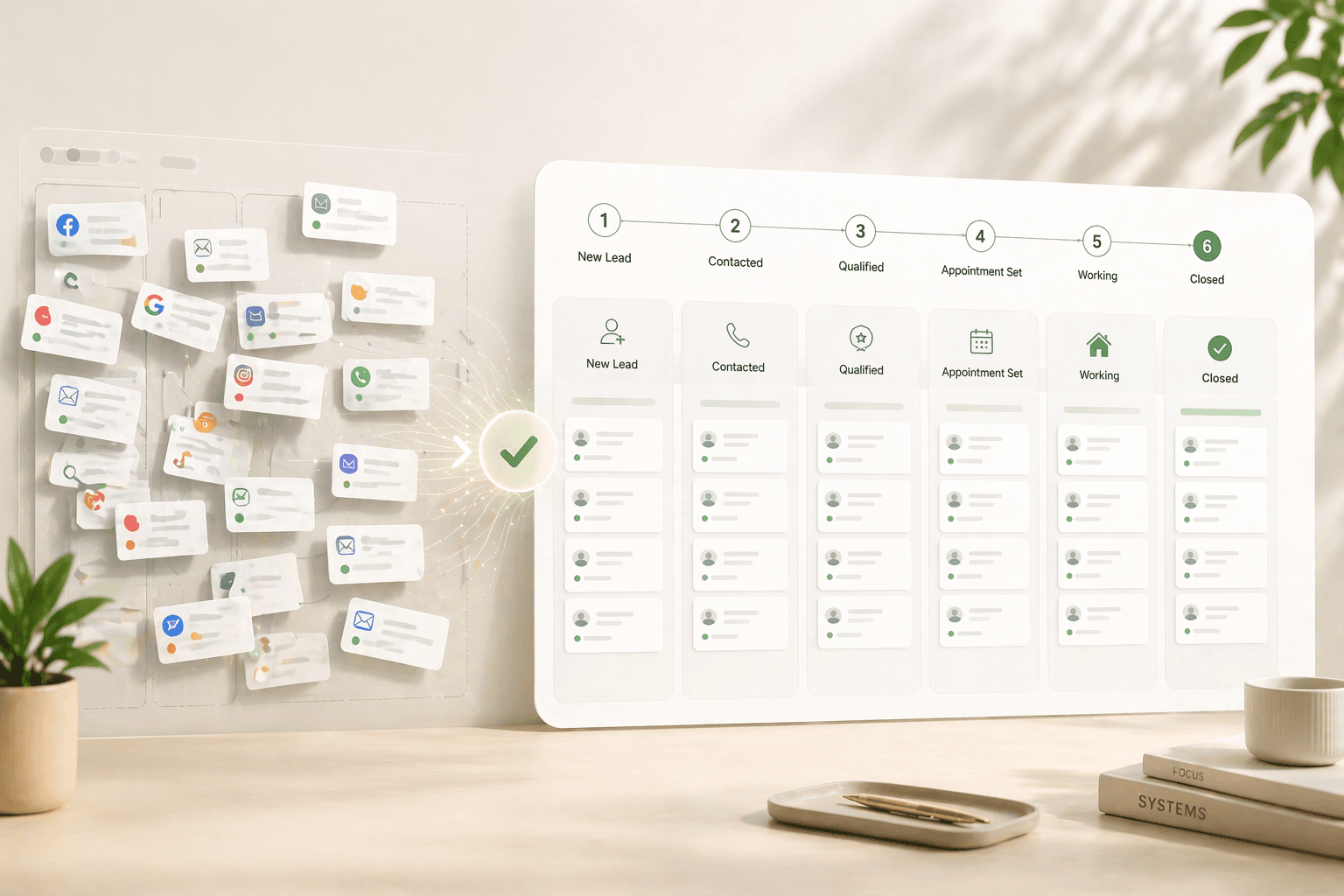
Effective lead workflow architecture runs through five integrated stages. Each stage serves a specific purpose, and the system advances prospects automatically based on behavior rather than on an agent's memory.
Stage 1 — Unified Lead Capture. Every source — website forms, portal inquiries, social media messages, text messages, phone calls, open house registrations — funnels into a single system. No lead enters through a side channel that bypasses the workflow. The system automatically tags source, timestamp, and inquiry type. This metadata is essential for calculating ROI by channel and identifying which sources generate the highest-conversion leads over time.
Stage 2 — Immediate Acknowledgment (Under 60 Seconds). Within one minute of lead capture, the system sends a contextually relevant acknowledgment — not a generic autoresponder. The message varies by inquiry type: a property inquiry triggers confirmation plus additional details on that specific listing; a showing request triggers a calendar link plus agent introduction; a valuation request triggers an instant estimate plus next-step explanation. The acknowledgment also asks two or three qualification questions (timeline, budget, pre-approval status), beginning the qualification process before the agent is even aware the lead came in. The script that converts best at this stage is direct and specific: "Hi [Name], I got your inquiry about [address]. I'm pulling together the full details now and will follow up within [X hours]. Quick question before then — are you pre-approved, or would a lender introduction be helpful?"
Stage 3 — Dynamic Scoring and Segmentation. Based on initial responses and ongoing browsing behavior, the system assigns a priority score and routes each prospect into the appropriate sequence. Hot prospects (score 80–100: pre-approved, 0–3 month timeline, actively viewing listings daily) trigger an immediate agent notification for high-touch personal follow-up. Warm prospects (score 50–79: qualified but 3–6 month timeline) go into an automated nurture sequence with weekly value touchpoints. Cold contacts (score 0–49: unqualified or 6+ month timeline) receive monthly content until signals change. A prospect who was warm yesterday can become hot tonight if they suddenly view six listings in one session — the score updates in real time.
Stage 4 — Intelligent Nurture Sequences. Different segments receive different content matched to their specific needs. First-time buyers receive educational content about process, financing timelines, and what to expect at closing. Sellers receive comparable sales data, market trend updates, and pricing strategy breakdowns. Relocating professionals receive neighborhood guides, school-district ratings, and commute analyses. Investors receive rental yield projections and cash flow models. If a prospect consistently opens market-trend emails but ignores neighborhood content, the system skews future sends toward data. If engagement drops to zero, the sequence shifts to re-engagement messaging before archiving the contact.
Stage 5 — Behavioral Trigger Escalation. The system monitors for buying signals and fires an immediate agent alert when one appears: a prospect views multiple properties in a single session; a prospect who went silent for 60 days suddenly re-engages; a prospect starts viewing listings in a higher price tier; a prospect clicks "schedule showing." Rather than making 50 check-in calls weekly hoping to catch someone at the right moment, an agent using Stage 5 makes 8 to 10 strategic calls per week — all to prospects who have just shown active intent. Real Trends research found that leads receiving six or more contact attempts convert at rates 70% higher than those receiving fewer touches, per AgentZap's 2025 analysis of the data — but those touches only need to happen with prospects who've demonstrated genuine interest.
Reducing Response Time Without Burnout
The five-minute response window creates anxiety for agents who interpret it as a requirement to monitor their phones around the clock. It isn't. The key is separating immediate automated acknowledgment from personalized agent follow-up — what works in practice is a two-tier model.
Tier 1 — Automated Acknowledgment (Under 60 seconds): The system sends a contextually relevant message the moment a lead arrives. This satisfies the urgency window without requiring the agent to be available. According to NAR's 2025 Generational Trends Report, 95% of buyers rate agent responsiveness as "very important." The automated acknowledgment earns that rating before the agent has to do anything.
Tier 2 — Personalized Follow-Up (Within 3 hours for hot leads, 24 hours for warm): The agent reviews qualification responses and behavioral data that the system has already collected, then reaches out with a contextually informed message. Because the lead has already been acknowledged, qualified, and scored, the agent's outreach can skip basic data collection and move directly to consultation.
Time blocking completes the model. Rather than reactive monitoring, agents using structured systems block three daily windows for lead follow-up: morning (9–10 AM) to review overnight leads and respond to hot-scored prospects; midday (1–2 PM) to check for new high-priority alerts and make follow-up calls; and evening (6–7 PM) for a final review of time-sensitive inquiries. Because automation has handled the mechanical acknowledgment and preliminary qualification, these blocks focus entirely on meaningful conversations with prospects who've already signaled intent.
The 80/20 principle applies directly: in most databases, approximately 20% of prospects generate 80% of conversions. A structured system identifies that 20% automatically through behavioral scoring, so an agent spends 80% of personal time engaging the high-probability segment while automation handles routine nurturing for the rest. Agents who apply this model report significant reductions in weekly time spent on lead management — from 22+ hours to under 10 — while simultaneously improving their lead-to-appointment conversion rates.
Automating the Workflow: What to Look For in a Platform
The five-stage architecture described above is only as effective as the tools that run it. When evaluating a platform, the critical requirements are: unified lead capture that accepts inputs from Zillow, Realtor.com, your own website, and social ads simultaneously; automated acknowledgment triggers that fire within 60 seconds of capture; behavioral scoring that updates in real time as prospects interact with your content; segmented nurture sequences that route different lead types to different content tracks; and escalation alerts that notify you immediately when a hot signal fires.
Pinova's CRM combines IDX property search with a behavioral lead-scoring engine that automatically moves contacts between Hot, Warm, and Cold segments based on property view frequency, showing requests, and engagement with drip content — and fires an agent push notification the moment a pre-set intent threshold is crossed.
Before and After: A Workflow Transformation
Consider a mid-market residential agent with five years of experience, a 300-contact database, and 18 transactions annually — comparable to many solo agents in mid-tier US markets. Before implementing a structured workflow, the pattern looks like this: average response time of 6 hours during business hours, 20+ hours on evenings and weekends; lead-to-appointment conversion of approximately 12%; 22 hours per week spent on manual lead management tasks (logging activities, writing reminders, checking multiple inboxes); database engagement rate of around 8% monthly. The core problems: no response to weekend inquiries, warm prospects who went quiet never re-engaged, and equal treatment of all 300 contacts regardless of their actual buying readiness.
After deploying the five-stage workflow — unified capture, automated acknowledgment, dynamic scoring, segmented nurture, behavioral escalation — the same agent's metrics shift considerably. Response time drops to under 2 minutes for the automated acknowledgment tier, with personalized agent follow-up to hot leads within 3 hours. Lead-to-appointment conversion moves toward 30–34%, an improvement of roughly 180%. Weekly time on lead management drops to 8–10 hours. Database monthly engagement climbs to 25–30% as properly segmented nurture sequences reach the right people with the right content.
The timeline to results follows a predictable arc: weeks 1–2 are configuration (content library, workflow logic, lead-source integrations); weeks 3–4 are database import and initial segmentation; month 2 is when response-time improvements become visible and appointment conversion begins climbing; month 3 is when engagement rates rise as segmentation matures; months 4–6 are full optimization, with the agent reporting meaningful time savings and deal flow increases. The most important shift isn't in any single metric — it's that the agent stops treating all 300 contacts as equally urgent and starts operating from a prioritized daily list of 10–12 genuinely high-intent prospects.
The Competitive Advantage in a Shifting Market
The gap between structured and unstructured agents is measurable. FoneSwift's analysis of top-performing agents found that the top 1% average a 2.3-minute response time and a 5.8% lead-to-client conversion rate. The median agent averages a 47-hour response time and a 1.2% lead-to-client rate. That is not a marginal difference — it is a factor of nearly five in conversion, driven almost entirely by operational structure rather than talent, charisma, or market knowledge.
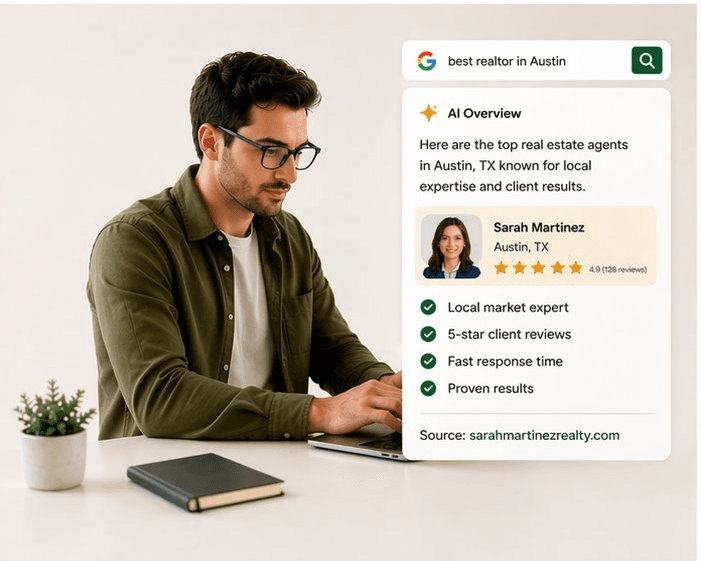
Zillow's 2025 Consumer Housing Trends Report for Agents adds another dimension: 33% of buyers now say online research played a key role in choosing their agent — up sharply from prior years — and 36% of sellers now find their agent through online sources, more than double the 15% who did so in 2018. That means your response time and follow-up cadence are increasingly visible to prospects before first contact, through your reviews, your online presence, and your reputation for responsiveness. Structured agents who consistently respond fast build that reputation systematically.
The 2026 market demands operational precision. More inventory means more opportunities — but only for agents with systems capable of capturing them. Agents who respond within 5 minutes, score leads by intent, and concentrate personal effort on the top 20% of their database will consistently outperform those working harder on the wrong 80%. Speed and structure win. Manual systems, however diligently maintained, cannot close the gap.
| Key Statistic / Finding | Source & Year |
|---|---|
| Average monthly housing inventory rose 18.3% year-over-year in 2025, peaking at 1.63 million in July | Redfin, 2025 Housing Market Year in Review |
| National active listings remained roughly 11% below pre-pandemic 2019 levels as of mid-2025 | ResiClub Analytics, State Inventory Update August 2025 |
| 78% of homebuyers work with the first agent who responds to their inquiry | NAR 2025 Home Buyers and Sellers Generational Trends Report |
| 47% of buyers and 59% of sellers hired the first agent they contacted | Zillow 2025 Consumer Housing Trends Report for Agents |
| The average real estate agent takes 917 minutes (over 15 hours) to respond to a new lead inquiry | Inman 2025 Real Estate Technology Survey, cited by AgentZap |
| Leads contacted within 5 minutes are 100x more likely to result in contact and 21x more likely to qualify than those reached after 30 minutes | Dr. James Oldroyd, MIT/InsideSales.com Lead Response Management Study, published Harvard Business Review 2011 |
| 36% of sellers now find their agents through online sources — more than double the 15% share in 2018 | Zillow 2025 Consumer Housing Trends Report for Agents |
| 68% of home buyers contact multiple agents simultaneously when beginning their search | AgentZap 2025 Real Estate Lead Statistics |
| Leads receiving six or more contact attempts convert at rates 70% higher than those receiving fewer touches | Real Trends buyer lead conversion research, cited by AgentZap 2025 |
| Top 1% of agents average a 2.3-minute response time and 5.8% lead-to-client conversion vs. the median agent's 47-hour response and 1.2% conversion | FoneSwift, Real Estate Lead Response Time Analysis, 2025 |
Frequently Asked Questions
How quickly should a real estate agent respond to a new lead?
Within 5 minutes is the research-backed target. Dr. James Oldroyd's MIT and InsideSales.com Lead Response Management Study found that leads contacted in 5 minutes are 100 times more likely to result in contact and 21 times more likely to qualify compared to those reached after 30 minutes. In practice, a two-tier model works best: an automated acknowledgment fires within 60 seconds, and the agent's personal follow-up for hot prospects happens within 3 hours. The automated tier satisfies the urgency window without requiring the agent to be available around the clock.
What percentage of real estate leads convert to clients?
Industry conversion rates for online leads typically range from 0.4% to 2.4%, according to TheClose's benchmarks. Top-producing agents who prioritize response speed and systematic follow-up can reach 5–6% or higher. The variance is almost entirely explained by workflow quality: agents who respond within 5 minutes and apply 6 or more structured follow-up touches convert at dramatically higher rates than those who rely on manual, reactive outreach. The goal is not more leads — it is losing fewer of the leads you already have.
What are the most important intent signals for real estate lead scoring?
The six signals that most reliably predict near-term buying readiness are: viewing frequency (daily rather than monthly), depth of inquiry (requesting a showing versus browsing), velocity (sudden activity spike after dormancy), specificity (asking about a particular address or block), financial signals (mortgage calculator engagement or mention of pre-approval), and decision-maker involvement (forwarding a listing to a partner). A prospect who triggers three or more of these signals simultaneously is a Hot lead requiring personal agent outreach within hours, not days.
How many leads should a real estate agent follow up with each day?
Rather than a fixed number, the right framework is focusing daily personal outreach on whoever scored Hot in the last 24 hours, regardless of total database size. In a 300-contact database, that typically surfaces 10 to 12 high-priority prospects on any given day. Automation handles nurture for the remaining 80% of contacts. Trying to personally follow up with every contact daily leads to burnout and shallow conversations with people who aren't ready to transact — which produces worse conversion than a focused, behavior-driven daily list.
Why do real estate agents lose leads to competitors?
According to Inman's 2025 Real Estate Technology Survey, the average agent takes over 15 hours to respond to a new inquiry. By that point, 78% of buyers have already chosen a different agent — the one who responded first, per NAR's 2025 Generational Trends data. Secondary causes include treating all leads equally regardless of intent, failing to follow up more than once or twice, and losing track of warm leads who went quiet. REsimpli's 2024 data found that 42.83% of leads were classified as dead, largely because no automated nurture system kept them warm during the 3–6 month consideration window.
What is a good lead-to-appointment conversion rate for real estate?
A baseline industry conversion from lead to booked appointment is approximately 8–12% for agents relying on manual processes. Agents who implement automated acknowledgment, behavioral scoring, and segmented nurture sequences typically see lead-to-appointment rates in the 28–34% range. The gap is explained by response time (automated first contact hits the 5-minute window), follow-up persistence (automated sequences maintain contact through the full 3–6 month consideration window), and prioritization (personal agent time concentrates on the highest-intent prospects rather than being spread evenly across the full database).
Does increasing housing inventory make real estate leads harder or easier to convert?
It makes leads harder to convert with manual systems but easier to convert with structured ones. When inventory rises, buyers take longer to decide — they browse more properties, compare more options, and delay commitment. This extends the nurture window and demands more follow-up touches per prospect than a tight-market sprint required. Agents using manual processes can't sustain consistent contact across a 90–180 day consideration window without burning out. Automated nurture sequences handle that window systematically, keeping the agent top-of-mind without requiring manual effort for every touch, so the agent's personal time remains focused on prospects who are actively showing buying signals.
Ayushman Singh
— Co-Founder & Chief Brand & Marketing OfficerAyushman Singh is the co-founder and Chief Brand & Marketing Officer of Pinova. He shapes the narrative, builds the brand, and tells the stories the industry doesn't want to hear. He believes the real estate system was designed to extract from agents, not empower them — and he's building the counter-narrative.