How Real Estate Agents Should Organize Their Day with AI

Quick Answer
How should a real estate agent organize their day for maximum productivity?
Start each morning with a single prioritized action list — not your inbox. Research from MIT and InsideSales.com shows that agents who respond to leads within 5 minutes are 21 times more likely to qualify them than those who wait 30 minutes, yet according to Inman's 2025 survey the average agent takes over 15 hours to respond. Pair time-blocked morning outreach with an AI system that monitors lead behavior around the clock, surfaces the 3–5 highest-impact tasks daily, and handles routine follow-up automatically so your cognitive energy goes to conversations that close deals.
Key Takeaways
- The average real estate agent takes 917 minutes — over 15 hours — to respond to a new lead inquiry, far beyond the 5-minute window where conversion rates peak, per Inman's 2025 Real Estate Technology Survey.
- MIT and InsideSales.com research found that contacting a lead within 5 minutes makes an agent 21 times more likely to qualify that prospect compared to waiting just 30 minutes.
- Gloria Mark's research at the University of California, Irvine found it takes an average of 23 minutes and 15 seconds to fully regain focus after a single interruption — meaning every reactive task-switch in an agent's day costs nearly half an hour of productive capacity.
- AI adoption among real estate agents reached 87.3% by 2025, up from 75% in early 2024, according to the Delta Media Group AI survey of brokerage leaders — but most agents use AI only for writing, not for daily workflow prioritization.
- Agents who build a structured morning routine anchored by AI-generated priority briefings convert more leads without working longer hours, because they consistently act during the 5-minute window when prospects are most receptive.
Marcus Webb, a solo agent in Austin, Texas, spent three years averaging 8 closed transactions a year — respectable, but not what he'd imagined when he got his license. He wasn't losing deals because of bad negotiating or weak listings. He was losing them because a Zillow lead would come in at 7 PM on a Tuesday, he'd see it at 9 PM, reply at 10 PM, and by morning the buyer had already booked a showing with someone else. Marcus estimated he left roughly $180,000 in gross commission on the table in 2023 alone, not from poor performance, but from a day that never gave him a fighting chance to respond fast enough.
This article explains exactly how to restructure your day so that speed, follow-up consistency, and focused action become system outputs rather than acts of willpower. You will finish with a concrete morning framework, a clear understanding of why interruptions destroy agent productivity at a neurological level, and a practical approach to using AI for behavioral lead prioritization — not just content generation.
The Hidden Weight Agents Carry Every Day
The productivity problem in real estate is not a motivation problem — it is a cognitive architecture problem. Every agent begins their day carrying dozens of open loops in working memory: leads to call, follow-ups overdue, appointments unconfirmed, documents outstanding, and messages half-answered across three different apps. None of this is written down in one place. All of it competes for attention simultaneously.
The neurological cost of this fragmentation is concrete and measurable. Gloria Mark's landmark research at the University of California, Irvine found that after a single significant interruption, it takes an average of 23 minutes and 15 seconds to fully regain focus on the original task. Agents don't experience one interruption a day. They experience dozens. A new lead notification, a client text, a broker email, a portal alert — each one triggers a task switch, and each task switch burns 23 minutes of refocus time. The cumulative cost is staggering: Harvard Business Review estimates that knowledge workers toggle between applications over 1,200 times per day, costing roughly four hours of productive time every week.
The cost of one interruption: After a significant task switch, the average worker takes 23 minutes and 15 seconds to fully regain focus — and passes through two unrelated tasks before returning to the original work. — Gloria Mark, University of California, Irvine, "The Cost of Interrupted Work"
For agents, the problem is compounded by the structure of the job itself. Real estate has no fixed workflow. A seller's call can restructure the entire afternoon. A contract issue at noon wipes out the morning's task list. The business demands constant context-switching by design — which means the standard advice to "time block" and "stay consistent" is nearly impossible to follow without a system that adapts when the day shifts.
Agents who try to manage this complexity through memory and willpower alone will always fall behind. The cognitive load is genuinely too high for any human to handle unaided. The agents who stay ahead are those who have externalised the load — who have a system that remembers, monitors, and prioritises on their behalf while they focus on the conversations that require a human being.
Why AI Is the Perfect Assistant for Realtors
The gap between what buyers expect and what agents typically deliver is, on its own, a business opportunity. According to Inman's 2025 Real Estate Technology Survey, the average real estate agent takes 917 minutes — that's over 15 hours — to respond to a new lead inquiry. The buyer, meanwhile, submitted the same inquiry to three or four other agents. The first one to reply earns the client in the majority of cases: NAR lead data shows that 70% of homebuyers work with the very first agent who responds to them, ending their search right there.
The research on what that 15-hour delay costs is unambiguous. MIT and InsideSales.com found that responding within 5 minutes makes an agent 21 times more likely to qualify a lead compared to waiting 30 minutes. Velocify's analysis of millions of lead records found that contacting a lead within the first minute boosts conversion rates by 391% compared to waiting even two minutes. These numbers are steep because intent decays fast: the moment someone submits a property inquiry, their attention is at its peak. Every minute of delay is a minute they spend browsing competitors, talking to another agent, or simply moving on.
The 5-minute window: Agents who contact a lead within 5 minutes are 21 times more likely to qualify that prospect than agents who wait 30 minutes, and 78% of buyers ultimately work with the first agent to respond. — MIT and InsideSales.com Lead Response Management Study
No human can monitor eight lead sources simultaneously, 24 hours a day, and respond within five minutes every time. An AI system can. It doesn't sleep, doesn't get distracted, doesn't deprioritise a 10 PM lead because it's tired. It also doesn't just respond — it monitors engagement signals continuously, identifying which leads have revisited a listing page three times in an hour, which buyers asked about school districts at midnight, and which past client suddenly re-opened their closing folder. These behavioral signals, invisible in a traditional CRM, are where the next transaction is hiding.
AI adoption among agents has accelerated sharply in response to exactly this pressure. The Delta Media Group's 2025 AI survey of brokerage leaders found agent AI usage climbing to 87.3% — up from 75% in early 2024. But the NAR 2025 Technology Survey reveals the critical gap: most agents use AI primarily for writing listing descriptions and social media content, not for workflow prioritization or lead management. The agents who will compound advantages over the next three years are those who deploy AI as a daily operational system, not just a content shortcut.
The Traditional Agent's Day: A Cycle of Chaos and Catch-Up
Walk through a typical agent morning and the structural problem becomes obvious. The day starts not with a clear plan but with triage. Notifications from Zillow, Realtor.com, a portal app, email, two text threads, and a voicemail arrive overnight. The agent works through them in the order they appear, which is not the order they matter. A lukewarm lead at the top of the list gets attention; a high-intent buyer buried in the middle gets a reply four hours later — after they've already booked with a competitor.
The afternoon follows a similar pattern. Agents jump between showings, document prep, and client calls with no unifying priority system. According to 2024 research published in PMC, chronic multitasking can consume up to 40% of a person's productive time due to the cognitive overhead of constant task-switching. For an agent working 35 hours a week — the median figure from NAR's 2025 Member Profile — that represents 14 lost hours every week, roughly two full working days, simply because the day has no structured sequence.
The follow-up problem compounds this. Research validated by Inman shows that 80% of real estate sales require five or more follow-up contacts after the initial inquiry, yet 44% of agents give up after just one attempt. The gap isn't laziness — it's load. When an agent is juggling 30 active contacts across multiple stages of the pipeline, manually tracking who needs a third follow-up versus who needs a seventh is genuinely impossible without a dedicated system. Leads don't convert because no one followed up at contact number four.
The day ends the same way it started: with the agent mentally cataloguing what didn't get done. They know roughly what's outstanding but can't quantify it precisely. Tasks slip through because they existed only in memory. Relationships cool because the follow-up window closed silently. The next morning, the cycle restarts from the same place.
The AI-Organized Day: Clarity First, Action Second
Restructuring the agent day starts with a single principle: your morning should begin with a briefing, not an inbox. The distinction matters enormously. An inbox presents information in chronological order, which has nothing to do with strategic priority. A briefing presents information ranked by impact — who is most likely to transact, what requires your personal voice today, and what has already been handled automatically overnight.
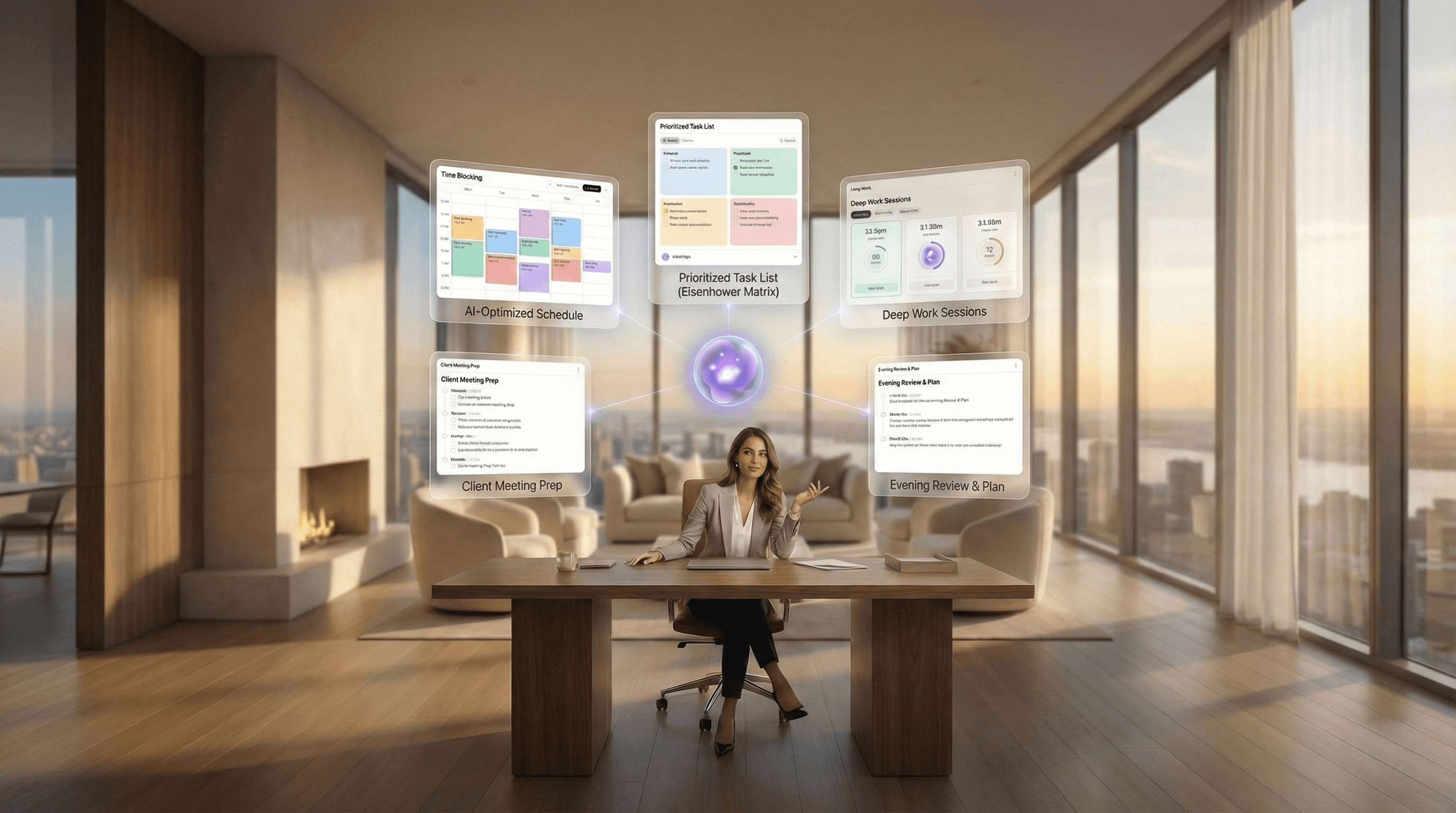
A concrete morning structure that consistently outperforms reactive approaches looks like this: the first 20 minutes go to reviewing an AI-generated daily briefing — new leads received, re-engagement signals detected, follow-ups completed automatically, and appointments confirmed. The next 60 minutes go to outbound calling on the top 5 prioritized contacts. These are not chosen at random; they are surfaced by behavioral signals — leads who viewed a property three or more times in the last 24 hours, prospects who clicked a market report link, contacts whose engagement pattern has shifted from passive to active. This 80-minute morning block handles the work that most directly drives revenue.
The afternoon then becomes execution time: showings, appointments, document reviews, and listing work. The critical difference is that the afternoon's schedule was not assembled reactively — it was pre-populated by the system before the day started, based on what was already known about pipeline status and client timing. Nothing is forgotten because nothing depended on memory to survive.
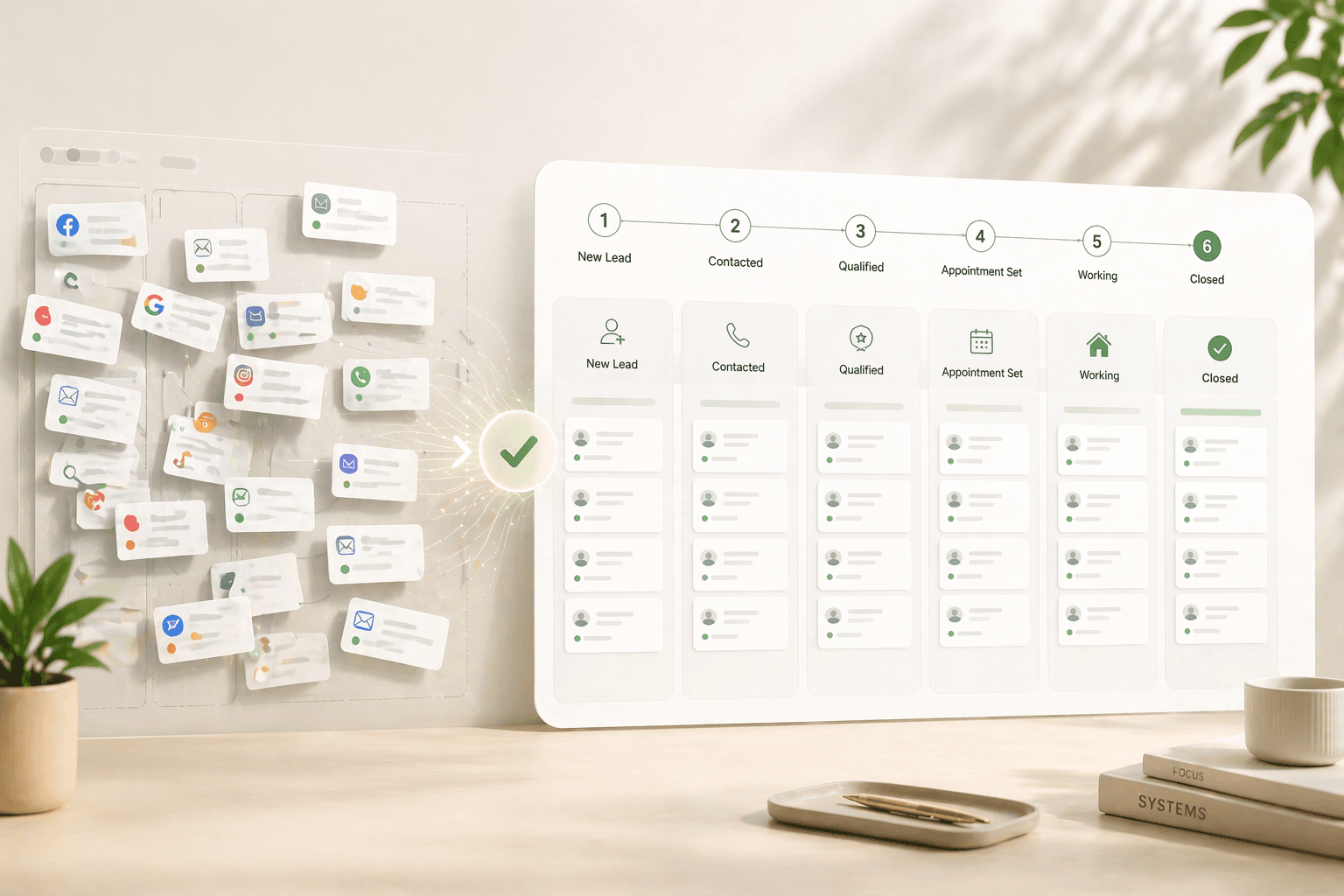
Pinova's daily briefing feature scans all lead activity, engagement data, and pipeline status overnight, then surfaces a ranked action list each morning — automatically separating high-intent contacts from passive ones so agents can direct their first hour toward the conversations most likely to move.
The result is not a more rigid day. It is a more coherent one. You still take unplanned calls, handle surprises, and adapt to shifting client needs. But you do so from a position of clarity about what actually matters, rather than from the panicked crouch of someone who started the morning already behind.
How AI Surfaces Priority Actions
Priority in a real estate pipeline is not determined by who contacted you most recently. It is determined by behavioral signals — the specific patterns of engagement that correlate with imminent buying or selling decisions. A lead who views the same listing seven times in 48 hours is not the same as a lead who opened one email four days ago, even if the recent email-opener appears higher in a standard CRM queue sorted by last contact date.
This is exactly what AI can do that a human brain cannot do consistently under load: monitor every contact's engagement pattern continuously and flag the moment behavior shifts from passive to active. Specific signals worth tracking include: a prospect revisiting a saved search more than three times in one session, a seller opening a comparable market analysis email twice within an hour, a past client returning to the website after a six-month absence, or a buyer clicking a mortgage calculator link embedded in an automated nurture sequence. Each of these behaviors is a data point. In aggregate, they reveal intent far more reliably than any agent's gut feeling about who is "warm."
The practical application is straightforward. Rather than scanning a 200-contact CRM and trying to decide who deserves a call today, you work from a system-generated list of the 5 contacts showing the highest behavioral intent scores. You call the first name on the list with the specific context the system provides: "Re-engaged last night — viewed 3-bed listings in Hyde Park four times." That context transforms the call from a generic check-in to a genuinely relevant conversation. The prospect notices. Response rates improve because the outreach is timed to their interest, not your schedule.
Agents who don't have this system will eventually build an intuition about who to call — but intuition is slow to develop, inconsistent under stress, and invisible to teammates or a transaction coordinator. A behavioral prioritization system is immediate, consistent, and shareable. It scales in a way that personal judgment never can.
Creating a Structured Workflow Without Feeling Restricted
The most common objection agents raise to structured daily systems is flexibility: "My schedule changes every hour. A rigid workflow will box me in." This objection confuses structure with inflexibility. A good system doesn't prescribe what you do at 2:47 PM — it ensures that when something unexpected arrives at 2:47 PM, you already know what you were supposed to be doing and can return to it deliberately rather than forgetting it existed.
The three-layer daily framework that works for high-producing agents follows a consistent pattern regardless of market or geography. Layer one is fixed time: a 60–90 minute morning block dedicated exclusively to priority outreach, protected from all non-urgent interruptions. Research from the American Psychological Association on task-switching costs confirms that protecting even a single uninterrupted focus block significantly improves both output quality and completion rates. Layer two is scheduled appointments: showings, listing meetings, and client calls, blocked in advance with clear start and end times. Layer three is flexible buffer: 60–90 minutes of open time, deliberately left unscheduled to absorb the surprises that real estate guarantees.
Within this framework, the AI runs continuously in the background — not by demanding your attention, but by updating priorities dynamically. If a prospect who was 9th on this morning's list suddenly views a listing four times at 11 AM, they move to 2nd on the afternoon list without any manual input from you. The system adapts to new information so you don't have to. Your structure stays intact; the content within it updates in real time.
The agents who report the highest satisfaction with structured workflows are not the ones with the most rigid schedules — they're the ones who have the clearest sense of what today's most important actions are. Clarity about priority is what creates calm. The structure is just the container that makes clarity possible.
The Competitive Advantage of Agents Who Adopt AI Early
The agents who adopted digital listings early in the early 2000s built databases competitors couldn't replicate for years. The agents who mastered Facebook ads between 2014 and 2017 generated their own leads while others kept buying them. Each wave of technology adoption created a structural advantage that compounded annually — not because early adopters worked harder, but because they operated with better information and lower friction than those still using the previous generation's tools.
The current AI wave is larger and faster than any prior shift. The RPR 2025 survey of NAR members found that 82% of agents have already adopted some form of AI tool. But the Delta Media Group data reveals that the agents gaining actual competitive ground are those moving beyond content generation into operational deployment — using AI for lead prioritization, automated follow-up sequences, and behavioral analytics. Among that group, Inman's 2025 data shows conversion rates and response-time metrics that are not marginally better than non-AI-using peers; they are categorically different.
The compounding effect works like this: an agent who responds 3 hours faster than average on day one converts one additional lead that month. Over 12 months, with consistent behavioral prioritization, that becomes six additional transactions. At a median commission of $7,500 per side, that's $45,000 in additional annual gross commission — without a single additional lead purchased, without working additional hours, and without a larger marketing budget. The input is organizational; the output is financial.
Agents who wait another 18 months to build this infrastructure will not be starting from neutral. They will be starting from behind. The gap between organized and reactive agents, already measurable in conversion rates and income, widens every quarter that AI systems accumulate behavioral data on their contacts while the reactive agent's CRM sits mostly empty. The agents who build the system now will have a database of engagement signals their competitors have never captured. That is not an advantage that can be bought later — it has to be built over time.
| Key Statistic / Finding | Source & Year |
|---|---|
| Average real estate agent takes 917 minutes (over 15 hours) to respond to a new lead inquiry | Inman Real Estate Technology Survey, 2025 |
| Agents who contact leads within 5 minutes are 21x more likely to qualify them vs. waiting 30 minutes | MIT and InsideSales.com Lead Response Management Study |
| Responding to a lead within 1 minute boosts conversion rates by 391% vs. waiting even 2 minutes | Velocify Lead Response Research, 2012 |
| 70% of homebuyers work with the first agent who responds to their inquiry | NAR Lead Data via AgentZap, 2025 |
| It takes an average of 23 minutes and 15 seconds to regain focus after a single interruption | Gloria Mark, University of California Irvine, 'The Cost of Interrupted Work' |
| Constant task-switching can consume up to 40% of a person's productive time | Rubinstein, Meyer & Evans via PMC, 'Digital Multitasking and Brain Health', 2024 |
| AI adoption among real estate agents reached 87.3% in 2025, up from 75% in early 2024 | Delta Media Group AI Survey of Brokerage Leaders, 2025 |
| 82% of real estate agents use AI tools, primarily for writing listing descriptions and social media content | RPR AI Adoption Survey of NAR Members, 2025 |
| 80% of real estate sales require 5 or more follow-up contacts, yet 44% of agents give up after just one attempt | National Sales Executive Association, validated by Inman, 2025 |
| Typical Realtor worked 35 hours per week and completed 10 transactions in 2024, with median gross income of $58,100 | NAR 2025 Member Profile |
Frequently Asked Questions
What is the best daily schedule for a real estate agent?
The most effective agent schedules follow a three-layer structure: a protected 60–90 minute morning block for priority outreach to high-intent leads, a middle block for scheduled appointments and client-facing work, and a 60-minute flexible buffer for unplanned tasks. The key is that the morning outreach list should be generated by behavioral data — not calendar order — so that the first calls of the day go to leads who viewed listings or re-engaged overnight. Agents using this structure report being able to handle the same volume of contacts in 35 hours per week that previously required 50+.
How quickly should a real estate agent respond to a new lead?
Within 5 minutes for web and portal inquiries, and ideally within 1 minute if your system supports it. MIT and InsideSales.com research shows that responding within 5 minutes makes an agent 21 times more likely to qualify a lead compared to waiting 30 minutes. Velocify's data goes further: contacting a lead within the first minute delivers a 391% boost in conversion rates compared to waiting even 2 minutes. The average agent currently waits over 15 hours, according to Inman's 2025 survey, which means any agent consistently responding in under 10 minutes is already outperforming the vast majority of their competition.
How do real estate agents handle too many leads at once?
The answer is prioritization by behavioral intent, not manual triaging by time of arrival. Rather than responding to leads in the order they appeared, effective agents use AI systems that score each contact based on engagement signals: how many times a listing was viewed, whether a market report was opened, whether a previously cold contact suddenly re-engaged. From a pool of 40 active leads, this approach surfaces the 5 who are most likely to transact in the next 2 weeks. Working that shortlist first — then moving down — produces more conversions than attempting to treat all 40 contacts equally.
Why do real estate agents lose so many leads?
Three causes account for the majority of lost leads. First, slow response time: 70% of buyers work with the first agent to respond, and the average agent responds 15 hours too late. Second, inconsistent follow-up: 80% of real estate sales require 5 or more contacts, but 44% of agents stop after one attempt. Third, no re-engagement detection: leads who go quiet for 30 days and then re-engage with a listing page are invisible in most CRMs unless the agent manually checks. All three problems are system failures, not effort failures — and all three can be solved with AI monitoring and automated follow-up cadences.
How can AI help real estate agents be more productive?
AI increases agent productivity through three specific mechanisms. First, it monitors all lead channels simultaneously and responds within seconds, eliminating the 15-hour average response delay. Second, it executes multi-step follow-up sequences automatically, so contacts receive the 5-plus touches required for conversion without any manual effort after the initial setup. Third, it surfaces behavioral signals — repeat listing views, after-hours inquiries, re-engagement after silence — that allow agents to direct their personal attention to the contacts who are actually ready to act. According to the RPR's 2025 survey of NAR members, 82% of agents already use AI for content generation; the productivity gains come from deploying it at the operational level.
What is the biggest time waster for real estate agents?
Context switching — moving reactively between tasks without a structured priority system — is the single largest destroyer of agent productivity. Gloria Mark's research at the University of California, Irvine found that each significant interruption costs 23 minutes of refocus time. Research from Harvard Business Review and industry surveys estimate that knowledge workers lose roughly four hours per week to application switching alone. For agents managing leads across five platforms, a text thread, email, and a CRM simultaneously, the accumulated daily cost of reactive multitasking can exceed two hours of productive capacity — every single day.
Should real estate agents use a CRM or AI for lead follow-up?
A traditional CRM stores contact data and requires the agent to manually create tasks, update pipeline stages, and decide when to follow up. AI-powered follow-up systems do the opposite: they monitor contact behavior continuously, automatically execute follow-up sequences at optimal intervals, and flag the agent only when a contact shows high-intent signals that warrant a personal call. The distinction matters because 44% of agents give up after a single follow-up attempt — not because they intend to, but because manual CRM maintenance breaks down under load. AI follow-up removes the manual step entirely, ensuring every contact receives the full sequence needed to convert.
Ayushman Singh
— Co-Founder & Chief Brand & Marketing OfficerAyushman Singh is the co-founder and Chief Brand & Marketing Officer of Pinova. He shapes the narrative, builds the brand, and tells the stories the industry doesn't want to hear. He believes the real estate system was designed to extract from agents, not empower them — and he's building the counter-narrative.