Real Estate Lead Generation Costs in 2026: What Actually Works

Quick Answer
How much does real estate lead generation actually cost per closed deal in 2026?
Zillow Premier Agent leads average $139–$223 each in most markets, rising above $450 in competitive metro ZIP codes, with a conversion rate of roughly 1–3% from lead to closed deal — putting effective cost-per-closed-deal between $8,000 and $25,000 before time is factored in. Google Ads for real estate average $2.53 per click with a 3.28% conversion rate, per WordStream's 2025 benchmarks. By contrast, referral leads — which accounted for 41% of the average agent's business according to NAR's 2025 Member Profile — cost near zero to acquire and convert at 40–50%. The agents closing the most deals in 2026 are building referral infrastructure and lead-conversion systems, not simply buying more contacts.
Key Takeaways
- Zillow Premier Agent leads cost $139–$223 on average in 2025, with metro markets regularly exceeding $450 per lead, per HousingWire's 2025 cost analysis.
- Google Ads for real estate average $2.53 per click and convert at just 3.28%, among the lowest of any industry, per WordStream's 2025 Google Ads Benchmarks report covering 16,000+ campaigns.
- Referrals and repeat clients generated 41% of the average Realtor's business in 2024, rising to over 40% for agents with 16+ years of experience, according to NAR's 2025 Member Profile.
- Responding to a lead within 5 minutes makes you 21 times more likely to qualify it than waiting 30 minutes, per the MIT and InsideSales.com Lead Response Management Study conducted by Dr. James Oldroyd.
- NAR's 2025 Profile of Home Buyers and Sellers found that 43% of buyers and 66% of sellers chose their agent through referral or past relationship — the single most common source by a wide margin.
- Doubling your conversion rate from 2% to 4% produces the same output as doubling your ad budget — at zero additional cost. Workflow investment compounds; lead spend does not.
Marcus Webb, a solo agent in Phoenix, spent $28,000 on Zillow Premier Agent in 2024 and closed three transactions from it — an effective cost of $9,333 per deal, before subtracting the 35% Opcity referral fee that applied to two of those closings. His gross commission on a typical Phoenix buyer transaction at 2.5% on a $420,000 home was $10,500. After Zillow spend allocation, the economics barely held. Meanwhile, a colleague in the same brokerage spent $1,400 on sphere-of-influence maintenance — handwritten cards, two lunch events, a monthly market email — and generated nine referrals. Nine deals. $1,400. The difference wasn't luck. It was infrastructure.
This article breaks down exactly what paid real estate leads cost in 2026, why the ROI on portal and search advertising keeps declining, what the referral numbers actually say when you look at verified NAR data, and how to build a lead system that generates compounding returns instead of requiring ever-larger monthly injections of cash. You'll leave with specific cost-per-deal formulas you can run on your own numbers, and a four-layer system you can start building this week.
- The Economics: Zillow Leads at $139–$450+, Google Ads at $2.53/Click
Zillow Premier Agent operates on a share-of-voice auction model: you buy a percentage of leads generated in a specific ZIP code, and competitors bid alongside you. Average lead costs in 2025 range from $139 to $223 nationally, with agents in competitive metro markets — Miami, Austin, Denver, Los Angeles — routinely reporting costs above $450 per lead. Monthly minimums in major markets start around $1,000 and scale rapidly with market share purchased.
Conversion reality: Zillow Premier Agent leads convert at roughly 1–3% from initial contact to closed transaction. At a 2% conversion rate and $200 per lead, you need 50 leads to close one deal — $10,000 in acquisition cost before a single showing. — HousingWire, September 2025
The structural problem is intent mismatch. Someone browsing listings at 10 PM who clicks "contact agent" is technically a lead. They are not a buyer. Zillow's own platform acknowledges that a meaningful share of inquiries come from people in early research mode, often browsing 6–12 months before they transact. You pay $200 for that contact the same as you'd pay for someone with a pre-approval letter ready to write an offer.
Google Ads present a different cost structure but similar conversion challenges. WordStream's 2025 Google Ads Benchmarks report — based on analysis of 16,446 US campaigns — puts the real estate category's average cost-per-click at $2.53, with a click-through rate of 8.43% but a conversion rate of just 3.28%, ranking among the lowest of any industry tracked. That $2.53 headline number is also misleading: it averages rural markets with metro markets. High-intent keywords — "Phoenix real estate agent," "homes for sale Buckhead Atlanta," "sell my house fast Chicago" — routinely command $15–$50 per click in competitive markets, making meaningful traffic volume expensive very quickly.
The Hidden Costs Beyond the Ad Invoice
Published lead costs capture only the most visible expense. Run through the full picture for any agent spending $2,000 per month on Zillow: a CRM subscription to manage the volume ($50–$200/month), landing page maintenance, follow-up automation tools, the hours spent calling unresponsive contacts, and the administrative time tracking which leads came from which source. Most agents underestimate their total lead generation investment by 30–50% because they never aggregate every category.
Add the Opcity/Connections Plus complication: if your Zillow leads come through that pre-qualification concierge layer, Opcity takes a 35% referral fee at closing — on top of the upfront spend. On a $10,500 gross commission, that's $3,675 off the top, before your brokerage split. In those scenarios, agents can close deals and still lose money relative to their acquisition cost.
- Why Paid Lead ROI Keeps Falling
Four years ago, Zillow leads averaged $60–$120. Google Ads for real estate ran under $2 per click. The deterioration since then isn't random — three structural forces are driving costs up while holding conversion rates condo or pushing them lower.
Agent Oversaturation in the Auction
NAR's 2025 Member Profile counted approximately 1.49 million Realtor members as of late 2025, all competing for a pool of transactions that has not grown proportionately. Both Zillow's share-of-voice model and Google's keyword auction are zero-sum: when more agents bid, every agent pays more and wins less. WordStream's data shows real estate CPC increased 20.48% from 2024 to 2025 alone, following a 35.48% increase the year before. That's a 65% cumulative increase in two years — with no corresponding improvement in lead quality.
The Extended Research Cycle
NAR's 2025 Profile of Home Buyers and Sellers found the typical seller had owned their home for a record 11 years before listing. Buyers are older than ever — median age of 59 for all buyers — and doing more research before engaging an agent. First-time buyer share dropped to a historic low of 21% of transactions. This means the leads who enter your pipeline via portals are arriving earlier in their decision journey, less committed, and more likely to be simultaneously researching three other agents. The cost to acquire them hasn't fallen to reflect this; it's risen.
Post-Settlement Hesitation
The 2024 NAR commission settlement introduced mandatory buyer representation agreements before showings. A prospect who might previously have scheduled a showing with a portal-referred agent now sometimes pauses at the formal agreement stage, extending the nurture timeline and adding friction to the conversion funnel. Agents report that the casual "tire-kicker" lead — the one who clicked contact while browsing listings without serious intent — is less likely to move forward than before the settlement, even though they still count as a lead and still incur acquisition cost.
Quality Dilution at Scale
Portal platforms profit from lead volume. As they expand their reach to capture more contacts, average quality inevitably dilutes. The most transaction-ready buyers and sellers — those who have financing arranged, clear timelines, and genuine urgency — represent a finite pool. Beyond that core segment, platforms capture progressively less qualified contacts who inflate metrics without improving outcomes. The agent pays the same price for both.
- The Referral Reality: What NAR's Data Actually Shows
The referral advantage isn't anecdote — it shows up clearly in NAR's published data. The 2025 Profile of Home Buyers and Sellers found that 43% of buyers used an agent found through a referral, while 18% worked with an agent they had used before. On the seller side, 66% found their agent through referral or a past relationship. Combined, referral and repeat business is by far the dominant channel — more than all paid digital sources combined.
Referrals dominate agent income: Repeat clients and referrals accounted for 41% of the average Realtor's business in 2024. For agents with 16 or more years of experience, repeat clients alone made up more than half their business. — NAR 2025 Member Profile
Why do referrals convert so dramatically better than cold portal leads? The mechanism is trust transfer. When your past client tells their colleague "call Sarah, she's the best," that colleague begins the conversation assuming competence. Sarah doesn't need to build credibility from scratch across 12 touchpoints. The sales cycle compresses from months to weeks. The prospect is less price-sensitive about commission and less likely to interview three competing agents simultaneously.
The Gap Between Intent and Action
NAR's buyer data shows that more than 9 out of 10 buyers would use their agent again or refer them. The same data shows only a fraction actually do — not because they're unhappy, but because their agent disappeared after closing. No check-in at 30 days. No home anniversary card at 12 months. No market update when their neighborhood's median price moved 8% in six months. The client meant to refer you. They just forgot you existed when the conversation came up.
Agents who systematically touch their sphere 2–3 times per month with genuinely useful content — a hyperlocal market update specific to their neighborhood, a seasonal maintenance checklist, a note about a local development — stay in the conversation. When referral opportunities arise, these agents surface first. The investment is $50–$100 per month in tools plus a few hours. The output from a 200-person database is 6–10 qualified referrals per year, at a cost-per-acquisition measured in dozens of dollars, not thousands.
- How to Build a Lead Generation System (Not Just Buy Leads)
A sustainable lead generation system is not a single channel — it's four layers operating simultaneously, each feeding the others. Here's how to build it.
Layer 1: Sphere of Influence Cultivation
Your database is your most valuable asset and the most underworked one. The specific system that works: a monthly email with hyperlocal market data (not generic national headlines — the sold prices within two miles of your contact's address), a quarterly touchpoint with genuine utility (a pre-winter home maintenance checklist, an updated property value estimate), and personal outreach to your top 50 relationships twice a year by phone or handwritten note. The phone call script is simple: "Hey [name], I was thinking about you — I know the Henderson house around the corner from you just sold. Did you see that number? I wanted to make sure you knew what the market's doing for your neighborhood." That's it. Not a pitch. An update.
Layer 2: Geographic Farming
Choose one neighborhood of 400–800 homes and become the only agent those homeowners think of. The tactic that establishes presence fastest: monthly direct mail with a single piece of genuinely useful data (this month's absorption rate, a breakdown of homes that sold vs. listed, the average price-per-square-foot movement). Pair it with just-listed and just-sold postcards showing your activity in the area. Geographic farming requires 9–12 months before leads materialize — but agents who stay consistent typically capture 20–35% of listing inventory in their target area within three years.
Layer 3: Strategic Content That Earns Organic Search
Write the resource your ideal client is actually searching for. "Is 2026 a good time to sell in [your city]?" is searched thousands of times per month in active markets. A 1,200-word guide with genuine local market data and a clear recommendation — your actual professional opinion — ranks organically, builds authority, and captures prospects who are months away from transacting. A first-time buyer education series does the same for your buyer pipeline. This content costs time, not money, and compounds in value as it accumulates inbound traffic.
Layer 4: Professional Referral Partnerships
Identify five professionals whose clients are your ideal clients: a lender who works with first-time buyers, an estate attorney handling probate sales, a financial advisor managing retirees who are downsizing, a corporate relocation coordinator, and a property manager with an investor network. Meet each quarterly. Refer to them when the opportunity arises. These relationships generate the highest-quality leads in any pipeline — prospects who arrive pre-qualified by trust, with a clear transaction timeline, and with implicit credibility already extended to you.
- Workflow Optimization Beats Lead Spending
The variable most agents ignore is conversion rate — and it has more leverage than any additional ad spend. If you're currently converting 2% of leads and you spend $15,000 to generate 100 leads per month, you're closing 2 deals. If workflow improvements push your conversion to 5%, the same $15,000 generates 5 deals. That's 2.5x the output at zero additional cost. No Zillow budget increase achieves that return.
The Response Time Multiplier
The MIT and InsideSales.com Lead Response Management Study — conducted by Dr. James Oldroyd and analyzing millions of lead interactions — found that responding to an inquiry within 5 minutes makes you 21 times more likely to qualify that lead than waiting 30 minutes. Velocify's research found that responding within the first minute produces a 391% improvement in contact rate compared to calling two minutes later. These numbers apply directly to real estate portal leads, where the prospect often submitted the same inquiry to multiple agents simultaneously. The first agent to call has a structural advantage that no amount of pitch quality or marketing spend can overcome.
Yet NAR data shows the average real estate agent response time is measured in hours, not minutes. If you receive a Zillow inquiry at 7:42 PM and respond at 9:00 AM the next morning — a common scenario — you're calling 13+ hours later into a competitive field where the prospect has already spoken to whoever called within the first 10 minutes.
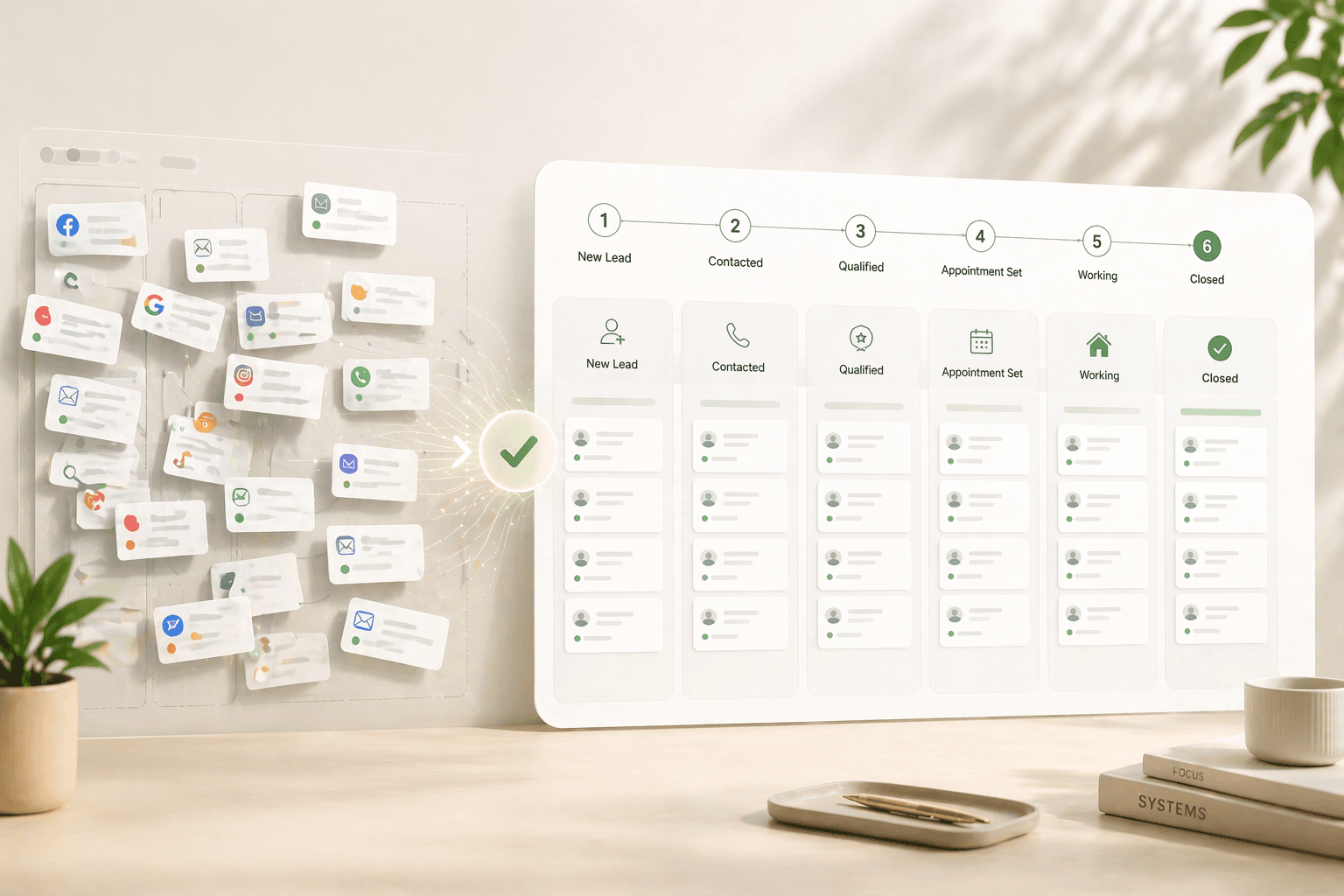
Pinova's lead response automation routes incoming inquiries to an AI that initiates a personalized text within seconds of form submission, captures the prospect's timeline and motivation, and schedules a call for when the agent is available — so no paid lead sits cold overnight.
The Nurture Sequence Compound Effect
Most agents make 1–2 contact attempts on a new lead and give up. Research from InsideSales.com — across 55 million sales activities and 5.7 million inbound leads — found that 57.1% of first call attempts happen after more than a week, and only 0.1% of inbound leads are engaged within 5 minutes. The immediate implication: the competitive bar for responsiveness is extremely low. A system that responds within 5 minutes and follows up at days 1, 3, 7, 14, and 30 outperforms the typical agent's process by an order of magnitude — and it doesn't require more leads, just a structured workflow.
Lead Qualification Before Lead Volume
Not every lead deserves equal time. A CRM filter that identifies high-intent signals — repeated property views within 48 hours, a specific timeline listed on the inquiry form, a pre-approval mentioned — lets you prioritize the 15% of leads most likely to transact in the next 90 days. Running this filter manually wastes hours. Running it through a CRM that scores leads based on behavioral triggers takes minutes. The result is the same lead budget converting at 2–3x the rate, because you're spending your follow-up time on the contacts most likely to respond.
- Measuring True Cost Per Closed Deal
Most agents track cost per lead. The only number that matters for business sustainability is cost per closed transaction, by source. Here's the four-step calculation every agent should run quarterly.
Step 1: Total Lead Generation Investment
Add every dollar: portal spend (Zillow, Realtor.com), Google and social ad budgets, CRM and automation subscriptions, website hosting, direct mail, event sponsorships, photography and content creation. Most agents underestimate by 30–50% because they track the big invoices but miss the stack of $29–$99 monthly subscriptions that support the lead operation.
Step 2: Source Attribution on Every Closed Deal
Tag every transaction with its original source: Zillow inquiry, Google Ad click, sphere referral, past client repeat, open house contact, geographic farm prospect. Without attribution, you're optimizing blindly — spending the same on channels that generate $150 per acquisition and channels that generate $12,000 per acquisition, with no data telling you which is which. Ask every new client at first contact: "How did you hear about me?" Record the answer in your CRM. Make this non-negotiable.
Step 3: Cost Per Acquisition by Channel
Divide annual channel spend by closed transactions from that channel. A representative calculation from a mid-market agent: $24,000 in annual Zillow spend producing 3 closed deals = $8,000 per acquisition. $18,000 in Google Ads producing 2 closed deals = $9,000 per acquisition. $1,400 in sphere cultivation producing 9 referral closings = $156 per acquisition. The ROI case writes itself — but only if you've tracked the attribution.
Step 4: Layer In Transaction Value and Commission
A $300,000 buyer-side transaction at 2.5% generates $7,500 GCI. If the acquisition cost was $8,000, the transaction lost money before expenses. A $650,000 listing at the same rate generates $16,250 — positive ROI at the same acquisition cost. Track average transaction value by source. Referral clients, who enter the relationship with trust already established, tend to take the agent's pricing and negotiation advice more readily, resulting in higher average sale prices and smoother closings. This compounds the referral economic advantage beyond just the lower acquisition cost.
The 2026 Reality: Systems Beat Spending
The agents spending the most on lead generation are not the ones earning the most. NAR's 2025 Member Profile data shows that the median Realtor spent $8,010 on total business expenses in 2024 — including all marketing — while earning $58,100 in gross income. The agents at the top of the income distribution aren't getting there by outspending competitors on Zillow; they're getting there because they've built databases that generate referrals, response systems that convert leads faster than competitors, and enough reputation in a geographic area that sellers call them directly.
When a Zillow lead costs $200 and converts at 2%, you need 50 leads to close one deal — $10,000 in acquisition cost. The same agent improving conversion to 5% through better workflows needs 20 leads — $4,000. The $6,000 difference, compounded across 12 months and a growing database, is the difference between a profitable business and a lead-spending treadmill.
Start with the numbers you already have. Run the four-step cost-per-acquisition calculation on last year's transactions. Find out which channels actually generated profitable deals and which ones absorbed budget without producing sustainable returns. Then reallocate 20% of your paid lead budget toward sphere cultivation infrastructure — tools, direct mail, content — and measure what happens over 90 days. The math almost always tells the same story. Systems compound. Spending doesn't.
| Key Statistic / Finding | Source & Year |
|---|---|
| Zillow Premier Agent leads average $139–$223 per lead nationally, exceeding $450 in competitive metro ZIP codes | HousingWire — Is Zillow Premier Agent Worth the Cost?, September 2025 |
| Real estate Google Ads average $2.53 per click with an 8.43% CTR and 3.28% conversion rate — among the lowest conversion rates of any industry | WordStream / RentVision — 2025 Google Ads Benchmarks (16,000+ campaigns, April 2024–March 2025) |
| 43% of buyers used an agent found through referral; 66% of sellers chose their agent through referral or a past relationship | NAR 2025 Profile of Home Buyers and Sellers (survey period July 2024–June 2025) |
| Repeat clients and referrals accounted for 41% of the average Realtor's business in 2024; for agents with 16+ years of experience, repeat clients made up more than half their business | NAR 2025 Member Profile (based on 2024 transaction data, released August 6, 2025) |
| Responding to a lead within 5 minutes makes you 21 times more likely to qualify it than waiting 30 minutes; 78% of buyers purchase from the first company to respond | MIT and InsideSales.com Lead Response Management Study, Dr. James Oldroyd |
| Calling a lead within 1 minute of inquiry produces a 391% improvement in contact rate compared to calling after 2 minutes | Velocify Lead Response Research (now ICE Mortgage Technology), 2012 |
| Only 0.1% of inbound leads are engaged within 5 minutes; 57.1% of first call attempts occur after more than a week — from a study of 55 million sales activities | InsideSales.com 2021 Lead Response Research |
| The median Realtor gross income rose to $58,100 in 2024; agents with 16+ years of experience earned $78,900 while those with 2 or fewer years earned $8,100 | NAR 2025 Member Profile (released August 6, 2025) |
| Real estate Google Ads cost per click increased 20.48% from $2.10 to $2.53 between 2024 and 2025, following a 35.48% increase from 2023 to 2024 | WordStream Google Ads Benchmarks by Industry 2025 |
| Median Realtor annual business expenses were $8,010 in 2024, down slightly from $8,450 in 2023; the median spent on website maintenance was just $60 | NAR 2025 Member Profile |
Frequently Asked Questions
How much does a Zillow Premier Agent lead cost in 2026?
Zillow Premier Agent leads average $139 to $223 nationally, but costs in competitive metro markets frequently exceed $450 per lead. Monthly minimums in major metro ZIP codes typically start at $1,000 and can climb to $20,000 or more for agents buying large market share. The cost is determined by a share-of-voice auction, meaning more competing agents in your ZIP code directly raises what you pay per lead.
What is the conversion rate for Zillow leads to closed deals?
Industry data consistently shows Zillow Premier Agent leads converting at 1–3% from initial contact to closed transaction. At a 2% conversion rate with $200 average lead cost, an agent needs to spend $10,000 in Zillow budget to close a single deal — before accounting for time invested, CRM costs, or any referral fees from the Opcity/Connections Plus layer. Conversion rates for referral leads, by comparison, typically run 40–50%.
What percentage of real estate business comes from referrals?
According to NAR's 2025 Profile of Home Buyers and Sellers, 43% of buyers found their agent through referral and 18% used an agent they had worked with previously. On the seller side, 66% chose their agent through referral or past relationship. NAR's 2025 Member Profile — based on actual 2024 transaction data — found that referrals and repeat clients combined accounted for 41% of the average Realtor's total business, rising to more than 50% for agents with 16 or more years of experience.
How fast do I need to respond to a real estate lead to convert it?
The MIT and InsideSales.com Lead Response Management Study found that responding within 5 minutes makes you 21 times more likely to qualify a lead than waiting 30 minutes. Velocify's research adds that calling within the first minute produces a 391% improvement in contact rate compared to calling two minutes later. NAR data shows the average real estate agent response time is measured in hours. An agent with an automated response system that engages leads within seconds has a structural conversion advantage that no amount of ad spending can offset.
Is it worth spending money on Google Ads for real estate leads in 2026?
Google Ads for real estate averaged $2.53 per click with a 3.28% conversion rate in 2025, per WordStream's benchmark report covering 16,000+ campaigns. That average hides significant variation: high-intent local keywords in competitive markets regularly run $15–$50 per click. At those rates, generating a single appointment can cost $500–$2,000+ depending on market and keyword targeting. Google Ads can work, but only with precise keyword targeting, optimized landing pages, and a lead response system that contacts prospects within minutes — without those elements, the economics rarely justify the spend.
How do I calculate my true cost per closed deal from paid leads?
Add your total annual investment in each lead channel — including platform fees, CRM costs, advertising tools, and an honest estimate of time — then divide by the number of closed transactions attributed to that source. A $24,000 annual Zillow budget that produces 3 closed deals equals $8,000 per acquisition; a $1,400 sphere cultivation budget that produces 9 referral closings equals $156 per acquisition. Tag every closed deal with its original source at the time of first contact, or the calculation is impossible to run accurately.
What is geographic farming in real estate and does it work?
Geographic farming means choosing a specific neighborhood — typically 400–800 homes — and executing a consistent, long-term presence campaign there through monthly direct mail with hyperlocal market data, just-sold and just-listed postcards, and community involvement. It requires 9–12 months before leads materialize, which is why most agents abandon it before it works. Agents who sustain it consistently typically capture 20–35% of listing inventory in their target area within three years, at a cost-per-acquisition far below portal leads.
Why do more experienced real estate agents earn so much more than new agents?
NAR's 2025 Member Profile shows agents with 16 or more years of experience earned a median of $78,900 in 2024, compared to $8,100 for agents with two or fewer years. The income gap is driven primarily by the referral and repeat client base that takes years to build — for veteran agents, that network generates more than half their annual business automatically, without any paid lead spend. New agents have no referral engine yet, so every transaction requires direct prospecting effort. The agents who survive past the first three years and build a systematic database typically reach the point where referrals fund their business rather than the other way around.
📚 Related Reading
Amaan Sheikh
— Co-Founder & CEOAmaan Sheikh is the co-founder and CEO of Pinova. He sets the product direction, builds the partnerships, and personally works with every founding partner. His focus is making enterprise-grade real estate technology accessible to ambitious agents and teams — without the enterprise price tag.