Best AI Tools for Real Estate Agents in 2026

Quick Answer
What are the best AI tools for real estate agents in 2026?
The highest-ROI AI tools for real estate agents in 2026 fall into five categories: AI-powered CRMs for automated follow-up, conversational chatbots for 24/7 lead response, AI virtual staging for listing photos, predictive analytics for identifying likely sellers, and AI writing tools for listing copy. The single biggest performance gap between top producers and average agents is lead response speed - agents who respond within five minutes are 21x more likely to qualify a lead than those who wait 30 minutes, per InsideSales.com research. The tools that close that gap deliver the highest measurable return.
Key Takeaways
- 68% of real estate agents now use AI daily or several times a week, up from a marginal minority two years ago, per RPR's February 2026 AI Adoption Report - but only 17% report a significant positive impact, meaning most agents are using the wrong tools for the wrong tasks.
- Agents who respond to a web inquiry within five minutes are 21x more likely to qualify that lead than those who wait 30 minutes, per InsideSales.com - yet the average agent still takes over 15 hours to respond, per Inman's 2025 Technology Survey.
- AI-assisted response systems improve lead capture by 40% or more compared to manual-only systems, per Inman and Real Trends' 2025 Technology Adoption Survey, with the optimal stack combining instant automated acknowledgment followed by a human call within five minutes.
- AI virtual staging costs between $1 and $30 per photo versus $500–$1,500 per room for physical staging, while staged listings sell 73% faster and receive offers up to 25% higher than vacant-photo listings, per industry data tracked by the Real Estate Staging Association.
- Over 87% of brokerages and agents actively use real estate AI tools daily as of 2026, according to Delta Media - making the question no longer whether to adopt AI, but which five categories to prioritize first.
Sarah Jenkins, a solo agent in Austin, had 47 unread lead inquiries sitting in her inbox on a Monday morning. She had spent the weekend at two open houses and hadn't touched her phone after 7 PM on Saturday. By the time she called back the first lead on Monday at 9 AM - about 38 hours after the inquiry came in - the buyer had already toured with a competitor agent and made an offer. That lead represented a potential $25,000 commission. The problem wasn't Sarah's skill. It was that she had no system running while she slept.
This guide breaks down the five categories of AI tools that eliminate that specific failure mode - slow response, inconsistent follow-up, manual listing prep, and cold databases. For each category you'll get the specific tools agents are running in 2026, what they actually do mechanically, and the data on what happens to your conversion rate when you use them versus when you don't.
How AI changed real estate in 2026
The shift that actually happened between 2024 and 2026 was not AI replacing agents - it was AI separating agents who respond at 2 AM from agents who respond at 9 AM. NAR's 2025 Technology Survey found that 46% of AI-adopting agents reported using AI-generated content for listing descriptions, and AI adoption reached 68% overall. But that headline number masks the most important finding: only 17% said AI had a significant positive impact on their business. The remaining 51% were using AI for low-leverage tasks - social captions, one-off ChatGPT prompts, novelty tools - rather than the workflows that directly govern whether a lead converts.
Stat: 82% of real estate agents said their clients responded positively or very positively to the integration of technology in the buying and selling process.
- NAR 2025 Technology Survey, Jessica Lautz, Deputy Chief Economist
The agents in the 17% who saw significant impact had one thing in common: they deployed AI specifically to cover the hours they aren't working and the tasks that repeat more than three times a week. That means lead response automation, follow-up sequencing, listing photo prep, and database prospecting - not content creation for its own sake. RPR's February 2026 AI Adoption Report, surveying 225 NAR members, found that 68% of AI users were running their tools daily or several times a week. The agents closing more deals aren't the most tech-fluent. They're the ones who identified their biggest bottleneck - usually lead response or follow-up consistency - and automated specifically that.
The 5 categories of AI tools agents need
There are over 50 AI tools marketed to agents in 2026. Most agents who try to use all of them use none of them well. The agents running the highest-ROI stacks have tools in exactly five categories - and nothing else until those five are running smoothly.
1. AI-Powered CRM
The gap between a standard CRM and an AI CRM is the difference between a contact database and a prioritized daily call list. AI-enhanced CRMs analyze behavioral signals - website revisits, email open patterns, search frequency - to rank which leads to call today versus next month. According to data compiled by Ascendix Technologies, AI-enhanced CRMs are projected to be used by nearly 89% of top agents in 2026, with the core value being a projected 67% boost in conversion rates from AI-driven lead prioritization. Practically: if you have 200 contacts in your database, an AI CRM tells you which 12 to call this morning. Follow Up Boss (with its 2025 AI module) and Lofty (formerly Chime) are the two platforms agents in high-transaction markets run most consistently, with the AI layer drafting follow-up sequences and summarizing lead history before each call.
2. Conversational AI / Lead Response Chatbot
A chatbot that engages a 2 AM inquiry in 30 seconds is not a convenience feature - it is the difference between qualifying that lead and losing it to the next agent who also has automated response. The data from InsideSales.com is definitive: five-minute response makes you 21x more likely to qualify a lead than a 30-minute response. Structurely (AI ISA for SMS/email qualification), Ylopo (RAIYA AI texting and voice), and Roof AI (website chatbot) all handle initial qualification - gathering timeline, budget, pre-approval status - and push a summary to your CRM before you wake up. The important nuance: chatbot-only approaches show 14% lower conversion than hybrid stacks where AI handles first-touch and a human calls within five minutes, per 2024 data from GreetNow.
3. AI Virtual Staging
Physical staging of a vacant home costs $2,000–$6,000 upfront. AI virtual staging produces MLS-ready images for $1–$30 per photo, with turnaround under 30 seconds per room. NAR's 2025 Profile of Home Staging found that 83% of buyers' agents said staging makes it easier for buyers to picture a property as a future home, and 49% of sellers' agents reported that staging reduced time on market. The Real Estate Staging Association's Q1 2025 data adds a financial measure: across 84 tracked homes, sellers averaged a $23.34 return for every $1 invested in staging. For AI staging specifically, the workflow is upload photo → select style → download MLS-ready file - the same result in minutes that used to require two days of furniture logistics.
4. Predictive Analytics / Seller Identification
SmartZip aggregates over 25 data sources - mortgage records, life events, equity position, time since last purchase - and uses predictive modeling to identify homeowners most likely to sell in the next six to twelve months, at 72% accuracy. Top Producer's Smart Targeting uses similar logic to surface the top 20% of likely sellers in your farm area and pairs that list with automated direct-mail tools. The practical output: instead of farming an entire zip code, you call and mail specifically to the 60 homeowners statistically most likely to list in the next quarter. That specificity is why predictive analytics tools deliver measurable ROI rather than just interesting data.
5. AI Writing Tools
Listing descriptions, buyer emails, follow-up sequences, CMA commentary, and neighborhood narratives represent hours of weekly writing that compounds into days over a quarter. Tools like ChatGPT (with a real estate prompt library), Lofty's built-in AI Copywriter, and OpenPhone's AI call summarization module handle the repetitive writing load. The tactical rule: use AI to produce the first draft of every piece of written communication, then spend three minutes personalizing it. The output is both faster and more consistent than writing from scratch each time. For a solo agent doing 40 transactions a year, this category alone recovers six to eight hours per week.
Top AI tools ranked
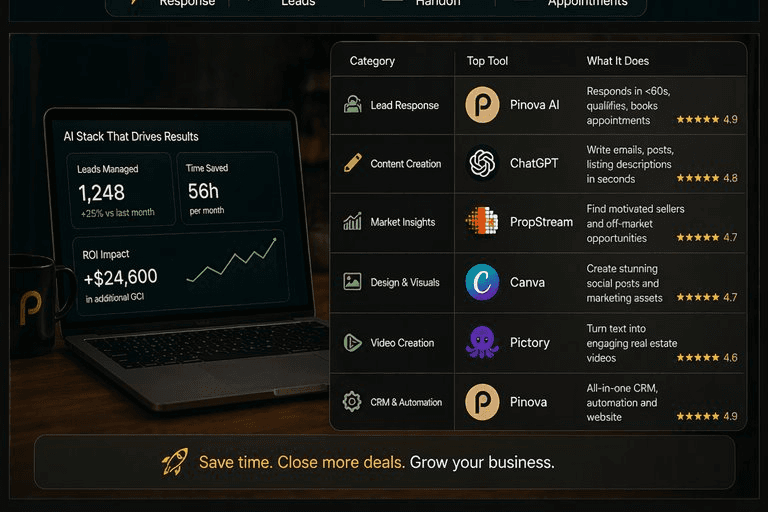
The tools below are ranked by the specificity of their real estate use case and the directness of their ROI - not by marketing budget or review count. Each serves a defined slot in the five-category framework above.
| Key Statistic / Finding | Source & Year |
|---|---|
| Follow Up Boss + AI module (AI CRM) - Drafts follow-up sequences, summarizes lead history into pre-call briefs, prioritizes daily call list by behavioral signal | $69/user/mo + $20/mo AI | FUB official pricing, 2026 |
| Lofty / formerly Chime (AI CRM + chatbot) - AI Sales Assistant qualifies leads, sets appointments, and nurtures prospects automatically across web/text/email | Custom pricing; mid-market teams | Lofty product page, 2026 |
| Structurely / Aisa Holmes (Lead response / AI ISA) - Qualifies leads via SMS and email on timeline, budget, pre-approval, readiness - routes hot leads to human agent | Custom; per-lead pricing | Structurely product page, 2026 |
| Ylopo / RAIYA (Lead response / AI nurture) - AI texting and voice follows up based on browsing behavior; moves hot prospects toward human handoff | Custom; brokerage-level pricing | Ylopo product page, 2026 |
| SmartZip (Predictive analytics) - Aggregates 25+ data sources; identifies top likely sellers in your farm with 72% accuracy and automates direct mail | Subscription per zip code | SmartZip product page, 2026 |
| Top Producer Smart Targeting (Predictive analytics) - Surfaces top 20% of likely sellers in farm area; pairs with automated marketing tools for outreach | Bundled with Top Producer CRM | Top Producer product page, 2026 |
| Virtual Staging AI / AI HomeDesign (Virtual staging) - AI generates furnished room photos from empty listing images; MLS-ready output in under 30 seconds per room | $15-$35/mo subscription | Virtual Staging AI pricing, 2026 |
| ChatGPT with RE prompt library (AI writing) - Drafts listing descriptions, buyer/seller emails, CMA commentary, neighborhood narratives from structured prompts | $20/mo (Plus) | OpenAI pricing, 2026 |
| OpenPhone AI module (AI writing + communication) - Summarizes calls, drafts follow-up SMS from call transcript, handles after-hours AI greeting | $19/user/mo | OpenPhone pricing, 2026 |
| Fello (Predictive analytics / CRM add-on) - Scores existing database contacts by likelihood to sell in next six months; generates hyper-personalized marketing campaigns | Custom; per-contact pricing | Fello product page, 2026 |
The practical stack for a solo agent doing fewer than 40 transactions a year: an AI CRM ($69–$89/mo), a chatbot or AI ISA layer ($50–$150/mo), an AI staging subscription ($20–$35/mo), and ChatGPT Plus ($20/mo). Total: $150–$295 per month to cover lead response, follow-up, listing prep, and daily writing. Agents running this stack consistently report recovering 8–12 hours per week of manual tasks.
How Pinova uses AI differently
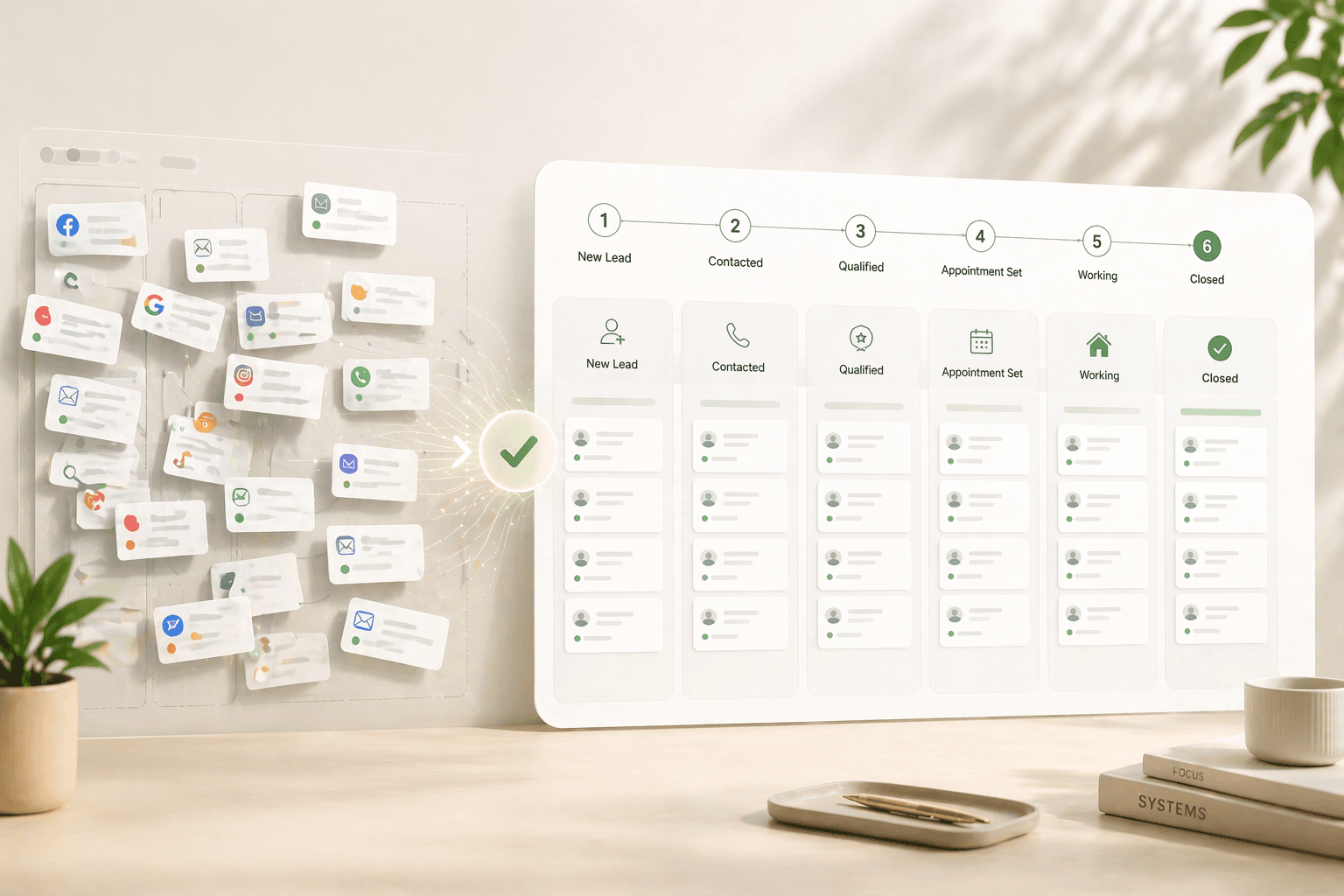
Most AI tools for real estate agents are point solutions - one tool for lead response, a different tool for CRM, a third for the website, a fourth for follow-up sequences. The integration overhead of connecting four separate platforms, each with its own login, data format, and billing cycle, creates its own friction that many agents don't get past. Pinova's AI layer is built directly into a single platform that includes the IDX website, CRM, and automated follow-up sequences in one environment. Specifically: when a lead submits an inquiry through your Pinova website, the AI instantly acknowledges the inquiry via SMS, qualifies the lead with a structured conversation (timeline, budget, current agent status), logs the outcome to the CRM, and pushes the lead into the appropriate follow-up sequence - all before you pick up your phone. There's no integration to configure between a chatbot vendor and your CRM because they're the same system.
Build a stack or use all-in-one?
The stack vs. all-in-one question comes down to transaction volume and technical tolerance. For agents closing 40+ transactions a year with team support, a custom stack - best-in-class CRM plus a dedicated AI ISA plus a staging subscription - can be optimized for each layer independently. But the setup and maintenance overhead is real: you'll spend two to four hours per month managing integrations, troubleshooting data sync, and updating automations when one vendor changes its API.
For agents doing fewer than 40 transactions, or for agents who want AI running without ongoing technical management, an all-in-one platform has a measurable advantage: data about a lead doesn't need to be translated between systems, which means the AI logic has the full context of every interaction - website visit, chatbot conversation, email open, call note - in one place. That complete context is what makes AI follow-up feel personalized rather than robotic.
Stat: Teams using a hybrid stack - instant automated first-touch plus a human follow-up call within five minutes - see 34% higher conversion rates than agents relying on either pure automation or pure manual response.
- GreetNow Speed-to-Lead Study, 2024
The practical decision rule: if you have fewer than 150 active leads in your database and you're working alone or with one assistant, start with an all-in-one before adding point solutions. If you have 500+ contacts, a CRM that already works well for your team, and an assistant who can manage vendor relationships, a best-of-breed stack will outperform any all-in-one at the top end. The 34% conversion lift from hybrid automation only materializes when the human follow-up actually happens - which means you need either calendar discipline or a system that makes the handoff unavoidable.
Key Statistics: AI Tools in Real Estate 2026
| Key Statistic / Finding | Source & Year |
|---|---|
| 68% of real estate agents who use AI report using it daily or several times a week | RPR (Realtors Property Resource) AI Adoption Report |
| Only 17% of AI-adopting agents report a significant positive impact on their business, while 46% see no noticeable difference | NAR 2025 Technology Survey |
| Agents who respond to web leads within 5 minutes are 21x more likely to qualify that lead compared to those who wait 30 minutes | InsideSales.com / Real Trends Lead Response Study |
| The average real estate agent takes 917 minutes (over 15 hours) to respond to a new lead inquiry | Inman 2025 Real Estate Technology Survey |
| Agents using AI-assisted response systems report lead capture improvements of 40% or more compared to manual-only systems | Inman/Real Trends Technology Adoption Survey 2025 |
| Teams using hybrid automation (instant AI first-touch + human follow-up within 5 min) see 34% higher conversion than pure automation or pure manual response | GreetNow Speed-to-Lead Study 2024 |
| 83% of buyers' agents say staging makes it easier for buyers to visualize a property as a future home; 49% of sellers' agents say staging reduced time on market | NAR 2025 Profile of Home Staging |
| AI virtual staging costs $1-$30 per photo vs. $500-$1,500 per room for physical staging; AI images are ready in under 30 seconds vs. 24-48 hours for manual | Virtual Staging Statistics 2026 Report |
| Staged homes sell 73% faster and can receive offers up to 25% higher than vacant-photo listings | Real Estate Staging Association / industry data |
| SmartZip predictive analytics identifies likely sellers with 72% accuracy by aggregating data from 25+ sources | SmartZip product documentation |
| AI-enhanced CRMs are projected to be used by 89% of top agents in 2026, with a projected 67% boost in lead conversion rates | Ascendix Technologies 2026 analysis |
| 46% of NAR members use AI-generated content (e.g. for listing descriptions); eSignature (79%) and social media (75%) remain the most widely used tools | NAR 2025 Technology Survey |
Frequently Asked Questions
What is the single highest-ROI AI tool for a real estate agent in 2026?
For most solo agents, AI-powered lead response automation delivers the highest direct ROI because it attacks the biggest revenue leak: slow response time. Agents who respond within five minutes are 21x more likely to qualify a lead than those who wait 30 minutes, per InsideSales.com research. A chatbot or AI ISA that acknowledges every inquiry instantly - even at 2 AM - and hands off to a human within five minutes during business hours closes the gap that causes most online lead losses. The monthly cost of a basic AI response tool ($50–$150) is typically recovered in a single additional qualified appointment per month.
How much do AI tools cost for real estate agents per month?
A functional AI stack for a solo agent in 2026 costs $150–$295 per month: an AI-enhanced CRM runs $69–$89 per user, an AI chatbot or ISA layer runs $50–$150, AI virtual staging is $20–$35 on a subscription, and ChatGPT Plus is $20. Teams and brokerages running enterprise-level tools like Ylopo or Lofty's full platform should budget $500–$2,000+ monthly depending on database size and lead volume. The relevant comparison is not tool cost versus zero - it is tool cost versus the commission value of one additional conversion per month, which for most agents is $10,000–$25,000.
Does AI actually help real estate agents close more deals, or is it just hype?
The impact depends entirely on which tasks you automate. NAR's 2025 Technology Survey found that 46% of AI-using agents see no noticeable difference in business outcomes - those agents are primarily using AI for social captions and one-off content, not for the workflows that govern conversion. Agents who deploy AI specifically for lead response, follow-up sequencing, and listing presentation (virtual staging) consistently report measurable results: Inman and Real Trends data shows a 40% improvement in lead capture for agents using AI-assisted response systems. The agents seeing no benefit are automating the wrong tasks.
What is the best AI chatbot for real estate lead qualification?
Structurely (Aisa Holmes), Ylopo (RAIYA), and Lofty's AI Sales Assistant are the three most widely used real estate-specific AI chatbots for lead qualification in 2026. Structurely focuses on SMS and email qualification conversations - asking about timeline, budget, pre-approval status, and readiness - then routing hot leads to a human. Ylopo specializes in behavior-aware follow-up that triggers based on what the lead viewed on your website. Lofty's assistant is best for agents who want CRM, website, and chatbot in one integrated platform. All three require a human to handle the conversation once a lead signals they're ready to schedule a showing.
Is AI virtual staging legal and do I need to disclose it on MLS listings?
AI virtual staging is legal across all major markets, but disclosure requirements vary by MLS. Most major MLS systems - including Bright MLS, CRMLS, and SDMLS - require you to label virtually staged images as "virtually staged" or "digitally altered" in remarks or photo captions, and some require the original unstaged photo to appear alongside the staged version. Always confirm the current handbook for your specific MLS before publishing. The legal risk is not in using AI staging - it's in failing to disclose it clearly to buyers. NAR's 2025 Profile of Home Staging confirms that 83% of buyers' agents say staging improves a buyer's ability to picture a home, so the practice itself is widely accepted and encouraged.
How does AI predictive analytics work for finding seller leads?
Predictive analytics tools like SmartZip and Top Producer Smart Targeting aggregate data across 25+ sources - mortgage origination dates, equity position, life events (marriage, divorce, children, job changes), time since purchase, and neighborhood transaction velocity - and use machine learning models to score every homeowner in your farm area on their probability of listing in the next 6–12 months. SmartZip reports 72% accuracy on its seller predictions. The output is a ranked list of the top 20–30% of homeowners in your farm most likely to move. Instead of sending postcards to 500 households, you call and mail specifically to the 100 with the highest predictive scores. That targeting improvement is why agents using predictive analytics report a measurable drop in cost per listing appointment.
What is the difference between an AI CRM and a regular CRM for real estate?
A standard CRM stores contact data and sends scheduled follow-up reminders. An AI CRM analyzes behavioral signals - how many times a lead revisited your website, whether they opened your last three emails, how long since their last active search - and uses those signals to rank which contacts to prioritize today and draft the follow-up message most likely to get a response. The practical difference: with a standard CRM you decide who to call; with an AI CRM the system surfaces who's most likely to transact in the next 30 days and drafts the first message before you open the app. Follow Up Boss, Lofty, and Pinova all offer AI layers on top of core CRM functionality.
How long does it take to set up AI tools for a real estate business?
Most AI tools marketed to individual agents are designed for same-day setup: chatbots embed in a website with a single script tag, AI CRM modules activate as an add-on to existing subscriptions, and AI staging tools require only photo uploads. A practical starting stack - AI response chatbot plus AI writing tool - can be operational in under two hours. The more complex setups (predictive analytics platforms, full AI CRM migrations, multi-tool integration workflows) take one to two weeks to configure and test properly. The RPR 2026 survey found that the majority of adopters who saw no business impact stopped using tools within 30 days of setup, usually because they hadn't connected the tool to their actual lead sources. The connection to your lead intake - website, Zillow, portal - is the step most agents skip and then wonder why the AI isn't producing results.
Amaan Sheikh
— Co-Founder & CEOAmaan Sheikh is the co-founder and CEO of Pinova. He sets the product direction, builds the partnerships, and personally works with every founding partner. His focus is making enterprise-grade real estate technology accessible to ambitious agents and teams — without the enterprise price tag.