Real estate lead management software: the only guide agents need

Quick Answer
What is real estate lead management software and do agents actually need it?
Real estate lead management software captures, scores, routes, and nurtures leads from all sources — Zillow, Realtor.com, your website, social media, and referrals — into a single pipeline with automated follow-up sequences. According to NAR's 2025 Technology Survey, agents using automated lead management convert leads at 2–3 times the rate of those relying on manual follow-up. The practical difference: a team generating 100 leads per month at a 30% contact rate (typical without automation) versus 60% (typical with speed-to-lead automation) doubles the yield from the same marketing spend. Most agents don't need more leads. They need a system that ensures the leads they already pay for actually get followed up with — consistently, quickly, and over a long enough period to capture the 65% of leads that convert beyond 90 days.
Key Takeaways
- 71% of real estate agents say their biggest technology challenge is managing leads from multiple sources in one place — not lead quality — per NAR's 2025 Technology Survey.
- Teams that automate lead routing and initial contact achieve a 28% higher contact rate and 19% higher appointment-setting rate than teams using manual assignment, per Redfin's 2024 agent technology benchmarking data.
- 74% of real estate leads that ultimately transact do so more than 6 months after initial inquiry — after most agents have abandoned follow-up — per T3 Sixty's Real Estate Technology Study, making long-term automated nurture the highest-ROI feature in any lead management platform.
- Nucleus Research's 2024 CRM ROI analysis found that organizations still achieve an average return of $3.10 per dollar spent on CRM, with time savings from individual productivity gains accounting for 51% of total ROI — not revenue lift alone.
- Only 38% of real estate agents have any automated follow-up system for leads older than 90 days, per NAR's 2025 Technology Survey — meaning the 62% who don't are systematically abandoning a majority of their eventual conversion opportunity.
David Park, a solo agent in Atlanta, Georgia, was generating 80 leads per month in Q3 2024 and closing two transactions from them — a contact rate he described as "fine, considering how busy I am." When he audited his CRM, he found 63 of those 80 leads had received zero follow-up after the initial automated email. The automated email was sent from a platform he'd subscribed to for $180 per month. He was paying for a contact database, not a lead management system. Two platforms that look identical on a comparison chart can produce radically different results depending on whether they automate the work or simply organize the waiting.
This guide defines what lead management software actually does (as distinct from a CRM), identifies the features that move conversion rate in 2026 versus the features that don't, compares the major platforms by agent type, walks through the ROI math so you can evaluate your own stack, and gives you a week-by-week implementation sequence that doesn't require you to stop working your current pipeline.
What lead management software actually does
A CRM stores contacts. Lead management software moves them. The distinction matters because most agents who describe their CRM as "not working" are using a contact database that requires manual triggering for every follow-up, manual data entry for every new lead, and manual decision-making about which leads to contact and when. None of that scales when you are also showing homes, writing offers, and managing transactions.
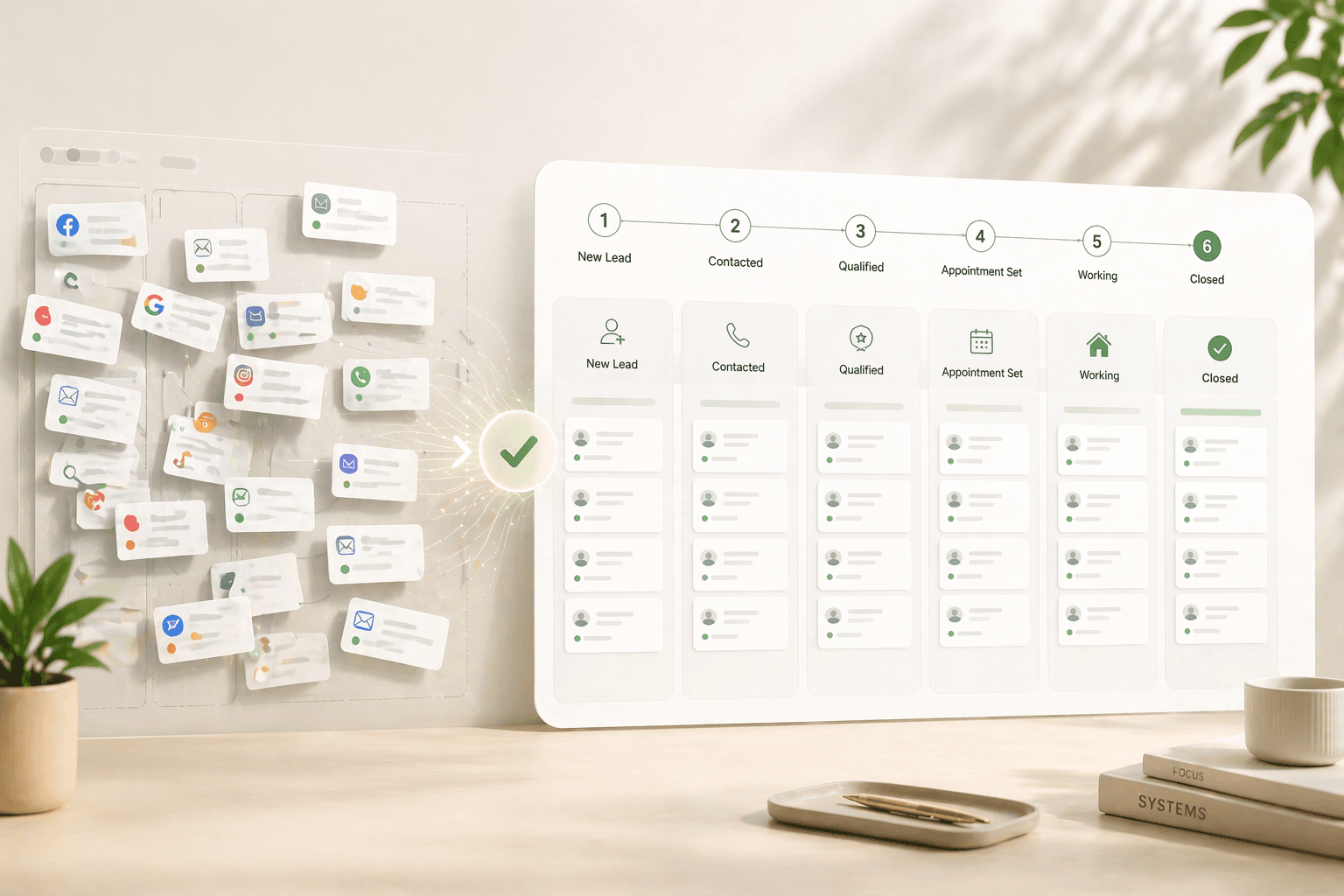
Real estate lead management software does four things automatically: it captures leads from every source (Zillow, Realtor.com, your IDX website, Facebook, Google, open house sign-in sheets) into a single record without manual import; it scores those leads based on behavioral signals — how many times they've visited your website, which listings they've saved, how recently they've been active — so you know which ones deserve immediate attention; it routes new leads to the right agent or follow-up sequence within minutes of inquiry submission; and it nurtures leads that aren't yet ready to transact through automated sequences that run for months or years without agent intervention.
Stat: 71% of real estate agents say their biggest technology challenge is managing leads from multiple sources in one place — not the quality of leads themselves. — NAR 2025 Technology Survey
The practical test for whether your current platform qualifies as lead management software or just a CRM: open it right now and answer three questions. First, does a new Zillow lead appear in your pipeline automatically, or do you have to import it? Second, when a lead visits your website for the third time at 9 PM on a Friday, do you receive a behavioral alert? Third, does your platform continue sending value-based follow-ups to a lead that hasn't responded in 45 days — without you doing anything? If the answer to any of those is "no" or "I have to set that up manually each time," you have a contact database, not a lead management system. The upgrade path is either switching platforms or connecting your existing CRM to the automation layer it is missing.
The real problem: it's not the leads
The most common complaint among agents who spend $1,000–$3,000 per month on Zillow leads is that "the leads are garbage." The data says otherwise. According to T3 Sixty's Real Estate Technology Study, 74% of real estate leads that ultimately transact do so more than 6 months after initial inquiry — well past the point when most agents have given up following up. The leads are not garbage. The follow-up system stopped before the leads were ready.
Follow Up Boss's 2025 Agent Performance Benchmark Report, which analyzed behavior across their platform user base, found that the average agent follows up with a new lead an average of 1.4 times before stopping. The research-supported minimum for meaningful contact is 7–12 attempts. The gap between 1.4 and 7 is not a discipline problem — it is a capacity problem. A solo agent with 40 active leads in their pipeline cannot manually make 7 follow-up attempts per lead while also running their business. They deprioritize the follow-up, and the lead goes cold. The US Tech Automations analysis of NAR's 2025 Technology Survey found that only 38% of agents have any automated system for leads older than 90 days. The other 62% rely entirely on manual outreach, which reliably stops at 30–60 days due to capacity constraints.
Stat: 74% of real estate leads that ultimately transact do so more than 6 months after initial inquiry. Agents who respond consistently over a 12-month period capture 3× more transactions from the same lead set than those who stop at 30 days. — T3 Sixty Real Estate Technology Study; Zillow Research 2025 Agent Productivity Report
The financial framing that makes this concrete: T3 Sixty estimates that the average established real estate team has $200,000–$600,000 in gross commission income dormant in their existing database, from leads they've already paid to acquire but abandoned before the lead was ready to transact. According to T3 Sixty's 2025 Real Estate Almanac, systematic database nurturing — not new lead generation — is the single highest-ROI opportunity available to teams with an established pipeline. Yet lead generation spend exceeds database cultivation spend by a ratio of 5:1 in the typical team budget. The implication: if you are currently spending $2,000 per month on new leads and $0 on automated nurture for your existing database, you are investing in the more expensive, lower-ROI channel while ignoring the less expensive, higher-ROI one.
Must-have features in 2026
The feature set that actually moves conversion rate in 2026 has narrowed considerably. Here are the six capabilities that Zillow Research's 2024 Agent Effectiveness Study identified as the primary determinants of lead conversion outcomes, along with what to look for when evaluating whether a platform delivers them.
1. Sub-5-minute automated first response. The platform must fire an SMS — not just an email — within 90 seconds of a new lead submission from any connected source. Email-only first responses have a fraction of the open rate of SMS for time-sensitive messages. The SMS should be personalized (include the lead's name and the property or area they inquired about) and come from the agent's own number, not a generic platform number. Platforms that send first responses from a shared pool number significantly reduce engagement rates.
2. Behavioral lead scoring. The platform should monitor what leads are doing on your IDX website and surface the ones showing purchase signals — saving specific properties, returning multiple times, narrowing their search criteria. A lead who visits your site seven times in one week is not the same priority as a lead who signed up three months ago and has never returned. Without behavioral scoring, agents work their leads in chronological order, which is almost never the right order.
3. Multi-channel automated nurture sequences. The platform should run sequences that alternate between SMS, email, and call prompts — not just email drips. NAR's 2025 analysis of automated follow-up found that agents using automated sequences across all lead sources are 3.2× more likely to maintain contact for 12+ months, the window when the majority of leads convert.
4. Source attribution tracking. The platform must track where each lead came from and report conversion rate by source. Without this, you cannot tell whether Zillow or your IDX website or Facebook is producing your closings. This single piece of data determines your entire marketing budget allocation.
5. Mobile-first logging. Any note, contact update, or task the agent needs to complete in the field must take under 60 seconds from a phone. Platforms that require desktop access for core workflow functions will not get used between showings, and the data quality collapses.
6. Long-term nurture tracks with automatic enrollment. The platform must automatically move leads that have not converted after 30 or 60 days into a long-term nurture track without the agent needing to manually reassign them. The track should continue for at least 12 months. Platforms that require manual re-enrollment at each stage see abandonment rates above 80% at the 45-day mark, per US Tech Automations' analysis.
Platform comparison
The right platform depends on three variables: your lead volume, your team size, and whether you want a combined IDX website and CRM or a standalone CRM that connects to your existing site. Here is how the major options stack up on those dimensions, based on publicly available data as of May 2026.
Solo agents, under 50 leads per month: Follow Up Boss at $69/month (solo tier) integrates with 200+ lead sources out of the box, includes action plans (pre-built nurture sequences), and has a mobile app built for field use. It does not include an IDX website, so you will need a separate site. Wise Agent at $32/month is the lowest-cost option with solid automation and integrations with Mojo Dialer, BombBomb, and Google Workspace. For agents who want IDX plus CRM in one tool, kvCORE's solo tier includes both. The tradeoff is a steeper learning curve.
Growing teams, 50–200 leads per month: Follow Up Boss at $499/month (unlimited users) is the most cost-efficient at this tier for teams of 5+. It adds team accountability features — tracking which agents are following up and which aren't — that solo plans don't include. CINC serves over 50,000 agents and teams, sources leads from Google and Meta, and includes automated text, call, and voicemail drip campaigns with behavior-driven follow-ups through its AutoTrack functionality. Pricing starts around $899/month, making it a meaningful investment that only pays off if your lead volume justifies it.
High-volume teams, 200+ leads per month: BoomTown and Sierra Interactive both include IDX websites, CRM, and managed advertising services. BoomTown's managed PPC and social media campaigns are designed for organizations that want to outsource advertising complexity entirely. Sierra Interactive is the cleaner option for teams that want a combined IDX and CRM without managed advertising. Luxury Presence reported that their clients grow 6 times faster than market peers and close 2.9 times more transaction volume per agent, driven by an AI-powered CRM layered on top of custom website design and managed marketing — the integrated approach is the pattern worth noting regardless of platform.
The ROI math
The ROI calculation for lead management software is not complicated, but most agents run it wrong by only counting the cost of the software against the revenue from new closings it appears to generate. The right calculation includes what you were already spending on leads that were going unworked, and what that unworked portion is worth.
Here is the calculation for a typical solo agent. Inputs: 60 leads per month at $25/lead average = $1,500/month in lead spend. Current contact rate: 25% (15 leads actually reached). With automation: contact rate rises to 50% (30 leads reached), per the Redfin benchmarking data showing a 28% improvement from automation. That contact rate improvement effectively recovers $750/month in lead spend value — leads you already paid for but previously never contacted. Over 12 months, that is $9,000 in recovered lead value. The software subscription cost for a solid solo plan runs $70–$200/month, or $840–$2,400 per year. Even before attributing a single additional closing to the system, the lead recovery math produces a 3.75–10x return on the software cost.
Stat: Nucleus Research's 2024 CRM ROI analysis found organizations achieve an average return of $3.10 per dollar spent on CRM. Time savings from individual productivity gains account for 51% of total ROI — meaning the value is not purely in additional revenue, but in reclaiming hours that go back to selling. — Nucleus Research, January 2024
The second ROI layer — additional closings from long-term nurture — compounds over time. If your platform keeps leads in automated follow-up for 12–18 months and captures even 3–5 closings per year that you would have previously abandoned at the 45-day mark, those transactions at a $12,000 median commission represent $36,000–$60,000 in GCI recovered from leads already in your database. That is the ROI case that makes the software decision obvious: not whether the monthly fee is affordable, but whether the closings it saves from abandonment pay for the subscription.
How to implement without disruption
The most common implementation failure is trying to migrate everything at once. Agents import 2,000 old leads, get overwhelmed by the resulting task list, and abandon the platform within 30 days. The sequence that works is narrower: start with new leads only, get the automation running for those, and only then migrate older contacts.
Week 1: Connect your active lead sources — Zillow, Realtor.com, your website form — to the platform. Test the automated first-response SMS by submitting a test inquiry from your own phone. Confirm it fires in under 2 minutes and reads naturally. Do not touch old leads yet.
Week 2: Build or activate two sequences: a 10-day new-lead sequence (day 1 SMS, day 1 call attempt, day 2 email with relevant listing, day 4 SMS, day 7 call, day 10 SMS) and a 30-day+ nurture sequence that sends one value-focused email per week — market update, matched listing, neighborhood snapshot — to any lead that has not converted after the first 10 days.
Week 3: Add every new lead exclusively through the platform. Use the mobile app or voice-to-text note logging after every showing or call. The goal is not to be perfect — it is to break the habit of adding leads to a spreadsheet or your phone contacts.
Week 4: Pull your first pipeline report. Filter by "last contacted more than 7 days ago" and work through that list manually. This filter — run weekly — is the single most valuable report any lead management platform can produce. It surfaces the leads falling through the cracks before they are lost, rather than after. Pinova's platform automates this sequence end to end: leads from any connected source enter a structured pipeline, the first SMS fires within 90 seconds, and the long-term nurture track activates automatically at the 30-day mark — the agent's first required action is the qualifying conversation, not the data entry or sequence setup.
| Key Statistic / Finding | Source & Year |
|---|---|
| 71% of real estate agents say managing leads from multiple sources in one place is their biggest technology challenge | NAR 2025 Technology Survey, via US Tech Automations |
| Agents using automated lead management convert leads at 2–3× the rate of those relying on manual follow-up | NAR 2025 Technology Survey |
| Teams automating lead routing achieve a 28% higher contact rate and 19% higher appointment-setting rate vs. manual assignment | Redfin 2024 Agent Technology Benchmarking |
| 74% of real estate leads that ultimately transact do so more than 6 months after initial inquiry | T3 Sixty Real Estate Technology Study |
| Agents who follow up consistently over 12 months capture 3× more transactions from the same lead set than those who stop at 30 days | Zillow Research 2025 Agent Productivity Report |
| Only 38% of agents have any automated follow-up system for leads older than 90 days; 62% rely entirely on manual outreach | NAR 2025 Technology Survey, via US Tech Automations |
| The average agent follows up with a new lead 1.4 times before stopping; 7–12 contacts are needed to convert the average lead to an appointment | Follow Up Boss 2025 Agent Performance Benchmark Report |
| Nucleus Research found an average CRM return of $3.10 per dollar spent; time savings account for 51% of total ROI | Nucleus Research CRM ROI Analysis, January 2024 |
| Established teams have $200,000–$600,000 in GCI dormant in their existing databases due to lack of systematic nurture | T3 Sixty 2025 Real Estate Almanac, via US Tech Automations |
| Agents using automated follow-up sequences across all lead sources are 3.2× more likely to maintain lead contact for 12+ months | NAR 2025 Technology Survey, via US Tech Automations |
| 68% of home buyers contact multiple agents simultaneously to compare responsiveness | AgentZap 2025 Real Estate Lead Statistics |
| Contact rate without automation averages 30%; with speed-to-lead automation, it rises to 60% — effectively doubling yield from the same lead spend | Zillow Research Agent Effectiveness Study 2024, via US Tech Automations |
Frequently Asked Questions
What's the difference between a real estate CRM and lead management software?
A CRM stores contacts and tracks interactions. Lead management software automates the actions that move those contacts toward a transaction — capturing new leads from portals automatically, scoring them by behavior, firing a first-response SMS within 90 seconds, and running multi-touch nurture sequences for months without manual input. Most basic CRMs (spreadsheets, simple contact databases) do none of this automatically. The practical test: does your system respond to a new Zillow lead at 11 PM on a Saturday without you doing anything? If not, you have a CRM. If yes, you have lead management software. The distinction is not about software category — many platforms that call themselves CRMs include full lead management automation. The question is whether the automation is actually running.
How much does real estate lead management software typically cost?
Pricing spans from roughly $30/month (Wise Agent, solo tier) to $1,500/month or more for team platforms with managed advertising included (CINC, BoomTown). The mid-range options that cover the core automation features — automated first-response SMS, multi-channel nurture sequences, behavioral lead scoring, and source attribution — typically run $70–$200/month for solo agents and $200–$500/month for teams. The more important number than monthly cost is cost per closed deal recovered: Nucleus Research's 2024 CRM ROI study found organizations achieve $3.10 in return per dollar spent on CRM, primarily through time savings and higher contact rates. An agent closing one additional transaction per quarter from leads previously abandoned pays for a year of most mid-tier platforms in a single deal.
What are the most important features to look for in real estate lead management software in 2026?
The six features that most directly affect conversion rate, per Zillow Research's 2024 Agent Effectiveness Study: automated first-response SMS within 90 seconds of lead submission; behavioral lead scoring based on IDX website activity; multi-channel nurture sequences (SMS + email + call prompts combined, not just email drips); source attribution tracking that shows conversion rate by lead source; mobile-first contact logging that takes under 60 seconds from the field; and automatic enrollment in long-term nurture tracks for leads that haven't converted by day 30. Features that look valuable on a comparison chart but rarely move conversion rate in practice include social media publishing integrations, complex pipeline stage visualizations, and video email tools — useful in specific contexts, but not drivers of the core metrics.
Can I use lead management software if I'm a solo agent, not a team?
Yes, and solo agents typically benefit more than teams on a per-user basis. The core problem lead management software solves — not having enough capacity to manually follow up with every lead at the right frequency — is more acute for a single agent than for a team with a dedicated ISA. For a solo agent generating 30–80 leads per month, the automated first-response SMS, the 10-day initial sequence, and the long-term nurture track collectively cover most of what a full-time ISA would do for a fraction of the cost. Follow Up Boss at $69/month, Wise Agent at $32/month, and kvCORE's solo tier are the most commonly adopted by individual agents, with Follow Up Boss having the strongest integration ecosystem for portal lead sources.
How long does it take for lead management software to show results?
Contact rate improvements are typically visible within the first 30 days, because the automated first-response SMS fires immediately once the platform is connected to your lead sources. Appointment-setting rate improvements follow in weeks 4–8 as leads begin responding to consistent multi-touch sequences. Conversion rate improvements — where leads actually become closings — take 60–90 days minimum, and the full benefit of long-term nurture sequences doesn't appear until 6–12 months after implementation, because 74% of leads that ultimately transact do so more than 6 months after first inquiry, per T3 Sixty's research. Agents who evaluate the software after 30 days and cancel because they haven't closed anything new are abandoning the tool before most of its value has been delivered.
What happens to leads that don't respond to the initial follow-up sequence?
They should automatically enter a long-term nurture track that runs for at least 12 months. A well-designed long-term track sends one value-based touch per month — a market update for the lead's target neighborhood, new listings matching their stated criteria, or a mortgage rate update — alternating between email and SMS. The goal is not to close these leads on the next message; it is to remain the agent they think of when they are finally ready to move. According to NAR's 2025 Profile of Home Buyers and Sellers, the average buyer spends 15 months researching before contacting an agent. Most of the leads currently in your database are not dead — they are simply not yet at the decision point. Only 38% of agents have automated follow-up for leads older than 90 days, so consistent long-term nurture alone puts you ahead of the majority of your market.
How do I know if my current lead management system is actually working?
Track five numbers monthly: total leads in by source, percentage contacted within 5 minutes, average number of contact attempts per lead, conversion rate by source, and average age of converted leads. If your platform cannot produce all five of these metrics in a single report, it is not functioning as a lead management system — it is functioning as a contact database. The most diagnostic single number is average contact attempts per lead. If that number is below 4, you are mathematically unable to reach the minimum follow-up threshold identified by research as necessary for meaningful conversion rates. The second most diagnostic number is percentage of leads contacted within 5 minutes — anything below 50% indicates the automated first-response is either not set up or not working correctly.
Amaan Sheikh
— Co-Founder & CEOAmaan Sheikh is the co-founder and CEO of Pinova. He sets the product direction, builds the partnerships, and personally works with every founding partner. His focus is making enterprise-grade real estate technology accessible to ambitious agents and teams — without the enterprise price tag.