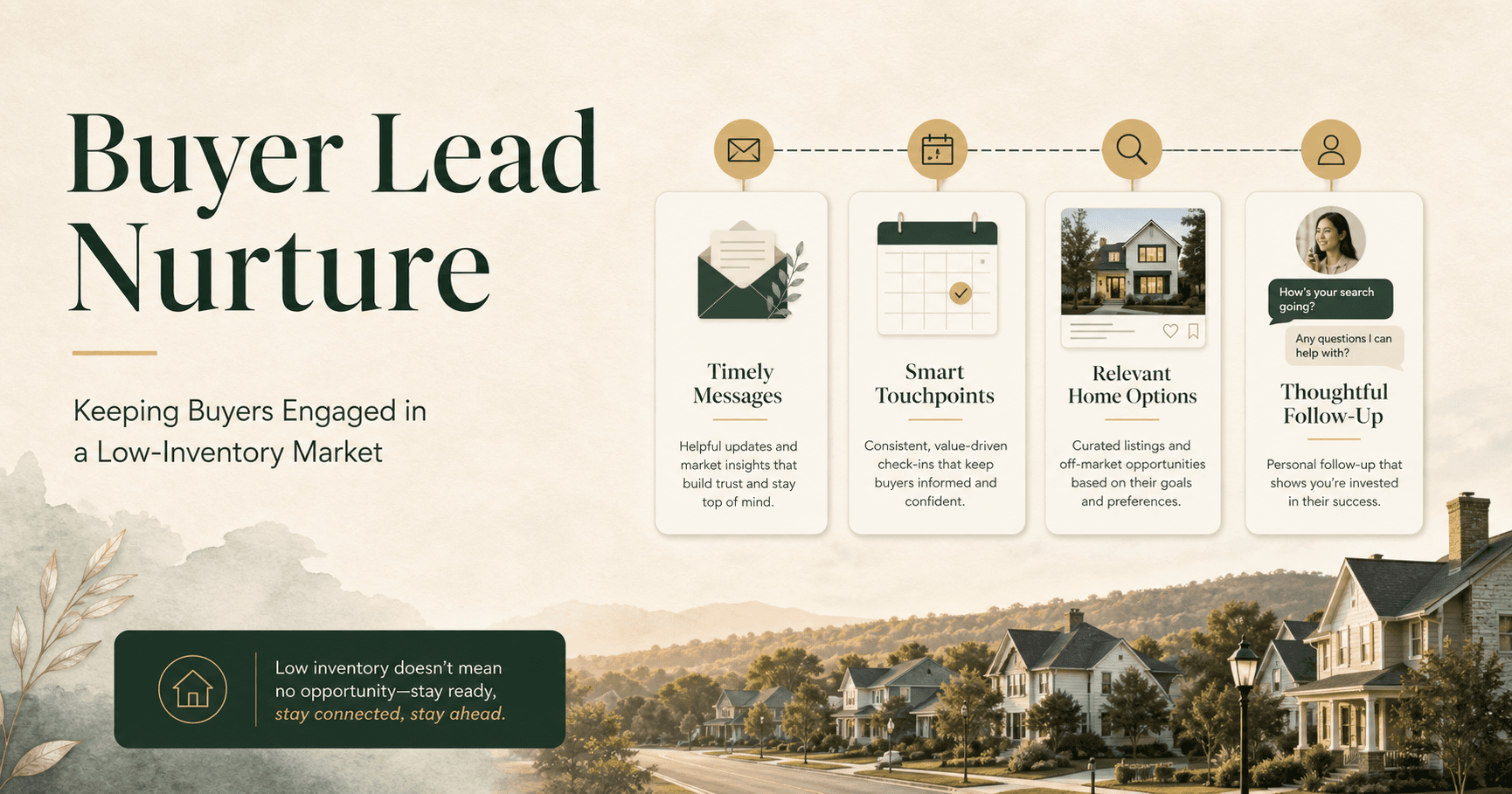
Buyer Lead Nurture in a Low-Inventory Market


Quick Answer
Is national inventory actually low in 2026, or is that outdated advice?
It's genuinely mixed, and both halves matter for how you nurture buyers. Nationally, existing-home months of supply climbed from 3.3 in December 2025 to 4.6 in June 2026, according to NAR, real loosening, but still short of the 5–6 months typically considered a balanced market. And that national average hides sharp local variation: metros like Boston, Grand Rapids, Kansas City, and Columbus remain genuine seller's markets with homes moving in under a month, even as Austin, Miami, and Phoenix have flipped firmly to buyer's markets. The practical result is that a real, qualified buyer in a tight submarket can easily spend four to seven months searching and lose more than one offer before closing, which means the agents who win are the ones with a nurture system built for months, not weeks.
Key Takeaways
- National existing-home inventory rose from 3.3 months' supply in December 2025 to 4.6 in June 2026, real improvement, but still below the 5–6 months usually considered balanced (NAR).
- The median home buyer searches for 10 weeks and views 14.2 listings before ever contacting an agent, meaning your nurture window often starts long before first contact, per NAR's 2025 Profile of Home Buyers and Sellers.
- The average online home search now runs about 4.7 months start to finish, according to NAR and SearchLab 2026 data.
- Internet-sourced leads convert at just 2–5% overall, but referrals convert at 14–20%, and agents who use a CRM consistently see a 29–41% lift in conversion versus those who don't.
- Tight, competitive submarkets persist even in a nationally loosening market, Boston-area listings sell in under 22 days, while Miami and Phoenix listings now commonly sit 60+ days.
- A buyer who goes quiet after a few unsuccessful showings is far more often discouraged, not disinterested, the agents who keep showing up are the ones who eventually get the call when the right listing appears.
Inventory is recovering nationally, but it hasn't reached "balanced" yet, and it never recovers evenly.
A buyer in a tight submarket is living in a different market than the national headlines describe. Your nurture system has to be built for their actual market, not the average.
Devon Marsh had been working with the Ferreira family for five months when they finally closed. Four accepted-then-fallen-through near misses, two losing offers in the first month, and one long stretch, nearly seven weeks, where nothing in their price range and school-zone requirement hit the market at all. Most agents would have quietly let that lead go cold around month three. Devon didn't, because her CRM was doing the remembering for her: an automated monthly check-in that didn't ask "are you still looking?" but instead shared what had actually changed in their target neighborhood that month, new listings, a price cut nearby, an updated mortgage-rate scenario. By the time the right house appeared, the Ferreiras didn't need convincing. They needed her to call first, and she did.
That's the entire skill in this niche: not urgency, not a harder close, but simply outlasting the search. In a genuinely low-inventory submarket, the buyer isn't slow because they're uninterested, they're slow because the market is making them slow. The agents who win these buyers aren't the ones with the best pitch. They're the ones still in the buyer's inbox in month five.
Inventory Is Recovering, But Not Evenly, and Not to "Balanced" Yet
The national inventory story has genuinely improved since the record lows of 2021–2022. Months' supply of existing homes climbed from 3.3 in December 2025 to 4.6 in June 2026, according to NAR's Existing-Home Sales data, a meaningful, sustained recovery. But 6 months' supply is the traditional benchmark for a balanced market, and the national figure still hasn't reached it. More importantly, that single national number smooths over a housing market that Redfin's own economists describe as fractured: some metros remain firmly tilted toward sellers even as the country overall shifts toward buyers.
National Months' Supply of Existing Homes, 2025–2026
Redfin's own regional breakdown as of mid-2026 illustrates the split clearly: Boston-area listings are selling in under 22 days, and Grand Rapids, Kansas City, and Columbus remain among the fastest-moving submarkets nationally. Meanwhile Austin, Miami, and Phoenix have shifted decisively into buyer's-market territory, with listings in Miami commonly sitting 60 days or more. If your buyer is searching in one of the still-tight metros, the national "inventory is loosening" narrative is not their lived experience, and treating their frustration as a lead-quality problem, rather than a market-reality problem, is how agents lose otherwise-excellent buyers.
Why Buyer Leads Actually Go Cold
Most agents assume a quiet lead has lost interest. The data suggests something less dramatic and more fixable: buyers searching in a tight market simply take much longer than the standard follow-up cadence most CRMs are built around. NAR's 2025 Profile of Home Buyers and Sellers found the median buyer searches for 10 weeks and views 14.2 listings before ever reaching out to an agent in the first place, meaning the "nurture clock" often starts well before you've had a single conversation. Separately, NAR and SearchLab's 2026 research put the average total online home search at 4.7 months. A follow-up sequence that goes quiet after 30 days isn't following a cold lead, it's abandoning a warm one exactly when the search is still in its early-to-middle stretch.
Lead-to-Close Conversion by Source
The gap between a 0.8% portal lead and a 17% referral isn't primarily about lead quality, a referral and a portal inquiry can represent an equally serious buyer. The gap is nurture discipline: a referral arrives with implicit trust and usually gets consistent, personal follow-up, while a portal lead is dropped into a generic drip sequence and forgotten the moment it stops responding to the first few touches. Closing that gap on your internet leads, not just working harder to generate more of them, is the highest-leverage fix most agents overlook, and it's the same drop-off pattern behind why the majority of real estate leads are lost in the first place.
What Keeps a Buyer Warm for Months, Not Weeks
None of the four factors below require you to personally remember every buyer's timeline, that's exactly the job an automated lead nurture engine is built to carry, running the cadence in the background while you focus on the calls that actually need a human.
Search criteria that actually update
A buyer who's been looking for four months has almost certainly refined what they want. Alerts still tuned to their week-one criteria feel irrelevant fast, a quick recalibration call every 4–6 weeks keeps the matches worth opening.
Prevents alert fatigue and unsubscribesContext, not just listings
A monthly note that explains what's actually happening in their target area, a price cut nearby, a new pocket listing, a shift in rates, gives a buyer a reason to open the email even in a month with nothing new to show them.
Reframes silence as market reality, not neglectPre-approval maintenance
Rate locks and pre-approvals expire. A buyer who's been searching for three months with a stale pre-approval letter can lose a home purely on financing timing, a periodic reminder to refresh it protects a deal that hasn't happened yet.
Removes a silent, avoidable deal-killerFirst call on new and off-market inventory
In a tight submarket, being the agent who calls the moment a matching listing appears, or before it's even public, is worth more than any script. This requires an actual system for tracking what each buyer wants, not memory.
The single highest-value touch you can offerHonest expectation-setting after a loss
After a losing offer, buyers are deciding whether to keep going or step back. A same-week debrief, what the winning offer likely had that yours didn't, rebuilds trust faster than silence followed by a generic "any new listings for you?" email.
Prevents post-loss drop-off, the most common exit pointGeneric Check-In vs. Value-Add Touch
Puts the burden on the buyer to explain themselves, offers nothing new, and reads identically to the last four check-ins they ignored. Easy to leave unanswered, and easy to eventually mark as spam.
Demonstrates active tracking of their specific search, gives them a reason to respond, and reframes a quiet month as market conditions rather than agent neglect.
Four Channels for Staying Present Over a Long Search
Automated, criteria-matched alerts
Real-time alerts tied to a buyer's actual saved search keep you present without manual work, but only if the criteria are reviewed and refreshed periodically as the buyer's preferences evolve over a long search.
Monthly market-context check-ins
A brief, personal note on what's actually happening in their target area, even in months with no new matching listings, is what separates an agent a buyer trusts from one they've mentally filed away as "still searching, I guess."
Post-loss debriefs
The period right after a losing offer is when buyers are most likely to quietly disengage. A same-week, honest conversation about what happened, and what to adjust, determines whether they keep going with you or go silent. (If losing offers is a recurring pattern rather than a one-off, the offer strategy itself may need work, see our guide to winning multiple-offer situations.)
Pre-approval and financing check-ins
A simple reminder every 60–90 days to confirm a buyer's pre-approval and rate lock are still current protects against losing a home purely to expired paperwork, a failure mode that has nothing to do with the buyer's actual interest.
Scripts for the Long Nurture
"Hi [Name], quick update on [Area], nothing new matched your exact criteria this month, but [specific market detail: a price cut, new listing nearby, rate shift]. Still keeping an eye out daily, let me know if anything's changed on your end, like timeline or must-haves."
"I know that one stings, I want to walk you through what I think the winning offer likely had that ours didn't, so we're even stronger next time. Do you have 10 minutes this week? I'd also love to revisit your criteria in case anything's shifted after seeing a few more homes."
"I wanted to be upfront, [Area] has genuinely had very little inventory in your range the last several weeks, so the quiet isn't about you missing anything. A couple of things I'd suggest: widening the radius slightly, or being ready to move fast the moment something new lists. Which feels right for where you're at?"
Benchmarks: A Well-Run Long-Nurture Pipeline
| Key Statistic / Finding | Source & Year |
|---|---|
| National months' supply rose from 3.3 (Dec 2025) to 4.6 (June 2026), still below the 6-month balanced-market threshold | NAR Existing-Home Sales, via FRED, 2025–2026 |
| Median buyer searches 10 weeks and views 14.2 listings before contacting an agent | NAR 2025 Profile of Home Buyers and Sellers |
| Average total online home search duration is 4.7 months | NAR; SearchLab 2026 |
| Internet leads convert at 2–5% overall; portal-specific leads convert at 0.4–1.2%; referrals convert at 14–20% | Deal Machine OS 2026, compiling NAR/REDX data |
| Agents using a CRM consistently see a 29–41% lift in conversion rate | Deal Machine OS 2026 compilation |
| Boston-area homes sell in under 22 days; Miami and Phoenix listings now commonly exceed 60 days | Redfin regional market data, 2026 |
Common Questions About Buyer Lead Nurture
How long should I keep nurturing a buyer lead before giving up?
Given that the average online search runs 4.7 months and can extend well beyond that in tight submarkets, a nurture sequence built around a 30-day window is abandoning most buyers before their search has meaningfully progressed. A 6-month minimum cadence, with periodic check-ins on whether their timeline or motivation has changed, better matches actual buyer behavior.
Is national inventory actually low right now, or has that changed?
It depends entirely on where your buyer is searching. Nationally, months' supply climbed to 4.6 by June 2026, real recovery from the record lows of 2021–2022, but that's still short of the 6-month balanced threshold, and specific metros remain much tighter than the national average while others have flipped to genuine buyer's markets.
What should I say to a buyer who's discouraged after losing multiple offers?
Be specific and honest rather than generically reassuring, walk through what you believe the winning offer likely had that theirs didn't, and revisit whether their criteria, budget, or offer strategy needs adjusting. Buyers disengage more from vague reassurance than from honest, actionable feedback.
Should I stop sending alerts if a buyer hasn't responded in a while?
Not immediately, a quiet buyer in a slow-inventory stretch is more often waiting than gone. Shifting from generic alert emails to a monthly, context-rich check-in is usually more effective than stopping outreach altogether, since it gives the buyer new information rather than repeating the same ask.
How often should I actually contact a buyer during a multi-month search?
A monthly touch is a reasonable baseline for most buyers in a slower search, supplemented by real-time alerts whenever a genuinely matching listing appears. More frequent generic contact tends to produce diminishing returns and higher unsubscribe rates than fewer, more substantive touches.
Ayushman Singh
— Co-Founder & Chief Brand & Marketing OfficerAyushman Singh is the co-founder and Chief Brand & Marketing Officer of Pinova. He shapes the narrative, builds the brand, and tells the stories the industry doesn't want to hear. He believes the real estate system was designed to extract from agents, not empower them — and he's building the counter-narrative.