Real estate lead conversion rate: benchmarks and how to double yours


Quick Answer
What is the average real estate lead conversion rate and how do top agents improve it?
The national average real estate lead conversion rate is 0.4%–1.2%, per the National Association of REALTORS — meaning most agents close 1 to 2 clients from every 200 leads. Top producers convert 5%–9% from portal sources and above 25% from referrals, according to Ylopo's 2026 analysis. The gap is not luck or market conditions. It traces back to five measurable variables: response speed, follow-up volume, lead source mix, nurture duration, and tracking discipline. Agents who address all five consistently — particularly sub-5-minute response time and at least 6 contact attempts per lead — see conversion rates 2–3x the industry average.
Key Takeaways
- The national average real estate lead conversion rate is 0.4%–1.2%, per NAR research — roughly 1–2 closings for every 200 leads — while top producers using systematic follow-up reach 5%–9% from the same portal sources.
- Referral leads convert above 25% while paid portal leads (Zillow, Realtor.com) convert at 2%–9% depending on response speed; email leads convert at approximately 3.5% and paid search at 2.0%, per Listinghub industry analysis, 2025.
- 80% of real estate sales require five or more follow-up contacts, yet 44% of agents give up after a single follow-up attempt — per the National Sales Executive Association, validated by Inman research — making persistence the cheapest conversion lever available.
- Responding to a lead within 5 minutes makes an agent 21 times more likely to qualify it than responding after 30 minutes, per the MIT and InsideSales.com Lead Response Management Study; the average real estate agent takes over 15 hours to respond, per Inman's 2025 survey.
- Only 27% of captured real estate leads ever receive a single follow-up contact, per Follow Up Boss industry data — meaning for a typical agent receiving 15 leads a month, roughly 131 people per year expressed buying or selling intent and received no response.
Sarah Kowalski, a six-year agent in Charlotte, North Carolina, spent $18,000 on paid leads in 2024 and closed 4 transactions from them — a conversion rate of roughly 0.8%. Her colleague down the hall spent $12,000 on the same Zillow zip codes and closed 7 transactions, a rate just above 3%. Same leads. Same market. Same brokerage. When Sarah audited her follow-up logs, she found she had made an average of 1.4 contact attempts per lead. Her colleague averaged 7.2. The gap in their income that year was $52,000 in commission.
This article breaks down what the data actually says about real estate lead conversion rates by source, what specific behaviors drag the average agent's number down, and the five levers — each with a concrete tactic you can implement this week — that separate 1% converters from 8% converters. By the end, you will have a formula for calculating your own current rate and a 30-day plan for improving it.
Industry benchmarks by lead source
The first thing to understand about real estate conversion benchmarks is that the number is almost meaningless without the source. A 2% rate from Zillow paid leads is very good. A 2% rate from referrals is a sign of a broken follow-up system. NAR's published range of 0.4%–1.2% covers all lead types pooled together — and because paid portal leads make up the majority of most agents' pipelines and carry the lowest natural conversion rate, that broad average is dragged down significantly.
Here is how conversion rates actually break down by source, drawn from Ylopo's 2026 analysis and Listinghub's 2025 industry data: referral and sphere-of-influence leads convert above 25%, sometimes well above, because the trust is pre-established before the first conversation. Portal leads from Zillow and Realtor.com convert at 5%–9% for top-quartile agents who respond within 5 minutes and run a full nurture sequence; the same leads convert at 1%–2% for agents with slow response and minimal follow-up. Email nurture leads convert at approximately 3.5%, organic search leads at 2.2%, and paid search (Google/Meta ads) at 2.0%. Offline leads from open houses convert at 1%–3%, but carry zero cost-per-lead, making their ROI competitive with any paid channel.
Stat: The national average real estate lead conversion rate is 0.4%–1.2%, per NAR research. Top producers using systematic follow-up reach 5%–9% from Zillow/Realtor.com and above 25% from referrals. — NAR Profile of Home Buyers and Sellers; Ylopo Lead Conversion Analysis, 2026
Your conversion rate calculation: pull your CRM data for the last 12 months. Take the number of closed transactions and divide by the total number of leads captured. Multiply by 100. If that number is below 1%, your primary issue is almost certainly follow-up volume or response speed, not lead quality. If it is between 1% and 3%, you likely have the mechanics right but are leaving deals in your long-term nurture pool. If you are above 4%, the next opportunity is optimizing lead source mix — shifting budget toward higher-converting channels like referral systems and email nurture.
What's dragging your conversion rate down
Three specific behaviors account for most of the gap between the average agent's conversion rate and what their lead volume could theoretically produce. The first is abandonment after one contact attempt. Research from the National Sales Executive Association, validated by Inman's 2025 real estate-specific data, shows that 80% of sales in real estate require five or more follow-up contacts. Yet 44% of agents give up after a single follow-up, and 80% stop by the third attempt. The math on what this costs is direct: if 80% of your deals require 5+ contacts and you stop at 1–2, you are converting approximately one-fifth of the business your lead volume could produce.
Stat: 80% of real estate sales require five or more follow-up contacts, but 44% of agents give up after just one follow-up attempt. — National Sales Executive Association, validated by Inman 2025
The second drag is slow initial response. As covered in depth elsewhere, MIT and InsideSales.com research found a 21x qualification advantage for sub-5-minute responses versus 30-minute responses. In real estate specifically, Inman's 2025 survey found the average agent responds in over 15 hours. By that point, a buyer who submitted a Zillow inquiry on a Tuesday evening has already been called by two other agents, toured one property, and may have signed a buyer representation agreement. You are not following up on a warm lead — you are calling someone who has already moved on.
The third, least-discussed drag is premature lead death. Research from Digital Maverick's lead data across North American real estate teams found that only 8% of leads act within 30 days of initial contact, while 27% convert within 2–3 months. That means a staggering 65% of the eventual business in any lead database requires nurture beyond 90 days — and most agents' follow-up systems expire long before that. When an agent marks a lead "dead" at day 45 because they haven't heard back, they are often discarding a prospect who is 6 months away from being ready to transact. A lead is not dead when it stops responding. It is dead when the buyer or seller has signed with someone else.
The 5 levers that move conversion rate
Conversion rate is not a single variable you can "improve." It is the output of five distinct upstream inputs. Address any one of them and your rate moves. Address all five and you are operating in the top quartile. Here is each lever, the data behind it, and the specific tactic that activates it.
Lever 1 — Response speed. Already established: sub-5-minute response creates a 21x qualification advantage. The tactic: set up an automated SMS that fires within 90 seconds of any new lead, reading: "Hi [first name], this is [your name]. I just got your inquiry — I have a few minutes right now, would you like to talk?" This one message, sent before any other agent in your market calls, wins a disproportionate share of conversations. You do not need AI for this. A basic Zapier workflow or a CRM automation rule handles it.
Lever 2 — Contact attempt volume. Ylopo's analysis of their platform users found that meaningful conversations with new leads typically don't occur until after the seventh contact attempt. Separately, research cited by ChatbotGen found that making six or more contact attempts boosts conversion rates by 70% compared to fewer touches. The tactic: build a fixed 10-day initial sequence for every new lead — Day 1 (SMS within 90 seconds), Day 1 (phone call, hour later), Day 2 (voicemail), Day 3 (SMS), Day 5 (email with a relevant listing), Day 7 (phone call), Day 10 (SMS: "Still happy to help when timing is right — no pressure"). If no response by Day 10, move to the long-term nurture track. Do not mark the lead dead.
Lever 3 — Channel diversity. Data from Listinghub shows that 61% of online real estate searchers ultimately convert via a phone call, not a form or email. This means the channel that captured the lead (a Zillow form) is not the channel that closes it. Your follow-up sequence must include calls, SMS, and email in combination. Text messages have significantly higher open rates than email for time-sensitive messages; phone calls establish the relationship that email cannot; email allows you to share value (listings, market data) that SMS cannot support at length.
Lever 4 — Lead source mix. If 80% of your leads come from paid portals that convert at 1%–2% and 20% come from referrals that convert at 25%+, your blended rate will be low regardless of how well you follow up. The tactic: track conversion rate by source every quarter using a simple spreadsheet — source, leads in, closings out, conversion rate. If referral is producing at 20x the rate of paid search per lead, that is the signal to reinvest marketing spend toward referral activation (past client email sequences, review generation, anniversary calls) rather than more Zillow budget.
Lever 5 — Nurture duration. Buyers spend an average of 4.5 months shopping before making a decision; sellers think about listing for 6+ months before taking action. Your follow-up system needs to outlast both timelines. The tactic: any lead that has entered your database and not converted after 90 days should move to a monthly "long-term nurture" sequence — one touch per month, alternating between email (market update, new listing matching their criteria) and SMS ("just checking in, any update on your timeline?"). This costs almost no time if automated. The payoff is that a meaningful share of your eventual closings will come from leads you have been nurturing for 6–18 months — not from new leads you just paid to acquire.
How response speed alone can double your rate
Response time has a non-linear effect on lead conversion — it does not just improve your odds, it changes the competitive landscape entirely. When a buyer submits a Zillow inquiry, the platform often notifies multiple agents simultaneously. Zillow's own research shows that agents who respond within 5 minutes win the client 78% of the time. Agents who respond within 1 hour win 43% of the time. Agents who respond after 24 hours win fewer than 10%. At the average agent's 15-hour response time, you are operating in the same window as the bottom tier — not because you are a bad agent, but because the window has already closed.
The dollar value of this gap is concrete. Using NAR's 2025 median commission data and a typical portal lead cost of $80–$150 per lead: an agent generating 100 paid leads per month at a 1% conversion rate closes 12 deals per year from those leads. The same 100 leads per month at a 3% conversion rate — achievable with sub-5-minute response and a 7-touch sequence — closes 36 deals. At a $12,000 median commission per deal, that is the difference between $144,000 and $432,000 in gross commission income from the same marketing spend. The additional $288,000 requires no new leads. It requires a faster first text.
Stat: Agents in the top 10% for lead conversion achieve rates approximately 3x higher than the industry average. The primary differentiator identified is response time and consistent follow-up protocols. — Zillow Group Agent Performance Research, 2025
The practical fix for agents who cannot personally answer every lead within 5 minutes: use automation for the first touch and humans for the qualifying conversation. An automated SMS within 90 seconds establishes your presence and buys time for you to call back within 15–30 minutes, which is still well within the window where you are ahead of 90% of competitors. The automated message should be personal-sounding ("Hi, this is [name] — I just saw your inquiry, I'll call you in a few minutes") not robotic. The human call closes the qualification loop.
What 90-day nurture does to your numbers
The leads that convert in the first 7 days are the visible part of the pipeline — the ones that feel like wins. The leads that convert in months 3–18 are where the actual income difference between average agents and top producers lives. Greg Harrelson, who generates over 1,000 transactions annually, audited 5,000 leads in his database and found that 12% converted over a 24-month period — even though his own agent conversion rate on those leads was approximately 1%. The gap between 1% and 12% represents all the buyers who were in the same lead pool but converted with someone who kept following up.
The nurture sequences that actually move numbers share three traits. First, they deliver value rather than just checking in — a monthly email with three listings matching the lead's stated criteria, or a market update for their target neighborhood, gives the lead a reason to open the message. A "just checking in" email provides no reason to reply. Second, they vary the channel — alternating SMS and email maintains visibility across the platforms a lead actually uses day-to-day. Third, they are persistent without being aggressive — monthly contact over 12–18 months is low enough frequency that it feels like helpful presence, not harassment.
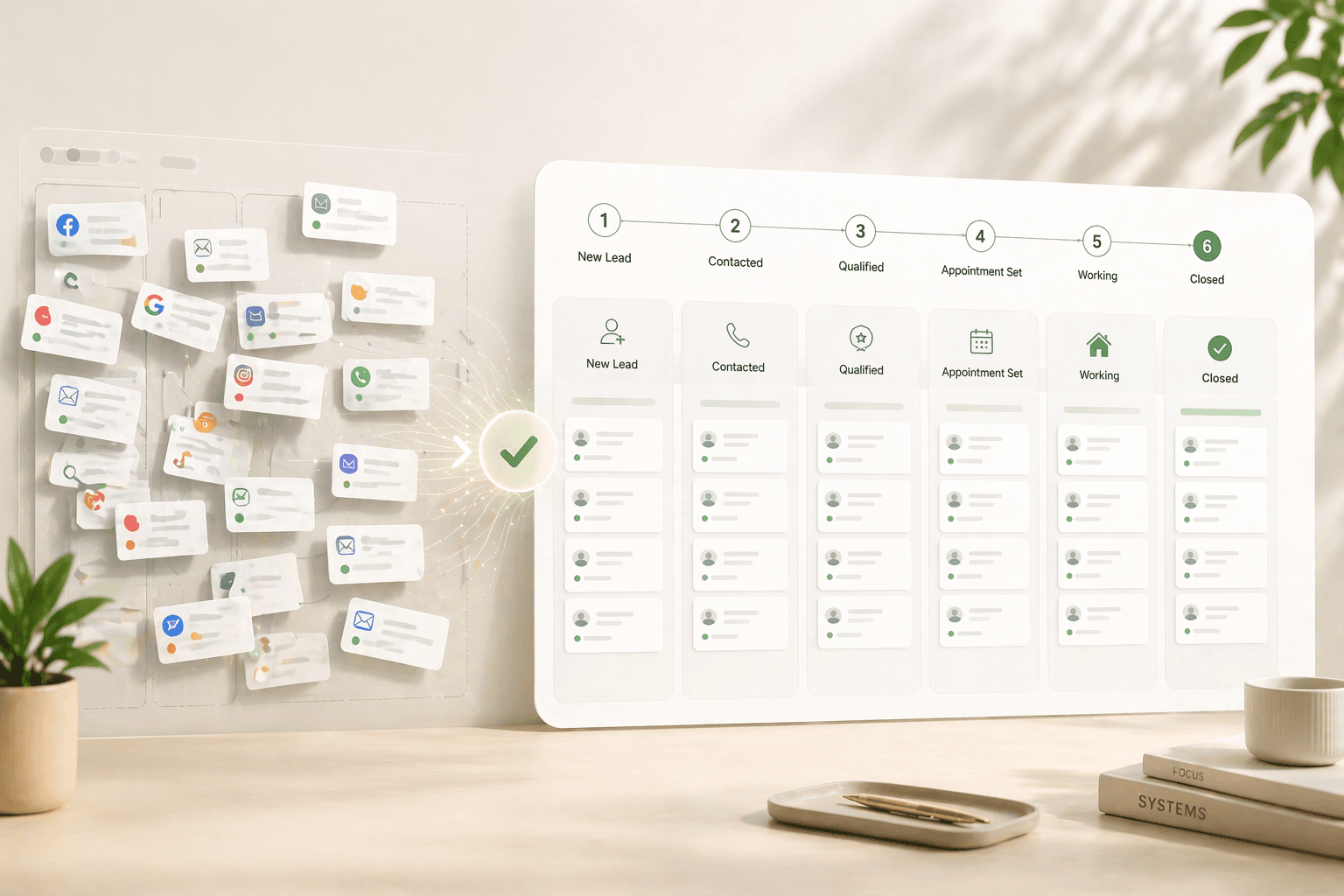
Pinova's follow-up system fires a channel-specific sequence for each new lead — initial SMS within 90 seconds, a 10-touch sequence over the first 30 days, then an automated long-term nurture track that sends market updates and matched listings to leads that have not yet converted, with no manual input required from the agent after the initial lead capture.
How to track and improve month over month
You cannot improve a number you are not measuring. Most agents track closings. Almost none track the five metrics that actually determine whether closings will improve: (1) leads in by source, (2) average response time, (3) contact attempts per lead, (4) conversion rate by source, and (5) average age of converted leads. Without these five numbers, any improvement you make is guesswork — you cannot tell whether a better quarter came from a new lead source, faster response, or just a stronger market.
The simplest tracking system that actually gets used: a five-column spreadsheet updated weekly. Column A: lead source. Column B: leads in this month. Column C: leads contacted within 5 minutes (%). Column D: average contact attempts before first conversation. Column E: closings this month, attributed to source. Review it on the first Monday of every month. The single question to ask: which source has the highest Column E relative to Column B? That is where you shift next month's budget and time.
A realistic 90-day improvement target for an agent currently converting at 0.8%: by month 1, implement automated first-touch SMS and a structured 10-day follow-up sequence; expect response time to drop from 15 hours to under 30 minutes. By month 2, you should see contact rate (percentage of leads you actually speak with) rise from a typical 15% toward 30%–40%. By month 3, conversion rate should be moving toward 1.5%–2% as your pipeline contains leads who have now received 6+ touches. That progression — from 0.8% to 2% — represents, on 100 leads per month, roughly 14 additional closings per year and $168,000 in additional gross commission income at a $12,000 average commission.
| Key Statistic / Finding | Source & Year |
|---|---|
| National average real estate lead conversion rate is 0.4%–1.2%; roughly 1–2 closings per 200 leads | National Association of REALTORS; Follow Up Boss industry data |
| Top producers using systematic follow-up reach 5%–9% conversion from portal leads; referrals convert above 25% | Ylopo Real Estate Lead Conversion Analysis, 2026 |
| Email leads convert at 3.5%, referral leads at 2.7%, organic search at 2.2%, paid search at 2.0% | Listinghub Real Estate Lead Generation Statistics, 2025 |
| 80% of real estate sales require 5 or more follow-up contacts; 44% of agents give up after just one follow-up | National Sales Executive Association, validated by Inman 2025 |
| Leads who receive 6 or more contact attempts convert at rates 70% higher than leads receiving fewer touches | Real Trends research on buyer lead conversion rates, cited by AgentZap 2026 |
| The average real estate agent takes 917 minutes (over 15 hours) to respond to a new lead inquiry | Inman 2025 Real Estate Technology Survey |
| Leads contacted within 5 minutes are 21x more likely to qualify than those contacted after 30 minutes | MIT / InsideSales.com Lead Response Management Study, Dr. James Oldroyd |
| Agents in the top 10% for lead conversion achieve rates approximately 3x higher than the industry average; key differentiator is response time and follow-up consistency | Zillow Group Agent Performance Research, 2025 |
| Only 27% of captured real estate leads ever receive a single follow-up contact | Follow Up Boss industry data, cited by Neudash 2025 |
| 12% of leads in a 5,000-lead database converted over 24 months; only 1% converted with the original agent — the rest converted with competitors | Greg Harrelson / Real Geeks lead audit, 2024 |
| Only 8% of leads act within 30 days of initial contact; 65% require nurture beyond 90 days to convert | Digital Maverick real estate lead follow-up data, 2025 |
| 61% of online real estate searchers ultimately convert via a phone call, not a form or email | Listinghub Real Estate Lead Generation Statistics, 2025 |
Frequently Asked Questions
What is a good real estate lead conversion rate?
A good conversion rate depends entirely on lead source. For paid portal leads (Zillow, Realtor.com), the industry average is 0.4%–1.2%; a rate of 3%–5% from these sources indicates strong follow-up systems. For referral leads, anything below 15% suggests problems in follow-through. The national blended average across all sources is approximately 2.4%, per Listinghub's 2025 industry analysis, though top producers using systematic nurture reach 5%–9% from portal leads. If you cannot calculate your own current rate because you do not track leads to closings by source, that is the first thing to fix — you cannot improve a number you are not measuring.
How do I calculate my real estate lead conversion rate?
Take the number of transactions you closed in the last 12 months that originated from a specific lead source, divide by the total number of leads you received from that source in the same period, and multiply by 100. For example: 4 closings from 300 Zillow leads equals a 1.3% conversion rate. Run this calculation for each lead source separately — the blended number across all sources tells you your average, but source-specific numbers tell you where your systems are working and where they are failing. Your CRM should make this a simple filter-and-count exercise. If it doesn't, that is a sign your CRM setup needs adjustment.
Why is my real estate conversion rate so low even though I get a lot of leads?
High lead volume with low conversion almost always traces to one of three causes. First, slow initial response — leads that are not contacted within 5–30 minutes have already been captured by competing agents; Inman's 2025 survey found the average response time is over 15 hours. Second, insufficient follow-up attempts — the National Sales Executive Association's research, validated by Inman, shows 80% of deals require 5+ contacts, but most agents stop at 1–3. Third, premature lead abandonment — leads that don't respond in 30–60 days are marked dead, but Digital Maverick data shows 65% of conversions happen beyond 90 days. Fixing all three — faster first response, more contact attempts, and longer nurture duration — will typically double a below-average conversion rate within 60–90 days.
How many times should I follow up with a real estate lead before giving up?
The research-supported answer is at least 8–12 times over the first 30 days, then monthly for 12–18 months. Ylopo's analysis of their platform users found that meaningful conversations typically don't occur until after the seventh contact attempt. Research from ChatbotGen found that six or more contact attempts produce a 70% higher conversion rate versus fewer touches. The follow-up should vary by channel — mixing SMS, phone calls, voicemails, and emails — and by content, alternating between direct outreach ("checking in") and value delivery (relevant listings, market updates). A lead that stops responding is not a dead lead; it is a lead that has not yet reached its transaction window.
Do referrals actually convert better than online leads?
Yes, by a significant margin. Referrals and sphere-of-influence leads convert above 25%–30% in most analyses, compared to 0.4%–1.2% for internet leads in aggregate. NAR's 2025 Home Buyers and Sellers data shows that 43% of buyers hire an agent based on a personal recommendation, and 65% of sellers find their agent through a referral or repeat relationship. The practical implication: if you currently spend $2,000/month on Zillow leads and zero time on past-client follow-up, a reallocation toward referral activation (quarterly client check-ins, review requests, anniversary messages) will almost always produce a higher ROI per dollar and per hour spent. Online leads provide volume; referrals provide efficiency.
What is the fastest way to improve my real estate conversion rate?
The single fastest lever is reducing your response time to under 5 minutes for all new leads. MIT and InsideSales.com research shows a 21x qualification improvement at sub-5-minute response versus 30-minute response. In practice, this means setting up an automated SMS that fires within 90 seconds of any new lead inquiry, personalized to the lead's source and the property or area they inquired about. This one change — implemented in an afternoon with a basic CRM automation or a Zapier workflow — routinely produces measurable improvements in contact rate within the first week. The second fastest lever is extending your follow-up sequence from 1–2 attempts to 7+ over the first 10 days. Both changes together, consistently applied for 60 days, typically move conversion rate from below 1% toward 2%–3% without adding any new marketing spend.
How long does it take for a real estate lead to convert on average?
The timeline varies significantly by lead type and buyer readiness. Portal leads (Zillow, Realtor.com) that convert quickly typically do so within 3–6 months of first inquiry. However, Digital Maverick's analysis of real estate lead data found that only 8% of leads act within 30 days of initial contact, 27% convert within 2–3 months, and 65% of eventual conversions require nurture beyond 90 days. Buyers typically spend 4.5 months shopping before making a decision, while sellers think about listing for 6 months or more before taking action. This means a lead that enters your database today and is still unresponsive in 6 months is not necessarily a dead lead — they may simply be 6 months away from being ready to transact. The agents who win those long-cycle leads are the ones still in their inbox with monthly value-focused follow-up.
Ayushman Singh
— Co-Founder & Chief Brand & Marketing OfficerAyushman Singh is the co-founder and Chief Brand & Marketing Officer of Pinova. He shapes the narrative, builds the brand, and tells the stories the industry doesn't want to hear. He believes the real estate system was designed to extract from agents, not empower them — and he's building the counter-narrative.