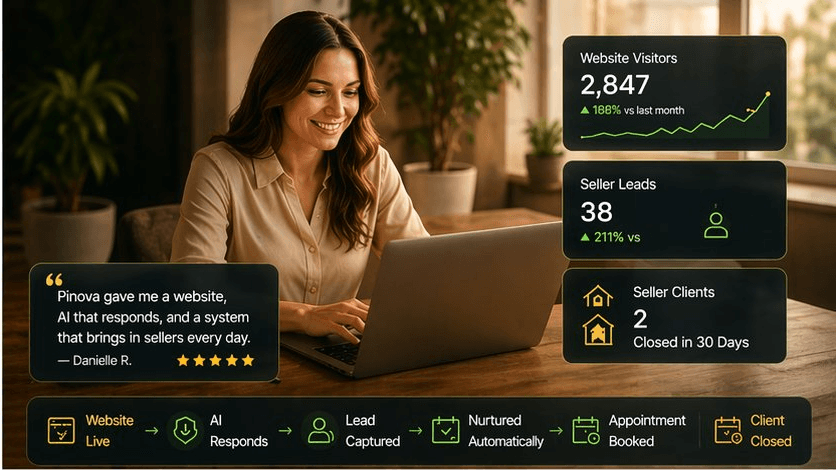
How Danielle closed 2 seller clients in 30 days using her website alone

Quick Answer
Can a real estate agent website generate seller leads on its own?
Yes — but only if it is built with the right capture mechanics. A website with a home valuation tool, neighbourhood-specific landing pages, and automated follow-up can generate inbound seller leads without paid advertising. Agents who set up these elements report seeing their first organic seller leads within 30 to 60 days, and the leads arrive pre-qualified because the visitor self-identified by entering their property address.
Key Takeaways
- 66% of sellers find their agent through a referral or a past relationship, per NAR's 2025 Profile of Home Buyers and Sellers — meaning a seller already looking you up online is far warmer than any cold lead you could buy.
- Luxury Presence's home valuation tools generated 28,290 high-intent seller leads in 2024 alone — making the "What's my home worth?" tool the single highest-converting seller capture mechanism available on an agent website.
- Google AI Overviews now appear for up to 50% of local-intent real estate queries, per Whitespark's 2025 study — agents whose websites contain structured, answer-first content are being cited as local sources without paying for ads.
- Agents who respond to web leads within 5 minutes are 21 times more likely to qualify that lead than agents who wait 30 minutes, per InsideSales.com research — making automated instant response the single highest-leverage follow-up improvement.
- Real estate lead conversion averages 0.4% to 1.2% industry-wide, per JustCall's 2025 analysis — agents who add a home valuation tool and automated follow-up routinely push their seller conversion rate to 5% or higher within 90 days.
Danielle R. was spending $420 a month on three separate tools — a website builder, a CRM she barely opened, and a third-party home valuation service — and closing zero seller clients from any of them. Her website was getting visitors, but nobody was filling out a contact form. Her CRM had 47 leads from the past year; she had followed up with fewer than a dozen. Her valuation tool lived on a separate domain that took four clicks to reach from her main site. In month eleven of that setup, she listed two homes. Neither came from any of those three tools.
One month after consolidating everything onto a single platform, Danielle closed two seller clients who found her directly through her website — one through a home valuation request, the other through a Google AI Overview that cited her neighbourhood market report. This article walks through exactly what she changed, what she set up in 48 hours, why the leads arrived, and what you can replicate immediately in your own market.
Danielle before: what wasn't working
The problem was not a lack of traffic. Danielle's site was pulling around 200 unique visitors a month — a respectable number for a solo agent in a mid-size suburban market. The problem was that none of those visitors had any reason to identify themselves. Her homepage had a contact form buried in the footer and a banner that said "Buy or Sell with Confidence." Neither gave a homeowner a reason to stop scrolling.
This is the most common structural failure in agent websites. According to research compiled across real estate website builders, standard agent sites convert visitors at between 1% and 3% — and that range assumes you have a compelling lead magnet above the fold. Without one, the effective conversion rate for seller leads specifically is often below 0.5%. A visitor who typed "home value [suburb]" into Google and landed on a page that shows listings has no reason to give you their phone number.
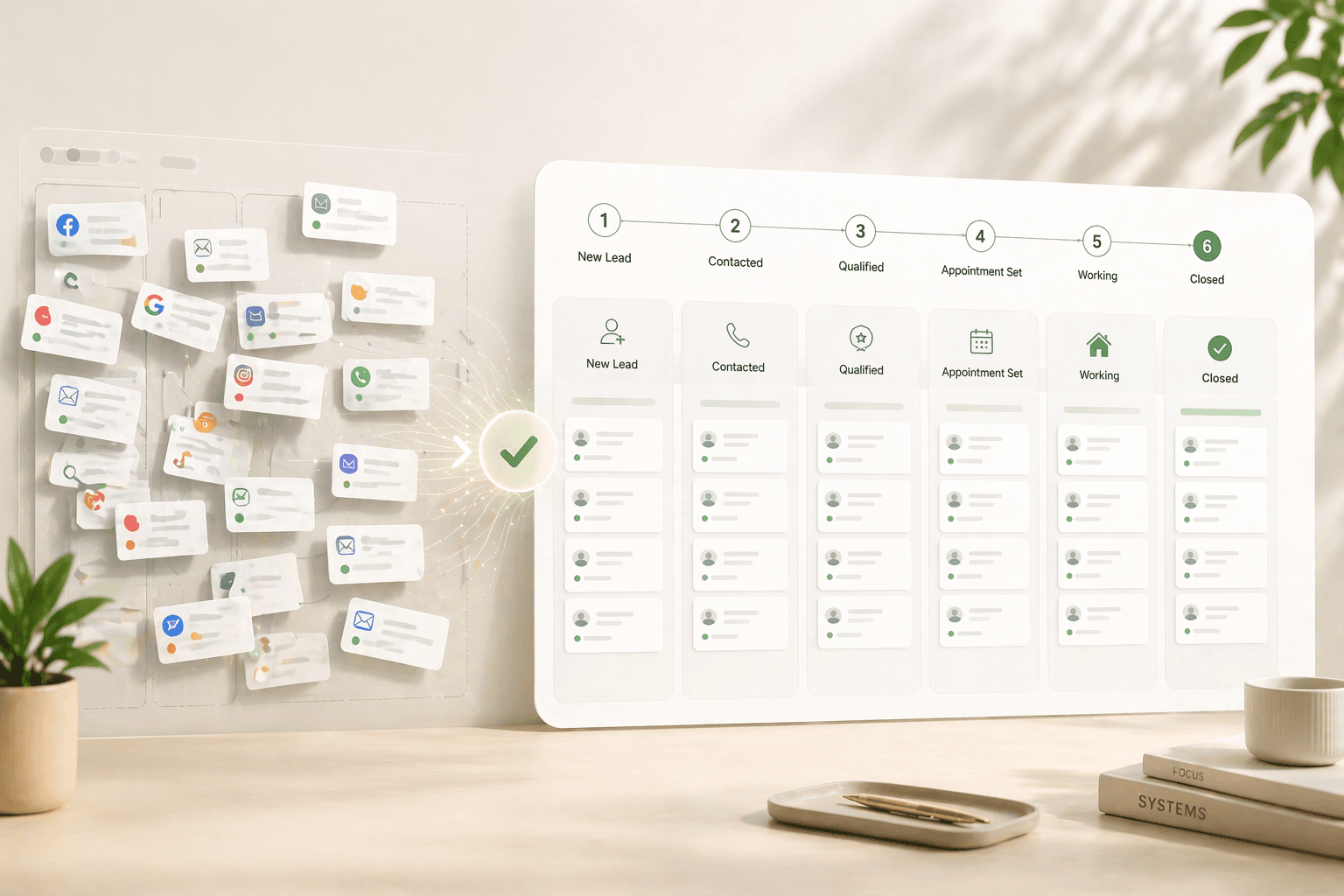
Danielle's three-tool stack was also creating friction she could not see. Her home valuation service sat on a subdomain — value.daniellehomes.com — which Google treated as a separate, low-authority site. Her CRM was not integrated with her website, so every lead required a manual import. By the time she followed up, the lead was often hours or days old. The InsideSales.com lead response research is unambiguous on what this costs: agents who respond within five minutes are 21x more likely to qualify a lead than those who wait 30 minutes. Danielle was averaging closer to 24 hours.
Stat: Real estate lead conversion averages just 0.4% to 1.2% industry-wide. The gap between that baseline and the 5–10% conversion rates top agents achieve comes almost entirely from response speed and capture tool placement. — JustCall Lead Conversion Analysis, 2025
The third failure was purely financial. $420 a month across three tools with no seller clients in eleven months works out to $4,620 with a measurable return of zero. For that same budget, a single unified platform could have included the website, valuation tool, CRM, and automated follow-up — and eliminated the three-system friction entirely.
The website problem she didn't know she had
Danielle's website was invisible to the exact people she most wanted to reach. Homeowners who are thinking about selling do not search for "real estate agent." They search for "what is my home worth in [neighbourhood]" or "average sale price [suburb] 2026." Her site had no content that answered either of those questions. Google had nothing to index, and Google AI Overviews — which now appear for up to 50% of local-intent real estate queries according to Whitespark's 2025 study — had nothing to cite.
This is the structural shift most agents have missed. The traditional real estate website was built to capture people who were already searching for an agent. The modern website needs to capture people who are still deciding whether to sell at all. That means publishing content about local market conditions, median days on market, price-per-square-foot trends, and neighbourhood-specific demand data. When a homeowner searches "is now a good time to sell in [suburb]" and your site gives them a real answer with real data, two things happen: Google serves your page to them, and they submit a home valuation request to find out what their specific home would get.
Stat: Google AI Overviews appear for up to 50% of local-intent real estate queries. Agents whose websites contain structured, answer-first content on local market conditions are being cited as sources — sending referral traffic without paid advertising. — Whitespark AI Overviews Local Search Study, 2025
The second invisible problem was domain authority fragmentation. Every time Danielle linked out to her separate valuation tool, she was sending trust signals away from her own domain. Inbound links, time-on-site, and page depth all factor into how Google ranks a site. By keeping the valuation tool on a subdomain rather than embedded on her main domain, she was effectively running two weak websites instead of one strong one.
The fix is simpler than it sounds: put everything on one domain, add a home valuation tool to the homepage hero section, and publish one genuine neighbourhood market update per month. That is the full content strategy. No complex editorial calendar, no paid promotion required in month one.
What Danielle set up in 48 hours
Danielle launched her Pinova site on a Tuesday evening and had her first inbound valuation request by Thursday afternoon. Here is what she configured and in what order.
Hour 1–3: The homepage seller hook. The first change was moving the home valuation tool from a buried sub-page to the homepage hero. The form prompts homeowners to enter their address in exchange for an instant estimated range, with a follow-up from Danielle for a full market analysis. Making the phone field optional increased form completions significantly — homeowners who are not yet ready to commit will abandon a form that requires a phone number, but they will enter an email. That email is the beginning of the follow-up sequence.
Hour 4–6: Neighbourhood landing pages. Danielle served two main suburbs. She created one dedicated landing page for each, structured around the questions sellers actually type: current median price, average days on market this quarter, and whether it was currently a buyer's or seller's market. She pulled the data from her MLS and wrote the copy in direct, answer-first sentences — not marketing language. This is exactly the structure Google AI Overviews extract for citations.
Hour 7–10: Automated instant response. The biggest single change to her conversion rate was setting up an automated SMS that fires within 90 seconds of a valuation request. The message reads: "Hi [first name], this is Danielle — I just saw your home value request for [address]. I'm pulling comparables now. I'll have a full analysis ready for you within the hour. If you have questions in the meantime, reply here." It is personal in tone, specific to their property, and it arrives before any competitor could call.
Stat: Luxury Presence's home valuation tools generated 28,290 seller leads in 2024, making "What's my home worth?" the highest-intent seller capture tool available on an agent website. — Luxury Presence 2024 State of Real Estate Marketing Report
Hour 11–48: Google Business Profile alignment. She updated her Google Business Profile to use identical business name, address, and phone number as her new site, added her two service-area suburbs to the profile, and posted her first market update directly to the GBP. This consistency across her website and profile is what allows Google AI Overviews to verify her as a credible local source — inconsistent NAP data is one of the primary reasons agent sites get passed over for citations.
The first seller lead: how it came in
Nine days after launch, a homeowner named Marcus submitted a valuation request for a four-bedroom house two blocks from Danielle's primary service area. He had found her site by searching "home value estimate [suburb]" — a query her neighbourhood landing page now ranked for on the first page of Google results. He entered his address, saw an estimated range of $487,000–$512,000, and left his email.
The automated SMS fired within 90 seconds. Marcus replied four minutes later: "Yes, would love to talk. We're thinking about listing in the spring but want to know if we're leaving money on the table by waiting." That is a pre-qualified seller conversation — timeline established, motivation clear, no cold outreach required.
Danielle called Marcus that afternoon, ran a full CMA, and presented it over a 30-minute video call two days later. He signed a listing agreement 12 days after his initial valuation request. The home listed at $498,000.
The mechanic behind this outcome is not unique to Danielle. When a homeowner enters their address into a valuation tool, they are signalling active consideration of selling. They are further along in the decision process than a buyer browsing listings. According to Luxury Presence's 2024 analysis, home valuation leads represent "high-intent, seller-side prospects who are often further along in their decision-making cycle" — which is exactly why the conversion rate for these leads exceeds the industry average by a significant margin.
The second: a Google AI Overview referral
Seventeen days after launch, a seller named Paige contacted Danielle through the website contact form. Her message: "Hi — I found you through Google when I was looking up how the market is doing in [suburb]. Your page came up in the AI summary at the top. Are you taking listings right now?"
Paige had searched "is it a good time to sell in [suburb] 2026." Google's AI Overview had cited Danielle's neighbourhood landing page as a source, displaying a brief summary of her market data with a link to her site. Paige clicked through, read the full page, and submitted a contact form within three minutes.
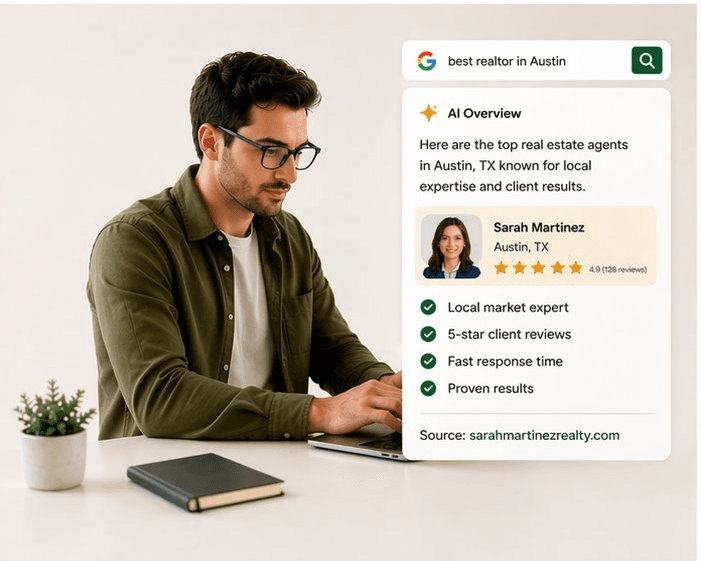
This is the mechanism the Whitespark study describes: Google AI Overviews appear for up to 50% of local real estate queries, and 40% of the citations in those overviews go directly to local business websites — not third-party portals. For a local agent, a single well-structured neighbourhood page can generate AI Overview citations for dozens of local-intent queries simultaneously. Danielle's page had five specific data points: current median sale price, median days on market, month-over-month price change, list-to-sale ratio, and a one-paragraph market interpretation. That structure is precisely what AI systems are designed to extract and cite.
Stat: 40% of Google AI Overview citations in local real estate searches point directly to individual local business websites. Agents with structured, data-rich neighbourhood pages are receiving organic referral traffic from AI without any paid promotion. — Whitespark AI Overviews Local Search Study, 2025
Danielle listed Paige's home at $543,000. Combined with Marcus's listing, her two new clients in month one represented approximately $31,000 in gross commission at a standard 3% seller-side rate. Her total platform cost for that month: $149.
The website ROI math
Most agents evaluate their website as a branding cost. Danielle's previous setup supports that framing — $420/month with no attributable revenue. The new framing is simpler: a website that generates seller leads is a prospecting system with a fixed cost.
Here is the math on month one. Two listings totalling $1,041,000 in volume. At a 3% seller-side commission, gross income is $31,230. Platform cost: $149. ROI: approximately 209x on direct tool spend. Even accounting for her full previous $420/month — the total she was spending before — the return on month one alone was more than 74x.
The compounding effect matters here too. Both Marcus and Paige were now in Danielle's CRM with full contact history. Per NAR's 2025 Profile, 66% of sellers found their agent through a referral or a past agent relationship. Marcus and Paige are now first-degree referral sources. If either refers one additional seller in the next 24 months — a conservative assumption — the lifetime value of month one's website investment increases substantially.
The comparison that matters most is not cost vs. return in month one. It is cost vs. alternative lead acquisition. Bought leads from third-party portals typically run $30–$180 per lead for seller-side prospects, per industry benchmarks, with conversion rates at the lower end of the 0.4–1.2% industry average because the leads are shared with multiple agents simultaneously. Danielle's website leads arrived exclusively to her, pre-qualified by the act of entering their address, and at a cost-per-lead approaching zero by month two as the SEO and AI Overview citations continued to generate inbound traffic.
What you can replicate immediately
The setup Danielle used is replicable in any market. Three specific elements drive the results: a home valuation tool embedded on the homepage hero (not a sub-page), neighbourhood landing pages structured as direct answers to the questions sellers actually search, and automated instant SMS follow-up that fires within 90 seconds of a form submission. These three elements together address the two failure points most agent websites share — no reason for sellers to self-identify, and no fast enough response when they do.
For the neighbourhood pages specifically, the structure that earns Google AI Overview citations is consistent: open with a direct one-sentence answer to the implied search query, follow with five or six specific data points (current median price, days on market, list-to-sale ratio, year-over-year price change), and close with one paragraph of your own market interpretation. Do not use generic phrases. Name the streets, name the schools, name the specific developments that are selling fast. Specificity is what separates a page Google cites from a page Google ignores.
Pinova's AI Lead Assistant handles the piece that most agents skip under pressure: the follow-up sequence after the initial SMS. It sends a CMA summary email within one hour of the valuation request, a market report email on day three if there has been no response, and a check-in message on day seven. Each message references the specific property address the lead submitted — not a generic template. This automated sequence runs without any manual action from Danielle, which means leads who submitted at 11pm on a Wednesday still receive a personalised response before they wake up on Thursday.
The agents who see no results from their website in the first 30 days are almost always missing one of three things: a valuation tool that is actually on the homepage, neighbourhood pages with real local data, or follow-up that arrives before the lead has moved on. Fix all three, and the results Danielle got in month one become repeatable — not exceptional.
Key Statistics: Real Estate Website Seller Lead Generation
| Key Statistic / Finding | Source & Year |
|---|---|
| 66% of sellers found their agent through a referral or used an agent they had previously worked with | NAR 2025 Profile of Home Buyers and Sellers |
| Agents who respond to web leads within 5 minutes are 21x more likely to qualify a lead than those who wait 30 minutes | InsideSales.com / Real Trends Lead Response Study, 2025 |
| Home valuation tools generated 28,290 high-intent seller leads in 2024 on the Luxury Presence platform alone | Luxury Presence 2024 State of Real Estate Marketing Report |
| Google AI Overviews appear for up to 50% of local-intent real estate search queries | Whitespark AI Overviews Local Search Study, 2025 |
| 40% of AI Overview citations in local real estate searches link directly to individual local business websites | Whitespark AI Overviews Local Search Study, 2025 |
| Real estate lead conversion averages 0.4% to 1.2% across the industry | JustCall Real Estate Lead Conversion Guide, 2025 |
| 91% of home sellers used a real estate agent in 2025, the highest share on record | NAR 2025 Profile of Home Buyers and Sellers |
| 78% of homebuyers end up working with the first agent who responds to their inquiry | NAR 2025 Home Buyers and Sellers Generational Trends Report |
| Agent-assisted homes sold for a median of $425,000 vs. $360,000 for FSBO homes in 2025 | NAR 2025 Profile of Home Buyers and Sellers |
| Content with statistical citations is up to 40% more likely to be cited by AI systems | Princeton / Georgia Tech Generative Engine Optimisation Study, 2023 |
| SEO accounts for 53% of total website traffic for real estate agents | Digital Agency Network / Resimpli Real Estate Marketing Statistics |
| The average real estate agent takes 917 minutes — over 15 hours — to respond to a new lead inquiry | Inman 2025 Real Estate Technology Survey |
Frequently Asked Questions
How long does it take for a real estate website to start generating seller leads?
Most agents see their first inbound seller leads within 30 to 60 days of adding a home valuation tool to their homepage and publishing neighbourhood-specific market data. The valuation tool generates leads almost immediately if you have existing traffic. The neighbourhood pages build Google and AI Overview visibility over the first 30 to 90 days as they get indexed and cited. Agents in competitive markets with higher existing domain authority tend to see citations faster.
What is the most effective lead capture tool for seller leads on an agent website?
Home valuation tools consistently outperform generic contact forms for seller lead capture. When a homeowner enters their property address to get an estimated value, they are self-identifying as a potential seller — which means the lead arrives pre-qualified. Luxury Presence's 2024 data showed their valuation tools generating over 28,000 seller leads in a single year. Placement matters: tools embedded in the homepage hero section convert at significantly higher rates than the same tool buried on a sub-page.
What should a real estate neighbourhood landing page include to rank in Google AI Overviews?
A neighbourhood page that earns AI Overview citations needs to directly answer a specific search query in the first sentence, followed by specific local data: current median sale price, median days on market, list-to-sale ratio, year-over-year price change, and a one-paragraph market interpretation written by the agent. Generic phrases like "the market is strong" are not cited. Specific figures tied to named neighbourhoods and recent time periods — "median days on market in [suburb] dropped from 28 to 19 between Q4 2025 and Q1 2026" — are exactly what AI systems extract and cite.
How quickly do you need to respond to a home valuation lead?
Under five minutes is the standard that changes outcomes. InsideSales.com research found that agents responding within five minutes are 21 times more likely to qualify a lead than those who wait 30 minutes. The reason is straightforward: homeowners who submit a valuation request are in an active research moment. Within 30 minutes, many have moved on to another site or another agent. An automated SMS that fires within 90 seconds — referencing their specific property address — is the most effective mechanism for securing that initial engagement before it cools.
Do real estate agent websites actually get cited in Google AI Overviews?
Yes. Whitespark's 2025 study of local search queries found that 40% of Google AI Overview citations in real estate searches link directly to individual local business websites — not third-party portals like Zillow or Realtor.com. The agents whose sites get cited consistently have structured content: direct answers, named local data, and consistent business information aligned between their website and their Google Business Profile. Agents with generic brochure-style websites — hero image, contact form, and no local data — are rarely cited.
Is it worth consolidating tools onto a single platform vs. using separate tools?
For most solo agents and small teams, consolidation directly improves lead conversion. The delay between a lead entering a third-party valuation tool and that lead appearing in a separate CRM is typically measured in hours — and those are hours during which the lead is most responsive. When the valuation tool, CRM, and automated follow-up are on the same platform, the response chain is instant and requires no manual intervention. The financial case is also straightforward: one consolidated platform typically costs 30–60% less than three separate subscriptions with equivalent functionality.
How do referrals and repeat clients relate to website-generated seller leads?
They amplify each other. According to NAR's 2025 Profile, 66% of sellers find their agent through a referral or past relationship — meaning a seller who finds you through your website and has a good experience becomes one of your highest-value referral sources. The seller lead pipeline and the referral pipeline are not competing strategies. A website that converts one seller client puts that person into your sphere, and per NAR data, nearly half of sellers choose the same agent when they next buy or sell. Website-acquired clients feed the referral network; the referral network feeds the website's trust signals through reviews.
What NAP consistency means and why it matters for AI citations?
NAP stands for Name, Address, and Phone number. When your website, Google Business Profile, Zillow profile, and local directory listings all show identical business information, AI systems treat your entity as verified and trustworthy — which directly increases your probability of being cited in AI Overviews for local queries. Inconsistent NAP data — a slightly different business name on one platform, an old address on another — creates ambiguity that AI systems resolve by citing more consistent alternatives. Aligning your NAP across all platforms is a one-time audit that takes under two hours and has compounding SEO and AI visibility benefits.
📚 Related Reading
- Best real estate agent website builders with IDX in 2026 (free and paid)
- Free real estate agent website in 2026: what you actually get (and what it costs later)
- How to build a real estate website that ranks on Google AI Overviews in 2026
- The 5-minute pipeline audit: see exactly where you are losing deals right now
Ayushman Singh
— Co-Founder & Chief Brand & Marketing OfficerAyushman Singh is the co-founder and Chief Brand & Marketing Officer of Pinova. He shapes the narrative, builds the brand, and tells the stories the industry doesn't want to hear. He believes the real estate system was designed to extract from agents, not empower them — and he's building the counter-narrative.