The 5-Minute Pipeline Audit: See Exactly Where You Are Losing Deals Right Now

Quick Answer
What is a real estate pipeline audit?
A real estate pipeline audit is a structured review of every lead and active client in your CRM, organised by pipeline stage, to identify who has not been contacted, who went silent too early, and which appointments or active clients are at risk of being lost. A complete audit covers five stages - New, Contacted, Appointment Set, Active Client, and Under Contract - and takes under five minutes when done with saved CRM filters.
Key Takeaways
- Most agents lose deals at Stage 2. They stop following up after 1 or 2 touches, but research from Expert Callers shows 8 to 12 contacts are required to convert a real estate lead.
- According to the Harvard Business Review, leads contacted after 30 minutes are 21x less likely to qualify than those reached within 5 minutes.
- A pipeline audit requires one CRM filter per stage and produces an immediate action list, not a multi-hour project.
- Unconfirmed appointments have a 23% average no-show rate. Research published in NIH/PMC shows that two confirmation texts (24 hours out and 2 hours out) reduce no-shows by 30 to 60%.
- Data from AgentZap.ai shows that 80% of real estate leads go cold within 48 hours of inquiry. The audit's primary job is surfacing leads that crossed that threshold with zero contact logged.
Marcus had 34 leads in his CRM and called his pipeline "pretty healthy." He hadn't done a systematic review in about six weeks - things were busy, deals were moving, and he figured he'd clean it up at the end of the month. When he finally filtered by last contact date, he found 11 leads sitting untouched for more than 30 days. Three of them had submitted new Zillow inquiries within the past two weeks - with a different agent's name in the follow-up thread.
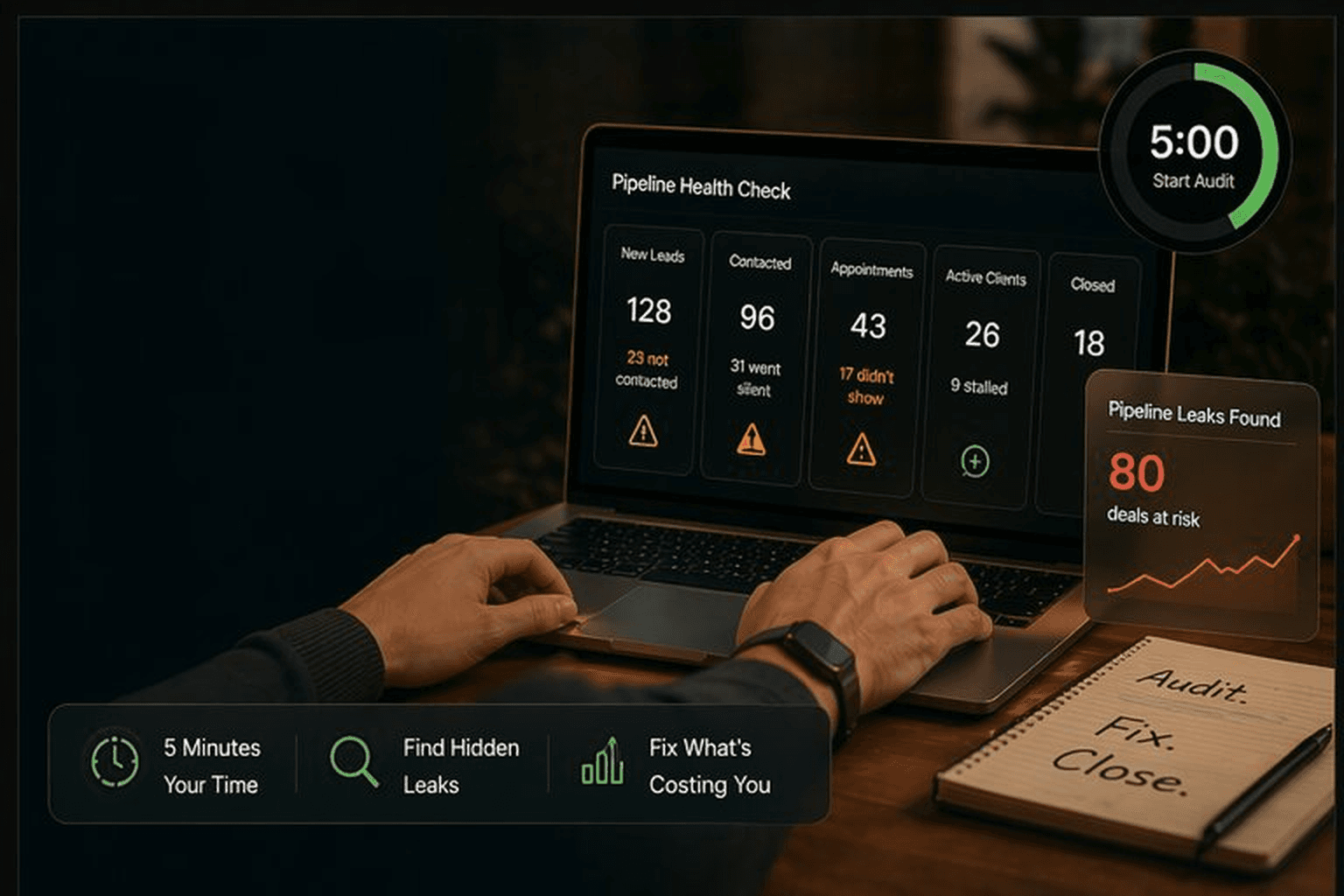
Back-of-the-napkin math: at his average $4,300 commission per deal, those three leads represented $47,000 in potential GCI gone. Not because his market dried up. Because his CRM went dark and nobody noticed. A pipeline audit is not a deep project. It is a structured scan - five stages, one question per stage, less than five minutes from open to action list. You are not rebuilding your process. You are finding the specific names that need a phone call today.
What the Audit Always Uncovers
Every pipeline audit reveals the same three problems, regardless of how organised the agent thinks they are.
Problem 1: Leads never properly contacted. The average real estate agent takes 47 minutes to respond to an online inquiry, according to data from CallChloe.ai. Research from MIT's Dr. James Oldroyd found that leads contacted within 5 minutes are 100x more likely to be reached and 21x more likely to be qualified than leads contacted after 30 minutes. For a solo agent doing $200K GCI annually, a 10% improvement in new-lead contact rate is worth roughly $20,000 in recovered commission.
Stat: Leads contacted within 5 minutes are 21x more likely to qualify than those reached after 30 minutes. — Harvard Business Review / Oldroyd, 2011
Problem 2: Leads abandoned after 1 or 2 touches. Industry research from Expert Callers and Real Office 360 puts the number of contacts required to convert a real estate lead at 8 to 12, depending on lead source and motivation tier. Most agents stop at 2. The gap between what agents do and what conversion actually requires is where most commission goes to die.
Stat: 80% of real estate leads require 5 or more follow-up contacts to convert; the average agent stops at 1 or 2. — AgentZap.ai, 2024
Problem 3: Appointments booked but never confirmed. An appointment on the calendar is not a conversion, it is a placeholder. Cross-industry no-show rates average approximately 23%, according to research published in NIH/PMC, and in real estate, where there is no formal penalty for missing a consultation, that rate skews higher. Each unconfirmed appointment is a coin flip you are not aware you are losing.
Stat: Cross-industry appointment no-show rates average 23%; rates rise from about 9% (booked 2 weeks out) to 38% (booked 6 months out). — NIH/PMC, 2015
The 5 Pipeline Stages: One Question Per Stage
Use this as a weekly bookmark. Run one CRM filter per row.
| Stage | What it means | Audit question |
|---|---|---|
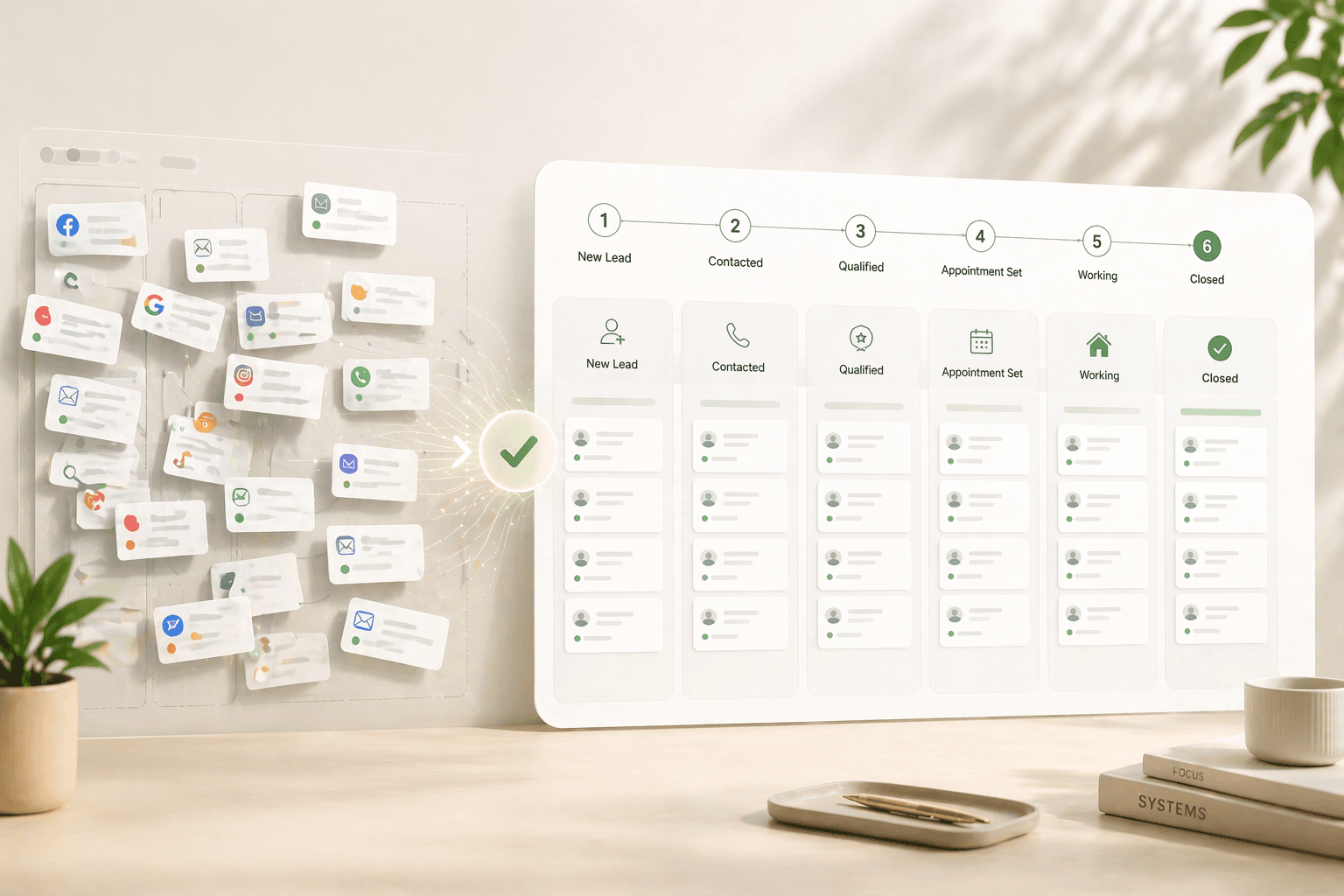
| New | Lead came in, zero contact logged | Anyone created 48+ hours ago with 0 outreach attempts? |
| Contacted | At least one call, text, or email sent | Who hasn't responded in 7+ days with fewer than 5 touch attempts? |
| Appointment Set | Agreed to a consult, buyer call, or showing | Does every scheduled appointment have a confirmation touch logged? |
| Active Client | Signed buyer or seller working with you | Have I communicated meaningfully with every active client in 14 days? |
| Under Contract | Accepted offer, working toward close | Are all milestones (inspection deadlines, financing contingencies) on the calendar? |
Stage 1: New Leads - Who Hasn't Been Contacted
The MIT data is the starting point: leads called within 5 minutes are 21x more likely to qualify. By 30 minutes, you have lost the first-mover advantage to whoever called faster. Velocify research adds another layer: leads generated between 8 and 10 PM have 15% higher purchase intent than daytime leads, which means the standard 9-to-5 response window loses you the highest-intent inquiries by default.
The exact CRM filter to run
Created more than 48 hours ago + Status = New + Contact Attempts = 0.
Every name that surfaces has gone past the warm window. Research from AgentZap.ai consistently shows 80% of real estate leads go cold within 48 hours of inquiry. That does not mean they are unreachable. It means you are playing catch-up instead of first responder.
What to say - copy this word for word
"Hi [name], this is [your name] - you inquired about [property/area]. Sorry I'm a bit behind on replies. Still looking? Happy to send you some updated options if so."
Short, no pressure, gives them a reason to respond. Log the attempt. Move them to a 5-touch follow-up sequence. Do not let them sit in "New" status for another week. According to Velocify, calling a lead within the first minute produces a 391% improvement in lead conversion rate. By hour 24, that advantage drops to 17%. After 48 hours, you are not following up. You are cold calling a stranger who has already moved on.
Stat: Calling a lead within 1 minute produces a 391% improvement in conversion rate vs calling after 1 hour. — Velocify, 2016
Stage 2: Contacted - Who Went Silent
This is where the biggest invisible revenue leak lives. An agent reaches out once, gets no reply, marks the lead "low priority," and moves on. This happens hundreds of times per year in a solo pipeline - and it's based on a false premise: that silence after one touch means the lead isn't serious.
How many follow-ups does it actually take?
Industry research is consistent: 8 to 12 contact attempts are required before a real estate lead converts or can reasonably be classified as inactive, according to data from Expert Callers and Real Office 360. The agents winning on follow-up are not more talented. They just kept going past touch 2.
Stat: Converting a real estate lead requires 8 to 12 contact attempts. Most agents stop at 1 or 2. — Expert Callers, 2024
Define "went silent" precisely
For this audit: no response in 7 days after 2 or fewer contact attempts. Filter for that. Every name that surfaces is a lead you still have a claim on.
Re-engagement SMS - send this today
"Hey [name] - [your name] here. I reached out a couple weeks back about homes in [area/price range]. No worries if timing's changed. If you're still thinking about it, I just got access to a few off-market listings this week that might be worth a look. Want me to send them over?"
Text, not email. A real question, not a check-in. Off-market listings as the hook. A yes/no close. This structure gets replies from leads that have been dark for 3–4 weeks. Log every attempt. If you hit 8 touches across all channels with zero response, only then move to a long-term nurture drip.
Stage 3: Appointments - Who Didn't Convert
Appointment Set is the most deceptive stage because it feels like progress. Agreed ≠ showed ≠ signed. There are exactly three places an appointment leaks, and each has a specific fix.
Leak 1 - No-show
Cross-industry no-show rates average 23%, rising from about 9% when booked 2 weeks out to 38% when booked 6 months out, according to research published in NIH/PMC. Fix: Two confirmation texts. One 24 hours before ("Looking forward to tomorrow, still on for 10am?") and one 2 hours before ("Heading your way, see you at [address]."). No-show rate drops 30 to 60% with this protocol.
Leak 2 - Showed but didn't sign
The appointment happened but no agreement was signed. This usually means the meeting lacked a clear commitment ask. Fix: End every appointment with a named next step: "So the next thing we do is get your pre-approval confirmed and pull properties in your criteria. Want to do that now or schedule a call for tomorrow?" Vague endings produce vague leads.
Leak 3 - Signed but went cold before closing
Fix: Weekly 3-sentence check-in: one piece of new market data, one question about their situation, one clear next step you're taking on their behalf. Surfaces objections before they become silent exits.
Stage 4: Active Clients - What's Stalled
Active pipeline rot is quieter than a lost lead. There is no alert. The client is still technically in your pipeline - but if you don't catch it, you'll learn they signed with another agent when you see the MLS listing.
Three signals that a client is stalling
No meaningful communication in 14+ days. Not a mass email blast - an actual exchange. Check your activity log.
Showing homes for 6+ weeks without writing an offer. Decision fatigue is real. At this point you need a re-qualification conversation, not another showing.
Pre-approval expired or within 30 days of expiration. Most pre-approvals are valid 60–90 days. An expired pre-approval is a dead stop - and most agents don't track the expiration date.
Three questions to ask a stalled client - on a call, not over text
"On a scale of 1 to 10, how motivated are you to move before [specific date]?" - Anything below 7 is a re-qualification issue.
"Is there anything that's changed since we last spoke - job situation, timeline, budget?" - This surfaces the real blocker.
"Would it be useful to pause the search for 30 days and revisit, or do you want to push through?" - This is not giving up. It is protecting your time while respecting theirs.
Catching a stalled client at week 2 of silence is recoverable. Week 6 usually isn't.
How Smart Lists in Pinova Make This Automatic
The manual audit above takes about 5 minutes weekly. Smart Lists in Pinova compress it to a 30-second daily check.
A Smart List is a saved, auto-updating CRM filter that surfaces contacts matching specific criteria in real time - no manual sorting required. You build: "New leads, 0 contact attempts, created 48+ hours ago" - and it refreshes every time you open your dashboard. Same for "Contacted, last touch 7+ days ago, fewer than 5 attempts" and "Appointments set, no confirmation logged within 24 hours." Each becomes a named list in your sidebar. Glance at the count, click in, work the names.
NAR data shows 62% of agencies have adopted CRM software. The gap between adoption and actual conversion improvement is a systematic review cadence, which is exactly what Smart Lists replace. You stop running the audit manually because the audit is always running.
Key Statistics: Real Estate Pipeline and Lead Conversion
| Key Statistic / Finding | Source & Year |
|---|---|
| Average agent response time to online inquiry: 47 minutes | CallChloe.ai, 2026 |
| Leads contacted in under 5 min are 21x more likely to qualify than those reached after 30 min | Harvard Business Review / Oldroyd, 2011 |
| Calling within 1 minute produces 391% higher conversion vs calling after 1 hour | Velocify, 2016 |
| 80% of real estate leads go cold within 48 hours of inquiry | AgentZap.ai, 2024 |
| 8 to 12 contact attempts required to convert a real estate lead | Expert Callers, 2024 |
| 80% of sales require 5 or more follow-up contacts | AgentZap.ai, 2024 |
| Average appointment no-show rate across service industries: 23% | NIH/PMC, 2015 |
| No-show rate rises from about 9% (2-week lead time) to 38% (6-month lead time) | NIH/PMC, 2015 |
| 62% of real estate agencies have adopted CRM software as of 2025 | NAR, 2025 |
| Leads generated between 8 and 10 PM have 15% higher purchase intent than daytime leads | Velocify, 2016 |
Frequently Asked Questions
How do I audit my real estate pipeline?
Run one CRM filter per pipeline stage: (1) New leads created 48+ hours ago with zero contact attempts, (2) Contacted leads with no response in 7+ days and fewer than 5 touch attempts, (3) Appointments set with no confirmation touch logged, (4) Active clients with no meaningful communication in 14+ days, (5) Contracts with no calendar entries for upcoming milestones. Each filter produces a named action list. The full process takes under 5 minutes.
How many times should I follow up with a real estate lead before giving up?
Research from Expert Callers and Real Office 360 puts the required number of contact attempts at 8 to 12 before a real estate lead converts or can be classified as inactive. Most agents stop at 1 or 2 attempts. A lead who does not respond to 2 touches is not a dead lead. They are an under-followed lead. Only after 8+ attempts across multiple channels (call, text, email) should a lead move to a long-term passive nurture sequence.
How long do real estate leads stay warm?
Research consistently shows 80% of real estate leads go cold within 48 hours of their initial inquiry. The MIT Lead Response Management Study found that a lead contacted within 5 minutes is 21x more likely to qualify than one reached after 30 minutes. After 48 hours, contact is still possible, but conversion probability has dropped significantly and the lead has likely already engaged with another agent.
What is a good real estate pipeline conversion rate by stage?
Rough benchmarks for a well-managed pipeline: New to Contacted: 40 to 60% (within 5 minutes of inquiry). Contacted to Appointment Set: 20 to 30%. Appointment Set to Signed Client: 50 to 70% (with active confirmation protocol). Signed Client to Closed: 70 to 85%. If your stage-by-stage rates fall below these, a pipeline audit will surface exactly where the gap is.
What percentage of real estate appointments are no-shows?
Cross-industry no-show rates average 23%, according to a systematic review of 105 studies published in NIH/PMC. In real estate, where there is no formal deposit or contractual penalty for missing a consultation, the rate tends to be higher. Sending two confirmation texts (24 hours and 2 hours before the meeting) has been shown to reduce no-show rates by 30 to 60% in appointment-dependent service businesses.
What does a stalled real estate client look like in a CRM?
Three signals indicate a stalled active client: (1) No meaningful communication logged in 14 or more days, (2) Actively touring homes for 6+ weeks without writing a single offer, which typically signals decision fatigue or a budget mismatch, (3) Pre-approval letter expired or within 30 days of expiration. Any of these warrants a direct re-qualification call, not a check-in text, to surface the underlying obstacle.
How do Smart Lists work for real estate CRM pipeline management?
Smart Lists are saved, auto-updating CRM filters that surface leads matching specific behavioral criteria in real time without manual sorting. A typical setup includes three permanent lists: (1) new leads past the 48-hour contact window, (2) contacted leads approaching the abandonment threshold, and (3) appointments without a confirmation touch. Each list refreshes automatically, turning the weekly manual audit into a daily 30-second dashboard check.
Why do most real estate agents lose leads in the first 7 days?
The primary cause is response lag combined with insufficient follow-up volume. The average agent responds to online inquiries in 47 minutes, well past the 5-minute window where conversion probability is highest. After initial contact, most agents make 1 or 2 attempts before classifying a non-responding lead as uninterested, when research shows 8 to 12 attempts are required. The compounding effect of a slow first touch plus early abandonment means most leads never receive the minimum outreach required to convert.
📚 Related Reading
Amaan Sheikh
— Co-Founder & CEOAmaan Sheikh is the co-founder and CEO of Pinova. He sets the product direction, builds the partnerships, and personally works with every founding partner. His focus is making enterprise-grade real estate technology accessible to ambitious agents and teams — without the enterprise price tag.