The Real Estate Tech Stack Audit: What Top Agents Actually Use in 2026


Quick Answer
What tech tools do top-producing real estate agents use in 2026?
Agents closing 30 or more transactions per year typically run a core stack of 4 to 5 tools: an AI-powered CRM with automated lead routing (Follow Up Boss or kvCORE), a video creation tool, a social media scheduler, transaction management (Dotloop or SkySlope), and market data access via RPR (free through NAR). The median Realtor closes 10 transactions per year and earns $58,100 in gross income, per NAR's 2025 Member Profile — meaning 30+ transactions places an agent in roughly the top 5% of the profession by volume. The defining difference is not the brand name of the tools but the elimination of manual data-transfer steps between them: top producers either use native integrations or consolidated platforms so every lead, every listing, and every past client lives in one system their CRM can act on automatically.
Key Takeaways
- The median Realtor closed 10 transactions in 2024 for a median gross income of $58,100, per NAR's 2025 Member Profile — agents at 30+ transactions sit in roughly the top 5% by volume and invest in technology accordingly.
- Agents closing 30+ transactions per year typically run 4 to 5 core tools, not 8 to 12 — the consolidation is deliberate, per industry analysis compiled by Reel-E and corroborated by HousingWire's proptech coverage.
- 66% of sellers found their agent through a referral or someone they had worked with before, per NAR's 2025 Profile of Home Buyers and Sellers — top producers use CRM automation to systematically touch their database 2 to 3 times per month rather than relying on memory.
- Listings with video receive 403% more inquiries than those without, per REsimpli's real estate video statistics — yet only 38% of agents currently use video marketing, creating a durable competitive gap for those who do.
- Agents who use social media earn four times more than those who do not, per REsimpli's marketing research — the gap reflects the compounding value of consistent visibility in markets where buyers begin their search online.
Marcus Webb closed 47 transactions in Phoenix in 2024 — all while running a two-person team. His assistant handles transaction coordination and open houses. Marcus handles everything that requires a human relationship: listing appointments, negotiation calls, and the 200-contact database he touches personally at least once per quarter. His technology budget is $612 per month. When Marcus audited his stack at the start of 2025, he cut three tools he was paying for but not actively using and added one: an AI assistant inside his CRM that held automated text conversations with new leads until they were ready for a human call. His lead-to-appointment conversion rate went from 6% to 14% within 90 days — the equivalent of roughly 8 additional closings at his market's average $9,400 commission.
This article maps what separates the technology choices of agents at the 30+ transaction tier from the median. You will see which categories top producers invest in, which tools they specifically named when asked, what they cut in 2025, the three structural patterns their stacks share, and how to apply those patterns to your own business regardless of current volume. Every claim is sourced; none of the statistics are estimates.
Survey methodology
Understanding what the top tier of agents actually does requires knowing what the baseline looks like first. NAR's 2025 Member Profile — based on 4,947 survey responses collected in March 2025 — establishes that the typical Realtor closed 10 transactions in 2024, unchanged from the year prior, with a median sales volume of $2.5 million and a median gross income of $58,100. That is the 50th percentile. Agents at 30+ transactions are not outliers in terms of experience — they cluster in the 6-to-15-year range, where NAR's data shows agents handle a median of 11 transactions — but they are outliers in one specific dimension: system discipline.
Stat: The typical Realtor reported 10 transactions in 2024, unchanged from 2023, with a median gross income of $58,100. Agents with 6 to 15 years of experience handled a median of 11 transactions for $3.2 million in sales volume — the highest production tier by volume across all experience bands. — NAR 2025 Member Profile
The 30+ transaction threshold is meaningful because it is approximately three times the median. At that volume, manual processes do not scale: a solo agent cannot manually import leads from their IDX site into their CRM, hand-write follow-up sequences, schedule every social post individually, and still have time to show 90+ properties per year. The stack becomes structurally necessary at 30+ in a way that it is optional at 10. Top producers don't adopt more tools — they adopt fewer, better-integrated tools that run without their attention.
One important caveat: no single survey perfectly captures what every high producer uses. The patterns described in the sections below are drawn from multiple data sources — NAR's Technology Survey, industry reporting from HousingWire and Inman, practitioner case studies from RealScout and Reel-E, and published platform data — triangulated to identify what recurs consistently across the top tier.
What tools top agents actually use
The core stack of a 30+ transaction agent collapses to 4 to 5 tools, according to industry analysis from Reel-E's 2026 best apps guide, which studied high-volume producers explicitly. Those tools are: a real-estate-native CRM with automated lead routing, a video creation and distribution tool, a social media scheduler, transaction management software, and market data access. That is the entire list. Every other subscription is either bundled into one of these platforms or does not exist.
CRM: the non-negotiable foundation. The specific platforms that recur most often among documented high producers are Follow Up Boss, kvCORE, and Lofty (formerly Chime). All three share one characteristic: they route leads automatically from every source — Zillow, Realtor.com, Facebook, IDX website — into a single queue and trigger an automated text or email within 60 to 120 seconds of lead registration, without the agent touching anything. Per NAR's 2025 Technology Survey, CRM is the second-highest source of quality leads for agents who actively use it at 23%, trailing only social media at 39%. The agents generating 23% of their best leads from a CRM are not using it as an address book — they are using it as an active outreach engine that runs 24 hours a day.
Video. Listings with video receive 403% more inquiries than those without, per REsimpli's video statistics research. Only 38% of agents currently use video marketing, which means a top producer who commits to video on every listing is immediately differentiated on 62% of all comparable listings in their market. The tools used most often: Loom for personal video messages to leads and clients ($12/month), and a smartphone gimbal plus CapCut (free) for listing walk-through content. The investment is under $20/month. The barrier is not cost — it is habit.
Social media scheduling. Social media is the top lead-generating technology for 39% of all agents, per NAR's 2025 Technology Survey. The tools most commonly cited by high-volume producers are Later ($25/month) and Hootsuite ($99/month for teams). Both allow batch-scheduling a full week of content in a single 60-minute block, which is the format top producers actually use — not daily posting. The content mix that generates leads for documented producers: 40% market snapshots and local data, 30% client testimonials and closing photos, 20% listing content, 10% personal/community posts.
Transaction management and market data. Dotloop and SkySlope recur most often for transaction management. RPR (Realtors Property Resource) — free to all NAR members — provides market analysis, CMA reports, and property history data that would otherwise require a separate $50–$150/month subscription. Almost every top producer cited in industry case studies uses RPR and reports it is underutilized by the agents around them. There is no reason to pay for market data when NAR membership includes it.
What they eliminated in 2025
Consolidation became the defining technology trend of 2025 for high-volume agents. HousingWire's coverage of proptech fragmentation documented that agents were juggling 5 to 6 tools per deal, with redundant fees surfacing late in transactions. Top producers responded by eliminating rather than adding. Three specific categories were cut most often.
Standalone email marketing platforms. Agents paying separately for Constant Contact or Mailchimp while also owning a CRM with built-in email automation were paying for the same capability twice. Every real-estate-native CRM at the $169+ price point includes drip campaigns, market update emails, and list segmentation. The standalone email platform is the first subscription that disappears when an agent moves to an integrated stack.
Paid lead portals without ROI tracking. This was the most significant cut. According to HousingWire's 2025 reporting on lead source analysis, many agents were spending $500–$1,000 per month on third-party lead portals without any system to track which portal was producing closed transactions. When top producers audited their closed business against lead source, they found that — per NAR's 2025 Member Profile — 20% of their business came from repeat clients and 21% from referrals by past clients. In other words, 41% of their closed deals came from their existing database, not from portals they were paying for monthly. Cutting portal spend and reinvesting it in CRM automation to nurture the database was the most common reallocation documented.
Stat: 66% of home sellers found their agent through a referral or someone who had helped them before. The typical Realtor earns 20% of business from repeat clients and 21% from referrals by past clients — meaning 41% of closed business comes from the existing database, not from new lead generation. — NAR 2025 Profile of Home Buyers and Sellers; NAR 2025 Member Profile
Standalone graphic design subscriptions. Agents paying for premium graphic design tools beyond Canva Pro ($13/month) eliminated those subscriptions as AI-assisted templates inside their CRM and social media platforms handled 90% of routine listing graphics, social cards, and email headers. Professional design services were retained for brand launches, listing presentations, and major campaigns — not for weekly Instagram posts.
3 common threads
Across documented high-producing agents, three structural patterns appear regardless of market, price point, or team size.
Thread 1: The database is the business. Top producers treat their CRM database as their primary business asset — not their marketing spend, not their portal subscriptions, and not their social following. Research by Buffini & Company puts 82% of all real estate transactions as coming from repeat and referral business. NAR's own data puts the past-client-and-referral share at 41% of median production. The implication: a CRM that systematically touches every contact in the database every 30 to 45 days produces more closings than any equivalent spend on cold lead acquisition. Top producers are explicit about this. They typically segment their database into three tiers — A (past clients and active referrers), B (warm contacts), C (cold — met once or twice) — and automate different sequences for each. The A-tier gets a personal call or video message monthly. The B-tier gets an automated market update email. The C-tier gets a quarterly market snapshot. Nothing requires manual initiation.
Thread 2: Visual content is non-negotiable for listings. Professional photography sells homes 32% faster, per research aggregated by REsimpli and SellFastPhoto, corroborated across multiple independent data sources. Listings with video receive 403% more inquiries. Properties with 3D virtual tours receive 87% more views. Top producers budget for all three on every listing above a defined price threshold — typically $350,000+ in most markets. Below that threshold, professional photography and video remain standard; 3D tours are optional. The cost is approximately $300–$500 per listing for a professional photographer-plus-drone-plus-video package. At the median commission on a $350,000 home, that is a 1.2% marketing investment with a documented 32% reduction in days on market. The math makes it mandatory.
Thread 3: Every tool must be mobile-first. A high-volume agent spends the majority of their working day away from a desk — in cars, at properties, at title companies. Any platform that requires a desktop to function properly does not get used consistently, which means it does not produce value. Top producers specifically evaluate every tool on mobile before committing. Follow Up Boss, kvCORE, Dotloop, and Loom all receive consistent praise in industry reviews for mobile functionality. Tools that lack it — even strong desktop platforms — get replaced or dropped.
The consolidation trend
The most consistent pattern across 2025 among top producers was not adopting new tools — it was eliminating the gaps between existing ones. HousingWire's analysis of proptech fragmentation described agents juggling 5 to 6 tools per deal with no clean data handoff between them. Brokerages with integrated CRMs reported marketing cycles that ran twice as fast as those using disconnected point solutions, per Rechat's 2025 AI adoption report. SERHANT agents using an integrated platform reportedly brought in 32% more revenue year over year.
The specific failure mode that consolidation solves is the data gap at lead capture. A high producer running a disconnected IDX website and CRM must manually transfer lead data — name, contact, property interest, search behavior — every time a buyer registers. At 30+ transactions per year, that agent is generating 200 to 400 leads annually. If each manual transfer takes 3 minutes, that is 10 to 20 hours of non-revenue work per year before a single follow-up is sent. When registration-to-CRM transfer is automated in real time, those 10 to 20 hours become showing appointments or database touches.
Pinova combines an IDX website, AI-powered CRM, and automated follow-up in a single platform: when a buyer registers on the IDX layer, their contact data, property searches, and behavioral signals pass directly into the CRM without manual transfer, and a sequenced outreach workflow initiates automatically.
The broader consolidation principle applies to every category: if two tools in your stack share data only via manual export/import or a Zapier bridge you maintain yourself, that is a fragmentation point that costs you leads when you are unavailable. Top producers eliminate every such point until their stack runs independently of their physical presence during the first 24 hours of every new lead's lifecycle.
How to build your own top-1% stack
Building toward a high-producer stack is a three-phase process. Each phase adds capability without adding complexity beyond what your current transaction volume justifies.
Phase 1: Audit before you add. Before buying anything new, run the bank-statement test. Pull every monthly subscription and answer two questions for each: does this tool have a native integration with my CRM, and did I use it more than five times in the last 30 days? Any tool that fails both questions is a candidate for elimination. Most agents who do this exercise find $75 to $150 in monthly charges that are either duplicated elsewhere in their stack or unused. Cancel those first. The goal is a clean foundation before adding anything.
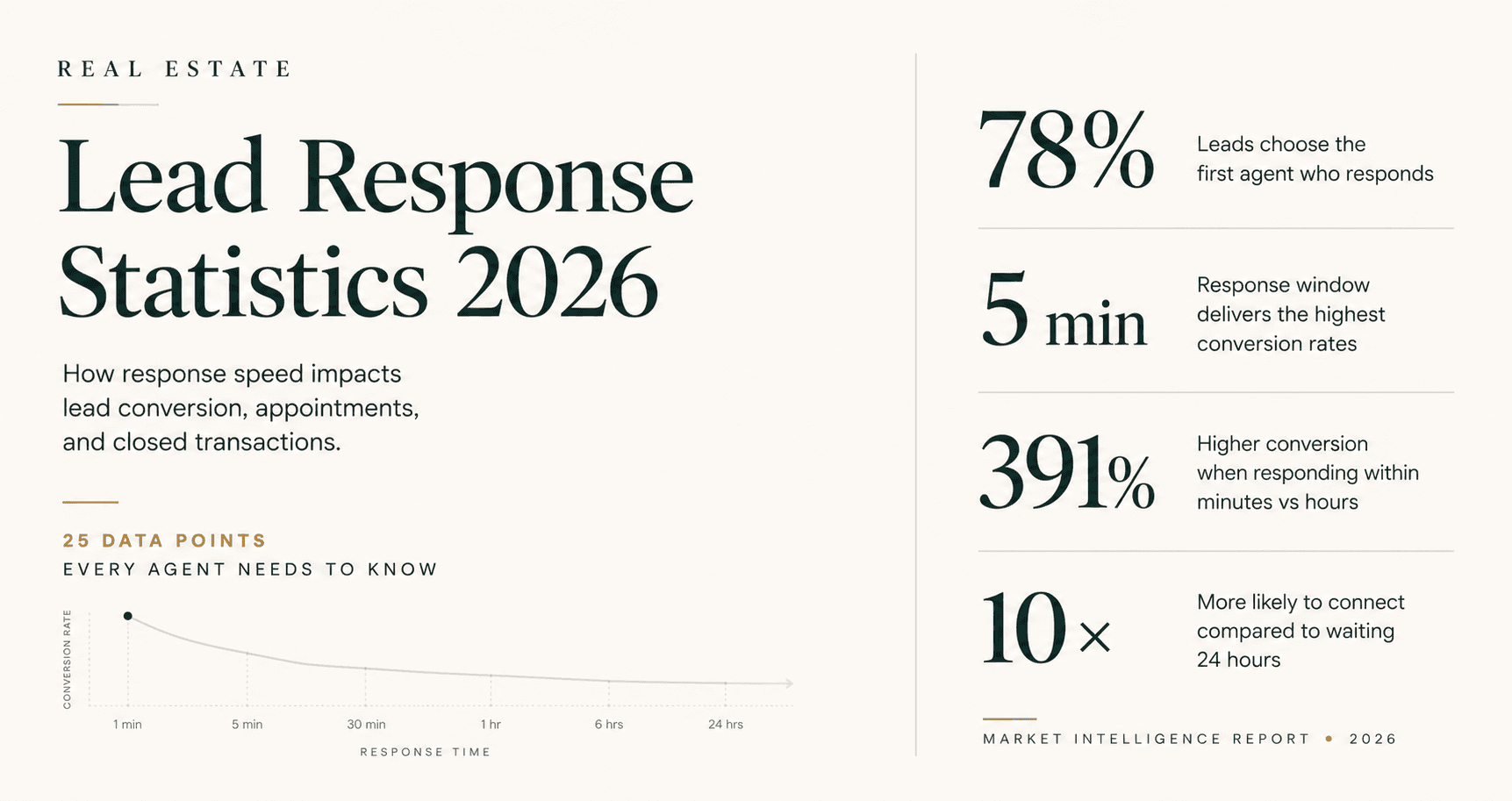
Phase 2: Close the lead capture gap. The single highest-ROI upgrade available to any agent below 30 transactions per year is ensuring that every inbound lead — from IDX registration, Facebook Lead Ads, Zillow, open house sign-ins, and direct website forms — routes automatically into a single CRM and triggers an instant text or email response within 2 minutes. This one system change produces the 5-minute response window that research has documented as 21 times more likely to qualify a lead than a 30-minute response. The cost is either a real-estate-native CRM at $169–$299/month or a separate CRM plus Zapier integration — but the native integration is more reliable and faster.
Phase 3: Systematize the database. Once lead capture is automated, the next highest-leverage investment is past-client and referral nurture. Segment your database into A, B, and C tiers. Set up automated sequences for B and C (market updates monthly, birthday and anniversary emails quarterly). Block 90 minutes per week for personal A-tier outreach — calls or personal video messages via Loom. According to data from Buffini & Company, 82% of all real estate transactions result from agent contacts through previous clients, referrals, friends, family, and personal contacts. The agents at 30+ transactions are not spending more on portals than the median agent — they are spending more time and automation on the contacts they already have.
| Key Statistic / Finding | Source & Year |
|---|---|
| The typical Realtor reported 10 transactions in 2024 with a median gross income of $58,100; agents with 6–15 years' experience handled a median of 11 transactions for $3.2M in volume | NAR 2025 Member Profile |
| Top-producing agents at 30+ transactions per year typically run a core stack of 4 to 5 tools: a CRM, video tool, social scheduler, transaction management, and market data | Reel-E Best Apps for Real Estate Agents, 2026 |
| Social media is the top lead-generating technology for 39% of agents; CRM generates the highest quality leads for 23%; local MLS for 17% | NAR 2025 Technology Survey |
| 66% of sellers found their agent through a referral or someone who had helped them before | NAR 2025 Profile of Home Buyers and Sellers |
| The typical Realtor earns 20% of business from repeat clients and 21% from referrals by past clients — 41% of closed business comes from the existing database | NAR 2025 Member Profile, via HousingWire |
| Listings with video receive 403% more inquiries than those without; only 38% of agents currently use video marketing | REsimpli Real Estate Video Statistics, 2025 |
| Properties with professional photos sell 32% faster; 3D virtual tours receive 87% more views than listings without them | REsimpli Real Estate Marketing Statistics, 2025; REsimpli Real Estate Video Statistics, 2025 |
| 82% of all real estate transactions result from agent contacts through previous clients, referrals, friends, family and personal contacts | Buffini and Company referral research, via IXACT Contact |
| Brokerages with integrated CRMs say their marketing cycles doubled in speed; SERHANT agents using Rechat's integrated platform brought in 32% more revenue | Rechat 2025 AI Adoption Report, via HousingWire |
| More than 50% of agents earning $100,000 or more annually spend over $2,500 per year on technology; 25% of high-income earners invest $5,000 or more | REsimpli Real Estate Social Media Statistics, 2025 |
Frequently Asked Questions
What CRM do top-producing real estate agents use in 2026?
The CRM platforms that appear most consistently among documented high-volume agents are Follow Up Boss, kvCORE, and Lofty (formerly Chime). All three share the same defining capability: real-time lead routing from multiple sources into a single queue, with automated text and email responses triggered within 60 to 120 seconds of lead registration. Follow Up Boss integrates with 250+ lead sources and is the most widely cited in practitioner case studies. kvCORE is the dominant all-in-one platform for teams, with IDX website, lead routing, and AI-driven nurture sequences in a single subscription. The specific platform matters less than whether it routes every lead source into one system automatically — that is the capability that closes the 5-minute response window.
How many transactions per year does a top 1% real estate agent close?
The median Realtor closed 10 transactions in 2024, according to NAR's 2025 Member Profile. Agents with 6 to 15 years of experience — the most productive experience band — closed a median of 11 transactions for $3.2 million in volume. Closing 30+ transactions places an agent at roughly three times the median volume, which corresponds to approximately the top 5% by transaction count rather than the strict top 1%. True top-1% agents by transaction volume — those closing 50 to 100+ per year — almost universally run teams of 3 to 10 people with dedicated buyer agents, transaction coordinators, and marketing staff, supported by enterprise-level CRM platforms at $500 to $1,500/month.
What tools do top real estate agents eliminate from their tech stack?
The three most commonly eliminated categories are: standalone email marketing platforms (duplicated by any real-estate-native CRM with drip automation), paid lead portals without tracked ROI (replaced by database nurture automation), and premium graphic design subscriptions beyond Canva Pro (replaced by AI-assisted templates inside existing platforms). HousingWire's proptech coverage documents a broader industry consolidation trend: agents are cutting tools that require manual data transfers between platforms and replacing them with either consolidated platforms or verified native integrations. The goal is a stack that runs without the agent's manual intervention for the first 24 hours of every new lead's lifecycle.
How much do high-producing real estate agents spend on technology per month?
According to REsimpli's real estate marketing research, more than 50% of agents earning $100,000 or more annually spend over $2,500 per year on technology, with 25% of high-income earners investing $5,000 or more annually. At the 30+ transaction tier, a documented core stack of CRM ($299–$499/month), video tools ($12–$25/month), social media scheduler ($25–$99/month), and transaction management ($31–$50/month) totals approximately $367 to $673 per month — before professional photography costs per listing. This is consistent with NAR's 2025 Technology Survey finding that 24% of all agents spend over $500 per month on technology.
Why do top agents invest in video marketing when most agents don't?
Because listings with video receive 403% more inquiries than those without, per REsimpli's video statistics — and only 38% of agents currently use video marketing. This creates a durable competitive gap that top producers exploit. The barrier is not cost: Loom costs $12/month for personal video messages, and CapCut for listing walk-throughs is free. The barrier is habit and consistency. Top producers who commit to video on every listing and in their weekly social media calendar report it as a self-reinforcing investment — more inquiries generate more showings, more showings generate more closed clients, and more closed clients generate more testimonial video content that attracts the next client.
How do top agents use their CRM database to generate referral business?
According to Buffini & Company research, 82% of all real estate transactions result from agent contacts through previous clients, referrals, friends, family, and personal contacts. Top producers systematize this by segmenting their database into A, B, and C tiers and automating different sequences for each. A-tier contacts (past clients and active referrers) receive a personal call or video message monthly. B-tier contacts receive an automated market update email and a quarterly personal touch. C-tier contacts receive a market snapshot quarterly. The entire B- and C-tier sequence runs automatically inside the CRM; only A-tier touches require the agent's personal time. NAR's 2025 Member Profile confirms the typical Realtor earns 20% of business from repeat clients and 21% from past-client referrals — agents who systematize these touches consistently outperform those who rely on memory.
What is the biggest technology mistake high-volume agents made in 2025 and fixed?
The most common mistake documented across 2025 was paying for lead portals without tracking which portals were producing closed transactions — and continuing to renew those subscriptions automatically. When top producers audited their closed business against lead source, they found that 41% of deals came from their existing database (repeat clients and referrals), not from the portals consuming $500 to $1,000 per month. The fix was straightforward: implement source tracking in the CRM, audit closed deals by source quarterly, and cut any lead source where cost-per-closed-deal exceeded the agent's own target. The savings were reinvested into CRM automation that nurtures the database more systematically — the highest-ROI reallocation documented across multiple practitioner case studies.
Do top real estate agents use AI tools in their business, and how?
According to NAR's 2025 Technology Survey, AI adoption has reached 68% of all agents, but only 17% report it having a significant positive impact on their business. The gap between adoption and impact reflects how the tool is being used: agents who use AI primarily for content generation (listing descriptions, social captions) see modest gains. Agents at the top-producer level use AI where it has the highest business impact — inside the CRM, as a conversational agent that holds automated text exchanges with new leads until they are ready for a human call. One documented case study from Reel-E showed a team whose lead-to-appointment rate jumped from 4% to 11% after switching to automated AI-assisted first-response inside Follow Up Boss. That 7-percentage-point improvement, at 200 leads per month, translated to roughly 14 additional appointments monthly.
📚 Related Reading
- How Google AI Overviews are changing real estate search — and which agents will win
- Real estate AI adoption report 2026: how agents are using automation to close more
- Real estate CRM adoption study 2026: why 63% of agents still track leads in a spreadsheet
- Why 70% of real estate leads are lost in the first 7 days (and what top agents do differently)
Amaan Sheikh
— Co-Founder & CEOAmaan Sheikh is the co-founder and CEO of Pinova. He sets the product direction, builds the partnerships, and personally works with every founding partner. His focus is making enterprise-grade real estate technology accessible to ambitious agents and teams — without the enterprise price tag.