How Google AI Overviews are changing real estate search — and which agents will win

Quick Answer
How do Google AI Overviews affect real estate agents in 2026?
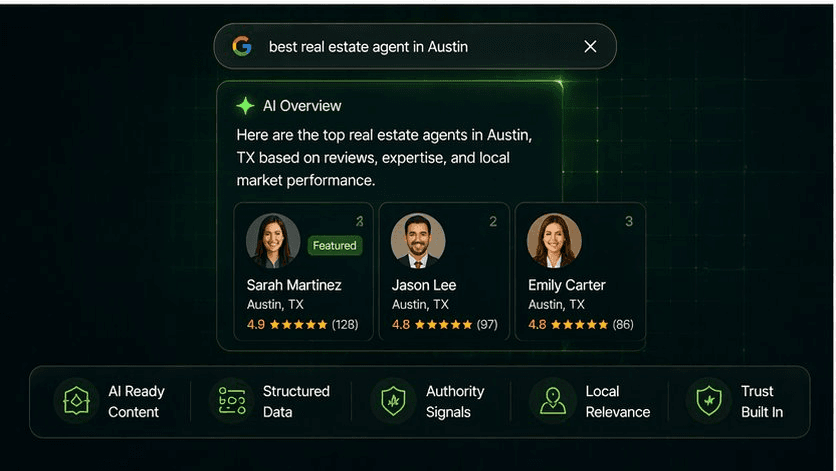
Google AI Overviews appear on roughly 4–5% of real estate search queries — the lowest trigger rate of any major consumer vertical — but when they do appear, they surface only 3–5 agent names per search. Meanwhile, 61.3% of buyer-side real estate searches now begin in an AI search engine rather than Google or Zillow, according to FlyDragon's 2026 State of AI SEO in Real Estate. Agents who earn AI citations close those leads at 9.6% versus 2.4% for Zillow Premier Agent leads. The agents getting cited are not necessarily the highest bidders or the top Google rankers — they are the ones whose content is structured so AI systems can extract, verify, and confidently recommend them.
Key Takeaways
- 91% of U.S. real estate agents are invisible to AI search tools, per FlyDragon's 2026 State of AI SEO in Real Estate — a study of 12,400 AI responses across 192 metros.
- The share of homebuyers using ChatGPT, Perplexity, Gemini, or Google AI Overviews as their primary agent-research tool jumped from 17% to 67% in 18 months, per FlyDragon's 4,180-respondent buyer survey.
- AI-sourced leads close at 9.6% within 90 days — four times higher than Zillow Premier Agent's 2.4% close rate — with an average GCI of $1,180 per lead versus $240 for Zillow, per FlyDragon and HousingWire.
- Agents who began AI SEO work in early 2025 now hold 5.7x the citation share of agents who started the same work twelve months later, per FlyDragon's benchmark data.
- Pages with FAQ schema markup are 60% more likely to be featured in AI Overviews compared to pages without structured data, per Snezzi's 2025 research.
- Distributing content to a wide range of publications can increase AI citations by up to 325% compared to only publishing on your own site, per Stacker, December 2025.
Sarah Marek closed 27 transactions in 2024 without spending a dollar on Zillow Premier Agent. Her leads came in at an average close rate of 9.6% — nearly four times what her competitors were getting from portal leads. The difference wasn't a bigger ad budget or a better zip code. It was that when a buyer in her market asked ChatGPT "who's the best agent in Naperville for a first-time homebuyer," Sarah's name was one of three that came back. Her competitors, most of them spending $500–$2,000 per month on lead portals, weren't mentioned at all.
This article explains why 91% of agents are invisible to AI search right now, what signals Google AI Overviews and other AI platforms actually use to decide which agents to surface, and the specific content, schema, and authority actions you can take to become one of the 9% who get recommended. Each section maps to a concrete action you can complete within 30 days.
What changed with Google AI Overviews
The shift is not gradual. In 18 months, the share of homebuyers using an AI tool as their primary research method before contacting an agent went from 17% to 67%. That figure comes from FlyDragon's 2026 State of AI SEO in Real Estate, a study spanning 12,400 AI-generated responses, 8.2 million tracked queries across 192 metros, and a 4,180-respondent buyer survey — the largest publicly published analysis of AI search behavior in U.S. residential real estate. The same report found that 61.3% of buyer-side real estate searches now begin in an AI search engine rather than Google or a listing portal.
The portal model is already absorbing the hit. Zillow's share of agent-discovery traffic fell from 41.2% to 33.8% year-over-year — its first-ever decline since FlyDragon began tracking in 2024. That displaced traffic did not move to Realtor.com or Redfin. It moved to AI tools. Session replay analysis of 12,000 buyer journeys in the study shows the average buyer asks 8.7 questions before narrowing to a two-to-three agent shortlist, and 71% of those queries are hyper-local — the kind a portal cannot answer but a well-structured agent website can.
Stat: 67% of homebuyers now use an AI tool as their primary research method before contacting an agent — up from 17% just 18 months ago. — FlyDragon, 2026 State of AI SEO in Real Estate
The mechanism that makes this matter for individual agents is simple: AI tools rarely surface more than three to five names per search. Traditional Google returns ten blue links on page one. AI returns a short, confident recommendation. If your name is not in that recommendation, you do not exist for that buyer — regardless of how much you've spent on paid leads or how high your Zillow reviews sit.
What AI Overviews look for
Real estate has the lowest AI Overview trigger rate of any major consumer vertical: just 4.48%, according to Arvow's analysis of BrightEdge and Conductor data. A separate April 2026 study by 5WPR and Haute Residence put the figure at 0.14% for real estate-specific AI Overview appearances. These numbers are not a reason to ignore AI search — they are a reason to understand where the actual opportunity lives, which is not Google AI Overviews on broad transactional queries, but in the conversational AI platforms (ChatGPT, Perplexity, Gemini) where buyer research now begins.
Across all AI platforms, seven factors consistently determine which content gets cited. A 2025 analysis of 15,847 AI Overview results identified semantic completeness as the strongest predictor, with a correlation of 0.87: content that fully answers a query in a self-contained 134–167 word unit is 4.2 times more likely to be cited than content that requires the reader to click elsewhere for context. Structured data markup increases selection probability by 73% in the same study. Pages with FAQ schema specifically are 60% more likely to be featured, per Snezzi's 2025 research.
Stat: 44.2% of all LLM citations come from the first 30% of a piece of content — the introduction. — Growth Memo, February 2026
E-E-A-T signals (Experience, Expertise, Authoritativeness, Trustworthiness) appear in 96% of AI-cited sources, per the same 2025 ranking factors study. For a real estate agent, this means your content needs a named author byline with verifiable credentials, specific local market data with dates attached, and references to your actual transactions — not generic claims about "helping buyers find their dream home." Replace "the market is strong" with "median days on market in [your city] fell from 34 to 19 in Q4 2025, per [county MLS]." Specificity is the signal.
Google's AI also uses a process called query fan-out: when a buyer types a question, the AI breaks it into five to ten sub-queries and searches for the best answer to each. Your content does not need to answer the entire question. It needs to be the clearest, most extractable answer to one specific sub-question. A blog post titled "Average time to close on a home in [your city] in 2026" — answered in the first paragraph with a specific number and sourced — has a higher citation probability than a 3,000-word buyer's guide that buries the answer in paragraph twelve.
Who is winning right now
Only 8.4% of agents appear in AI responses at all. Among those who do, the top 1% hold 47% of citation share across metros, according to FlyDragon's HousingWire analysis. That concentration is not random. Agents who began AI SEO work in early 2025 now hold 5.7x the citation share of agents who started the same work twelve months later — despite the later group spending more money on average. The first-mover advantage in AI search is structural: citation share compounds because AI tools use prior citations as trust signals for future recommendations.
The quality of the leads arriving through AI citation is dramatically different from portal traffic. Across 42,180 tracked leads in FlyDragon's dataset, AI-sourced leads closed at 9.6% within 90 days, compared to 2.4% for Zillow Premier Agent and 1.8% for Google Ads. Average GCI per AI lead was $1,180 versus $240 for Zillow. Time to close was roughly half: 42 days compared to 87. The mechanism behind this is that a buyer who has spent 30-plus minutes asking an AI about a market arrives pre-educated and with something close to a warm referral mindset — they were told your name by a source they trusted.
Stat: AI-sourced real estate leads close at 9.6% within 90 days — nearly four times the 2.4% close rate of Zillow Premier Agent leads — with average GCI of $1,180 per lead versus $240. — FlyDragon / HousingWire, 2026
The agents winning AI citations today share three characteristics. First, they publish hyper-local content at a cadence of at least two posts per month — not generic market updates, but posts structured around the exact questions buyers type into AI tools ("Is [neighborhood] safe for families?" "What's the average price per square foot in [zip code]?"). Second, they have fully optimized Google Business Profiles with weekly posts, current Q&A entries, and consistent NAP (name, address, phone) information across all directories. Third, their website content uses FAQ schema, Article schema with a verified author, and LocalBusiness schema that connects to the same entity information appearing on their GBP.
How to optimise your presence
The single highest-leverage change you can make today is restructuring your existing content to lead with direct answers. AI systems extract from the first 30% of content 44.2% of the time, per Growth Memo's February 2026 analysis. If your blog posts open with two paragraphs of scene-setting before reaching the point, AI skips them. The fix: rewrite your introductions so the first 50–70 words contain a specific, verifiable answer to the post's title question. Then add a Q&A block at the bottom of every page using natural-language questions your actual clients ask — "How long does it take to buy a house in [city]?", "Do I need a real estate agent to buy a house?" — and answer each one in three to five standalone sentences.
Schema markup is the second lever. Pages with proper schema markup are three times more likely to earn AI citations, per a 2026 analysis by MikeKhorev.com. The four schema types that matter most for agents are: FAQPage (for any page with question-answer pairs), Article with author and datePublished (for blog posts), LocalBusiness linking your entity to your GBP, and Review/AggregateRating tied to your Google reviews. Validate all schema using Google's Rich Results Test before publishing. Any schema error — a missing required field, a mismatched entity name — reduces the confidence score AI systems assign to your content.
Third: distribute content beyond your own site. Research by Stacker in December 2025 found that distributing content to a wide range of publications can increase AI citations by up to 325% compared to publishing only on your own domain. For agents, the practical version of this is: contribute a local market data post to your brokerage blog, submit a guest column to a local business journal, get quoted in a local news story about the housing market, and ensure your profile is fully populated on Realtor.com, Zillow, Homes.com, and Nextdoor. Each external mention is a node in the citation network AI tools use to verify that you are a real, credible, active agent in your stated market.
Website requirements for AI search
Your website needs to pass four technical criteria before content strategy matters at all. The first is crawlability: check your robots.txt file to confirm you are not blocking the AI crawlers (GPTBot, Bingbot/Copilot, ClaudeBot). Blocking these crawlers protects your content from training data inclusion but also removes you from citation consideration. The second is Core Web Vitals: Google's AI Overviews draw from the same trust pool as traditional search rankings, and poor page experience scores are a disqualifier. Third is HTTPS — every page, no redirect chains. Fourth is a clean XML sitemap submitted to Google Search Console so AI crawlers can discover your full content graph, not just the pages linked from your homepage.
At the content architecture level, you need topical clusters rather than isolated posts. AI systems treat topical authority as a trust signal: one great article on a topic you have never covered elsewhere will not outrank a site with 15 well-organized, interlinked articles on the same subject. For a buyer's agent in a specific metro, that means a cluster of pages covering: neighborhood guides (one per major neighborhood you serve), market update posts refreshed quarterly, buyer FAQ pages, and a transaction process explainer specific to your state. Each page should reference and link to at least two others in the cluster. AI tools recognize the semantic web, not just the individual page.
Stat: Question-based queries are 84% more likely to trigger an AI Overview than non-question queries — up from 60% in early 2025. Queries with 8 or more words are 7x more likely to trigger an AI Overview. — Snezzi, 2025; Single Grain, 2026
Your Google Business Profile functions as a parallel trust signal. Google's own AI Overviews pull from GBP data when surfacing local recommendations. A complete GBP requires: a keyword-rich description that explicitly names the cities and neighborhoods you serve, your license number and brokerage affiliation, weekly posts (at minimum one market update or client milestone per week), and active Q&A with you providing the answers. Incomplete or stale GBPs are filtered out of local AI recommendations regardless of how strong your website content is — the two signals need to be consistent and current.
How Pinova fits into the AI search equation
Pinova's agent website builder generates pages pre-structured with Article, FAQPage, and LocalBusiness schema — the three schema types with the strongest correlation to AI citation selection. Each blog post created through Pinova's content tool automatically includes a named author byline linked to a structured author entity, a 50–70 word answer block at the top of the page formatted for AI extraction, and a FAQ section at the bottom with schema markup applied at publication. The platform also maintains NAP consistency across the agent's profile and syncs listing data to the GBP via API — removing the manual overhead of keeping the entity signals aligned as market data changes.
Your 30-day AI search action plan
Week 1 is infrastructure. Audit your robots.txt and confirm AI crawlers are not blocked. Validate your existing schema using Google's Rich Results Test and fix any errors. Submit or update your XML sitemap in Search Console. Fully complete your Google Business Profile — description, service areas, license number, first weekly post.
Week 2 is content restructuring. Take your three highest-traffic existing pages and rewrite their introductions to lead with a direct, verifiable answer in the first 50 words. Add a five-question FAQ block to the bottom of each page with schema markup. Pull specific local stats — median days on market, median price per square foot, months of inventory — from your MLS and embed them with the data date. These updates signal freshness, which AI systems use as a ranking input.
Week 3 is new content. Publish one hyper-local neighborhood guide structured around the exact questions buyers ask AI tools: "What is [neighborhood] like?", "Is [neighborhood] good for families?", "What is the average home price in [neighborhood]?" Answer each in a standalone paragraph that makes sense without surrounding context. Embed your author bio with your license number, years active, and number of transactions closed in that market. Submit the URL to Google Search Console immediately after publishing.
Week 4 is distribution. Get your content in front of at least three external sources: your brokerage blog, one local media outlet (even a free community newsletter), and one real estate directory profile. Update your Realtor.com, Homes.com, and Nextdoor profiles with the same market-specific language appearing on your website. Each external mention strengthens the entity signal AI tools use to verify you are the agent you claim to be in the market you claim to serve. Agents who started this process in early 2025 now hold 5.7x the citation share of those who started in early 2026 — the compounding effect is real, and it starts in week one.
Key Statistics: Google AI Overviews & Real Estate Search 2026
| Key Statistic / Finding | Source & Year |
|---|---|
| 91% of U.S. real estate agents are invisible to the AI search tools their buyers use first | FlyDragon, 2026 State of AI SEO in Real Estate |
| 67% of homebuyers now use an AI tool as their primary research method before contacting an agent, up from 17% 18 months earlier | FlyDragon, 2026 State of AI SEO in Real Estate |
| AI-sourced real estate leads close at 9.6% within 90 days vs. 2.4% for Zillow Premier Agent and 1.8% for Google Ads | FlyDragon / HousingWire, 2026 |
| Average GCI per AI-sourced lead is $1,180 vs. $240 for Zillow Premier Agent leads | FlyDragon / HousingWire, 2026 |
| Agents who began AI SEO work in early 2025 hold 5.7x the citation share of agents who started twelve months later | FlyDragon, 2026 Benchmark Report |
| Real estate has a 4.48% AI Overview trigger rate — the lowest of any measured consumer industry | Arvow / BrightEdge / Conductor, 2026 |
| Pages with FAQ schema are 60% more likely to be featured in AI Overviews vs. pages without structured data | Snezzi, 2025 |
| 44.2% of all LLM citations come from the first 30% of a piece of content (the introduction) | Growth Memo, February 2026 |
| Distributing content to a wide range of publications can increase AI citations by up to 325% vs. publishing only on your own site | Stacker, December 2025 |
| Top position organic CTR fell from 28% to 19% as AI Overviews dominate mobile SERP real estate | Single Grain / Advanced Web Ranking, 2026 |
| Zillow's share of agent-discovery traffic fell from 41.2% to 33.8% year-over-year — its first ever decline | FlyDragon, 2026 State of AI SEO in Real Estate |
| Structured data markup increases AI Overview selection probability by 73%; pages with all seven optimization factors are 4.2x more likely to be cited | AI Overview Ranking Factors Study, 2025 |
Frequently Asked Questions
Do Google AI Overviews appear for real estate searches?
Yes, but rarely for transactional queries. Real estate has the lowest AI Overview trigger rate of any major consumer vertical — roughly 4.48%, per Arvow's analysis of BrightEdge and Conductor data. AI Overviews appear most often on informational real estate queries like "how does a buyer's agent get paid" or "what is escrow," not on queries like "homes for sale in Austin." The more significant opportunity for agents is in conversational AI tools — ChatGPT, Perplexity, Gemini — where 61.3% of buyer-side real estate searches now begin.
How do I get my name to appear when buyers search for agents on ChatGPT or Perplexity?
AI tools surface agents whose content passes three tests: it answers specific local questions directly (not generically), it carries structured data signals like FAQ schema and a named author entity, and it appears consistently across multiple credible external sources. Practically: publish hyper-local content structured around the exact questions buyers ask AI tools, fully complete your Google Business Profile with weekly posts, implement FAQPage and LocalBusiness schema on your website, and get your name and market into at least three external sources beyond your own domain. Agents who started this in early 2025 now hold 5.7x the AI citation share of agents who started a year later.
Are AI-generated real estate leads actually worth pursuing?
The close rate data says yes. Across 42,180 tracked leads in FlyDragon's 2026 dataset, AI-sourced leads closed at 9.6% within 90 days — nearly four times the 2.4% close rate of Zillow Premier Agent leads and more than five times Google Ads' 1.8%. Average GCI per AI lead was $1,180 versus $240 for Zillow. Time to close was 42 days versus 87. The buyers arriving through AI citation arrive pre-educated and with a referral-like trust level because the AI recommended you specifically rather than listing ten options.
Does ranking #1 on Google guarantee I'll appear in AI Overviews?
No — and this is the most important misconception to correct. Research by Moz's Tom Capper found that 88% of AI Mode citations are not in the organic SERP for the same query. AI tools and Google's traditional blue links pull from different source pools. You can rank first organically and be completely absent from AI recommendations. AI citation correlates strongly with semantic completeness (how fully your content answers a query in isolation), structured data, and external entity mentions — not solely with your organic position.
What schema markup should a real estate agent implement first?
Start with three: FAQPage schema on any page with question-and-answer content (your FAQ page, neighborhood guides, buyer guides), Article schema with a named author, datePublished, and dateModified on every blog post, and LocalBusiness schema on your homepage and contact page with consistent NAP information that exactly matches your Google Business Profile. Pages with FAQ schema are 60% more likely to be featured in AI Overviews than pages without it. Validate every implementation using Google's Rich Results Test before publishing.
How often do I need to publish new content to maintain AI visibility?
AI systems treat content freshness as a trust signal — outdated statistics and stale publication dates reduce citation probability. A sustainable baseline is two new hyper-local posts per month plus quarterly updates to your highest-traffic existing pages (refreshing stats, adding new local market data, updating the dateModified field). Add "Updated [Month Year]" near the top of important guides. Agents who do this consistently see compounding returns: each new page strengthens the topical authority signal that makes all their other pages more likely to be cited.
Is Zillow still worth investing in given AI search growth?
It depends on your market and time horizon. Zillow Premier Agent leads close at 2.4% — roughly four times lower than AI-sourced leads — and cost $25–$80 per lead, per FlyDragon CEO Tim Harvey. Zillow's share of agent-discovery traffic fell year-over-year for the first time in 2025. If your business relies heavily on Zillow today, the data suggests diversifying toward AI visibility now rather than waiting until the structural disadvantage is irreversible. Agents who built AI citation share in early 2025 already hold structural advantages that later entrants cannot buy their way out of, per FlyDragon's benchmark data.
What is GEO and how is it different from SEO for real estate agents?
GEO (Generative Engine Optimization) is the practice of structuring your digital presence so AI platforms cite, recommend, or mention you when users ask conversational questions. Traditional SEO optimizes for ranking in Google's blue-link results. GEO optimizes for being the name an AI tool surfaces when a buyer asks "who is the best agent in [city] for first-time homebuyers?" The tactics overlap — both reward E-E-A-T signals, structured data, and quality content — but GEO places additional emphasis on external entity mentions, semantic completeness of individual passages, and consistency across all platforms where your name appears, not just your own website.
📚 Related Reading
- Real estate AI adoption report 2026: how agents are using automation to close more
- Real estate CRM adoption study 2026: why 63% of agents still track leads in a spreadsheet
- The real estate tech stack audit: what the top 1% of agents actually use in 2026
- Why 70% of real estate leads are lost in the first 7 days (and what top agents do differently)
Amaan Sheikh
— Co-Founder & CEOAmaan Sheikh is the co-founder and CEO of Pinova. He sets the product direction, builds the partnerships, and personally works with every founding partner. His focus is making enterprise-grade real estate technology accessible to ambitious agents and teams — without the enterprise price tag.