Real Estate AI Adoption Report 2026: What Agents Are Actually Doing

Quick Answer
How are real estate agents using AI in 2026?
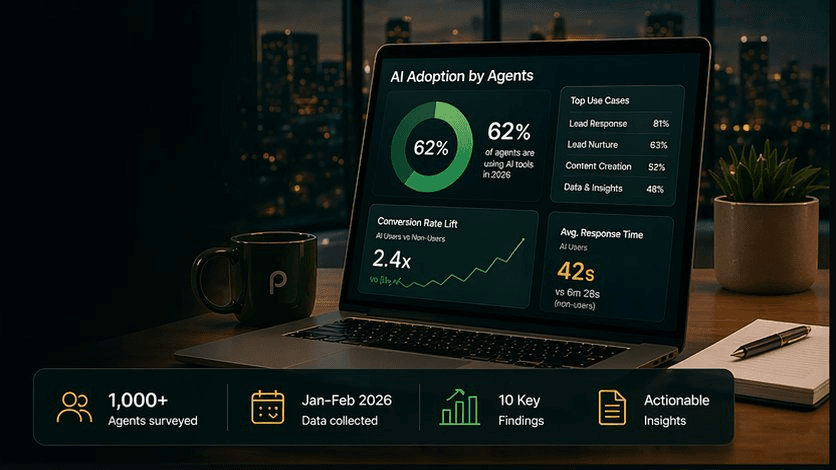
82% of real estate agents now use AI tools in their business, per RPR's February 2026 survey of NAR members — up from 68% in NAR's July 2025 Technology Survey and approximately 15% in 2023. The most common uses are writing listing descriptions (68%), creating social media content (59%), and drafting emails (53%). AI delivers the clearest ROI in three high-leverage areas: automated first response to leads within 60 seconds, predictive lead scoring that prioritizes which contacts to call first, and consistent nurture sequences that run for 6-plus months without agent effort. The biggest gap: only 17% of agents report significant positive business impact from AI, suggesting most adoption is still concentrated in low-leverage marketing tasks rather than conversion-moving workflows.
Key Takeaways
- 82% of real estate agents now use AI tools, per RPR's February 2026 survey — up from an estimated 15% in 2023. Yet only 17% report AI having a significant positive impact on their business, per NAR's 2025 Technology Survey, pointing to a gap between adoption and effective deployment.
- 97% of brokerage leaders surveyed in January 2026 confirmed their agents are actively using AI, per the Delta Media Real Estate Leadership AI Survey — a threshold that led the report to describe AI as having crossed from experimentation to infrastructure.
- 68% of agents report saving at least one hour per week using AI, and 34% save over four hours weekly, per RPR's 2026 survey. The biggest time savings come from writing tasks, but the highest revenue impact comes from lead response automation.
- AI chatbot integration in real estate CRM systems can improve lead conversion rates by up to 40% and reduce response time by 60%, per a 2025 systematic literature review published in the International Journal of Scientific Research and Technology.
- Fair Housing Act civil penalties for first-time violations reached up to $26,262 under HUD's July 2025 penalty schedule — the most underestimated AI risk for agents using AI-generated marketing content without human review.
Paige S. is a buyer's agent in Austin who adopted AI tools in early 2025. A year later, she uses ChatGPT to write listing descriptions, Canva's Magic Studio for social graphics, and a calendar integration to schedule showings. Her marketing looks more professional. Her content comes out faster. And her conversion rate — leads to signed contracts — is exactly the same as it was before she adopted any of it. Meanwhile, James K., a solo agent in Atlanta who adopted an AI-powered CRM in mid-2025, is running a 12-week automated nurture sequence for every new inquiry and responding to 62% of his leads within 90 seconds at any hour of the day. His showing bookings increased 38% in six months without any change to his lead spend. Both agents "use AI." Only one is seeing the business impact that justifies the adoption curve.
This report breaks down the real state of AI adoption in residential real estate as of early 2026 — the actual numbers, where the gains are concentrated, where the limitations are underestimated, what the ROI data shows across verified sources, what is holding the remaining 18% of agents back, and what the next 12 months are likely to look like as the industry moves from generative AI to agentic AI. By the end, you will know precisely which AI workflows move the conversion needle, which ones are productivity improvements that don't directly translate to closed deals, and which carry compliance risk that most agents are not yet managing.
AI adoption by the numbers
Real estate AI adoption moved faster between 2023 and 2026 than almost any prior technology shift in the industry. In 2023, approximately 15% of agents were using AI tools in any meaningful way. By July 2025, NAR's Technology Survey put that number at 68%. By February 2026, RPR's survey of 225 NAR members — published by HousingWire on February 18, 2026 — found 82% of agents had integrated AI tools into their business, with 68% using them daily or several times a week. Among brokerage leaders, the Delta Media Real Estate Leadership AI Survey published in January 2026 found 97% reported their agents are actively using AI, with agent usage having climbed from 75% in early 2024 to 87.3% by the 2025 survey. The report described the shift in stark terms: AI has crossed from a technology experiment to infrastructure — meaning agents who are not using it are now the anomaly, not the norm.
Stat: 82% of real estate agents have integrated AI tools into their business — yet only 17% report AI having a significant positive impact, while 46% see no noticeable difference in their business outcomes. — RPR AI Survey, February 2026 (via HousingWire); NAR 2025 Technology Survey, September 2025
The single most revealing number in all the 2025–2026 AI adoption data is not the 82% adoption rate. It is the 17%. NAR's 2025 Technology Survey — conducted in July 2025 with a random sample of 49,233 active Realtors — found that only 17% of agents reported AI having a significant positive impact on their business, while 46% reported no noticeable difference at all. The gap between adoption and impact is the defining story of real estate AI in 2025–2026. Agents are adopting AI at near-universal rates, but most are applying it to marketing and content tasks that improve productivity without directly moving their conversion rate.
The breakdown of what agents are actually doing with AI confirms the pattern. RPR's survey found the top uses are writing listing descriptions (68.47% of respondents), creating social media content (59.46%), and drafting emails or newsletters (53.15%). Image editing tools come in fourth at 39.19%, and market analysis or pricing tools fifth at 38.74%. The uses that most directly affect revenue — AI-powered lead response, predictive lead scoring, and automated nurture sequences — are adopted by a smaller share of agents. That is the opportunity gap, and it explains why two agents can both claim AI adoption while producing radically different business outcomes.
Where AI helps most
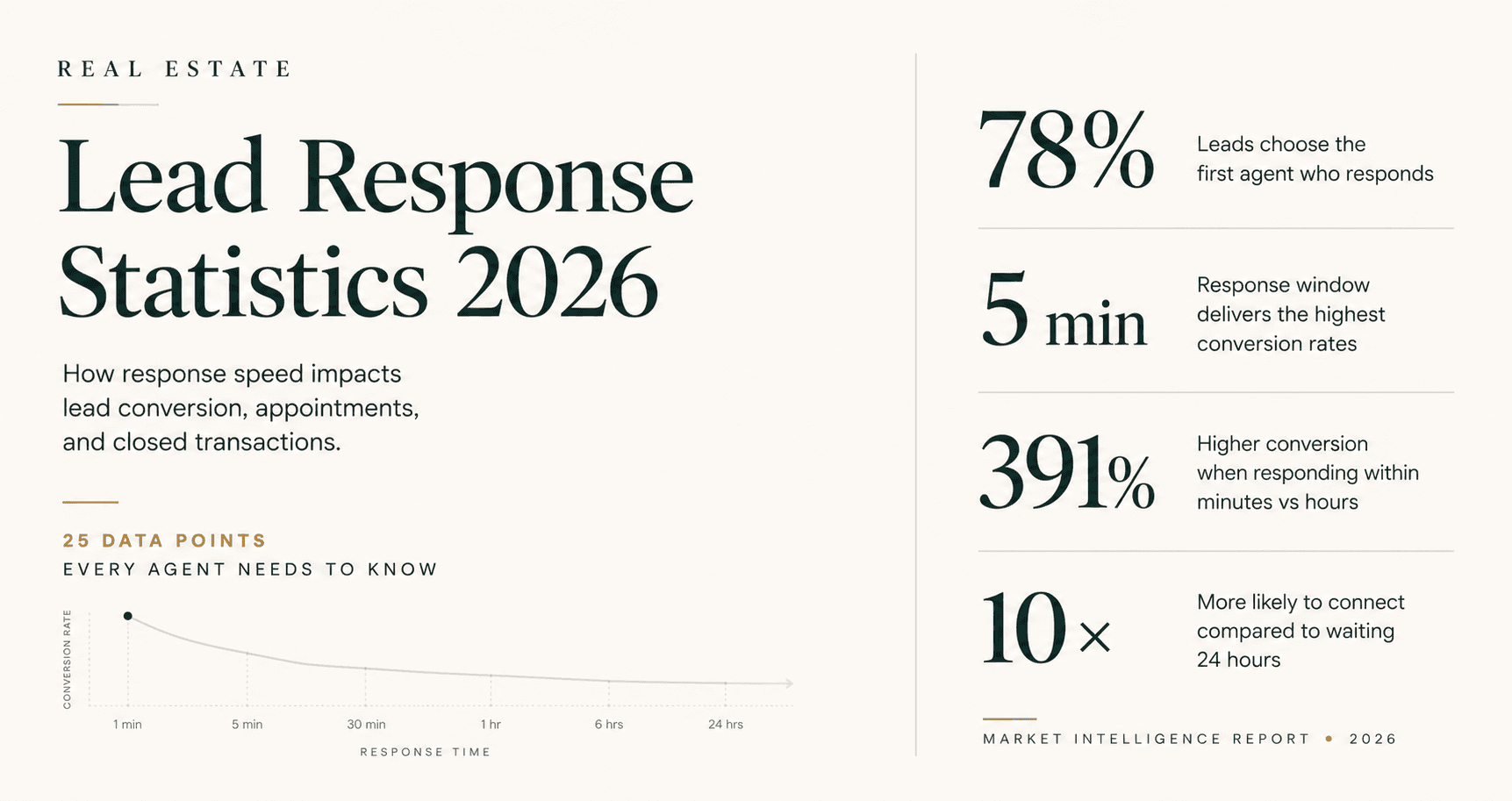
The highest-ROI AI applications in residential real estate cluster around a single variable: response time. MIT's Lead Response Management Study found that agents who respond within 5 minutes are 21 times more likely to qualify a lead than those who wait 30 minutes. Inman's 2025 Real Estate Technology Survey found the average agent takes 917 minutes to respond. The math is unambiguous: an AI system that consistently fires a qualifying SMS within 60 seconds of an inquiry captures the peak intent moment that the average agent misses by 15 hours. A 2025 systematic literature review in the International Journal of Scientific Research and Technology found that AI chatbot adoption in real estate CRM systems can improve lead conversion rates by up to 40% and reduce response time by 60%.
The second high-leverage application is lead scoring. AI systems that analyze behavioral signals — which listings a prospect views, how many times they return to a property, whether they search by school district (a 40% higher close-rate predictor, per MindStudio's 2026 AI lead management analysis), how long they spend on a home valuation page — can rank a database of 200 leads into a prioritized call list in seconds. A major real estate franchise that implemented AI-driven lead scoring improved predictive accuracy from 71% to 89%, per the same MindStudio analysis, which translated directly into higher conversion because agents focused their time on the leads statistically most likely to transact. Teams implementing AI lead management report conversion rates improving from 5–8% baselines to 11–12% or higher.
The third is automated nurture. Rechat's 2026 real estate marketing report, analyzing brokerage survey data and platform performance metrics published by HousingWire, found that 90% of 2025 AI investment in real estate was driven by efficiency, insights, and personalization. Brokerages using unified AI-integrated platforms reported marketing cycles that doubled in speed, and SERHANT. agents using Rechat's platform reportedly saw 32% more revenue compared to prior periods. The mechanism is consistent follow-up at scale — something a solo agent cannot do manually across 200 active contacts, but an AI system does automatically without fatigue, scheduling errors, or forgotten touchpoints.
Stat: Agents saving the most time from AI report over 4 hours per week recaptured — but the revenue gains are concentrated among agents using AI for lead response and nurture, not writing tasks. — RPR AI Survey, February 2026 (via HousingWire)
The time savings data from RPR's 2026 survey is instructive here. 71% of agents cite time savings as AI's top benefit. 68% save at least one hour per week. 34% save over four hours weekly. But time saved on listing descriptions and social posts does not automatically translate to more closed deals — it translates to more time available, which an agent then directs toward whatever activity they choose. The agents getting the outsized conversion results are not just saving time; they are redirecting it into the human activities that AI cannot replicate: negotiating offers, building trust in listing appointments, and walking buyers through the emotional complexity of a purchase decision.
Where it still falls short
The most significant underestimated risk in real estate AI adoption is Fair Housing compliance. The REALTOR® Association of Sarasota and Manatee published a formal warning in March 2026 that AI-generated marketing content can produce language that violates the Fair Housing Act without any discriminatory intent on the agent's part. AI pulls patterns from large datasets of existing marketing copy — copy that may contain historically discriminatory language or coded phrases that have since been identified as problematic. When an AI generates a listing description that says "great for young professionals" or "close to churches," it is echoing patterns from training data. The agent who publishes that content without review is legally responsible for it, regardless of where it originated.
HUD's published civil penalty schedule, effective July 14, 2025, lists Fair Housing Act penalties of up to $26,262 for a first-time violation — rising for repeat violations, with federal lawsuits capable of reaching $100,000 or more in compensatory and punitive damages, per the AI Regulation 2026 guide published by The AI Consulting Network. California's AB 723, effective January 2026, goes further on a specific AI use case: using AI to alter listing photos without disclosure is now a misdemeanor. NAR's Code of Ethics Articles 2 and 12 require "Virtually Staged" labels on all AI-enhanced images in most MLS systems. Agents cannot hide behind the tool that generated the content. If it appears in MLS remarks, a flyer, or a Facebook ad, the agent is responsible.
The second limitation is accuracy at scale. RPR's 2026 survey found that 63% of agents cited accuracy of AI outputs as their top concern, with compliance or legal issues second at 49% and misinterpretation of market data third at 47%. These concerns are not theoretical. AI language models generate confident-sounding prose whether or not the underlying facts are correct. An AI that writes "the home features original hardwood floors" when the listing notes say "laminate" creates a disclosure problem. An AI that generates a market analysis summary with a wrong price trend inverts an agent's negotiating position. The practical mitigation is a read-every-word policy before any AI output touches the market — which adds back some of the time savings, but remains faster than writing from scratch.
The third limitation is client trust in high-stakes interactions. NAR's 2025 Technology Survey found that agents' confidence in AI drops sharply when it comes to pricing interpretation, compliance-sensitive conversations, and client negotiations. Only 8% of agents surveyed said they never plan to use AI — but the tasks they are most reluctant to automate are precisely the tasks where relationships are won or lost. Buyers and sellers making the largest financial decision of their lives want a human voice at the moment of commitment. AI can do the work of getting that human into the room; it cannot reliably replace what happens in the room.
ROI data from real agents
The most credible ROI data for agent-level AI adoption comes from three sources that reported concrete outcome metrics rather than sentiment surveys. The first is Rechat's 2026 real estate marketing report, which found that agents at brokerages using unified AI-integrated platforms (where CRM, listings, and marketing tools share a single data layer) brought in 32% more revenue than prior-period comparables, and reported marketing tasks that previously took 10 hours completing in under 2 minutes. The report specifically attributed this to behavioral personalization — AI matching communication content to the specific properties and search patterns of each lead — rather than generic automation.
The second source is the MindStudio AI lead management analysis, which found that real estate teams implementing AI lead management see conversion rates improve from typical 5–8% baselines to 11–12% or higher. That improvement — roughly a doubling of conversion from the same lead volume — has a direct GCI implication. An agent generating 40 leads per month at a 6% conversion rate closes 2.4 deals per month. At 11%, the same lead volume produces 4.4 deals — an 83% increase in transactions without any change to lead spend or market conditions.
The third is Luxury Presence's reported outcome from their AI Lead Nurture Tool, which the company states increases lead reply rates to over 50% — compared to typical follow-up email reply rates of 5–15% in most real estate CRMs. That improvement is mechanically consistent with what MIT's lead response research predicts: a lead who receives a relevant, personalized message within 60 seconds of an inquiry is far more likely to engage than a lead who receives a generic email 12 hours later.
Pinova's automated nurture and AI response system tracks the behavioral sequence from first inquiry to booked showing — firing a personalized qualification SMS within 60 seconds of every new lead, segmenting non-responders into a 12-week nurture sequence, and surfacing re-engagement opportunities when behavioral signals indicate renewed intent.
At the brokerage level, Morgan Stanley's analysis of 162 REITs and CRE firms with $92 billion in combined labor costs projects that AI could unlock up to $34 billion in efficiency gains across the real estate industry over the next five years. The analysis finds that brokers and services show the highest potential for automation gains, with a possible 34% increase in operating cash flow for those that adopt generative AI at scale.
What's holding agents back
The remaining 18% of agents who do not yet use AI — and the far larger group who use it only for low-leverage content tasks — cluster around four concerns that the data largely validates as legitimate, even if their consequences are overstated.
Accuracy concern (63% of agents, per RPR 2026). This is a real risk in the specific contexts where AI generates factual claims about properties, prices, or market conditions. It is not a material risk for AI lead response systems, where the AI is asking a qualifying question rather than making a factual assertion. The practical distinction matters: "Are you looking to schedule a showing this week or still narrowing down areas?" cannot hallucinate a square footage. A generated market analysis can. Agents should apply the accuracy concern selectively — rigorously for content that goes to clients, less so for routing and response workflows.
Compliance and legal concern (49% of agents, per RPR 2026). Also a real risk, specifically for AI-generated marketing content, as covered in the previous section. The mitigation — human review before any content reaches the market — is straightforward. The concern becomes a blocker only when agents assume compliance review defeats the time-savings purpose of AI, which is not correct: a 30-second human read of a machine-generated first draft is faster than writing from scratch.
Learning curve concern (30% of agents, per RPR 2026). The 2026 data suggests this concern peaked in 2024. Delta Media's survey found that from 2024 to 2026, brokerage leaders increased their AI importance rating from 5 out of 10 to 5.9 out of 10, and their future importance expectation to 7.2 — with a concurrent rise in agent usage from 75% to 97% reporting that agents actively use AI. The tools have become sufficiently intuitive that the learning curve concern is now predominantly about moving from basic content tools to conversion-affecting systems — CRMs with AI response, not just ChatGPT prompts.
Client trust concern (often unstated but structurally significant). A portion of agent resistance is the reasonable intuition that real estate is a relationship business and that automation undermines the personal touch that differentiates a trusted agent from a portal. The data does not support this concern at the response and nurture level. Buyers do not know or care whether the 11 PM SMS asking about their showing timeline was written by a human or an AI — they care that someone responded. The human interaction that builds trust is the listing appointment, the negotiation call, and the walk-through. AI handles the pipeline work that gets you to those moments.
What 2026 looks like for AI in real estate
Every major real estate platform shipped AI functionality in an 18-month window between late 2024 and early 2026. Zillow launched a ChatGPT-integrated app in October 2025. Redfin launched conversational AI in November 2025. Realtor.com launched its ChatGPT app on March 30, 2026. Google rolled out AI Mode for real estate in March 2026. The consumer-facing AI layer of the industry is now largely built. What is being built in 2026 is the agentic layer — AI that does not just respond to prompts but acts continuously on behalf of agents without human initiation.
PwC's Emerging Trends in Real Estate 2026 distinguishes between generative AI (the first wave, now mainstream) and agentic AI (the second wave, now beginning to reach the residential market). Agentic AI can plan and act with minimal prompting, running continuous processes with limited supervision — use cases include lead routing, follow-up sequencing, appointment scheduling, and market intelligence delivery that updates automatically as data changes. The Rechat 2026 report describes this as a shift from automation to anticipation: instead of AI tools that execute tasks an agent assigns, agentic systems that identify the right task and execute it before the agent thinks to ask.
Ascendix's 2026 analysis projects that AI-enhanced CRMs will be used by nearly 89% of top agents before the end of 2026. The Delta Media survey found brokerage leaders in 2026 planning aggressive AI expansion into CRM systems, workflow automation, recruiting and training, and back-office administration — infrastructure decisions, not individual agent experiments. The practical implication for solo agents and small teams is that the gap between agents using AI for conversion and those using it only for content is about to widen. When 89% of top agents have AI-powered lead response running 24/7, the agents without it are not just slower — they are structurally disadvantaged in the first moments of every buyer or seller relationship.
Two compliance developments will shape 2026 and beyond. The Colorado AI Act, effective June 30, 2026, requires formal impact assessments for any AI used in "consequential decisions" including housing — a regulatory model several other states are expected to follow. And NAR's submission to the White House Office of Science and Technology Policy in September 2025 called for a balanced national AI framework that protects consumer data privacy, promotes fair housing compliance, and preserves copyright in listing content. The direction of travel is more scrutiny on how AI is deployed in housing decisions, not less. Agents who build review processes now will be ahead of compliance requirements that are likely to become mandatory within 24 months.
| Key Statistic / Finding | Source & Year |
|---|---|
| 82% of real estate agents have integrated AI tools into their business, with 68% using AI daily or several times a week | RPR (Realtor Property Resource) AI Survey, February 2026, reported by HousingWire |
| Only 17% of agents report AI having a significant positive impact on their business; 46% see no noticeable difference | NAR 2025 Technology Survey, September 2025 |
| 97% of brokerage leaders surveyed in January 2026 report their agents are actively using AI — up from 75% in early 2024 | Delta Media Real Estate Leadership AI Survey 2026, analyzed by WAV Group |
| 90% of 2025 AI investment in real estate was driven by efficiency, insights, and personalization; brokerages with unified platforms doubled marketing execution speed | Rechat Real Estate AI Marketing Report 2026, reported by HousingWire |
| AI chatbot integration in real estate CRM systems can improve lead conversion rates by up to 40% and reduce response time by 60% | International Journal of Scientific Research and Technology, AI-Enhanced CRM With Chatbots, 2025 systematic literature review |
| Teams implementing AI lead management report conversion rates improving from typical 5–8% baselines to 11–12% or higher | MindStudio AI Lead Management Analysis, 2026 |
| 34% of agents report AI saves them over four hours per week; 68% save at least one hour; 71% cite time savings as AI's top benefit | RPR AI Survey, February 2026, reported by HousingWire |
| Fair Housing Act civil penalties reached up to $26,262 for a first-time violation under HUD's July 2025 penalty schedule | HUD Civil Penalty Schedule, effective July 14, 2025; RASM REALTOR® Association of Sarasota and Manatee, March 2026 |
| AI is projected to unlock up to $34 billion in efficiency gains across real estate over the next five years | Morgan Stanley Analysis of 162 REITs and CRE firms, July 2025 |
| AI-enhanced CRMs are projected to be used by nearly 89% of top agents by end of 2026 | Ascendix Real Estate Technology Analysis 2026, cited in Discount Property Investor report |
Frequently Asked Questions
What percentage of real estate agents use AI in 2026?
82% of real estate agents have integrated AI tools into their business as of February 2026, per RPR's survey of NAR members published by HousingWire. That is up from 68% in NAR's July 2025 Technology Survey and approximately 15% in 2023. Among brokerage leaders, the Delta Media 2026 survey found 97% report their agents are actively using AI. The most common use cases are writing listing descriptions (68%), creating social media content (59%), and drafting emails (53%) — with higher-leverage applications like AI lead response and predictive lead scoring adopted by a smaller but faster-growing share of agents.
What is the ROI of AI for real estate agents?
The ROI varies significantly by use case. For content creation (listing descriptions, social posts), AI delivers time savings of 1–4+ hours per week, per RPR's 2026 survey, but does not directly move conversion rates. For AI-powered lead response — where a system fires a qualifying SMS within 60 seconds of every new inquiry — the conversion impact is measurable: MIT's Lead Response Management Study found agents responding within 5 minutes are 21 times more likely to qualify a lead than those who wait 30 minutes. Teams implementing AI lead management report conversion rates improving from 5–8% baselines to 11–12% or higher, per MindStudio's 2026 analysis. Morgan Stanley projects AI could unlock $34 billion in efficiency gains across real estate over five years.
Can AI-generated real estate content violate Fair Housing laws?
Yes. HUD confirmed in 2024 that the Fair Housing Act applies to AI-generated advertising and content. AI systems trained on historical marketing data can generate language that functions as coded steering — phrases like "great for young professionals," "close to churches," or "quiet neighborhood" can be interpreted as preference or exclusion under the Fair Housing Act, even when generated without discriminatory intent. The agent who publishes AI-generated content is legally responsible for it regardless of its origin. HUD's July 2025 civil penalty schedule lists first-time violation penalties of up to $26,262, with repeat violations and private lawsuits potentially reaching $100,000 or more. The practical safeguard is a human review of every AI-generated output before it reaches the MLS, a flyer, or a social ad.
What is agentic AI and how does it differ from what agents use now?
Most AI tools agents use today are generative — they create content (listing descriptions, emails, social posts) when prompted by a human. Agentic AI goes further: it can plan and act with minimal prompting, running continuous processes without human initiation. Real estate use cases include lead routing that fires automatically when a new inquiry arrives, nurture sequences that adjust messaging based on a lead's behavioral signals, appointment scheduling that coordinates calendars without agent input, and market intelligence updates that push relevant data to agents as it changes. PwC's Emerging Trends in Real Estate 2026 identifies agentic AI as the industry's next major adoption wave, moving from tools that execute tasks to systems that identify and execute the right task before the agent asks.
Why aren't more agents seeing business impact from AI?
The most common explanation in the data is misalignment between where AI is being deployed and where business impact is generated. NAR's 2025 Technology Survey found only 17% of agents report significant positive impact from AI, despite 82% adoption. The difference correlates with use case: agents applying AI to listing descriptions and social posts improve productivity but not conversion. Agents applying AI to lead response time — the variable most directly linked to qualification rate — see measurable pipeline growth. The underlying issue is that most agents start with the most visible AI tools (writing assistants) rather than the most consequential ones (response automation and nurture sequencing).
What are the biggest concerns agents have about using AI?
RPR's February 2026 survey found three dominant concerns: accuracy of outputs (63%), compliance or legal issues (49%), and misinterpretation of market data (47%). A learning curve concern was cited by 30% and fair housing issues by 28%. The accuracy and compliance concerns are legitimate in the context of AI-generated marketing content and market analysis — both require human verification before reaching clients. They are less applicable to AI lead response workflows, where the AI asks a qualifying question rather than making a factual claim. The fair housing concern is the most underestimated: most agents are aware of it in principle but have not implemented a specific review protocol for AI-generated content before it reaches the market.
Which AI tools are giving real estate agents the best results in 2026?
The highest-ROI category is AI-powered CRMs that automate lead response and nurture — platforms like Lofty, Ylopo, and integrated all-in-one systems that fire a personalized SMS within 60 seconds of every new inquiry, then maintain a 10–12 week follow-up sequence without manual effort. The second-highest ROI category is predictive lead scoring, which analyzes behavioral signals to rank a database by conversion probability. Writing tools (ChatGPT, Jasper, and real-estate-specific options) deliver time savings but limited conversion impact. Virtual staging AI (Styldod, BoxBrownie) reduces per-listing marketing costs. The consistent finding across 2026 research is that tools affecting response speed and follow-up consistency produce measurable deal volume increases; tools affecting content production improve agent efficiency without directly changing how many leads convert.
How is AI changing the real estate market for buyers and sellers?
Buyers in 2026 increasingly encounter AI at every touchpoint before speaking with an agent: Zillow's ChatGPT integration (launched October 2025), Realtor.com's AI app (March 2026), and Google's AI Mode for real estate (March 2026) all provide property search, market analysis, and preliminary guidance without human involvement. Sellers can access AI-powered home valuation tools on agent websites and major portals. The result is a buyer and seller population that arrives at first contact with more information and higher expectations for agent responsiveness. According to NAR's 2025 Home Buyers and Sellers Generational Trends Report, 95% of buyers rate agent responsiveness as very important — and with AI tools now setting a baseline of instant answers at any hour, agents who respond in 15 hours instead of 15 minutes face a steeper trust gap than they did two years ago.
📚 Related Reading
- Real estate CRM adoption study 2026: why 63% of agents still track leads in a spreadsheet
- The state of real estate lead nurture in 2026: a benchmark report
- How Google AI Overviews are changing real estate search — and which agents will win
- The real estate tech stack audit: what the top 1% of agents actually use in 2026
Amaan Sheikh
— Co-Founder & CEOAmaan Sheikh is the co-founder and CEO of Pinova. He sets the product direction, builds the partnerships, and personally works with every founding partner. His focus is making enterprise-grade real estate technology accessible to ambitious agents and teams — without the enterprise price tag.