Real estate CRM adoption study 2026: why agents still use spreadsheets

Quick Answer
Why do most real estate agents still use spreadsheets instead of a CRM?
Most real estate agents avoid CRM software because the systems require too much manual data entry relative to the value they return — NAR's 2025 Technology Survey found that social media (39%) and their CRM (23%) are the top lead sources, yet only about 30% of agents use a CRM consistently. The core problem is a mismatch between how CRMs are designed (for enterprise sales teams with dedicated admins) and how agents actually work (alone, in the field, switching between calls, showings, and paperwork). Agents who adopt CRM and use it daily see measurable results: a 41% increase in lead conversions and a 50% productivity gain, per industry research. The agents who don't adopt it keep losing leads they paid to generate.
Key Takeaways
- Only about 30% of real estate agents use a CRM consistently, despite CRM being cited as the second-largest source of quality leads by NAR's 2025 Technology Survey respondents (23%), behind social media (39%).
- The average real estate agent takes over 15 hours to respond to a new lead inquiry, per Inman's 2025 Real Estate Technology Survey — compared to the 5-minute window where MIT and InsideSales.com research shows a 21x higher qualification rate.
- 83% of senior executives across industries cite getting staff to use CRM software as their single biggest technology challenge, per research compiled by Really Simple Systems — the data entry burden, not the software price, is what kills adoption.
- Salesforce's 2024 State of Sales Report found that the average sales rep spends only 28–30% of their week actually selling; CRM data entry alone consumes roughly 4.5 hours weekly, directly displacing time for calls and follow-ups.
- Agents who reach a 90%+ CRM adoption rate report a 300% increase in conversion rates, according to CRM effectiveness research — the gap between consistent users and occasional users is not marginal; it compounds deal by deal.
Marcus Webb, a solo agent in Phoenix, Arizona, spent $2,400 on Zillow leads in Q1 2025. He tracked every inquiry in a color-coded Google Sheet — new leads in yellow, contacted in green, dead in grey. By April, he had closed exactly one deal from those leads. When he audited his follow-up timestamps, he found that his average response time was 19 hours. The buyers he lost hadn't disappeared; they had hired the agent who called them back within minutes.
This article explains why the spreadsheet habit persists, what it actually costs per year in lost commissions, why most CRM software is structurally misaligned with how agents work, and what the specific mechanics of adoption look like for the agents who fix this. By the time you finish, you will have a concrete checklist for evaluating whether your current system is costing you deals — and what to change first.
The numbers: where agents actually track leads
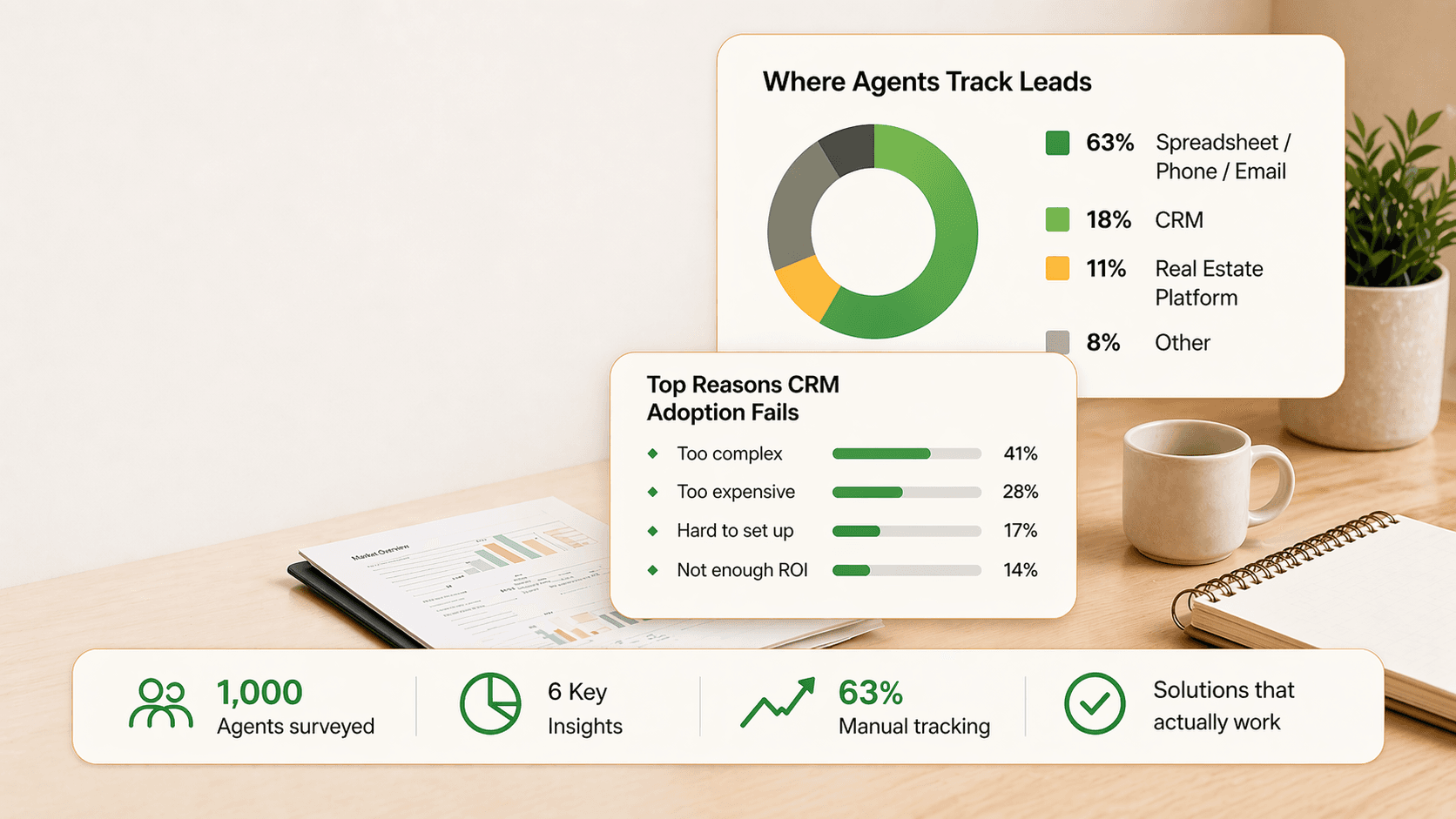
Despite CRM software being the second-highest source of quality leads in real estate, the majority of agents never build the habit of using one consistently. NAR's 2025 REALTORS Technology Survey — which compiled responses from 1,241 active agents — found that only 21% reported using a CRM with AI-powered insights, and just 23% said their CRM provided the highest volume of quality leads. Social media dominated at 39%, followed by local MLS at 17%. The picture this paints is not that agents lack awareness of CRM tools; it is that the tools haven't earned enough daily trust to become the first place agents look.
Stat: Only about 30% of real estate agents use a CRM consistently, even though CRM adoption leads to a 41% increase in lead conversions. — NAR 2025 REALTORS Technology Survey; industry research cited by Resimpli
The honest picture of where leads actually live for most agents is this: a mix of phone contacts saved as "Dan open house June," a spreadsheet that was last updated two weeks ago, and a Gmail inbox with 847 unread messages. This is not laziness. It is the rational result of adopting tools that impose more friction than they remove. The agents who do track leads in a CRM daily tend to close measurably more business — industry data shows CRM users experience a 41% lift in lead conversions — but getting to consistent daily use is the barrier most software products have failed to lower.
The clearest signal of where the industry stands: 46% of buyers say they only contacted one agent before committing, per NAR's 2025 Profile of Home Buyers and Sellers. That means the agent who responds first and follows up consistently wins the client by default, not by being the best negotiator or having the deepest market knowledge. The tracking system you use is not a back-office detail. It determines whether you are the first call back or the third.
Why CRM adoption fails
The failure of CRM adoption is not a real estate problem — it is a software design problem that hits agents harder than most users. Research compiled by Really Simple Systems found that 83% of senior executives across industries cite getting their staff to use CRM software as the single biggest challenge. In real estate, that stat is worse in practice because there is no manager enforcing the habit. The agent is both the executive and the staff.
The root cause is data entry. Salesforce's 2024 State of Sales Report found that the average sales rep spends only 28–30% of their week actually selling, with CRM administration consuming roughly 4.5 hours per week. For an agent who runs a one-person operation, that 4.5 hours represents roughly 11% of a 40-hour week — time that could otherwise go to prospecting, showing homes, or following up on warm leads. A 2024 industry survey found that 68% of sellers describe CRM data entry as their most time-consuming task, while only 2% say they trust the accuracy of the data they enter. The system asks for time without giving confidence in return.
Stat: 83% of senior executives report that getting staff to use CRM software is their biggest technology challenge. Less than 40% of CRM customers have end-user adoption rates above 90%. — Really Simple Systems; G2 CRM Research
The second failure mode is complexity. Sugar CRM's research found that 76% of CRM users cite the system's complexity or lack of user-friendliness as their primary frustration. Most CRMs were built for enterprise sales teams that have dedicated admins, ops staff, and IT departments. A solo real estate agent opening HubSpot or Salesforce for the first time faces the same interface as a Fortune 500 sales organization — hundreds of fields, pipeline stages, and settings that have nothing to do with booking a buyer consultation. The result is predictable: the agent logs a few leads, the system becomes partially populated and therefore unreliable, and by month two they are back to the spreadsheet. The spreadsheet never asks you to fill in 14 required fields before saving a contact.
What tracking in spreadsheets actually costs
The spreadsheet feels free. It costs you leads. The mechanism is response time, and the numbers make it concrete. MIT and InsideSales.com's Lead Response Management Study found that leads contacted within 5 minutes are 21 times more likely to qualify than leads contacted after 30 minutes. A separate Velocify study found that responding within the first minute produces a 391% improvement in contact rate compared to waiting just two minutes. Real estate agents average a 15-hour response time, according to Inman's 2025 Real Estate Technology Survey. At 15 hours, you are not competing for the lead — you are chasing a buyer who has already picked another agent.
The dollar translation is straightforward. If a Zillow lead costs $80, and a typical agent closes 1 in 66 leads (per Resimpli's 2025 industry data), the cost per closed deal from paid leads is roughly $5,280. Now factor in that 78% of buyers work with the first agent to respond, per NAR's 2025 Generational Trends Report. That means every lead your spreadsheet causes you to miss is not just a $80 line item — it is a fraction of a $10,000–$15,000 commission. For an agent generating 50 paid leads per month and closing at a 1.5% rate, a 15-hour response time versus a 5-minute response time likely represents 2–3 additional closings per year. At a median $15,000 commission, that gap is $30,000–$45,000 annually.
Stat: The average real estate agent takes 917 minutes — over 15 hours — to respond to a new lead inquiry, per Inman's 2025 Real Estate Technology Survey. MIT and InsideSales.com research shows a 21x qualification advantage for agents who respond within 5 minutes. — Inman 2025 Real Estate Technology Survey; MIT/InsideSales Lead Response Management Study
The specific tactic that closes this gap before any CRM upgrade: set up a two-step instant response system today. Step one — create a text message template that reads: "Hi [first name], this is [your name] from [brokerage]. I just got your inquiry about [address or area]. I have availability to talk in the next 30 minutes — would that work?" Set this to send automatically from your phone or a basic automation tool within 2 minutes of any web form submission. Step two — set a hard calendar block at 8 AM, 12 PM, and 5 PM daily labeled "Lead Check" where you process anything that came in since the last block. This alone will drop your average response time from 15 hours to under 4 hours without touching your CRM at all. The CRM upgrades the system further, but it is not the prerequisite.
What changes adoption behaviour
The agents who stick with a CRM long-term share one pattern: the system gives them something back immediately, not eventually. When you enter a lead and the system reminds you three days later with a pre-written follow-up message, you get direct value from the input you made. When you enter a lead and nothing happens, the input felt like filing. The behavioural research on habit formation is consistent here — reciprocity drives adoption. A tool that only takes data doesn't get used. A tool that converts your data into reminders, follow-up drafts, and lead scores earns continued use.
The second driver of adoption is mobile-first design. NAR's 2025 Profile of Home Buyers and Sellers found that 70% of buyers relied on mobile or tablet devices during their home search. Agents operate the same way — they are in their car between showings, on their phone between calls, not sitting at a laptop with good Wi-Fi. A CRM that requires desktop access to log a note, add a lead, or check a follow-up task will not get used in the field. The agents who report the highest daily CRM usage are consistently using mobile apps with voice-to-text logging or single-tap contact updates. When logging a lead after a showing takes 30 seconds instead of 4 minutes, it gets done.
The third factor is reducing required fields at the point of entry. Industry research on CRM design found that 43% of CRM users only use fewer than half the features they pay for, and 72% said they would trade functionality for ease of use. The practical application: when adding a new lead to your CRM, require only three fields — name, phone number, and source. Everything else (email, property preference, timeline, budget) gets added during the follow-up call. An incomplete record in your CRM is infinitely more valuable than a complete record in your head that disappears by Thursday.
The design problem with most CRMs
Most CRMs were not built for real estate agents. They were built for B2B sales teams with defined pipeline stages, quota systems, and dedicated data entry staff. When a product designed for a 50-person SaaS sales team gets rebranded with a "real estate" skin and sold to a solo agent, the underlying architecture doesn't change — and neither does the cognitive burden. The result is what researchers at CSO Insights call the "adoption death spiral": reps skip fields, data quality drops, managers (or in real estate, the agents themselves) stop trusting the system, reps have even less incentive to update it, and within 90 days the CRM is a ghost town with six leads in it from February.
The CRM failure rate across industries — estimated between 18% and 69% depending on how "failure" is defined — is not primarily a training problem. It is an architecture problem. Research shows that 22% of all CRM implementation problems are people-related or linked to user adoption, while the majority stem from poor implementation design, excessive complexity, and a lack of visible immediate value. For real estate specifically, the design mismatch shows up in four places: pipeline stages that don't map to a buyer's journey, follow-up sequences that require manual triggering, no integration with the portals (Zillow, Realtor.com) where leads actually come in, and no mobile-first interface for field logging.
Stat: 76% of CRM users cite complexity or lack of user-friendliness as their primary frustration. 72% say they would trade functionality for ease of use. — Sugar CRM; CSO Insights
The practical audit for your current CRM: open it right now and count how many clicks it takes to log a new lead from a Zillow inquiry. If the answer is more than three, your system is working against your adoption. The best-designed real estate CRMs in 2025 pull leads automatically from portals, pre-populate contact fields, and trigger an immediate text response without the agent doing anything. The agent's first interaction with the lead is a conversation, not a data entry task. That sequence — automation first, human second — is the design principle that actually drives consistent use.
What the solution looks like
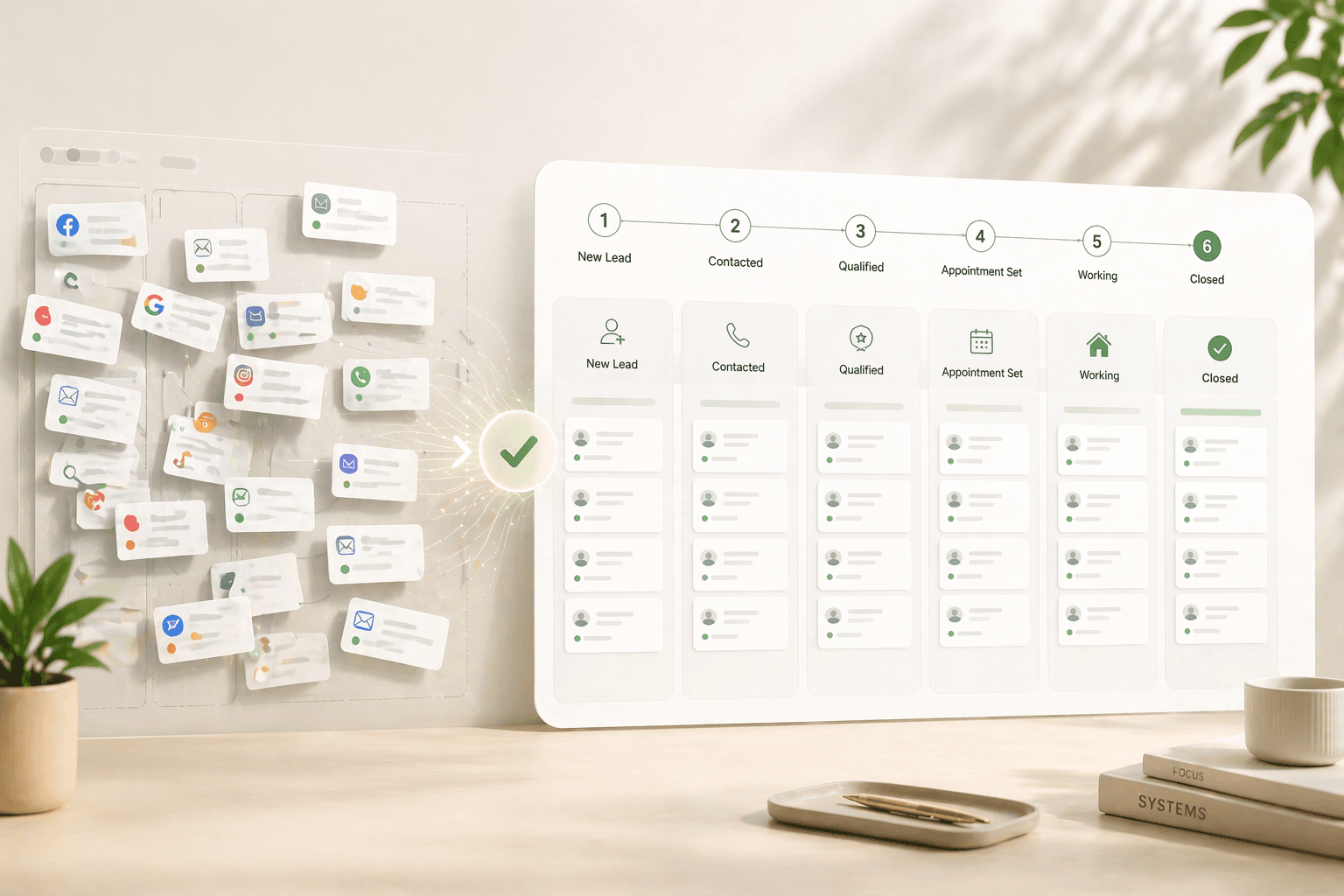
The agents who close the adoption gap don't change their personality or their work ethic. They change the sequence. Instead of generating a lead, manually copying it into a spreadsheet, and then remembering to follow up, they set up a system where the lead enters the CRM automatically, the first text message goes out within 90 seconds, and the agent's to-do list for the next 30 days is generated without any manual input. The CRM becomes the thing that does the remembering, not the thing that requires remembering to use.
The 30-day implementation that works for solo agents: Week 1 — Connect your lead sources (Zillow, Realtor.com, your website form) to your CRM so new leads populate automatically. Don't migrate old leads yet. Week 2 — Build three follow-up sequences: a 7-day new-lead sequence (day 1 text, day 2 email, day 4 text, day 7 call), a 30-day nurture sequence for leads not yet ready to transact, and a monthly "check-in" sequence for dead leads older than 90 days. Week 3 — Add every new lead exclusively through the CRM. Use the mobile app, voice-to-text, or a dedicated email address that auto-populates the system. Never add to the spreadsheet again. Week 4 — Review your pipeline for the first time. Filter by "last contacted more than 7 days ago" and work through that list. That filter alone will surface two or three warm leads you had mentally written off.
Pinova's platform pulls leads from Zillow, Realtor.com, and IDX websites directly into a contact record, fires an SMS response within 90 seconds of the inquiry, and generates a follow-up task sequence automatically — the agent's first required action is the qualifying call, not the data entry. The system captures the interaction log (texts, emails, call notes) against the contact record without the agent manually updating fields after each conversation.
| Key Statistic / Finding | Source & Year |
|---|---|
| Only about 30% of real estate agents use a CRM consistently | NAR 2025 REALTORS Technology Survey / industry analysis |
| CRM is the second-highest source of quality leads at 23%, behind social media at 39% | NAR 2025 REALTORS Technology Survey, HousingWire |
| The average real estate agent takes 917 minutes (over 15 hours) to respond to a new lead inquiry | Inman 2025 Real Estate Technology Survey, via AgentZap |
| Leads contacted within 5 minutes are 21x more likely to qualify than leads contacted at 30 minutes | MIT / InsideSales.com Lead Response Management Study, Dr. James Oldroyd |
| Responding within 1 minute produces a 391% improvement in contact rate vs. a 2-minute response | Velocify Lead Response Research, 2016 |
| 83% of senior executives say getting staff to use CRM software is their biggest technology challenge | Really Simple Systems CRM Research |
| Average sales rep spends 4.5 hours per week on CRM data entry; only 28–30% of their week is spent selling | Salesforce State of Sales Report 2024 |
| 76% of CRM users cite complexity or lack of user-friendliness as their primary frustration | Sugar CRM User Research |
| Agents who use CRM experience a 41% increase in lead conversions | Resimpli Real Estate Marketing Statistics 2025 |
| 78% of homebuyers end up working with the first real estate agent who responds to their inquiry | NAR 2025 Home Buyers and Sellers Generational Trends Report |
| 46% of real estate buyers only contacted one agent before committing to work with them | NAR 2025 Profile of Home Buyers and Sellers, via BAM |
| CRM adoption rates above 90% are associated with a 300% increase in conversion rates | CRM effectiveness research via Hey DAN |
Frequently Asked Questions
What percentage of real estate agents use a CRM?
Approximately 72.5% of real estate professionals have a CRM system in place, but only about 30% use it consistently on a daily basis. NAR's 2025 Technology Survey found that 23% of agents cite their CRM as the top source of quality leads — meaning even among those who have the software, a large share aren't extracting lead-generation value from it. The gap between having a CRM and using it effectively is where most agents lose deals.
Why do real estate agents still use spreadsheets instead of a CRM?
The core reason is that most CRMs impose more friction than they remove. Research by Sugar CRM found 76% of CRM users cite complexity as their primary frustration, and Salesforce's 2024 data shows that CRM data entry alone consumes 4.5 hours per week for the average sales professional. For a solo agent who is also doing showings, writing offers, and managing transactions, that administrative burden is enough to push them back to a spreadsheet — which, while less powerful, never requires logging in or filling out required fields. The agents who break this pattern are typically those who find or build a CRM that automates the data capture step so they never have to manually enter a lead.
How much faster do agents need to respond to leads to win more business?
Under 5 minutes is the research-supported target. MIT and InsideSales.com's Lead Response Management Study found that responding within 5 minutes makes you 21 times more likely to qualify a lead than responding at 30 minutes. Velocify's data goes further, showing a 391% improvement in contact rate when responding within 60 seconds versus 2 minutes. The average real estate agent responds in over 15 hours, per Inman's 2025 survey — meaning any agent who can consistently respond in under 30 minutes is already outperforming the vast majority of the market.
What is the best CRM for solo real estate agents?
The best CRM for a solo agent is one with three characteristics: automatic lead import from the portals you use (Zillow, Realtor.com, your website), a mobile app that lets you log contacts and notes in under 60 seconds, and built-in follow-up sequences that trigger without manual setup after each new lead. Beyond those requirements, the right answer depends on your budget and lead volume. Agents with fewer than 20 leads per month can often start with a simpler system and upgrade once their pipeline volume justifies additional features. The CRM you will actually use every day is more valuable than the most feature-rich system you open twice a month.
How long does it take for CRM adoption to show results in real estate?
Most agents who implement a CRM with automatic lead import and a follow-up sequence see measurable changes in response time and follow-up frequency within the first 30 days — because the automation removes the manual steps that cause delays. Conversion rate improvements typically become visible at 60–90 days, once the pipeline includes enough leads that have been nurtured through a full sequence. Industry research suggests agents with consistent CRM use (90%+ adoption) see a 300% improvement in conversion rates compared to inconsistent users, though that figure reflects the cumulative effect of systematic follow-up over time, not an immediate change.
Does using a CRM actually help real estate agents close more deals?
Yes, the data is consistent across multiple sources. Agents who use CRM systems report a 41% increase in lead conversions, per industry research. Separately, a 50% productivity improvement is attributed to consistent CRM use in real estate contexts. The mechanism is straightforward: a CRM ensures no lead goes uncontacted past a set threshold and no follow-up gets forgotten, which directly addresses the two most common reasons leads go cold. The 78% of buyers who hire the first agent to respond are won not by the best pitch, but by the system that sends the response.
What are the biggest reasons CRM implementations fail in real estate?
Three structural reasons account for most failures. First, excessive required fields at the point of entry — agents in the field won't complete a 12-field intake form after every inquiry; systems that require 3 fields or fewer see far higher consistent use. Second, no automatic lead import — if the agent must manually copy leads from Zillow or their inbox into the CRM, that step becomes the first thing dropped under time pressure. Third, no immediate value return — when the CRM only takes data and doesn't produce reminders, follow-up drafts, or lead prioritization, agents stop seeing a reason to maintain it. The 83% of executives who struggle with CRM adoption, per Really Simple Systems, are dealing with systems that demand input without delivering visible output to the individual user.
📚 Related Reading
- Real estate AI adoption report 2026: how agents are using automation to close more
- Why 70% of real estate leads are lost in the first 7 days (and what top agents do differently)
- How Google AI Overviews are changing real estate search — and which agents will win
- The state of real estate lead nurture in 2026: a benchmark report
Ayushman Singh
— Co-Founder & Chief Brand & Marketing OfficerAyushman Singh is the co-founder and Chief Brand & Marketing Officer of Pinova. He shapes the narrative, builds the brand, and tells the stories the industry doesn't want to hear. He believes the real estate system was designed to extract from agents, not empower them — and he's building the counter-narrative.