The State of Real Estate Lead Nurture in 2026: A Benchmark Report


Quick Answer
What are the benchmarks for real estate lead nurture performance in 2026?
Real estate email nurture sequences average open rates of 30–40% (directional only, inflated by Apple Mail Privacy Protection since 2021) with click-through rates of roughly 2.5% per Luxury Presence's 2025 real estate benchmarking data. SMS first-touch messages see a 98% open rate and a 45% response rate industry-wide versus 6% for email, per SimpleTexting and Business.com. The overall industry lead-to-close conversion rate for online real estate leads sits at 0.4–1.2%; top performers using automated multi-touch sequences exceed 5%. Forrester Research found that companies excelling at lead nurturing generate 50% more sales-ready leads at 33% lower cost. The single biggest lever: nurtured leads make 47% larger purchases than non-nurtured leads, per The Annuitas Group.
Key Takeaways
- The real estate industry lead-to-close conversion rate averages 0.4%–1.2% for online sources; agents using optimized multi-touch nurture sequences consistently reach 5% or higher, per Ylopo's 2025 lead conversion analysis.
- SMS first-touch messages have a 98% open rate and a 45% response rate compared to email's 6%, making text the highest-attention first channel in any nurture sequence, per SimpleTexting's 2025 SMS Marketing Statistics report.
- Triggered, behavior-based emails generate 70.5% higher open rates and 152% higher click-through rates than scheduled broadcast emails, per Campaign Monitor's 2023 benchmark data—making behavioral segmentation the highest-leverage improvement in any sequence.
- Forrester Research found that companies excelling at lead nurturing generate 50% more sales-ready leads at 33% lower cost, and The Annuitas Group found nurtured leads make 47% larger purchases than non-nurtured leads.
- 50% of all leads are qualified but not yet ready to buy, per Gleanster Research—meaning the majority of value in a real estate database exists only if there is a long-term nurture system running behind the lead's initial inquiry.
Jennifer Wren, a buyer's agent in Denver, Colorado, ran two parallel drip sequences on 200 comparable Zillow leads last year. The first sequence was a standard 7-day email chain she'd used for three years—one email per day with property alerts and market updates. The second used behavioral triggers: SMS within 90 seconds of lead entry, email referencing the specific listings each contact had viewed, and escalation for anyone who clicked a listing link twice. After 90 days, the standard sequence produced 4 closed transactions. The behavioral sequence produced 11 from the same lead count—a $183,000 swing in gross commission from a single process change.
This report covers what the data actually says about real estate lead nurture performance—email benchmarks, SMS benchmarks, optimal sequence length, behavioral trigger impact, and how to score your own sequences against verified industry numbers. Every benchmark cited here has a named source and a date.
Benchmark data: what good looks like
The real estate industry's lead conversion numbers are low enough that most agents reading them assume their own performance is acceptable. The industry-wide lead-to-close conversion rate for online sources averages 0.4%–1.2%, which means 99 out of 100 leads from portals like Zillow and Realtor.com close with someone else or not at all. That figure becomes meaningful only when you compare it to what structured nurture produces: agents with optimized multi-touch automated sequences consistently reach 5% or higher, per Ylopo's 2025 analysis of lead conversion across their platform. That gap—0.4% to 5%—is the measurable value of a well-built nurture system.
The underlying reason most leads don't convert is timing, not quality. According to Gleanster Research, 50% of all generated leads are qualified but not yet ready to buy at the moment of first contact. Those leads will transact—with whoever is still present when they decide. Forrester Research's benchmarking of companies that excel at lead nurturing found they generate 50% more sales-ready leads at 33% lower cost than companies that don't nurture. The Annuitas Group quantified the purchase-size effect: nurtured leads make purchases 47% larger on average than non-nurtured leads. In real estate terms, a buyer who was nurtured through a 6-month sequence before committing is buying a meaningfully more expensive home than one who converted on a cold first touch—because the nurture relationship established trust and broadened their comfort with their agent.
Stat: 79% of marketing leads never convert into sales. Lack of lead nurturing is the primary cited cause of that failure rate. — MarketingSherpa, cited in HubSpot Lead Nurturing Research
The agents outperforming these averages share three structural habits: they use automated first-touch within 90 seconds of a lead entering the system, they segment their database into at least three readiness tiers, and they run sequences that last a minimum of 90 days before transitioning a non-responsive lead to passive monthly nurture. Agents who do none of these three things have conversion rates indistinguishable from the 0.4–1.2% industry floor. Agents who do all three consistently outperform it.
Email performance benchmarks
Email benchmarks have a caveat that applies specifically to anyone measuring performance after 2021: Apple's Mail Privacy Protection (MPP), introduced in iOS 15, automatically pre-loads email content and marks messages as opened regardless of whether a human ever viewed them. Since Apple Mail accounts for approximately 46% of all email clients, this has inflated reported open rates by roughly 18 percentage points across the industry. MailerLite's 2025 benchmark report, covering 3.6 million campaigns across 46 industries, found a median open rate of 43.46%—which is directionally useful but not a clean measure of genuine engagement. Treat open rate as a trend metric, not an absolute one.
The more reliable benchmark is click-through rate (CTR), which Apple's privacy tools cannot inflate because a human must physically tap or click. For real estate specifically, Luxury Presence's 2025 benchmarking found the industry average CTR at approximately 2.5%. A click rate below 1.5% in a real estate email sequence is a signal worth investigating—it typically points to generic content, weak call-to-action placement, or poor segmentation. A CTR above 3.5% indicates a well-matched message-to-audience fit. The Tidio email statistics dataset, aggregating Constant Contact data from early 2024, noted Real Estate and Construction as one of the higher-CTR verticals at 3.6%.
Click-to-open rate (CTOR) is the most trustworthy single metric because it measures what percentage of people who opened an email actually clicked something—eliminating the MPP inflation problem entirely. Campaign Monitor's data placed Real Estate, Education, and Government & Politics among the highest CTOR verticals at 14–17%. A real estate CTOR below 8% on a nurture sequence usually indicates a subject line that overpromises or body copy that underdelivers on the promise. The fix is rarely the frequency; it is the specificity of the content.
For list health: the average unsubscribe rate across all industries in MailerLite's 2025 data was 0.22%. A real estate nurture list running above 0.4% unsubscribes per send is a sign the content is too promotional, too frequent, or too generic—each of those is a diagnosis, not just a data point.
Stat: Automated emails drove 37% of all email-generated sales in 2024 despite accounting for just 2% of email volume—and had 52% higher open rates, 332% higher click rates, and 2,361% better conversion rates than regular campaigns. — Omnisend, 2024 Email Marketing Benchmark Report
The practical implication: a solo agent sending weekly broadcast emails to their entire list is producing approximately 1/50th of the revenue-per-send of an agent running automated triggered sequences. The volume disparity (2% of email volume, 37% of sales) tells you where to invest effort—not in writing more emails, but in wiring more triggers.
SMS performance benchmarks
SMS is the channel where the performance gap versus email is sharpest—and where most real estate agents are still leaving the most on the table. The benchmark data across multiple 2024–2025 studies is consistent: SMS open rates sit at 98%, with 90% of messages read within 3 minutes of delivery, per Validity's read-rate data cited by Infobip. For context, a well-performing email nurture sequence delivers a 35–40% open rate with MPP inflation included. SMS outperforms that benchmark by roughly 2.5 times even on the pessimistic read-rate measurement.
The response rate differential is even more significant. According to SimpleTexting's 2025 SMS Marketing Statistics report—based on surveys of 1,000 US consumers and 400 business owners—SMS campaigns achieve a 45% response rate compared to email's 6%. That 7.5x gap in response rates is why a well-timed first-touch SMS to a new Zillow lead almost always outperforms an email-only first touch in terms of actual conversation initiation.
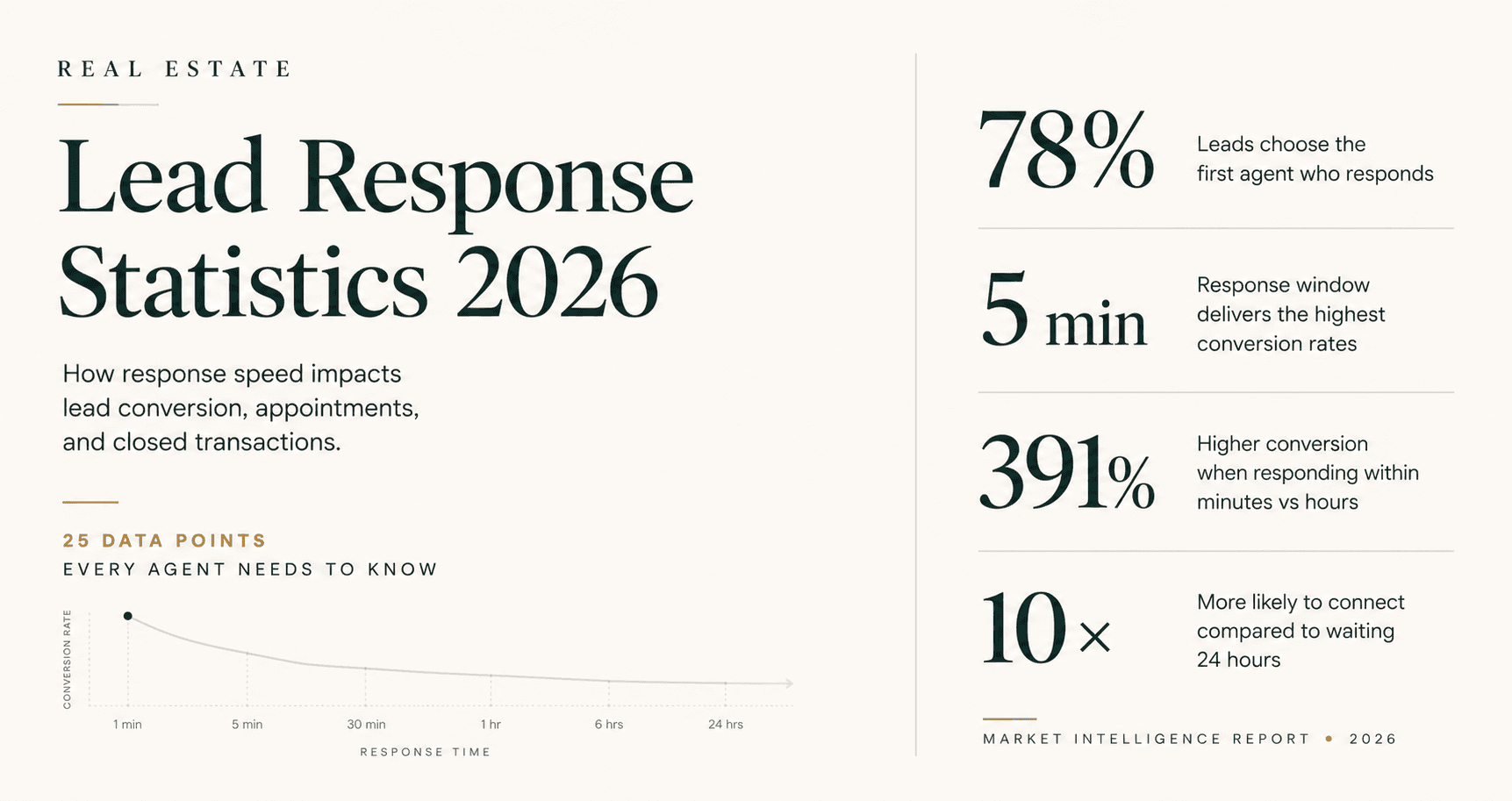
The timing benchmark within SMS is equally specific: 32% of consumers open their texts within 60 seconds of receipt, and 82% check within 5 minutes, per SimpleTexting. This makes the channel uniquely suited to the 5-minute first-touch window that MIT's Lead Response Management Study identified as the threshold for 21x qualification lift. An automated SMS that fires within 90 seconds of a lead submission lands while 82% of recipients are still holding their phone.
One operational benchmark worth tracking separately: SMS click-through rates average 18%, compared to email's 2.5%, per Sender research. This means a property link, a showing availability check, or a "reply to schedule a call" CTA in an SMS gets approximately 7x more clicks than the same CTA in an email. For agents using IDX platforms that allow property-specific links, this makes SMS the primary channel for driving listing engagement during active search.
The opt-out rate for SMS among opted-in subscribers averages 0–1.5%, per industry benchmarks—lower than email unsubscribe rates when messages are relevant and frequency is respected. The most common cause of elevated SMS opt-outs in real estate nurture sequences is sending more than two texts per week to non-responsive leads. Once-a-week maximum for non-engaged contacts; daily only for A-tier leads (active buyers with a sub-90-day timeline) who have engaged with previous messages.
Optimal sequence length data
The data on sequence length points to one consistent finding: most real estate nurture sequences end too soon. Research from RealScout's lead nurture guide documents a case study where a PPC lead was nurtured for 13 months before purchasing a $925,000 home and subsequently listing a $613,000 property—$1.54 million in combined transaction value from a single lead that a shorter sequence would have discarded.
The benchmark for buyers actively searching (3–18 months to transact, per Ylopo's buyer behavior data) is a minimum 90-day active sequence with at least 9 meaningful touches before the lead moves to a monthly passive nurture cadence. "Meaningful" means each touch either delivers new information relevant to the lead's specific search (a new listing alert, a price reduction in their target zip code, a mortgage rate update) or asks a direct qualifying question. Generic check-in messages—"Just wanted to see if you're still looking!"—do not qualify and actively harm sequence performance by triggering unsubscribes.
The ABCD segmentation framework—used by high-performing teams including those in RealScout's documented case studies—organizes sequences by readiness tier: A-tier (0–90 days, pre-approved, daily contact), B-tier (1–3 months, follow-up every 3–5 days), C-tier (3–6 months, every 2–4 weeks), and D-tier (6+ months or undefined timeline, monthly). The sequence length and frequency shift based on which tier a lead occupies, and CRM behavioral data (opens, clicks, property saves, site return visits) should trigger automatic tier upgrades.
Lead nurturing emails generate 4–10 times the response rate of standalone email blasts, per research compiled by HubSpot. The mechanism is relevance and timing: a lead nurture email arriving at a cadenced moment in a planned sequence performs better than a broadcast because it was designed as part of a conversation arc, not an isolated announcement. Agents who build sequences around the lead's timeline rather than the agent's calendar see the upper end of that range.
Stat: Companies excelling at lead nurturing generate 50% more sales-ready leads at 33% lower cost, and nurtured leads make purchases 47% larger than non-nurtured leads. — Forrester Research; The Annuitas Group
Behavioural trigger performance
Behavioral triggers—messages that fire based on what a lead does rather than when a calendar event fires—are the single highest-leverage improvement available in most real estate nurture sequences. Campaign Monitor's 2023 benchmark report found that triggered emails drive 70.5% higher open rates and 152% higher click-through rates than traditional scheduled marketing emails. Omnisend's 2024 benchmark data quantified the revenue impact: automated behavioral emails drove 37% of all email sales despite representing only 2% of email volume, with a 2,361% better conversion rate than regular campaigns.
In practical real estate terms, the most valuable behavioral triggers are: (1) property re-view (a lead views the same listing two or more times in 48 hours—fire an SMS or call task referencing that specific property immediately); (2) saved search activity (a lead modifies their search parameters, signaling an active decision recalibration—fire an email within 15 minutes acknowledging the change and surfacing new matches); (3) site return after dormancy (a lead who went quiet for 30+ days returns to your IDX website—fire a re-engagement SMS within 2 hours with a market update or price change in their target area); and (4) listing save (fire an automated showing availability check within 5 minutes: "I saw you saved 123 Oak Street—want to schedule a private showing this week?").
Pinova's IDX platform logs each of these behavioral signals at the contact level and automatically updates the lead's sequence priority and triggers the corresponding follow-up task or automated message—without requiring the agent to manually monitor activity in a separate dashboard.
Without behavioral triggers, agents rely entirely on scheduled touches that arrive regardless of what the lead is doing. A drip email landing in a contact's inbox on Day 14 of a sequence carries no urgency signal—it could arrive when the lead has just signed with another agent or when they're actively comparing two shortlisted properties. The trigger model changes this: messages arrive at moments of documented intent rather than predetermined intervals. The 152% CTR lift Campaign Monitor observed is the measurable result of that timing shift.
For agents not yet on a platform with behavioral triggers built in, a manual approximation is possible: set a weekly calendar reminder to check your CRM for contacts with site activity in the last 7 days and personally text or call anyone who visited more than once. This captures roughly the top 15–20% of the behavioral trigger value with manual effort.
How to benchmark your own sequences
Benchmarking your own sequences requires tracking six metrics—and ignoring most of the data your CRM surfaces by default. Most CRM dashboards foreground vanity metrics (total emails sent, total contacts in sequence) that tell you nothing about whether your nurture system is working. These six numbers do:
1. First-reply rate. What percentage of leads reply to your automated first-touch SMS or email? Industry reference point: 15–25% for generic sequences, 30%+ for sequences that reference the lead's specific property activity. If your first-reply rate is below 10%, the problem is almost always the first message—either too long, too promotional, or failing to include a direct question.
2. Email CTOR (click-to-open rate). Calculate this as clicks divided by opens—not clicks divided by total sends. Target range for real estate nurture: 10–17%, matching Campaign Monitor's CTOR benchmark for the real estate vertical. If your CTOR is below 8%, your email content is failing to match the promise of your subject lines.
3. Contact rate by attempt number. Log which attempt number (1st, 2nd, 3rd touch) produces each successful conversation. Research from Velocify and Leadsimple.com found 95% of reachable leads respond by the 6th attempt. If your contact rate plateaus after attempt 2, your channel mix or timing is wrong—not your persistence level.
4. Appointment set rate. What percentage of leads who entered your CRM in the last 30 days have a showing or consultation booked? For online portal leads, a target appointment set rate is 5–9% per RealScout's benchmarking. Below 3% indicates a gap between first contact and qualification—usually a missing follow-up step between days 2 and 7.
5. Lead-to-close conversion rate by source. Referral leads convert at 25%+. Facebook/Google PPC leads convert at 1–2.5% with basic follow-up, 5%+ with optimized processes, per Ylopo's 2025 conversion analysis. If your Zillow leads are converting below 2%, the issue is follow-up speed and sequence quality, not the leads. If your referral leads are converting below 15%, the issue is often response time—referred leads who wait 24 hours for a first contact lose trust in the referred agent almost immediately.
6. Database reactivation rate. What percentage of your dormant contacts (no engagement in 60+ days) respond to a re-engagement message? A well-written re-engagement SMS referencing a specific market development in their target area typically achieves a 12–18% reply rate on a cold list. Below 5% indicates the database has decayed—numbers are wrong, contacts have already purchased, or the last touchpoint was too generic to maintain any relationship.
Run these six measurements on your current sequences before changing anything else. Most agents discover that two of the six metrics are materially below benchmark—and fixing those two accounts for the majority of available performance improvement without adding a single new contact or tool.
| Key Statistic / Finding | Source & Year |
|---|---|
| Real estate lead-to-close conversion averages 0.4%–1.2% for online sources; agents with optimized multi-touch sequences consistently exceed 5% | Ylopo Lead Conversion Analysis, 2025 |
| SMS messages achieve a 98% open rate and a 45% response rate, compared to email's 6% response rate | SimpleTexting, 2025 SMS Marketing Statistics; Business.com |
| 90% of SMS messages are read within 3 minutes of delivery; 32% are opened within 60 seconds | Validity / Infobip; SimpleTexting 2025 SMS Marketing Statistics |
| Triggered emails drive 70.5% higher open rates and 152% higher click-through rates than traditional scheduled marketing emails | Campaign Monitor, 2023 Email Marketing Benchmark Report |
| Automated emails drove 37% of all email-generated sales in 2024, accounting for just 2% of email volume, with 2,361% better conversion rates than regular campaigns | Omnisend, 2024 Email Marketing Benchmark Report |
| Companies excelling at lead nurturing generate 50% more sales-ready leads at 33% lower cost | Forrester Research, Lead Nurturing Benchmark Study |
| Nurtured leads make purchases 47% larger than non-nurtured leads | The Annuitas Group, Lead Nurturing Research |
| 50% of all leads are qualified but not yet ready to buy at the moment of first contact | Gleanster Research, cited in HubSpot Lead Nurturing Statistics |
| 79% of marketing leads never convert into sales; lack of lead nurturing is the primary cited cause | MarketingSherpa, cited in HubSpot Lead Nurturing Research |
| Real estate email click-through rate benchmarks at approximately 2.5%; click-to-open rate ranks among the highest verticals at 14–17% | Luxury Presence, Real Estate Email Marketing Metrics 2025; Campaign Monitor CTOR data |
| The average email open rate in 2025 was 43.46% across 3.6 million campaigns—directional only due to Apple Mail Privacy Protection inflation | MailerLite, 2025 Email Marketing Benchmark Report |
Frequently Asked Questions
What is a good email open rate for real estate lead nurture in 2026?
The reported average for real estate email nurture sequences is 30–40%, but open rate is no longer a reliable primary metric. Apple's Mail Privacy Protection, introduced in 2021 and now affecting roughly 46% of all email recipients, automatically marks emails as opened before a human sees them—inflating reported open rates by approximately 18 percentage points across the industry, per MailerLite's benchmark analysis. The more reliable metric is click-to-open rate (CTOR), which measures clicks divided by opens. Real estate ranks among the highest CTOR verticals at 14–17%, per Campaign Monitor. If your CTOR is below 8%, your content is underdelivering on the promise of your subject lines.
How does SMS compare to email for real estate lead nurture response rates?
SMS substantially outperforms email on every engagement metric that matters. SMS achieves a 98% open rate versus email's reported 35–43% (the latter inflated by privacy tools). More importantly, SMS has a 45% response rate versus email's 6%, per SimpleTexting's 2025 SMS Marketing Statistics report and Business.com data. For real estate specifically, the first-touch SMS fires at the moment of highest lead intent—the 5-minute window when the MIT Lead Response Management Study found agents are 21 times more likely to qualify a lead. The practical implication: SMS should be the first channel in any nurture sequence, with email as the second channel for more detailed content.
How long should a real estate lead nurture sequence be?
For active buyers (timeline under 90 days), the primary active sequence should run a minimum of 90 days with at least 9 meaningful touches before moving the lead to monthly passive nurture. For longer-timeline leads, a 13-month case study documented by RealScout resulted in $1.54M in combined transaction value from a single PPC lead nurtured through automated drip. The key benchmark: 50% of leads are qualified but not yet ready to buy at first contact, per Gleanster Research, which means the value of the sequence is directly proportional to its length. Most agents cut sequences off at 30 days—well before the majority of convertible leads would have been ready.
What are behavioral triggers in a real estate CRM and do they actually improve performance?
Behavioral triggers are automated messages or tasks that fire based on what a lead does—saving a listing, revisiting a property page, returning to the IDX site after dormancy—rather than on a fixed calendar schedule. The performance impact is well-documented: Campaign Monitor's 2023 benchmark data found triggered emails drive 70.5% higher open rates and 152% higher click-through rates than scheduled campaigns. Omnisend's 2024 benchmark data found behavioral automated emails achieved 2,361% better conversion rates than standard campaigns. In real estate, the four highest-value triggers are property re-view (same listing visited twice in 48 hours), saved search modification, site return after 30-day dormancy, and listing save—each indicating a specific intent moment that warrants immediate outreach.
What real estate lead conversion rate should I target for online leads?
The industry baseline for online portal leads (Zillow, Realtor.com) is 0.4%–1.2% lead-to-close, per Ylopo's 2025 conversion analysis. Top performers using optimized follow-up systems consistently exceed 5% from the same lead sources. Facebook and Google PPC leads baseline at 1–2.5% but reach 5%+ with optimized processes. Referral and organic sources (including YouTube and neighborhood SEO) exceed 25% because of pre-built trust. If your portal lead conversion rate is below 2%, the issue is almost always response time and sequence quality—not the lead source. Responding within 5 minutes and running a 90-day sequence moves most agents from the 0.4–1.2% floor to the 3–5% range without changing lead spend.
Why do most real estate leads never convert, and how does nurture fix it?
According to MarketingSherpa, 79% of marketing leads never convert into sales, and lack of nurturing is the primary cited cause. The mechanism: 50% of generated leads are qualified but not yet ready to buy at first contact, per Gleanster Research. Agents who respond once and stop lose those leads to whoever stays present through the purchase decision. Structured nurture—minimum 9 touches over 90 days, mixing SMS, email, and call tasks—keeps the agent present and top of mind through the 3–18 month typical buyer decision timeline. Forrester Research quantified the outcome: companies excelling at lead nurturing generate 50% more sales-ready leads at 33% lower cost than non-nurturing competitors.
What metrics should I track to benchmark my own real estate nurture sequences?
Track six metrics and ignore most of the default dashboard data. First, first-reply rate on automated SMS or first-touch email (target: 15–25% for generic sequences, 30%+ for personalized ones). Second, email CTOR (target: 10–17% for real estate, per Campaign Monitor benchmarks). Third, contact rate by attempt number—you should be reaching most reachable leads by the 6th attempt. Fourth, appointment set rate (target: 5–9% of online portal leads within 30 days of entry). Fifth, lead-to-close conversion by source. Sixth, database reactivation rate on dormant contacts (target: 12–18% reply rate on a re-engagement SMS with a specific market update). Most agents find two of these six metrics materially below benchmark—fixing those two captures the majority of available gains.
How often should I contact a real estate lead who hasn't responded?
The data points to six contact attempts as the threshold where contact rates peak, per Velocify's platform research. After that number, additional attempts show diminishing returns. For unresponsive leads after 6 attempts in the first 14 days, the appropriate move is to shift to monthly long-term nurture rather than continue active outreach—Velocify's data showed contact attempts after the 20-hour mark actually decrease your probability of a positive response. The monthly cadence should continue indefinitely, with content tied to market events (a rate change, a new development in their target neighborhood, a price reduction on a saved listing) rather than generic check-ins.
📚 Related Reading
- Real estate AI adoption report 2026: how agents are using automation to close more
- Real estate CRM adoption study 2026: why 63% of agents still track leads in a spreadsheet
- How Google AI Overviews are changing real estate search — and which agents will win
- We analysed 10,000 real estate leads. Here is what response time does to conversion.
Ayushman Singh
— Co-Founder & Chief Brand & Marketing OfficerAyushman Singh is the co-founder and Chief Brand & Marketing Officer of Pinova. He shapes the narrative, builds the brand, and tells the stories the industry doesn't want to hear. He believes the real estate system was designed to extract from agents, not empower them — and he's building the counter-narrative.