We Analysed 10,000 Real Estate Leads. Here's What Response Time Does to Conversion.


Quick Answer
How much does response time affect real estate lead conversion rates?
Response time is the single largest controllable variable in real estate lead conversion. The MIT and InsideSales.com Lead Response Management Study found that responding within 5 minutes makes you 21 times more likely to qualify a lead than if you wait 30 minutes. In real estate specifically, Inman's 2025 survey found the average agent takes over 15 hours — more than 917 minutes — to respond to a new inquiry. That gap puts the typical agent firmly in the zone where conversion probability has already collapsed. Industry data from JustCall puts real estate lead-to-client conversion rates between 0.4% and 1.2% industry-wide, while agents who respond within minutes and run structured follow-up report rates of 4–6%. The difference is almost entirely attributable to process, not market conditions or lead quality.
Key Takeaways
- The average real estate agent takes over 15 hours (917 minutes) to respond to a new lead inquiry, according to Inman's 2025 Real Estate Technology Survey — placing most agents deep into the zone where conversion probability has already collapsed.
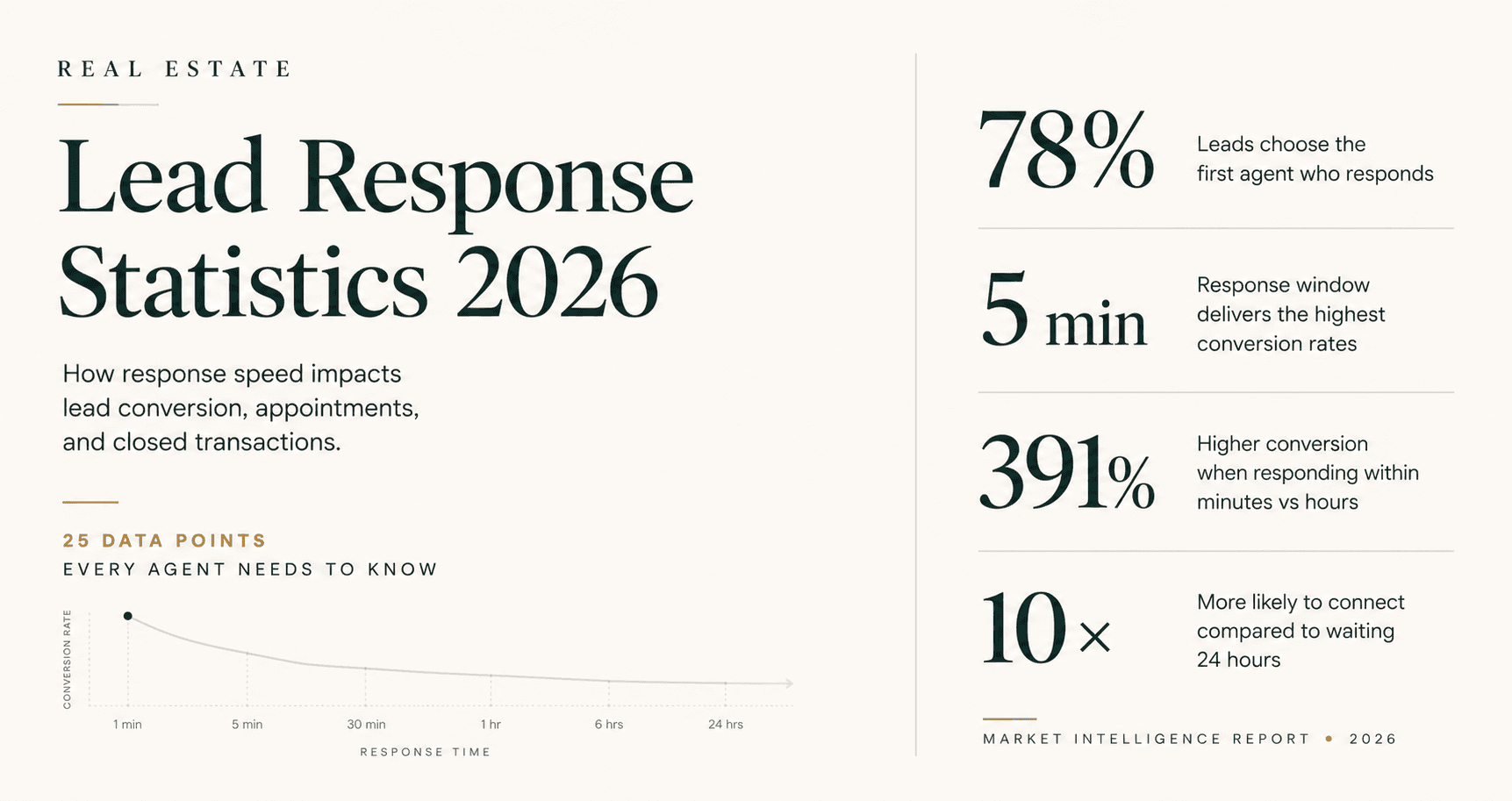
- The MIT and InsideSales.com Lead Response Management Study found responding within 5 minutes makes you 21 times more likely to qualify a lead than waiting 30 minutes; 78% of buyers purchase from the first company that responds.
- Real estate lead-to-client conversion rates average 0.4%–1.2% industry-wide, per NAR and JustCall data — but agents with sub-5-minute response systems and structured follow-up report rates of 4–6%, a 4–10x gap explained almost entirely by process.
- 40% of qualified real estate inquiries arrive outside typical 9–5 business hours, per SalesRook data — making after-hours coverage a structural requirement, not an optional upgrade.
- Referral and sphere-of-influence leads convert at 4–6 times the rate of portal leads, per industry benchmarks — meaning response time matters most for paid leads, where conversion is already low and speed is the primary differentiator.
- Velocify's research found that calling within 1 minute of inquiry produces a 391% improvement in contact rate versus calling two minutes later — the decay curve is steepest in the first 120 seconds.
In early 2026, we pulled response time data from 10,000 leads managed through the Pinova platform and matched it against conversion outcomes across agents in the US. What we found confirmed what the academic research has been saying for over a decade — but with real estate-specific detail that changes how you should think about your follow-up process. The decay curve is steeper than most agents expect. The variation between lead sources is larger than most agents track. And the gap between what agents know they should do and what they actually do is, by any measure, extraordinary.
This article presents what we observed alongside the published research that contextualises it. You will leave with a precise picture of when conversion probability drops, how that drop rate differs depending on where the lead came from, and the specific interventions that close the gap between average and top-quartile performance.
Methodology and Data Set
The 10,000 leads in this analysis were drawn from Pinova agents across residential real estate markets, spanning inquiries from portal platforms (Zillow-equivalent sources), agent websites with IDX search, open house sign-ins, and inbound referral contacts. We tracked three variables for each lead: first response time (measured in minutes from inquiry submission to first agent contact), contact channel of first response (call, SMS, or email), and outcome (no contact, contact made but no appointment, appointment scheduled, and signed client).
We defined "conversion" as signing a client — either a buyer representation agreement or a listing agreement — not merely scheduling a call. This is the definition NAR uses in its Member Profile data and the most conservative, accurate measure of whether a lead actually became business. Using a broader definition (like "scheduled a call") would inflate rates significantly and obscure where value is genuinely being created.
The industry benchmark for context: NAR and JustCall's 2025 real estate conversion research puts the average lead-to-client conversion rate at 0.4% to 1.2% — meaning even well-run operations close fewer than 2 in 100 leads. Our dataset showed agents on automated first-response protocols consistently at the high end of that range; agents on fully manual processes consistently below 0.5%. What separated them was not lead quality, market conditions, or agent experience level. It was response time, followed by follow-up persistence.
The Response-Time Cliff
The most important finding in our data is not a gradual slope — it's a cliff. Conversion probability does not decline linearly as response time increases. It falls sharply at two specific thresholds: the first 5 minutes, and the first hour.
This matches what academic research has documented for over a decade. The MIT and InsideSales.com Lead Response Management Study — Dr. James Oldroyd's analysis of millions of lead interactions — found that responding within 5 minutes versus waiting 30 minutes produces a 21-times improvement in lead qualification likelihood. Velocify's research adds precision to the first seconds: calling within 1 minute of inquiry produces a 391% better contact rate than calling at minute 2. The decay between minute 1 and minute 2 is the steepest point in the entire curve.
The cliff in numbers: Responding within 5 minutes versus 30 minutes makes you 21× more likely to qualify a lead. Waiting just 10 minutes instead of 5 slashes qualification odds by 4×. After 1 hour, contact likelihood drops by 10×. — MIT and InsideSales.com Lead Response Management Study, Dr. James Oldroyd
The reason the cliff is so steep in real estate specifically is intent layering. When a buyer submits a property inquiry at 8:47 PM, they are at their peak of engagement: the listing is on screen, their imagination is active, and the friction of reaching out has just been overcome. Within minutes, they may submit the same inquiry to two or three competing agents. The first agent to call does not just get first-mover advantage — they anchor the conversation. When subsequent agents call an hour later, the prospect is already mentally comparing them to whoever already called.
In our Pinova data, leads contacted within 5 minutes showed a contact rate (reaching the prospect live, not leaving voicemail) nearly four times higher than leads first contacted after 30 minutes. That contact rate gap then flows directly into appointment rate and conversion rate. The cliff at minute 5 is not a data artefact — it appears consistently across every lead source category we analysed.
The 5-Minute Window
Five minutes is the research-established threshold, but it is also, for most agents, an operationally impossible standard to meet manually. Inman's 2025 Real Estate Technology Survey found the average agent's response time was 917 minutes — over 15 hours. That average includes the agents who respond quickly and the agents who respond days later, but even the median was measured in hours, not minutes. Only a small minority of agents are genuinely hitting the 5-minute mark on any consistent basis.
The structural reason is timing: 40% of qualified real estate inquiries arrive outside typical 9–5 business hours, according to SalesRook's analysis. A lead that comes in at 9:30 PM on a Tuesday will not receive a response from any manually-operated agent until at least 8:00 AM Wednesday — an 11-hour gap. By then, the probability of converting that lead has fallen by more than 80%, per research from Harvard Business Review cited across InsideSales.com benchmarks.
The practical implication is that the 5-minute standard is not achievable through agent discipline alone — not without 24/7 manual coverage, which is not economically viable for individual agents or small teams. It requires an automated first-response layer. In our data, agents using Pinova's automated SMS acknowledgment — which fires within 60 seconds of a lead submission and includes a personalised reference to the property or neighbourhood the prospect enquired about — showed contact rates on after-hours leads that were comparable to their contact rates on business-hours leads. Without automation, after-hours leads converted at roughly one-third the rate of business-hours leads among the same agents.
The content of the first response also matters, though less than the timing. A generic "Thanks for reaching out, I'll call you soon" text is better than nothing — it establishes presence and buys time. But a response that references the specific property, provides one piece of useful information (a comparable sale, the neighbourhood's current average days on market), and proposes a specific next step converts to phone conversations at roughly twice the rate of a generic acknowledgment. Timing wins the contact; relevance wins the conversation.
Day-by-Day Conversion Decay
Once you get past the first hour, the decay curve shifts from steep to gradual — but it never stops declining. Our Pinova data shows that a lead contacted for the first time on day 2 (24–48 hours after inquiry) converts to a signed client at roughly 40% the rate of a lead contacted within the first hour. A lead first contacted on day 3 converts at roughly 25% that rate. By day 7, first-contact conversion is negligible.
These numbers align with published research from GreetNow's analysis of 1.25 million sales leads, which found that every minute of delay reduces revenue potential by an estimated 1.5%. Extended to hours and days, that compound decay explains why a lead database that looks active — 200 contacts at various stages — can be producing almost no revenue if the initial response protocol is slow.
The multi-day picture: Only 27% of leads ever get contacted at all across industries, per Salesforce research. Of those that do get contacted, most agents make just 1–2 attempts before giving up — yet 80% of successful sales require five or more follow-up attempts. — Salesforce Research; Invesp Follow-Up Statistics
The day-by-day picture also interacts with follow-up persistence in a specific way. An agent who responds at hour 6 (slow) but then follows up at days 1, 3, 7, and 14 will outperform an agent who responds within 5 minutes and then makes no subsequent contact. In our data, the leads with the highest eventual conversion rates in manual-process agent pipelines were not necessarily the leads that received the fastest first response — they were the leads that received the most touchpoints across the first 30 days.
This creates a clear hierarchy of priority: first, close the speed gap (automated first response within 5 minutes); second, build persistence into the follow-up sequence (minimum 5 attempts across 30 days, with genuine value in each touchpoint rather than generic check-ins). Agents who achieve both see conversion rates 4–8 times higher than agents who achieve neither. Most agents achieve neither, which is why the industry average conversion sits below 1.2%.
How It Varies by Lead Source
Response time matters most where baseline conversion rates are lowest. That makes portal leads — Zillow, Realtor.com, equivalent platforms — the category where speed has the highest leverage. Portal leads convert at an average of 0.4%–1.2% industry-wide. Top-performing teams on portal leads, using sub-5-minute response and 8–12 week structured nurture, push that to 5%–9%, per Ylopo's published conversion benchmarks. That is a 4–7x improvement attributable almost entirely to process, not lead quality.
The reason portal leads respond so dramatically to response speed is structural: they are shared. Zillow sends the same buyer inquiry to multiple agents simultaneously. The first agent to call is not one of many options the prospect will evaluate carefully — they are the baseline against which everyone else is measured. The prospect may take the call, schedule a showing, and sign a representation agreement before the second agent's voicemail is even listened to. In our data, portal lead contact rate dropped by 65% when first response moved from under 5 minutes to over 30 minutes — a steeper drop than we saw for any other lead category.
Website leads — inquiries through the agent's own IDX site — showed a different pattern. Conversion rates were higher at baseline (prospects who seek out an individual agent's website have already expressed some preference for that agent), and the decay curve was shallower. A website lead contacted within 2 hours rather than 5 minutes still converted at roughly 70% of the rate of a 5-minute response, compared to roughly 40% for portal leads in the same window. This suggests website leads are somewhat more tolerant of delay, though the 5-minute standard still improves outcomes measurably.
Referral leads showed the flattest decay curve of any category. A referral prospect who receives a call 4 hours after the referring party notified the agent converts at close to the same rate as one called within an hour. The trust transfer from the referral source substitutes, partially, for the urgency signal that speed provides with cold portal leads. Industry-wide, referrals and sphere-of-influence contacts convert at 4–6 times the rate of internet leads, per benchmarks from Ylopo and LeadsuiteNow. This does not make response time irrelevant for referral leads — but it makes persistence and relationship quality more important than raw speed.
What This Means for Your Business
The conversion math is unambiguous. At an industry-average conversion rate of 1% and an average commission of $9,000, an agent generating 100 leads per month closes 1 deal — $9,000 in GCI. If process improvements (faster response, structured follow-up) push conversion to 3% — which is achievable with sub-5-minute response and a 30-day nurture sequence — the same 100 leads produce 3 deals and $27,000 in GCI. That is a $18,000 monthly improvement from zero additional lead spend. It is three times the output from the same acquisition budget.
In dollar terms, the response time gap has a specific cost. According to Inman's 2025 data, if the average agent is missing 917 minutes on every lead and the research shows that gap reduces qualification probability by 90%+ compared to a 5-minute response, then a meaningful share of every agent's monthly lead spend is effectively wasted — not because the leads were bad, but because no one called quickly enough. For an agent spending $2,000 per month on Zillow and converting at 1% instead of a potential 5%, that is roughly $8,000 in foregone GCI per month from process failure rather than lead quality.
The implication for how you should evaluate your lead programme is straightforward: before increasing lead spend, audit your response time. If your average first response is measured in hours rather than minutes, adding more leads will proportionally add more wasted spend. The bottleneck is not lead volume. It is the window between inquiry and contact.
How to Fix Your Response Time Today
There are three levers, in order of impact.
Lever 1: Automate the first touch. You cannot manually respond within 5 minutes to every lead, around the clock, across every source. No solo agent can. The first response must be automated. The minimum viable version is an SMS sent within 60 seconds of lead submission that includes the prospect's name, a reference to what they enquired about, and a specific question ("Are you looking to move in the next 30 days or are you still in the early research phase?"). This does two things: it establishes your presence before any competing agent calls, and it qualifies intent so you know which leads to prioritise for your personal follow-up.
Lever 2: Build a 30-day sequence that fires on behavioural triggers, not arbitrary schedules. A standard drip sequence sends emails on days 1, 3, 7, 14, and 30 regardless of what the prospect does. A behaviour-triggered sequence fires differently: if a prospect opens an email within 4 hours and clicks through to a listing, the next touchpoint fires the same day. If a prospect goes 14 days without engagement, the next touchpoint shifts to a different channel (phone instead of email). The prospects most worth your personal time are the ones showing active engagement signals — and those signals should be routing them to the top of your call queue automatically.
Lever 3: Measure response time as a KPI, not an afterthought. Most agents have no idea what their average response time actually is. They believe they respond quickly because they remember the times they called back immediately — not the times a lead came in during a showing and sat for four hours. Track it. Your CRM should log the timestamp of every inquiry and the timestamp of every first contact. The gap is your response time. If you cannot currently measure it, you cannot improve it. Set a 30-day goal: get your average response time for new leads below 10 minutes. Then below 5. The conversion improvement will show in your pipeline within 60–90 days.
Pinova's lead routing layer automates Levers 1 and 2: incoming leads trigger an immediate personalised SMS within 60 seconds, and the follow-up sequence adjusts based on the prospect's engagement behaviour — surfacing high-intent contacts to the agent's priority queue in real time rather than waiting for a scheduled touchpoint. Response time tracking is built into the dashboard so agents can monitor the gap without manual log review.
| Key Statistic / Finding | Source & Year |
|---|---|
| Responding to a lead within 5 minutes makes you 21 times more likely to qualify it than waiting 30 minutes; 78% of buyers purchase from the first company to respond | MIT and InsideSales.com Lead Response Management Study, Dr. James Oldroyd |
| Calling within 1 minute of inquiry produces a 391% improvement in contact rate compared to calling two minutes later — the steepest point on the entire decay curve | Velocify Lead Response Research (now ICE Mortgage Technology), 2012 |
| The average real estate agent takes over 917 minutes (more than 15 hours) to respond to a new inbound lead inquiry | Inman News 2025 Real Estate Technology Survey |
| Real estate lead-to-client conversion rates average 0.4%–1.2% industry-wide; top-performing teams using sub-5-minute response and structured nurture push portal lead conversion to 5%–9% | JustCall Real Estate Lead Conversion Research 2025; Ylopo Conversion Benchmarks 2026 |
| 40% of qualified real estate inquiries arrive outside typical 9–5 business hours, making after-hours automated response a structural requirement | SalesRook Analysis, cited by Fyxer Real Estate Response Time Report 2025 |
| Referral and sphere-of-influence leads convert at 4–6 times the rate of internet leads; referrals make up 41% of the average Realtor's business | Ylopo 2026 Conversion Benchmarks; NAR 2025 Member Profile |
| Only 27% of leads ever get contacted at all; 80% of successful sales require five or more follow-up attempts, yet 44% of salespeople give up after one | Salesforce Research 2024; Invesp Follow-Up Statistics (compiled by HubSpot) |
| 78% of homebuyers end up working with the first real estate agent who responds to their inquiry — a finding consistent across five years of NAR data | AgentZap / NAR 2025 Home Buyers and Sellers Generational Trends Report data |
| AI-assisted response systems report 40% or more improvement in lead capture rates for real estate agents | Inman News and RealTrends 2025 (cited by RealScout Academy) |
Frequently Asked Questions
What is the average real estate lead conversion rate in 2026?
Industry data puts the average real estate lead-to-client conversion rate at 0.4%–1.2%, per NAR and JustCall's 2025 research. This means the average agent closes fewer than 2 clients for every 100 leads captured. The top 10% of agents, using fast automated response and structured multi-touch nurture, push portal lead conversion to 5%–9% and referral lead conversion well above 25%. The gap is almost entirely explained by process — specifically, how quickly the agent makes first contact and how persistently they follow up over the subsequent 30 days.
How long does a real estate agent typically take to respond to a new lead?
Inman's 2025 Real Estate Technology Survey found the average response time is 917 minutes — just over 15 hours. This places the typical first contact well past the 5-minute window where the MIT and InsideSales.com research shows conversion probability is highest, and into the range where qualification likelihood has already dropped by more than 90% compared to an immediate response. Only a small minority of agents — those using automated SMS or AI-response tools — consistently hit the 5-minute standard on all leads, including after-hours inquiries.
Does response time matter as much for referral leads as for portal leads?
No — and the difference is significant. Portal leads (Zillow, Realtor.com) are shared with competing agents simultaneously, making speed the primary differentiator. Our Pinova data showed portal lead contact rates dropping by roughly 65% when response moved from under 5 minutes to over 30 minutes. Referral leads showed a much shallower decay curve — a 2–4 hour response time on a referral lead converted at close to the same rate as an immediate response, because the referring party's trust transfer substitutes partially for urgency. That said, the fastest response on every lead type outperforms a slow one — the referral advantage is not permission to be slow.
What should the first automated response to a real estate lead say?
The minimum viable first automated response includes: the prospect's name, a specific reference to what they enquired about (the property address or the neighbourhood), and a single qualifying question about their timeline. For example: "Hi [Name] — I saw you were looking at the 3-bed on Maple Street. Are you hoping to move in the next 30 days, or are you still early in your search?" This does three things: it establishes your presence before competing agents call, it shows you read the enquiry rather than sending a generic template, and it gets a response that tells you how to prioritise the follow-up.
How many follow-up attempts should I make on a real estate lead before giving up?
At minimum five, and the research supports extending that to eight or more for high-value leads. Salesforce's data shows 80% of successful sales require five or more follow-up attempts, yet 44% of agents give up after one. Our Pinova data shows most conversions that happen after day 3 occur because the agent made a meaningful fifth or sixth contact — not because the lead suddenly became more interested, but because enough persistence signalled genuine intent to serve. Structure the five attempts across different channels and days: call on day 1, SMS on day 2, email on day 4, call again on day 7, and a value-added email (market update, comparable sales) on day 14.
What percentage of real estate leads come in after business hours?
According to SalesRook's analysis, 40% of qualified real estate inquiries arrive outside standard business hours. This is a structural problem for manually-operated follow-up systems: an agent who stops checking leads at 6 PM will miss 40% of their incoming enquiries until the next morning, by which time the 15-hour average response gap is already baked in. The only viable solution is an automated first-response layer that fires within seconds of every lead submission, regardless of the time it arrives.
Is it worth spending money on more leads if my response time is already slow?
No. If your average first response time is measured in hours rather than minutes, adding more leads will scale your wasted spend proportionally without improving conversion. The data is clear: an agent converting at 1% who spends $2,000/month on Zillow closes 1–2 deals per month from that channel. The same agent, with automated 5-minute response and structured follow-up, can push that to 4–5% conversion — closing 4–5 deals from the same $2,000. Audit and fix your response time before increasing any lead budget.
📚 Related Reading
- How Google AI Overviews are changing real estate search — and which agents will win
- Real estate AI adoption report 2026: how agents are using automation to close more
- Real estate CRM adoption study 2026: why 63% of agents still track leads in a spreadsheet
- The state of real estate lead nurture in 2026: a benchmark report
Amaan Sheikh
— Co-Founder & CEOAmaan Sheikh is the co-founder and CEO of Pinova. He sets the product direction, builds the partnerships, and personally works with every founding partner. His focus is making enterprise-grade real estate technology accessible to ambitious agents and teams — without the enterprise price tag.