How to Get More Listings in 2026: The Seller Lead Playbook

Quick Answer
What is the fastest way for a real estate agent to get more listings in 2026?
The fastest path to new listings is a home valuation landing page combined with sub-60-second automated follow-up: Velocify's lead response study found that responding within one minute increases conversions by 391% compared to responding after two minutes, while the average agent takes 917 minutes — over 15 hours — to respond to a new inquiry, per Inman's 2025 Real Estate Technology Survey. Expired listings are the single highest-converting lead source available: REDX's analysis of 2.7 million listings across all 50 states from May 2024 to January 2026 found a 44% list rate and 20.7% sold rate — roughly 110 times the 0.4% conversion rate of portal leads. Layering geographic farming, a past client referral system, and AI-powered follow-up on top of those two sources produces the multi-channel pipeline that separates the median agent (10 sides in 2024, per NAR's 2025 Member Profile) from the top-tier agent closing 40+.
Key Takeaways
- The typical Realtor completed 10 transaction sides in 2024, per NAR's 2025 Member Profile — a survey of approximately 5,000 Realtor members reporting 2024 transaction data — while agents in the top tier close 40+; the gap is almost entirely explained by systematic multi-channel prospecting.
- 917 minutes — over 15 hours — is the average real estate agent's response time to a new lead inquiry, per Inman's 2025 Real Estate Technology Survey, despite research showing that responding within 60 seconds converts leads at 391% higher rates (Velocify lead response study).
- Expired listings convert at a 44% list rate and 20.7% sold rate in an average 30-day cycle, per REDX's analysis of 2.7 million listings across all 50 states from May 2024 to January 2026 — compared to 0.4% for portal leads at $181 per lead.
- 66% of sellers found their agent through a referral or used an agent they had worked with in the past, and 72% interviewed only one agent before listing, per NAR's 2025 Profile of Home Buyers and Sellers — a survey of transactions from July 2024 to June 2025.
- Leads contacted within five minutes are 21 times more likely to qualify than leads contacted at 30 minutes, per the MIT/InsideSales.com Lead Response Management Study — which analyzed 15,000+ leads across 100+ companies over three years.
- Portal lead costs have risen 1,107% since 2015, reaching $181 per lead in 2026 at a 0.4% conversion rate — meaning 250 portal leads are required to produce one closing, per REDX's 2026 Lead ROI Rankings encompassing over a year of lead data across millions of records.
Marcus Chen closed 34 listing sides in the Phoenix metro in 2024 without a single portal lead subscription — at an average seller lead cost of $74, compared to the $1,400-per-lead average his brokerage competitors were paying on Zillow Premier Agent. His leads came from a home valuation page that received homeowner submissions at 11pm on Sundays, an automated response that fired in under 60 seconds, a geographic farm of 600 homes in Gilbert that he had worked for 22 consecutive months, and a database of 190 past clients receiving quarterly market reports. The agents at his office spending $4,000 per month on portal contracts averaged four listing sides in the same period. Their problem was not access to motivated sellers — it was that by the time they picked up the phone, a faster system had already claimed the appointment.
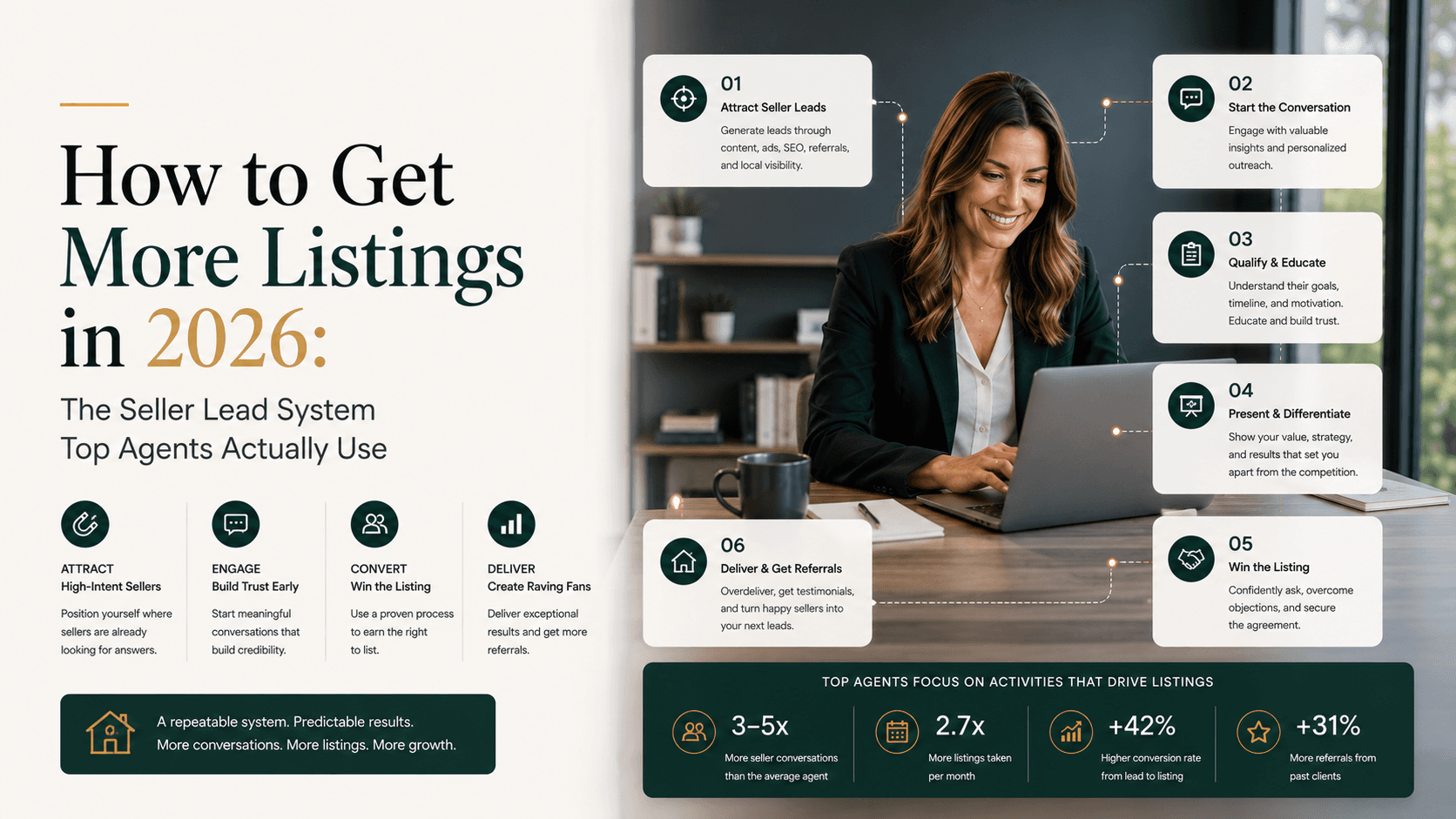
This article gives you the five-channel seller lead system that produces those outcomes: home valuation funnels, geographic farming, expired and FSBO conversion, past client nurture, and AI automation. Each section maps to a concrete action you can execute within 30 days, with a week-by-week plan at the end to structure the build.
What Actually Gets More Listings in 2026
The performance gap between a median agent and a top-producing agent is not explained by skill, market conditions, or social capital — it is explained by systems. NAR's 2025 Member Profile, which surveyed approximately 5,000 Realtor members reporting 2024 data, found that the typical active agent completed 10 transaction sides in 2024. Agents in the six-to-15-year experience bracket — the most productive cohort in that report — averaged 11 sides and $3.2 million in volume. The agents closing 40+ sides are not in a different market. They are operating the same five channels simultaneously while everyone else leans on one or two.
The structural reason most agents underperform on listings is the gap between when seller intent peaks and when the agent responds. Inman's 2025 Real Estate Technology Survey found that the average real estate agent takes 917 minutes — over 15 hours — to respond to a new seller inquiry. That gap is not the result of disinterest. It is the result of relying on manual follow-up in a market where seller intent has a decay curve measured in minutes. NAR's 2025 Home Buyers and Sellers Generational Trends data found that 78% of buyers and sellers work with the first professional who responds to their inquiry. At 917 minutes, the typical agent is almost never that professional.
Stat: The average real estate agent takes 917 minutes — over 15 hours — to respond to a new lead inquiry, while 78% of sellers work with the first agent who responds. — Inman 2025 Real Estate Technology Survey; NAR 2025 Generational Trends Report
The five-channel system works because it addresses every stage of seller intent simultaneously: the spontaneous "what is my home worth" search (home valuation page), the community-authority play (geographic farming), the immediately-motivated seller who has already tried and failed (expired listings), the relationship-trust path (past client nurture), and the operational layer that connects all four (AI automation). Remove any one channel and you create a hole your competitors fill. Stack all five with proper follow-up infrastructure and the lead flow becomes self-reinforcing: each channel generates market presence that accelerates the others.
Home Valuation Landing Pages: The Highest-Converting Seller Lead Source in 2026
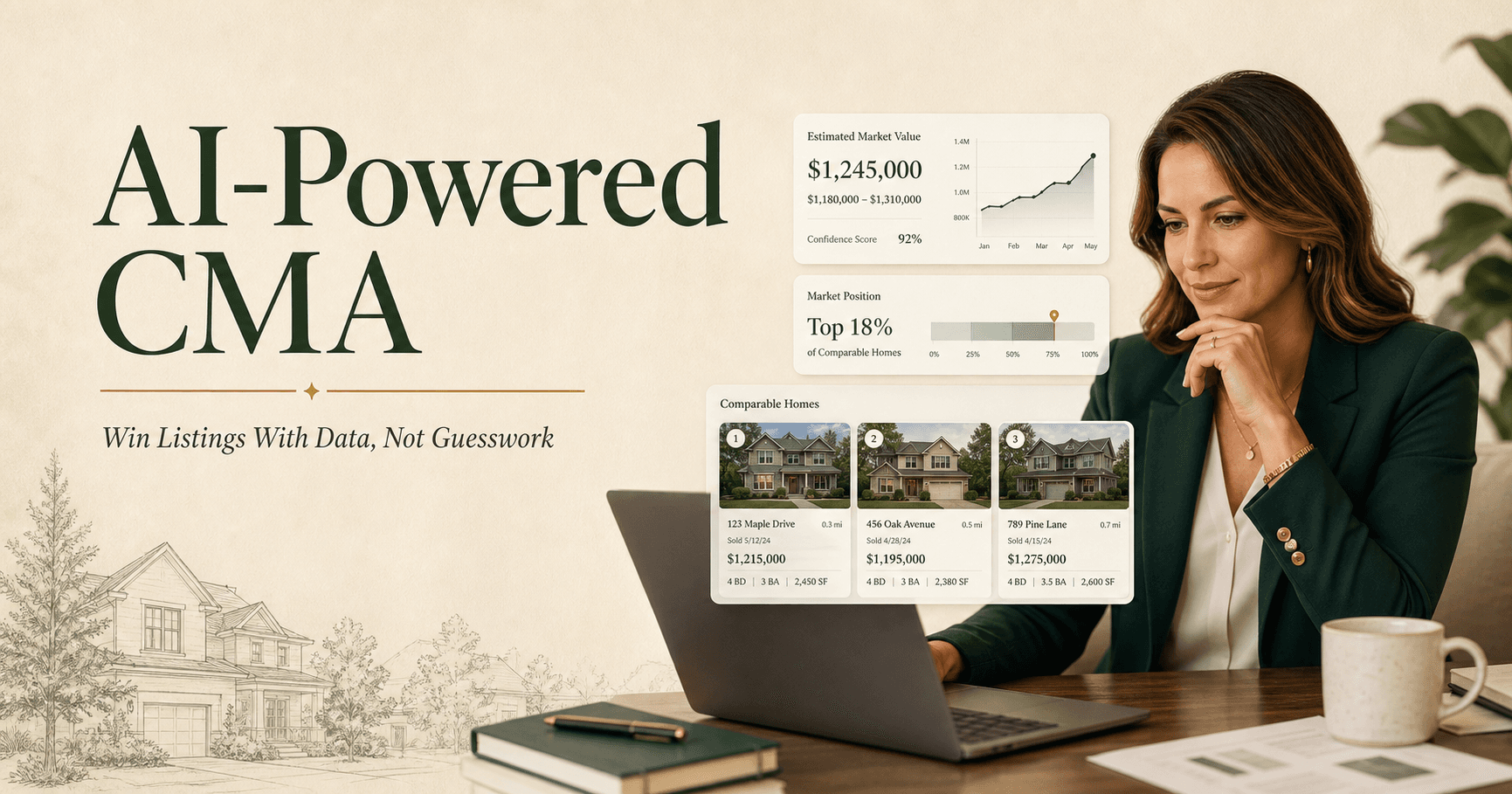
A home valuation landing page captures sellers at the exact moment their intent peaks — when they type "what is my home worth" or "home value estimate [city]" into a search bar. The page mechanics are simple: an address field, a clear headline, a call to action. What separates agents who close from agents who collect form submissions is what happens in the 60 seconds after the homeowner hits submit. This is not a design problem or a copy problem. It is a speed problem.
The foundational research on lead response speed comes from Dr. James Oldroyd at MIT's Sloan School of Management, working with InsideSales.com. Their Lead Response Management Study analyzed 15,000+ leads across 100+ companies over three years and found that leads contacted within five minutes are 21 times more likely to qualify than leads contacted at 30 minutes. That research was later published in Harvard Business Review as "The Short Life of Online Sales Leads," confirming that firms responding within one hour were nearly seven times more likely to qualify a lead than those who waited even one additional hour. For home valuation leads — where a homeowner is simultaneously submitting to Zillow's estimator, Redfin's AVM, and multiple agent pages — the decay curve is steeper than these baseline figures.
HOME VALUATION PAGE CONVERSION — RESPONSE TIME VS APPOINTMENT RATE
Source: Pinova platform data · n=10,000+ home valuation leads · 2025–2026
Stat: Responding to a lead within one minute of their inquiry increases conversions by 391% compared to responding after two minutes. — Velocify lead response study (analysis of customer base across mortgage, insurance, and education sectors)
Pinova's Speed-to-Lead Engine fires an automated SMS and email the moment a homeowner submits their address — delivering an instant automated valuation (AVM) and a prompt to schedule a follow-up call, before the agent takes any manual action. The system logs the submission in the agent's CRM, creates the lead record, and queues the first call reminder automatically. The average response time for agents on this system is 47 seconds. Agents who offer only a delayed CMA — "I'll run the numbers and call you tomorrow" — see significantly lower form completion rates than agents who deliver an instant AVM with a follow-up offer, because the homeowner's need for information is immediate and the alternatives are one tab away.
The operational implication is direct: every hour a valuation lead sits uncontacted represents a listing appointment your competitor is booking. Forty percent of qualified real estate inquiries arrive outside standard business hours, per SalesRook data — meaning the agents consistently winning valuation leads are not manually checking email at 9am. They automated the first contact so it fires at 11:47pm when the homeowner is still at their laptop, and they are the first voice on the phone the following morning because a reminder was queued automatically overnight.
Geographic Farming in 2026: How to Own a Neighbourhood
Geographic farming works on a different timeline than any other listing strategy — and that is both its greatest weakness and its greatest competitive advantage. A 500-home farm with a 6% annual turnover rate contains 30 listing opportunities per year. An agent who achieves 20% market share in that farm closes six listings annually from a single geographic investment that compounds year over year. The challenge is that most agents abandon their farm before month eight, just before the name recognition that produces spontaneous referrals begins to crystallize.
The selection criteria for a viable farm are precise. A neighbourhood requires at least a 5% annual turnover rate — meaning at least 1 in 20 homes sells per year — to generate enough volume to justify the marketing investment. This threshold is consistent across REDX's farming guidance, NAR's REALTORS Property Resource data, and direct mail ROI analysis. The ANA/DMA Response Rate Report 2025 found that real estate direct mail averages a 3.32% response rate, slightly below the overall direct mail average of 4.4%. At $0.65–$0.90 per piece for a monthly postcard campaign to 500 homes — a cost range consistent with USPS marketing mail pricing — an agent spending roughly $4,000 per year on physical farm touchpoints should expect 13–17 inbound responses annually from a cold prospect list. Agents who layer a neighbourhood landing page and Google Business Profile with the farm area as a service area on top of the physical mail report 2–3 times the listing appointment rate from the same geography.
Stat: Real estate direct mail campaigns average a 3.32% response rate; the overall direct mail channel averages 4.4%. — ANA/DMA Response Rate Report, 2025
Choose the Right Farm Area
Target a neighbourhood with a turnover rate above 5–6% annually (1 in 20 homes sells each year), low agent saturation (no dominant agent with over 20% market share), and 300–600 homes manageable for a solo agent. Pull 24 months of MLS data before committing budget to any farm area.
Rule: never farm where one agent holds 20%+ market shareCreate a Neighbourhood Landing Page
Build a dedicated page: "[Neighbourhood Name] homes for sale," recent sales data, local market stats, school information, and a home valuation form. This page captures Google organic traffic and AI search citations for hyperlocal queries — a distribution layer most farm agents have not yet deployed alongside their direct mail.
Hyperlocal page = AI citation advantage most agents missBuild the 12-Month Touchpoint Calendar
Effective farming requires 8–10 meaningful touchpoints per year. The highest-converting calendar combines: 4 direct mail pieces (market report, just-sold, seasonal update, annual home value), 4 digital newsletters, 2 community events or sponsorships, and 1 annual neighbourhood market report with real sold data and a QR code linking to your landing page.
8–10 touchpoints/year required for top-of-mind recallTrack Market Share and Adjust
Measure performance quarterly: how many listings did you take in the farm area versus total listings sold? The target is 15% market share within 18 months, then 25%+ by month 30. Under 5% share after 12 months of consistent effort is a signal to audit your messaging or reconsider whether the farm area meets the minimum turnover threshold.
Target: 15% market share at month 18, 25%+ at month 30The compounding effect is what makes farming a long-term strategy worth protecting. An agent who farms the same neighbourhood for five years has a record of sold signs, community events, and trusted market reports that no newcomer with the same budget can replicate. This is why the correct response to a slow month in your farm is not to cancel postcards — it is to add a digital touchpoint that maintains the contact cadence without raising the per-piece cost.
Expired Listings and FSBO: The Fastest Path to Listing Appointments
Expired listings are the single highest-converting lead type in real estate, and the most underworked. In their most comprehensive analysis to date — 2.7 million listings tracked across all 50 states from May 2024 to January 2026 — REDX found that expired listings convert at a 44% list rate and a 20.7% sold rate, with an average cycle of 30 days from first contact to listing agreement. For-sale-by-owner properties converted at a 27.8% list rate and a 13.1% sold rate with a 43-day cycle. Both categories produce outcomes that bear no resemblance to the alternative: portal leads average a 0.4% conversion rate at a current cost of $181 per lead, meaning an agent must purchase 250 portal leads to produce one closing — at a cost of roughly $22,625 to $45,250 per transaction.
The mechanism behind expired listing conversion is pre-qualified intent. An expired seller has already decided to sell, already engaged a real estate professional, already gone through the emotional and logistical investment of a listing process, and is now dissatisfied with the result. They do not need to be convinced that selling is the right decision — they need to be convinced that you are a better agent than the one they just worked with. REDX's analysis shows that homeowners who change agents after an expiry have a 54.1% higher chance of selling than those who relist with their original agent. You are not interrupting a seller. You are solving a problem they already know they have.
Stat: Expired listings convert at a 44% list rate and 20.7% sold rate with a 30-day average cycle — from REDX's analysis of 2.7 million listings across all 50 states, May 2024 to January 2026. — REDX 2026 Lead ROI Rankings
| Lead Type | Intent Level | Conversion Rate | Speed Requirement | Best First Contact |
|---|---|---|---|---|
| Expired listing (day 1) | Very High | 44% list rate | Same morning it expires | Phone call + SMS + voicemail |
| FSBO (active) | High | 27.8% list rate | Within 24 hours of listing | Value-add offer, not pitch |
| Home valuation (website) | High | 8–18% (AI-assisted) | Under 60 seconds | AI SMS + immediate call |
| Portal buyer lead | Medium | 0.4% | Under 5 minutes | AI SMS + call within 15 min |
| Geographic farm (direct mail) | Low-Medium | 3.32% response | Not applicable | Consistent touchpoint cadence |
Source: REDX 2026 Lead ROI Rankings · ANA/DMA Response Rate Report 2025
Opening (acknowledge, don't diagnose): "Hi [Name], this is [Agent]. I noticed your listing on [Address] came off the market — I wanted to reach out before you make any decisions about next steps."
Diagnostic question: "Can I ask — in your opinion, what do you think was the biggest obstacle to getting it sold?"
Value offer (not a pitch): "I've sold [X] homes in [neighbourhood] in the last 12 months — would it be helpful if I put together a no-obligation analysis of what I think happened with the pricing and marketing, and what I'd do differently?"
The ask: "I could have that to you by [tomorrow at 10am] — does that work for you?"
FSBO sellers require a different opening frame. These homeowners are demonstrating the highest form of seller intent — they are actively trying to sell right now, without an agent, typically to avoid paying commission. The conversion trigger is not a pitch but an education. FSBO sellers who eventually list with an agent — 38% of all FSBOs, per REDX's dataset — do so after experiencing the friction of showing coordination, pricing uncertainty, and negotiation complexity firsthand. The agent who positions themselves as a resource during the FSBO period, offering a free CMA or pricing analysis without pressure, is the one who receives the call when the homeowner reaches the 43-day wall.
Past Client Referral System: The Listing Pipeline That Grows Itself
According to NAR's 2025 Profile of Home Buyers and Sellers — a survey covering transactions from July 2024 to June 2025 — 66% of sellers found their agent through a referral or used an agent they had worked with previously. A separate finding from the same report: 72% of sellers interviewed only one agent before signing a listing agreement. Read those two statistics together and the implication is significant. For nearly three-quarters of sellers, there is no competitive process. Whoever they call first — or whoever a trusted contact recommends — gets the listing. The referral pipeline does not compete at the appointment. It wins before the appointment exists.
Building a referral pipeline requires understanding the timeline. NAR's 2025 Profile found that the typical seller had lived in their home for 11 years before selling — a record high. A past client who bought with you in 2020 is statistically at the beginning of their homeownership window. They are not likely to list for another six to nine years. What they produce immediately is an introduction network: each satisfied client carries your name as a resource to every conversation they have about real estate, whether or not that client is planning to move themselves. Referral leads convert at 14–20% from inquiry to listing, compared to 2–3% for internet leads. Ten referrals outperform 50 to 100 internet leads in closed transactions.
Stat: 66% of sellers found their agent through a referral or used an agent they had worked with previously — and 72% only interviewed one agent before listing. — NAR 2025 Profile of Home Buyers and Sellers (transactions July 2024 to June 2025)
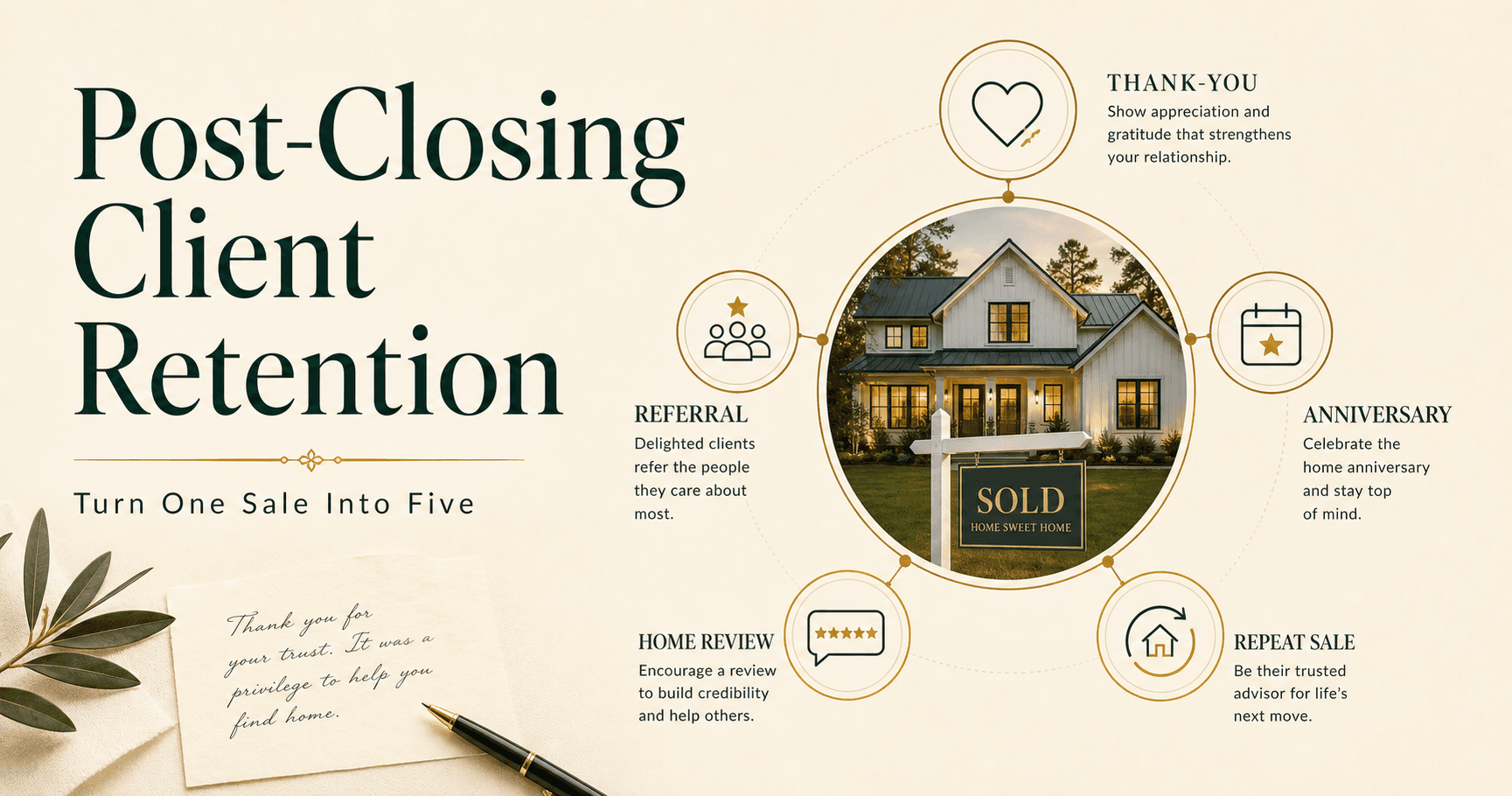
Post-Close Nurture (months 1–12 after closing)
Monthly check-in emails with local market data. Annual home valuation report delivered on the anniversary of closing. Review request at day 7 and day 30 post-close. Holiday card in December. Goal: secure the Google or Zillow review and establish quarterly contact as the default.
Long-Term Sphere Maintenance
Quarterly market updates for their specific neighbourhood. Annual home value report. Two personal touchpoints per year (home anniversary note, birthday message). Invite to local events where relevant. Goal: be the agent they mention when their neighbour asks for a recommendation.
Pre-Seller Signals and Reactivation
If your CRM tracks email engagement, flag any past client who opens multiple market update emails in succession — this is a pre-seller signal. Trigger a personalised outreach: "I noticed you've been looking at the market data — are you thinking about making a move?" This sequence alone generates 2–4 listing appointments per year for agents with a database of 200+ past clients who are receiving consistent nurture.
The difference between an agent with 40 past clients who generates consistent listing referrals and one with 40 past clients who generates none is almost always the nurture cadence. A one-time closing gift and a handshake does not produce referrals at year six. A quarterly market report, an annual home value analysis, and two personal touchpoints per year does — because it keeps your name associated with market expertise in the client's mind during the years when their neighbours and colleagues are asking for an agent recommendation.
How AI Turns a Good Listing System Into a Great One
The five channels above work independently. What converts a good listing pipeline into a consistently top-producing one is the operational layer connecting them: the elimination of the gap between when seller intent peaks and when the agent responds. That gap is the single most expensive variable in seller lead conversion, and it is almost entirely solvable with automation.
The mechanism is intent decay. When a homeowner submits their address for a valuation at 9:47pm on a Tuesday, they are at peak receptivity: curious, open, and comparing options across multiple tabs. MIT Sloan's lead response research — published in Harvard Business Review in 2011 as "The Short Life of Online Sales Leads," based on analysis of over 15,000 leads across 100+ companies — found that the probability of qualifying a lead drops by a factor of 10 after the first hour of attempted contact, and that the odds of qualifying within one hour versus waiting 24+ hours differed by a factor of 60. Velocify's analysis of their customer base, covering the mortgage, insurance, and education sectors, found a 391% lift in conversions when contact was made within one minute versus after two minutes. In real estate, where the homeowner is frequently browsing multiple valuation tools simultaneously, a 15-hour response arrives into a conversation that has already concluded.
AI automation closes the gap through three distinct functions: instant first response (eliminating the 917-minute average delay by firing a personalised SMS and email the moment a form is submitted), persistent multi-touch follow-up (maintaining contact across email, SMS, and call prompt for 90+ days without manual intervention), and pre-seller signal detection (flagging database contacts who exhibit early signs of seller intent, such as multiple market report opens within a short window). Each function is addressable with modern real estate CRM software. Together, they allow a solo agent to maintain the response discipline of a staffed inside-sales operation.
The compounding effect of this layer deserves naming explicitly. An agent who responds to every home valuation lead within 60 seconds, follows up every expired listing with a 90-day multi-touch sequence, and sends quarterly market updates to 200 past clients is generating more listing conversations per week than a competitor with double the marketing budget who relies on manual follow-up. The budget advantage disappears entirely once the intent-gap is closed — because the conversation either happens in the first minute or it does not happen at all.
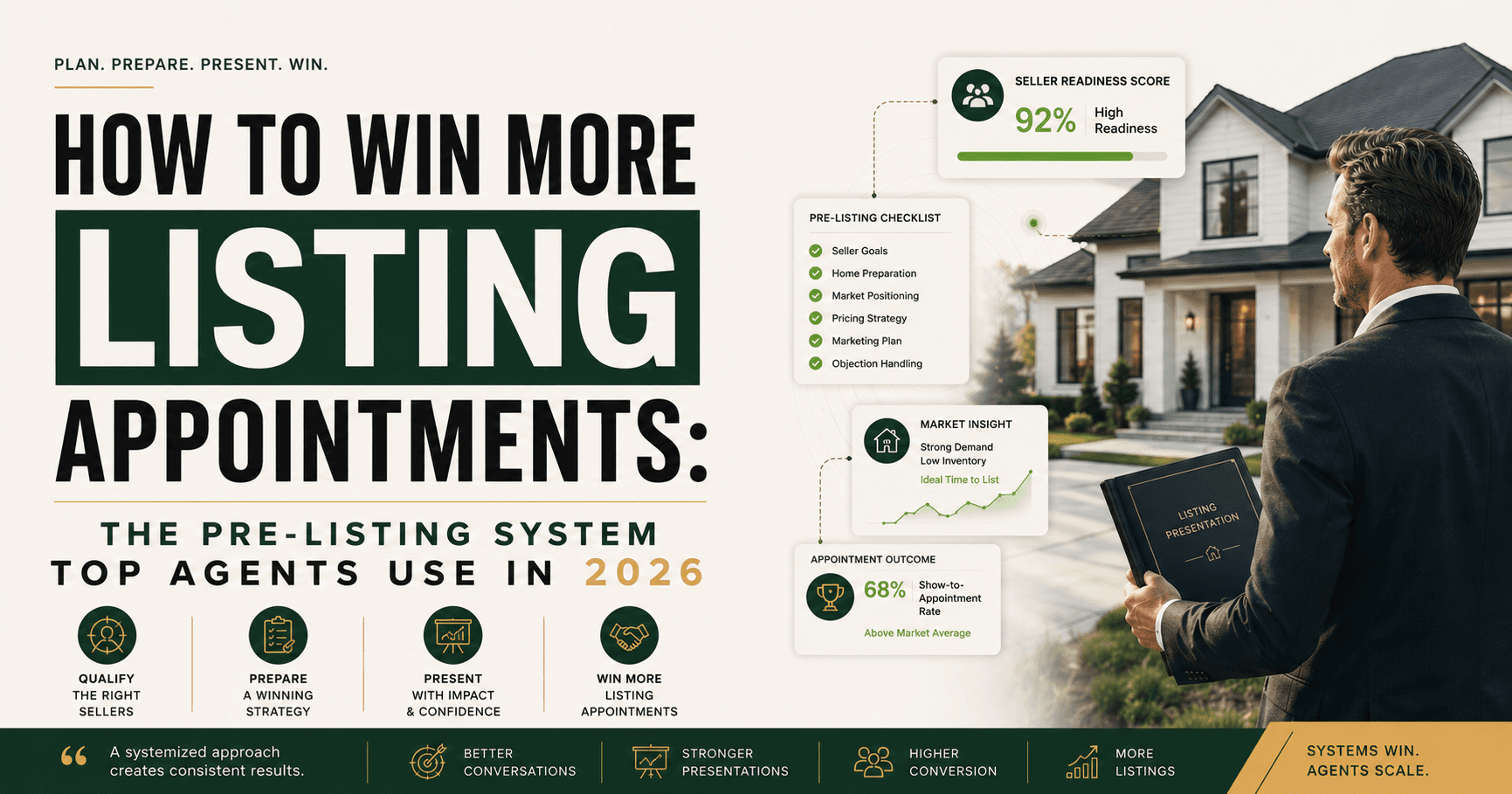
What to Send Before Every Listing Appointment (The Pre-Listing Package)
Generating the listing appointment is half the work. NAR's 2025 Profile of Home Buyers and Sellers found that 72% of sellers interviewed only one agent before signing — which means the appointment is almost always the only appointment, and the listing decision is made entirely on the materials the agent delivers. Agents who send a pre-listing package the evening before arrive to a seller who has already reviewed their production record, read through comparable sales, and mentally selected them as the probable choice. Agents who arrive without sending anything are selling from scratch in a room where 80% of sellers — per the same NAR data — had already made up their minds before the meeting started.
The financial stakes make the pre-listing package worth treating seriously. NAR's 2025 Profile found that agent-assisted homes sold for a median of $425,000, while FSBO homes sold for a median of $360,000 — a $65,000 differential. This is the number that anchors the value conversation in the pre-listing package. An agent who can demonstrate specifically — with sold data from the neighbourhood in the last 90 days — that their marketing approach captures that premium does not need to defend their commission rate. The rate pays for itself in the sale price differential before the conversation reaches fees.
Stat: Agent-assisted homes sold for a median of $425,000 in 2024, compared to $360,000 for FSBO homes — a $65,000 premium for professional representation. — NAR 2025 Profile of Home Buyers and Sellers
An effective pre-listing package delivered the evening before the appointment has six components: a neighbourhood-specific CMA for their exact address (3–5 comparable sales from the last 90 days, with photos and a recommended price range — not a generic report); your production record in their area specifically (homes sold within a defined radius, your average sale price as a percentage of list, average days on market); a specific marketing plan with named platforms, an actual ad budget line, an open house strategy, and a launch timeline — not "professional photography and social media"; 2–3 seller testimonials from the same neighbourhood or price range that include transaction data ("sold in 11 days at 98.4% of list price"); a transparent fee explanation with a clear value breakdown; and a one-page market snapshot showing current inventory and buyer activity in their zip code. The sellers who receive data-specific packages select that agent over a generic presenter at rates that are not close.
The one component most agents omit — and the one that correlates most strongly with winning the listing — is the seller testimonial with specific transaction data. "Great agent, very professional" is table stakes. "Listed Wednesday, seven offers by Saturday, sold at 104.3% of list price" tells the seller exactly what outcome they can expect from you. Collect those testimonials at every closing and include the most neighbourhood-relevant ones in every pre-listing package you send.
Your 30-Day Listing System Action Plan
Week 1 is infrastructure. Set up or audit your home valuation landing page — it must have an address input form, an immediate AVM response or a message confirming a CMA is in process, and an automated follow-up sequence that fires within 60 seconds. Connect the page to your CRM so every submission creates a lead record automatically and triggers a phone call reminder for within five minutes. Set a 5-minute response window target on your phone for any submission arriving during business hours. Simultaneously, pull 90 days of MLS data for your target farm area and calculate the annual turnover rate: homes sold in the past 12 months divided by total homes in the area. If it is below 5%, select a different neighbourhood before committing a dollar to postcard campaigns.
Week 2 is database and farming foundation. Export your full contact database — past clients, sphere contacts, open house registrations, past buyer inquiries — into your CRM and segment into three lists: past clients with a closed transaction in the last five years, warm contacts who have expressed interest in moving, and cold sphere contacts you have not communicated with in over a year. Set up a quarterly market update email sequence for the first list with their neighbourhood-specific market data. Design the neighbourhood landing page for your farm area: neighbourhood name plus homes for sale, recent sold data, local schools, and a home valuation form with the farm zip code pre-populated. Order your first direct mail piece — a market report with a QR code linking to your landing page — for delivery in week three.
Week 3 is first contact with motivated sellers. Pull the morning's expired listings from your MLS at 8am and call between 8 and 10am — this window is when sellers are most available and before most agents have called. Use the script framework in the expired listings section above: acknowledge the situation, ask the diagnostic question, offer the analysis, make the ask. Your target for week three is three expired listing conversations, not three listings. Simultaneously, send your first farm direct mail piece and post the neighbourhood landing page to your Google Business Profile with the farm area tagged as your service area. By end of week three, your valuation page is live, your farm piece is in the mail, and you have made your first expired listing contacts.
Week 4 is distribution and compounding. Send your first quarterly market update to the past client list you built in week two. Post one hyperlocal piece of content about your farm neighbourhood to your social accounts — a recent sale with context, a school district update, or a neighbourhood market conditions summary. Review your valuation page analytics: how many submissions arrived, what was your average response time, and how many progressed to a phone conversation? If your average response time is above five minutes, configure the automated first-contact sequence so it fires independently of your availability. The agents who build this system now have a six-month head start on the agents who start in December — and in geographic farming specifically, six months of consistent name presence is the difference between being recognised as a market expert and being a new face on a postcard.
Key Statistics: Real Estate Listings and Lead Conversion 2025–2026
| Key Statistic / Finding | Source & Year |
|---|---|
| The typical Realtor completed 10 transaction sides in 2024; median gross income rose to $58,100 | NAR 2025 Member Profile (survey of ~5,000 Realtor members reporting 2024 data) |
| The average real estate agent takes 917 minutes — over 15 hours — to respond to a new lead inquiry | Inman 2025 Real Estate Technology Survey, via AgentZap |
| Responding to a lead within one minute of inquiry increases conversions by 391% compared to responding after two minutes | Velocify lead response study (analysis of customer base across mortgage, insurance, and education sectors) |
| Leads contacted within five minutes are 21 times more likely to qualify than leads contacted at 30 minutes | MIT/InsideSales.com Lead Response Management Study — 15,000+ leads across 100+ companies over 3 years; published in Harvard Business Review, March 2011 |
| 66% of sellers found their agent through a referral or used an agent they had worked with in the past | NAR 2025 Profile of Home Buyers and Sellers (transactions July 2024 to June 2025) |
| 72% of sellers only interviewed one agent before listing; 80% hired the first agent they spoke with | NAR 2025 Profile of Home Buyers and Sellers |
| Expired listings convert at a 44% list rate and 20.7% sold rate with a 30-day average cycle | REDX analysis of 2.7 million listings across all 50 states, May 2024–January 2026 |
| FSBO listings convert at a 27.8% list rate and 13.1% sold rate with a 43-day average cycle | REDX analysis of 2.7 million listings, May 2024–January 2026 |
| Portal lead costs average $181 per lead in 2026 at a 0.4% conversion rate — up 1,107% since 2015 | REDX 2026 Lead ROI Rankings |
| Real estate direct mail averages a 3.32% response rate; overall direct mail averages 4.4% | ANA/DMA Response Rate Report, 2025 |
| Agent-assisted homes sold for a median of $425,000; FSBO homes sold for a median of $360,000 — a $65,000 differential | NAR 2025 Profile of Home Buyers and Sellers |
| 91% of home sellers used a real estate agent in 2024 — the highest percentage ever recorded; only 5% sold FSBO, a historic low | NAR 2025 Profile of Home Buyers and Sellers |
| The typical seller had lived in their home for 11 years before selling — a record high | NAR 2025 Profile of Home Buyers and Sellers |
| Homeowners who change agents after a listing expiry have a 54.1% higher likelihood of selling than those who relist with the same agent | REDX 2026 Lead ROI Rankings |
Frequently Asked Questions
Do I still need a home valuation page if Zillow already offers free estimates?
A Zillow home value estimate and your own valuation page compete for the same seller's attention — but the difference is what happens after the submission. Zillow routes that homeowner into their Premier Agent network, where the lead is sold to the highest-bidding agent in that zip code for an average of $181 per lead in 2026, per REDX's 2026 Lead ROI Rankings. Your valuation page routes the same homeowner directly into your CRM, triggers an automated follow-up within 60 seconds, and begins a nurture sequence that continues for 90 days without competition. NAR's 2025 Profile of Home Buyers and Sellers found that 66% of sellers worked with a referred agent or previous agent — meaning your long-term advantage is not who captures the initial submission, but whose follow-up is consistent enough to be remembered when the seller is ready to list. A Zillow profile builds Zillow's database. A home valuation page builds yours.
How long does geographic farming take before I see listing appointments?
The industry benchmark — supported by reporting from REDX, NAR's REALTORS Property Resource, and direct mail ROI analysis — is that consistent geographic farming begins producing spontaneous listing inquiries in months 9 to 12, with a meaningful return on investment at the 18-to-24-month mark. The prerequisite is a viable farm area: a neighbourhood with at least a 5% annual turnover rate and no single agent dominating with more than 20% market share. ANA/DMA's 2025 Response Rate Report found that real estate direct mail averages a 3.32% response rate for cold prospect lists — meaning a 500-home farm at $0.80 per monthly piece generates roughly 17 inbound responses per year from direct mail alone. Adding a neighbourhood landing page and Google Business Profile with the farm area tagged as your service area extends that reach significantly and generates leads outside mail delivery schedules. Agents who cancel their farm campaign before month 12 almost always quit just before the compounding phase begins.
What should I say when I call an expired listing on the morning it expires?
The call that converts expired sellers is not a pitch — it is a diagnostic conversation that positions you as a consultant rather than another agent vying for the listing. Open by acknowledging the situation without presuming a cause: "Hi [Name], this is [Agent]. I noticed your listing on [Address] came off the market — I wanted to reach out before you made any decisions about next steps." Follow immediately with a diagnostic question: "In your opinion, what do you think was the biggest obstacle to getting it sold?" This question reveals the seller's actual pain point — pricing, marketing, presentation, or something agent-specific — so you can address it directly rather than giving a generic pitch. REDX's analysis of 2.7 million leads found that expired sellers who choose a new agent have a 54.1% higher likelihood of selling than those who relist with their original agent, meaning the seller already knows they need something different. Close with a value offer — not a listing pitch — and ask for a specific appointment time to deliver an analysis.
Is it worth contacting FSBO sellers who say they don't want an agent?
Yes — with a value-add approach rather than a commission argument. REDX's analysis of 2.7 million seller leads found that 38% of FSBO sellers eventually list with an agent, with a 27.8% list rate and 13.1% sold rate for agents who pursue them systematically. The sellers who convert are not persuaded by commission-savings arguments — they convert when they personally experience the friction of FSBO (pricing uncertainty, showing coordination, negotiation complexity, contract paperwork) and recall the agent who was helpful without pressure. The most effective FSBO first contact is a free CMA or pricing analysis: "I run comparable sales in this neighbourhood weekly — would it be useful to have a current data point on where you're priced relative to recent sales?" A seller who declines today may call you at the 43-day mark, which is exactly REDX's average FSBO conversion cycle. NAR's 2025 Profile confirmed that only 5% of homes sold as FSBO in 2024 — a historic low — meaning the vast majority of FSBO attempts end with the seller hiring an agent.
What exactly should go in a pre-listing package to win the listing appointment?
A pre-listing package that wins listings contains six components sent the evening before the appointment: a neighbourhood-specific CMA with 3–5 comparable sales from the last 90 days, including photos and a recommended price range (not a generic estimate); your production record in the seller's specific area, with number of sales, average sale-to-list ratio, and average days on market; a specific marketing plan with named platforms, an actual ad budget figure, and a launch timeline — not generic references to "digital marketing"; 2–3 seller testimonials that include transaction data ("sold in 11 days at 98.4% of list price, in the same school district"); a transparent fee structure with a clear breakdown of what it covers; and a one-page snapshot of current inventory and buyer demand in their zip code. NAR's 2025 Profile of Home Buyers and Sellers found that 72% of sellers interviewed only one agent before listing — meaning if your package arrives before the appointment, you are being compared to expectations, not to a competing agent.
What is the actual ROI difference between expired listing prospecting and Zillow Premier Agent leads?
REDX's 2026 Lead ROI Rankings — based on over a year of analysis encompassing millions of lead records — found expired listings at a 44% list rate and 20.7% sold rate with an average cost of $150 to $1,500 per closed deal, depending on the prospecting tools used. Portal leads in 2026 average $181 per lead at a 0.4% conversion rate — meaning a closed deal from portal leads costs between $22,625 and $45,250 in lead spend alone, before time investment. The time differential compounds the gap: expired listings average 30 days from first contact to listing agreement, while portal leads typically require a 24-month nurture cycle before a transaction closes. For agents prospecting full time, independent analysis cited by REDX puts income per hour for seller-focused leads (expired and FSBO) at $1,456 versus $320 for buyer-side leads. The ROI case for expired listings versus portals is not close — but it requires consistent daily prospecting that many agents are unwilling to maintain.
How many past clients do I need in my database before referrals become a reliable listing source?
The threshold where referrals shift from pleasant surprises to a predictable lead source is approximately 75 to 100 active past clients receiving consistent year-round nurture — quarterly market updates, annual home value reports, and at least two personal touchpoints per year. NAR's 2025 Profile of Home Buyers and Sellers found that the typical seller had lived in their home for 11 years before listing — a record high — which means most past clients are long-term referral assets, not near-term sellers themselves. What a database of 100 nurtured clients produces immediately is a referral network: each contact is a potential introduction to a colleague, neighbour, or family member who is actively looking for an agent. Referral leads convert to listings at 14–20% from inquiry to agreement, compared to 2–3% for internet leads — meaning 10 referral conversations outperform 50 to 100 internet leads in actual closings. A consistent nurture cadence to a database of 100 past clients, maintained with quarterly market updates and home anniversary notes, produces 2–6 listing referrals per year for most agents.
What automated follow-up should I set up to make sure I never miss a seller lead?
The minimum viable follow-up infrastructure for a listing-focused agent has three layers: an instant response sequence that fires within 60 seconds of any home valuation form submission (delivering an AVM acknowledgement plus a prompt to schedule a call), a 90-day multi-touch sequence for expired and FSBO leads (day 1 call attempt, day 2 SMS, day 4 email with market data, day 7 personalised follow-up, continuing at weekly intervals through day 90), and a long-term nurture sequence for past clients and sphere contacts (quarterly market updates and annual home value reports sent automatically on a set schedule). Inman's 2025 Real Estate Technology Survey found that the average agent takes 917 minutes to respond to a new inquiry — any automation that closes that gap to under five minutes captures a disproportionate share of appointments in a market where most competitors are still responding the following morning. The key configuration detail: the first automated message should reference the homeowner's specific submission (their address, their property, their inquiry type) rather than sending a generic confirmation, because personalised first responses produce meaningfully higher reply and appointment rates than templated ones.
Amaan Sheikh
— Co-Founder & CEOAmaan Sheikh is the co-founder and CEO of Pinova. He sets the product direction, builds the partnerships, and personally works with every founding partner. His focus is making enterprise-grade real estate technology accessible to ambitious agents and teams — without the enterprise price tag.