Pinova vs BoomTown: what changes for your lead flow

Quick Answer
How does Pinova compare to BoomTown for real estate lead follow-up?
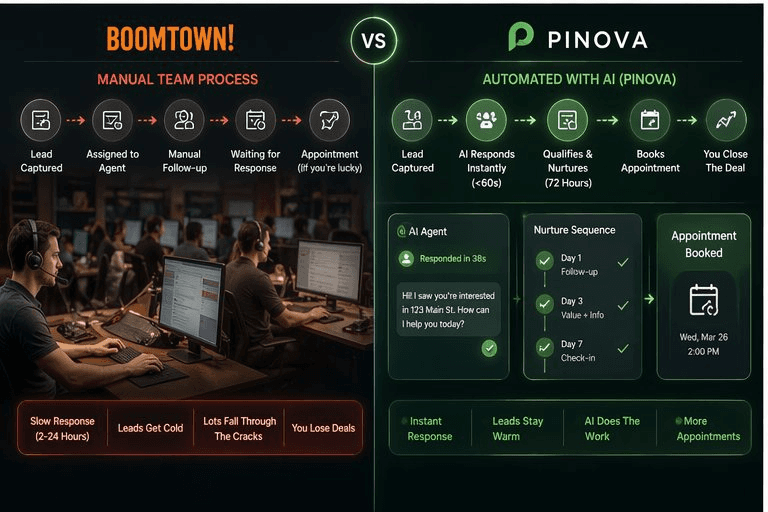
BoomTown is a PPC-focused lead generation platform built for teams of 3–20+ agents spending $1,000 or more per month on paid advertising. It excels at round-robin lead distribution and long-term drip nurturing but starts at roughly $1,000–$1,500 per month before ad spend. Pinova is an AI-first CRM and IDX platform designed for solo agents and small teams who want automated first-response, lead qualification, and follow-up sequences triggered within minutes of a new inquiry—without requiring a dedicated ISA or a five-figure monthly budget. The core difference is where automation kicks in: BoomTown assumes a human will handle the first 72 hours; Pinova automates them.
Key Takeaways
- BoomTown's entry-level "Launch" plan costs $1,000 per month plus a $750 setup fee, with an additional mandatory minimum of $250/month in PPC advertising spend, per InboundREM's 2025 pricing review.
- The MIT and InsideSales.com Lead Response Management Study found that leads contacted within 5 minutes are 21 times more likely to qualify than those contacted after 30 minutes—making automated first response the single highest-leverage change most agents can make.
- Inman's 2025 Real Estate Technology Survey found the average agent takes 917 minutes—more than 15 hours—to respond to a new lead inquiry, destroying the qualification window before the conversation even starts.
- BoomTown was acquired by Inside Real Estate in January 2023 and rebranded into the BoldTrail portfolio in June 2024; agents on older BoomTown contracts report minimal product updates since the acquisition, per verified Capterra reviews.
- NAR's 2025 Technology Survey found that 41% of REALTORS are currently using AI or generative AI in their business, and 66% cite saving time as the primary reason they adopt new technology—a gap BoomTown's manual-first workflow does not close for solo agents.
Marcus Webb runs a solo operation out of Austin, Texas. In March 2025 he was paying $1,400 per month for BoomTown's Grow plan plus another $800 on PPC to feed it—$2,200 a month before he'd touched a single lead. The platform's round-robin and drip tools were built for a team of five, but Marcus had no team. When a 2:00 AM Zillow inquiry came in for a $620,000 listing in Travis Heights, the BoomTown Now app sent him a push notification he didn't see until 7:30 AM. By then, the buyer had already scheduled a showing with a competing agent who had an auto-response set up. That one missed lead represented a potential $18,600 commission.
This article gives you a direct, feature-by-feature comparison of how BoomTown and Pinova handle lead flow—from the moment a buyer submits an inquiry through the first 72 hours of follow-up. You'll see exactly what each platform automates, what it leaves to you, what it costs at each agent type, and which one makes economic sense depending on your team size and lead volume.
What BoomTown does well
BoomTown earned its reputation by solving one specific problem extremely well: organizing high-volume PPC lead flow for teams. The platform's "Now Wall" displays a ranked feed of the leads your system predicts are most ready to transact today, scored using behavioral signals like saved searches, return visits, and price-range changes. For a team leader managing 10 agents and 500 active leads, that prioritization is genuinely valuable—it tells the team where to dial first each morning without anyone having to sort manually.
The platform's round-robin lead distribution is purpose-built for accountability. When a new lead arrives, BoomTown auto-assigns it to the next available agent in the rotation and logs the assignment timestamp. Team leaders can see response times per agent, call attempts, and email open rates from a unified analytics dashboard. For brokerages running 20+ agents, this oversight layer is hard to replicate in a lighter CRM. BoomTown also integrates with Mojo Dialer, dotLoop, and BombBomb, meaning a mature team with an established workflow can plug the platform into its existing tools without rebuilding from scratch.
Stat: According to BoomTown's own published case study, The Smits Team saw 2x more leads and 33% more commission income when they tested BoomTown against a competitor CRM for a full year. — BoomTown ROI / Capterra, 2024
BoomTown's Success Assurance program is worth calling out separately. For teams willing to pay more, Inside Real Estate supplies a team of lead concierges who monitor your database for behavioral triggers—a saved search suddenly showing daily activity, a lead who revisits the same listing three times in a week—and reach out on the team's behalf. This essentially functions as an outsourced ISA (Inside Sales Agent), handling initial qualification calls and warming leads before passing them to agents. For a high-volume brokerage where principals don't want to build an ISA function in-house, that's a real operational advantage.
Where BoomTown genuinely shines is with teams that have already solved the volume problem—those generating 200+ leads per month from paid sources, running structured call cadences, and needing a system to govern agent behavior and track accountability metrics. If your business looks like that today, BoomTown's infrastructure is mature and well-suited. The question is whether you're paying for a system you currently need, or one you aspire to need.
Where BoomTown falls short in 2026
The most consequential problem with BoomTown in 2026 is structural: it was built assuming a human would handle the critical first 72 hours of every lead. The platform sends push notifications and escalation alerts, but the actual first-contact call or text is still a manual action. That design decision was reasonable when the platform launched in the mid-2000s. It is a serious liability now. Inman's 2025 Real Estate Technology Survey found that the average agent takes 917 minutes—over 15 hours—to respond to a new lead inquiry. BoomTown's notification system does not solve that gap; it simply makes the gap more visible.
The MIT and InsideSales.com Lead Response Management Study, conducted by Dr. James Oldroyd across 15,000 leads and 100,000+ call attempts, found that the odds of qualifying a lead drop 21 times when you wait 30 minutes instead of 5. BoomTown's architecture means that the moment a buyer submits a form at 11:45 PM, the 5-minute window opens and closes while the agent sleeps. The platform's drip campaigns will eventually reach that buyer—but by the time the first automated email lands 48 hours later, the buyer has already called three agents and is likely in conversation with the one who responded first.
Stat: 917 minutes—the average time the typical real estate agent takes to respond to a new lead inquiry. — Inman Real Estate Technology Survey, 2025
The platform's ownership trajectory compounds the problem. Inside Real Estate acquired BoomTown in January 2023 and folded it into the BoldTrail portfolio in June 2024. Multiple verified Capterra reviews note that BoomTown has received minimal product updates since the acquisition, with one long-term user writing: "I fell in love with the Boomtown platform in 2016, but the platform has had minimal updates." Another review stated plainly: "Boomtown is now dying and the new owners tried to hide the facts." This stagnation matters because AI-powered first-response tools are advancing quickly elsewhere; users on a locked BoomTown contract are paying 2023 prices for 2016-era automation.
Cost structure is the third limitation. BoomTown's Launch plan runs $1,000 per month plus a $750 setup fee, with a mandatory minimum of $250 per month in additional PPC advertising—a total first-year cost floor of approximately $15,000 before a single transaction closes. The Grow plan for small teams is $1,300 per month plus a $1,700 setup fee. InboundREM's 2025 review of the platform notes that "BoomTown is ideal for real estate teams and brokerages with at least 3–5 agents and a marketing budget of $1,000+ per month" and that "solo agents may find it too expensive unless operating in high-volume or luxury markets." For the majority of agents—solo practitioners or two-person teams under $3M in annual GCI—that cost structure is difficult to justify.
Lead flow comparison
The practical difference between the two platforms becomes clearest when you trace a single lead from form submission to first conversation. Walk through this scenario with both systems.
BoomTown: A buyer submits a home search form at 9:47 PM. BoomTown ingests the lead, creates a contact record, adds them to a default drip sequence, and sends a push notification to the assigned agent's phone. If the agent is awake and checks immediately, they can call within minutes. If not—and NAR's 2025 Technology Survey data suggests most agents are not monitoring leads in real time outside business hours—the lead sits. The drip campaign's first automated email may go out within the hour, but it's a generic listing alert, not a personalized conversation. The lead will receive follow-up touches over the coming days, but no qualifying conversation has happened. If the buyer contacts another agent first, the drip sequence becomes noise.
Pinova: The same buyer submits a form at 9:47 PM. Pinova's AI responds within minutes—not with a generic drip email, but with a conversational message tailored to the specific listing the buyer was viewing, the price range they searched, and any behavioral signals collected during their session. The AI asks a qualifying question: "Are you pre-approved, or would it help to connect with a lender first?" That response starts a conversation. If the buyer replies, the AI qualifies further—timeline, budget, must-haves—and logs everything to the CRM automatically. If the buyer does not reply within 24 hours, the system sends a different message with a new angle. The agent wakes up the next morning to a CRM record that includes the full conversation transcript, a lead score, and a suggested next action.
Pinova's AI Lead Responder handles the first 72 hours of every new inquiry automatically—qualifying, nurturing, and scoring leads without agent intervention, then surfacing only the conversations that have demonstrated genuine buying or selling intent.
The downstream effect on conversion is significant. NAR's 2025 Generational Trends Report found that 78% of homebuyers end up working with the first agent who responds to their inquiry. That figure has held steady for five consecutive years. A platform whose automation kicks in at the drip-email level—after the human-response window has already closed—does not capture that first-responder advantage. A platform whose AI fires within minutes does.
Cost and ROI
Comparing cost between these two platforms requires honesty about what you're actually buying. BoomTown's pricing reflects the bundled value of lead generation (PPC management), website hosting, CRM, and concierge support. Pinova's pricing reflects a leaner stack—AI-powered CRM, IDX website, and automated follow-up—without the paid-ad management layer built in.
Here is what the numbers look like in practice. BoomTown's Launch plan: $1,000/month platform fee + $750 setup + $250/month mandatory minimum ad spend = $15,750 in year one before a single commission. The Grow plan for small teams: $1,300/month + $1,700 setup + ad spend = at least $17,300 in year one. Consumer Affairs' 2025 review puts typical BoomTown subscriptions between $1,000 and $1,700 per month, noting that "the average real estate agent spends $50 to $100 a month on web-based CRM software"—making BoomTown 10–17x the market average for software alone.
Stat: NAR's 2025 Technology Survey found that 27% of REALTORS spend between $50 and $250 per month on lead generation technology, while 24% spend more than $500 monthly on all technology combined. — NAR REALTORS Technology Survey, 2025
To calculate whether BoomTown's cost is justified, you need to know your average commission per transaction and your current lead-to-close conversion rate. Using NAR's benchmark that internet leads convert at 0.4% to 1.2% from inquiry to close, and a median US home price of approximately $407,000 with a 2.5% buyer's-agent commission, one closed transaction produces roughly $10,175 in gross commission. To break even on BoomTown's first-year cost of $15,750 (platform + minimum ad spend only), you would need to close approximately 1.5 additional transactions directly attributable to the platform—before subtracting any further ad spend you add above the minimum. For high-volume teams generating 300+ leads per month, that math works. For agents generating 30 leads per month, it rarely does.
NAR's 2025 Technology Survey also found that 33% of agents using AI reported a moderately positive impact on their business, while 41% are currently using AI in some form. The agents gaining ground fastest are not necessarily spending more on lead generation—they're converting a higher percentage of the leads they already have, by eliminating the 15-hour response gap that costs them the first-responder advantage on every single inquiry.
Who wins for which agent type
The answer depends almost entirely on three variables: team size, monthly lead volume, and whether you have—or want to build—a dedicated ISA function.
BoomTown makes sense if: You run a team of 5 or more agents. You close 50+ transactions per year and generate at least 150 leads per month from paid sources. You have (or plan to hire) an ISA or lead concierge to work first-contact calls during business hours. Your business model is built around PPC and portal leads, not organic or referral-based pipelines. You need an accountability layer to monitor agent activity across a distributed team. InboundREM's 2025 review puts this plainly: BoomTown "is best for large brokerages of at least 20 agents that specialize in converting PPC leads through long sales funnels and phone dialers."
Pinova makes sense if: You are a solo agent or a team of 1–4. You close 10–40 transactions per year and generate leads from a mix of organic search, social, portals, and referrals. You do not have (and do not want to fund) a dedicated ISA—you want the AI to handle first contact, qualification, and the first 72 hours of nurturing automatically. You want an IDX website and CRM on a single platform without committing to a 12-month contract at $1,000+ per month before you've seen results. The 88% of buyers who worked with a real estate professional in 2025, according to NAR's Profile of Home Buyers and Sellers, overwhelmingly chose the agent who responded first—not the agent with the most sophisticated team infrastructure.
There is a specific transition point where agents should reconsider: when your monthly lead volume exceeds 150 organic or mixed-source leads and you are actively scaling a team to 6+ agents with a structured call floor. At that point, BoomTown's team-management and accountability features—round-robin assignment, agent activity tracking, the Now Wall—start delivering value that a lighter platform cannot replicate. Below that threshold, you are paying for infrastructure you will not fully use.
One structural note worth tracking: BoomTown's product roadmap is now controlled by Inside Real Estate, and the BoomTown brand is being migrated into BoldTrail's unified portfolio. Agents currently on BoomTown contracts may find themselves transitioned to BoldTrail branding and pricing structures over the coming 12–18 months. If you are evaluating BoomTown now, ask your sales rep directly how the BoldTrail transition affects your contract terms and which features will be maintained versus deprecated.
| Key Statistic / Finding | Source & Year |
|---|---|
| Leads contacted within 5 minutes are 21x more likely to qualify than leads contacted after 30 minutes | MIT / InsideSales.com Lead Response Management Study, Dr. James Oldroyd |
| Average real estate agent takes 917 minutes (over 15 hours) to respond to a new lead inquiry | Inman Real Estate Technology Survey, 2025 |
| 78% of homebuyers work with the first agent who responds to their inquiry | NAR 2025 Home Buyers and Sellers Generational Trends Report |
| BoomTown Launch plan costs $1,000/month plus $750 setup and a mandatory $250/month minimum PPC ad spend | InboundREM BoomTown Review, 2025 |
| BoomTown is best suited for teams with at least 3–5 agents and a marketing budget of $1,000+ per month; solo agents may find it too expensive | InboundREM BoomTown Review, 2025 |
| 41% of REALTORS are currently using AI or generative AI in their business | NAR REALTORS Technology Survey, 2025 |
| 66% of REALTORS embrace new technology primarily to save time; 64% aim to enhance the client experience | NAR REALTORS Technology Survey, 2025 |
| 88% of buyers and 91% of sellers used a real estate professional in 2025 | NAR 2025 Profile of Home Buyers and Sellers |
| Internet leads convert at 0.4%–1.2% from inquiry to close; each missed lead can represent $7,500 or more in lost commission | NAR Lead Conversion Benchmark / Real Trends Commission Analysis, 2025 |
| Inside Real Estate acquired BoomTown in January 2023 and rebranded its portfolio as BoldTrail in June 2024 | Inman News / Inside Real Estate Press Release, 2024 |
Frequently Asked Questions
Is BoomTown worth the cost for a solo real estate agent?
For most solo agents, BoomTown is difficult to justify on cost alone. The entry-level Launch plan runs $1,000 per month plus a $750 setup fee and a required minimum of $250 per month in PPC advertising, putting the first-year floor at roughly $15,750 before any additional ad spend. InboundREM's 2025 analysis states directly that BoomTown "is best for large brokerages of at least 20 agents" and that solo agents may find it too expensive unless they operate in high-volume or luxury markets. A solo agent generating 20–40 leads per month will typically find that a leaner AI-powered CRM delivers better ROI by converting existing leads faster rather than buying more.
How long does BoomTown take to respond to a new lead automatically?
BoomTown does not automatically contact new leads. When a lead is captured, the platform sends a push notification to the assigned agent and may trigger a drip email sequence, but the first live contact—a call or personalized text—requires human action. Given that Inman's 2025 Real Estate Technology Survey found the average agent takes over 15 hours to respond to a new inquiry, BoomTown's notification-based model means most leads miss the critical 5-minute window identified in the MIT and InsideSales.com Lead Response Study, during which qualification likelihood is 21 times higher than at the 30-minute mark.
What happened to BoomTown? Is it still its own company?
BoomTown was acquired by Inside Real Estate in January 2023 in a deal that combined the two companies into a platform serving over 500,000 real estate professionals. In June 2024, Inside Real Estate rebranded its entire product portfolio—including BoomTown, kvCORE, btPRO, Brokermint, and AmpStats—under the BoldTrail name, per an announcement covered exclusively by Inman News. The BoomTown brand and product still exist, but its long-term product roadmap is now governed by Inside Real Estate's leadership team. Some agents on existing BoomTown contracts report that product updates have slowed significantly since the acquisition.
What is the difference between BoomTown's Success Assurance and an AI lead responder?
BoomTown's Success Assurance is a human concierge service: Inside Real Estate supplies a team of trained lead concierges who monitor your database and make outreach calls on your behalf when behavioral signals suggest a lead is ready to transact. It is effective but adds cost and is subject to business-hours staffing constraints. An AI lead responder—like the one built into Pinova—fires within minutes of any new inquiry, 24 hours a day, 7 days a week, asking qualifying questions and logging responses to the CRM automatically, without human intervention. The AI handles the first 72 hours of nurturing at scale; a human concierge handles selected warm leads during business hours.
How does lead response time actually affect real estate conversion rates?
The impact is significant and well-documented. The MIT and InsideSales.com Lead Response Management Study analyzed more than 15,000 leads and found that agents or companies contacting a lead within 5 minutes are 21 times more likely to qualify that lead than those who wait 30 minutes. NAR's 2025 Generational Trends Report found that 78% of buyers ultimately work with the first agent who responds to their inquiry—a figure consistent across five consecutive years of research. Internet leads convert at just 0.4% to 1.2% from inquiry to close under normal conditions, per NAR benchmarks, meaning speed is one of the few levers that meaningfully moves that number without requiring more lead volume.
Can I use BoomTown as an individual agent without a team?
Yes—BoomTown's Launch plan is nominally designed for individual agents. However, most of the platform's differentiated features (round-robin assignment, team accountability dashboards, agent activity tracking, the Now Wall's cross-agent prioritization) are designed for a team context. InboundREM's 2025 review notes that BoomTown's functionality "at the individual level is essentially an expensive lead-gen website plus drip CRM" and that smaller teams should "consider platforms like Real Geeks or Ylopo for similar quality leads at a much better price point." The 12-month contract requirement also means you are committing to $12,000+ before you know whether the platform fits your workflow.
How many real estate agents are using AI tools in their business right now?
Adoption is growing quickly. NAR's 2025 Technology Survey of 1,241 active REALTORS found that 41% are currently using AI or generative AI in their business, up from a smaller share in prior years. An additional 59% reported using some form of emerging technology but still learning. The same survey found that 66% of agents adopt new technology primarily to save time, and 64% do so to enhance the client experience. The agents moving fastest on AI adoption are those who see it as a response-time and qualification tool—automating the first 72 hours of lead handling that currently costs the average agent 917 minutes in delayed response.
What should I ask before signing a BoomTown contract in 2026?
Ask four questions before signing. First: how does the BoldTrail transition affect your contract—will you be migrated, and on what timeline? Second: what is the minimum total monthly spend including platform fee, setup amortization, and mandatory PPC? Third: what is the guaranteed first-response time for new leads under your specific plan—does the platform contact them automatically, or does it rely on you? Fourth: what is your exit clause if the platform is sunset or significantly repriced after the Inside Real Estate acquisition? Given that multiple verified user reviews describe minimal product updates since the January 2023 acquisition, understanding your contractual position before signing is important.
Amaan Sheikh
— Co-Founder & CEOAmaan Sheikh is the co-founder and CEO of Pinova. He sets the product direction, builds the partnerships, and personally works with every founding partner. His focus is making enterprise-grade real estate technology accessible to ambitious agents and teams — without the enterprise price tag.