The Real Estate Tech Stack Every Solo Agent Actually Needs in 2026


Quick Answer
What tech tools does a solo real estate agent actually need in 2026?
A solo agent's core stack covers five categories: an IDX website with lead capture, a CRM with automated follow-up, an eSignature tool, a social media scheduling tool, and a transaction management system. According to NAR's 2025 Technology Survey, the top three lead-generating technologies are social media (39%), CRM (23%), and local MLS (17%). Agents who respond to web leads within 5 minutes are 21 times more likely to qualify that lead than those who wait 30 minutes, which makes CRM automation the single highest-leverage tool in the stack. Solo agents at the $50,000–$100,000 GCI level typically spend $150–$350 per month total on technology; agents earning above $100,000 commonly invest $500 or more monthly.
Key Takeaways
- Social media is the top lead-generating technology for 39% of agents, followed by CRM at 23% and local MLS at 17%, per NAR's 2025 Technology Survey.
- Agents who respond to a web lead within 5 minutes are 21 times more likely to qualify it than agents who wait 30 minutes, according to research aggregated by InsideSales.com and Real Trends.
- The largest share of agents (34%) spend between $50 and $250 per month on technology tools, while 24% spend more than $500 monthly, per NAR's 2025 Technology Survey — suggesting most solo agents are underspending on conversion tools relative to top earners.
- eSignature (79%) remains the most universally adopted tech tool among Realtors, making it the only non-negotiable category regardless of business volume or stage.
- A fragmented stack — separate website, separate CRM, separate IDX plugin with no shared data — creates response delays that let competitors capture leads before you can log back into the right tab.
Emily Rogers, a solo agent in Austin, Texas, was paying for six separate tools — a WordPress site with an IDX plugin ($129/month), a standalone CRM ($79/month), an eSignature platform ($40/month), a social media scheduler ($29/month), a transaction management tool ($49/month), and a Canva Pro subscription ($13/month) — adding up to $339 per month before a single dollar of lead spend. When she audited her pipeline, she found that her IDX leads were not automatically entering her CRM, which meant new buyer inquiries were sitting in an email inbox for an average of 11 hours before she manually copied them over. She lost two verified $450,000 buyer clients in a single quarter to agents who responded within minutes. The problem was not the tools — it was the gap between them.
This article maps the five technology categories every solo agent must cover, names the specific tools worth paying for at each stage, shows exactly where fragmentation kills conversion, and tells you what your budget should look like at $0–$50K, $50K–$100K, and $100K+ GCI. By the end, you will know which subscriptions to cancel this week and which ones to upgrade.
The tool overload problem
The average solo agent does not have a technology shortage — they have an integration problem. NAR's 2025 Technology Survey found that 66% of agents adopt new tools primarily to save time, yet 46% report that AI — the most hyped category of the past two years — has had no noticeable impact on their business. The gap between owning tools and extracting value from them is where most solo agents lose time and money.
Stat: 24% of Realtors spend more than $500 per month on technology tools for their individual business, while 34% spend between $50 and $250 monthly — yet only 17% say AI has had a significant positive impact on business. — NAR 2025 Technology Survey
The overload problem has a specific shape for solo agents. Teams can assign someone to manage the CRM, someone to post on social media, and someone to handle transaction paperwork. You cannot. Every disconnected tool is a task you must manually bridge. An IDX plugin that does not feed leads into your CRM means you are the bridge — and when you are showing a home, that bridge is closed. The average real estate agent takes more than 15 hours to respond to a new lead inquiry, according to Inman's 2025 Real Estate Technology Survey. That number is not driven by laziness; it is driven by friction.
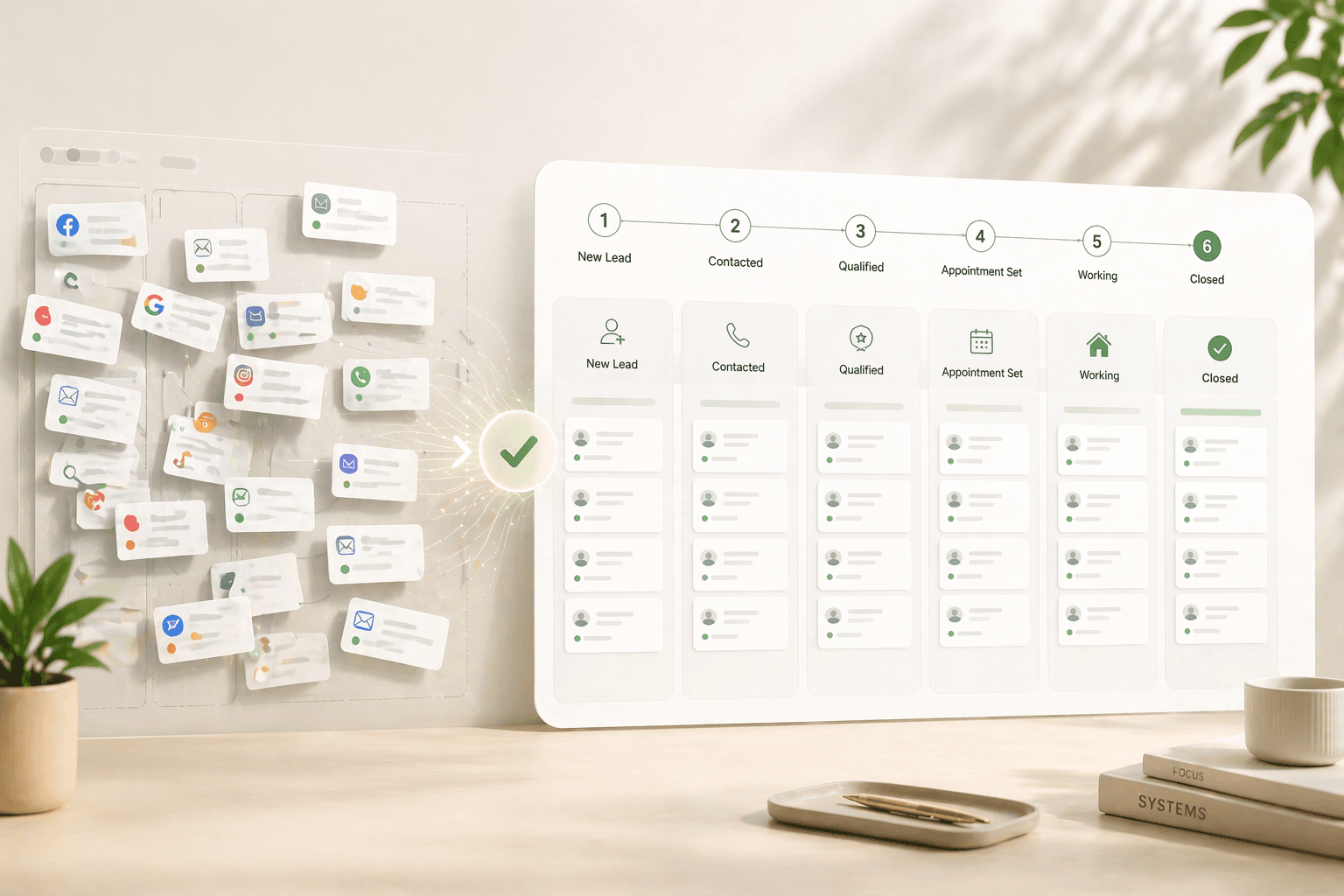
The fix is not to buy fewer tools in isolation — it is to buy tools that share data natively or via direct integration, eliminating manual transfer steps. The five-category framework below tells you what must be in every stack; the consolidation section tells you when to collapse categories into a single platform.
The 5 essential tool categories
Every solo agent's stack must cover five categories. Adding a sixth before these five are working is where most overload begins.
1. IDX website with lead capture. This is your owned digital presence — separate from Zillow or Realtor.com, where you do not control the buyer experience or the lead data. According to NAR's five-year analysis of buyer behavior, between 43% and 47% of buyers started their home search online as their first step in every year from 2020 to 2024. Your IDX site captures that initial search intent on a platform you own and routes it directly into your follow-up system. Without one, every buyer who Googles your name ends up on a portal that shows them your competitors.
2. CRM with automated follow-up. This is the highest-leverage tool in the stack. Research aggregated by Real Trends and InsideSales.com shows that agents who respond to web leads within 5 minutes are 21 times more likely to qualify that lead compared to those who wait 30 minutes. A CRM that auto-sends an immediate text and email when a lead registers on your IDX site closes that 5-minute window without requiring you to be at your desk. According to NAR's 2025 Technology Survey, CRM is the second-highest source of quality leads at 23% — meaning agents who actively use their CRM (not just store contacts in it) generate nearly one in four of their best leads from it.
3. eSignature. The most universally adopted tool in real estate: 79% of agents use it, per NAR's 2025 data. DocuSign and Authentisign are the market standards; either is acceptable. The only mistake is not having one and emailing PDFs for wet signatures, which adds 24–48 hours to every contract cycle.
4. Social media content tool. Social media is the single top lead-generating technology for 39% of Realtors, per NAR's 2025 Technology Survey. That does not mean spending three hours per day on Instagram — it means having a scheduler (Buffer, Later, or the native Meta Business Suite at $0/month) to batch-post two to three times per week. The specific content that converts for agents: local market snapshots, before/after listing transformations, and client testimonial videos. Set a 90-minute weekly block on Monday to prepare the week's posts and schedule them forward.
5. Transaction management. Once a contract is signed, the file needs a home that is not your email inbox. SkySlope, Dotloop, and Brokermint are the most common options; many brokerages provide one of these at no cost. If yours does, use it. If not, Dotloop's agent plan runs approximately $31/month and handles unlimited transactions with compliant storage. Agents who skip this category spend an average of 40 hours per transaction on administrative coordination, according to agent forum data compiled by TransactionMonster — time that could be in front of clients.
The case for consolidation
Running five separate best-in-class tools is technically optimal only if you have the time to manage five separate platforms, five billing cycles, and five support contacts. Most solo agents do not. The practical case for consolidation is not that all-in-one platforms do each category better than specialists — they often do not. The case is that native data sharing eliminates the manual bridging that costs you leads.
Stat: 78% of homebuyers end up working with the first real estate agent who responds to their inquiry, per NAR's 2025 Home Buyers and Sellers Generational Trends report. Response time is not a customer service metric — it is your primary competitive differentiator. — NAR 2025 Home Buyers and Sellers Generational Trends Report
Here is the specific failure mode to eliminate: a buyer registers on your IDX site at 7:42 PM on a Tuesday. Your IDX plugin sends a notification to an email address you check in the morning. Your CRM has no knowledge of this lead until you manually import it the next day. By 8:00 AM Wednesday, the buyer has spoken with two competitors who had automated instant-response systems. You lost that client during a 12-hour window while you were asleep. This is not hypothetical — it is the mechanism behind the 15-hour average response time documented by Inman's 2025 survey.
The consolidation threshold for solo agents is straightforward: if your IDX site and your CRM do not share lead data in real time, you need either a native integration (verified, not "Zapier-possible") or a platform that combines both. Platforms like BoldTrail, CINC, Real Geeks, and iHomeFinder bundle IDX and CRM with real-time lead routing. All-in-one real estate platforms that add AI-driven follow-up sequences to that combination take the next step — automatically texting a new lead within 60 seconds of registration regardless of what you are doing at that moment.
The consolidation trade-off is cost versus control. Bundled platforms typically run $169–$499 per month for solo agents versus $80–$200 for equivalent separate tools — but they remove 3–5 manual steps per lead from your workflow. If you are closing 10 or more transactions per year, the math almost always favors consolidation.
The lean stack for solo agents
The lean stack is not the cheapest stack — it is the stack with the fewest gaps, fewest manual hand-offs, and the fastest lead-to-response loop. Here is the specific configuration that hits all five categories with minimal friction.
Lead capture and CRM in one platform. The core decision for a solo agent is whether the IDX website and CRM live under the same roof. For agents doing fewer than 8 transactions per year, a standalone site (Placester at $79/month for basic IDX) combined with a lightweight CRM (Wise Agent at $49/month) works if you set up a direct Zapier integration between them. For agents doing 8 or more transactions, the ROI shifts toward a native bundle. Real Geeks ($299/month) covers IDX, CRM, and basic drip automation. Pinova combines an IDX website, AI-powered CRM, and automated lead follow-up in a single platform, routing inbound leads from the IDX layer directly into a sequenced outreach workflow without requiring manual import steps.
eSignature. If your brokerage provides DocuSign or Authentisign at no cost, use it — there is no reason to pay separately. If not, DocuSign's Real Estate plan runs approximately $45/month. Some bundled platforms include eSignature; verify before paying twice.
Social media. Meta Business Suite (free) handles Facebook and Instagram scheduling natively. Add Buffer's free tier for cross-platform scheduling if you are active on LinkedIn. Canva Pro ($13/month) handles listing graphics, social cards, and story templates. Avoid paying for third-party social management tools until your volume justifies it — the free tier covers everything a solo agent needs at under 20 posts per month.
Transaction management. Use your brokerage's provided tool if available. If not, Dotloop at $31/month handles unlimited transactions for a single agent with compliant document storage. This is the most frequently skipped category by newer agents — and the most likely to create compliance exposure when skipped.
When you add your first team member
Adding a buyer's agent or an admin changes your stack requirements in one specific way: lead routing. A solo agent can get away with a CRM that assigns all leads to themselves by default. The moment a second person is in the business, unrouted leads create conflict, duplication, and dropped follow-ups that no one owns. This is the single most common tech failure point for two-person teams, and it costs more in lost deals than the solution costs to fix.
The specific upgrade required is round-robin or rules-based lead assignment. Follow Up Boss ($69/month per user) was built specifically for this problem and integrates with over 250 lead sources including Zillow, Realtor.com, Facebook, and your IDX site. When a lead comes in, it is pushed to the next available agent via mobile push notification within seconds. The agent who claims it first owns it. Every interaction logs automatically, so there is no "I thought you were handling that" conversation.
The second upgrade is a shared transaction management workspace. When one person submits the contract and another person tracks the timeline, both need to see the same file. Dotloop's team plan or SkySlope handles this for $50–$100 per month for a two-person team. Skipping the upgrade and sharing documents via email creates version conflicts and compliance gaps that become expensive at closing.
The third upgrade — often overlooked — is a shared social media content calendar. Two agents posting independently from the same brand creates inconsistency. A $15/month Buffer team plan, or a shared Canva workspace, gives both people access to the same brand assets and prevents two posts going out on the same day with contradictory messages.
Budget breakdown by business stage
NAR's 2025 Technology Survey data shows a clear income-technology investment relationship: agents earning above $100,000 annually are disproportionately represented in the 24% who spend over $500 per month on tech. The correlation is not accidental. Higher-income agents are not spending more because they can afford to — they are earning more partly because they invested earlier in the tools that compress response time and automate follow-up.
Stage 1: Under $50K GCI (0–5 transactions per year). Your total tech spend should stay under $150/month. Use your brokerage-provided tools for eSignature and transaction management where possible. A standalone IDX site at $79/month (Placester) with a free or $25/month CRM (HubSpot free CRM or Wise Agent) covers the core. Use Meta Business Suite for free social scheduling. Canva free tier handles graphics. Total: approximately $80–$130/month.
Stage 2: $50K–$100K GCI (6–15 transactions per year). This is where fragmentation becomes measurably expensive. Move to an integrated IDX + CRM platform in the $169–$299/month range. Add a transaction management tool ($31/month) if your brokerage does not provide one. Add Canva Pro ($13/month) and a basic social scheduler. Total: approximately $213–$343/month. The jump in spend here typically recovers itself with the first additional transaction it captures from a faster response loop.
Stage 3: $100K+ GCI (15+ transactions per year). At this volume, your stack needs AI-assisted lead scoring, multi-channel automated follow-up (text + email + voicemail drop), and deeper MLS integration for listing alerts. Platforms in the $399–$599/month range cover all five categories with these capabilities. Add drone photography tools ($52/month for DJI Care) and a video editor (CapCut free or InShot at $15/month) for listing content. Total: approximately $466–$664/month. According to research cited by REsimpli, more than 50% of agents earning $100,000 or more annually spend over $2,500 per year ($208+/month) on technology — suggesting this Stage 3 range is consistent with documented high-earner behavior.
Stat: More than 50% of agents earning $100,000 or more annually spend over $2,500 on technology per year. Only 34% of all agents spend $50–$250 per month, suggesting a large segment is under-investing relative to the conversion advantages technology provides. — REsimpli Real Estate Social Media Statistics Report, 2025
One specific audit exercise: open every monthly subscription charge in your bank statement and mark each one with either an "L" (directly involved in capturing or converting a lead) or an "A" (administrative, compliance, or creative support). Any "A" tool that costs more than $30/month deserves a free-tier replacement check. Any "L" tool that is not integrated with your CRM deserves a consolidation review. Most agents who do this exercise find $50–$100 in redundant charges within 20 minutes.
| Key Statistic / Finding | Source & Year |
|---|---|
| Social media is the top lead-generating technology for 39% of agents; CRM is second at 23%; local MLS is third at 17% | NAR 2025 Technology Survey |
| Agents who respond to web leads within 5 minutes are 21 times more likely to qualify that lead than those who wait 30 minutes | Real Trends / InsideSales.com Lead Response Study, 2025, via AgentZap |
| The average real estate agent takes 917 minutes (over 15 hours) to respond to a new lead inquiry | Inman 2025 Real Estate Technology Survey, via AgentZap |
| 78% of homebuyers end up working with the first real estate agent who responds to their inquiry | NAR 2025 Home Buyers and Sellers Generational Trends Report, via AgentZap |
| eSignature (79%) remains the most widely used technology among Realtors; social media is second at 75%; drone photography is used by 52% | NAR 2025 Technology Survey |
| 34% of agents spend between $50–$250 per month on technology tools; 24% spend more than $500 per month; 20% spend $251–$500 | NAR 2025 Technology Survey |
| 66% of Realtors adopt new technology primarily to save time; 64% cite improving client experience as their motivation | NAR 2025 Technology Survey |
| Only 17% of agents say AI has had a significant positive impact on their business; 46% report no noticeable impact | NAR 2025 Technology Survey |
| 43%–47% of buyers started their home search online as their first step in every year from 2020 to 2024 | NAR Profile of Home Buyers and Sellers 5-Year Analysis, AIHomeDesign / NAR |
| More than 50% of agents earning $100,000 or more annually spend over $2,500 per year on technology | REsimpli Real Estate Social Media Statistics Report, 2025 |
Frequently Asked Questions
What is the minimum tech stack a solo real estate agent needs to start?
At minimum, a solo agent needs five things: an IDX website with lead capture, a CRM with automated follow-up, an eSignature tool, a social media content tool, and a transaction management system. If your brokerage provides eSignature and transaction management at no cost, your out-of-pocket minimum is approximately $80–$130 per month for a standalone IDX site and a basic CRM. The non-negotiables are the IDX-to-CRM connection and the eSignature platform — skipping either creates gaps that directly cost you deals or compliance standing.
How much should a solo real estate agent spend on technology per month?
NAR's 2025 Technology Survey shows that 34% of agents spend $50–$250 per month, 20% spend $251–$500, and 24% spend over $500 monthly. A practical guideline: agents under $50K GCI should stay under $150/month and lean on brokerage-provided tools; agents at $50K–$100K GCI should budget $200–$350/month for an integrated IDX+CRM platform; agents above $100K GCI typically invest $466–$664/month for AI-assisted follow-up and deeper automation. Research on high-earner behavior shows that more than 50% of agents earning $100,000 or more annually spend over $2,500 per year on technology.
Why is CRM the most important tool in a real estate agent's tech stack?
CRM is the connective tissue of the entire stack — it is where leads land, where follow-up sequences run, and where every client interaction is logged. Research aggregated by Real Trends and InsideSales.com shows that agents who respond within 5 minutes of a lead inquiry are 21 times more likely to qualify that lead than those who wait 30 minutes. A CRM with automated instant-response sequences closes that window even when you are in a showing. According to NAR's 2025 Technology Survey, CRM is the second-highest source of quality leads for agents who actively use it, at 23% — behind only social media at 39%.
What is the difference between an IDX website and a regular real estate website?
A regular real estate website shows static content — your bio, past sales, and contact forms. An IDX website integrates with your local MLS and displays live, searchable listing data, which gives buyers a reason to come back to your site repeatedly rather than going to Zillow or Realtor.com. IDX sites also capture lead registration data (name, email, phone, search criteria) when buyers save searches or inquire on listings — data that feeds directly into your CRM for automated follow-up. From 2020 to 2024, between 43% and 47% of buyers started their home search online as their first step, making an IDX site the front door to your buyer pipeline.
Should a solo agent use an all-in-one platform or separate best-in-class tools?
For agents closing 8 or more transactions per year, an all-in-one platform is almost always the better choice because native data sharing eliminates the manual transfer steps between disconnected tools. The average agent takes over 15 hours to respond to a new lead inquiry — a number largely driven by the friction of copying lead data between platforms. For agents under 8 transactions per year, a lean combination of a $79/month IDX site, a $25–$49/month CRM connected via a direct integration, and brokerage-provided tools for eSignature and transaction management typically delivers equivalent results at lower cost. The threshold question is: how many manual steps stand between a new lead registering on your site and entering your follow-up sequence?
Which social media platform generates the most leads for real estate agents?
According to NAR's 2025 Technology Survey, social media is the top lead-generating technology for 39% of Realtors, making it the single most widely cited lead source across all technology categories. Facebook remains the dominant platform for direct lead generation — 87% of agents use it according to NAR's own survey data. For purely lead-generation purposes, Facebook and Instagram ads allow demographic and interest-based targeting (including users who have shown interest in Zillow and Realtor.com), typically at $20–$50 per day for meaningful reach in a local market. Video content amplifies results: listings featuring video receive 403% more inquiries than those without, per industry data cited by CloseDaily.
How do I audit my existing real estate tech stack to find redundancies?
Start with a 20-minute bank statement audit. Pull every monthly subscription and label each one as either an "L" (directly involved in capturing or converting leads) or an "A" (administrative, compliance, or creative support). Any "A" tool over $30/month should be checked against free-tier alternatives — Canva Pro, Meta Business Suite, and HubSpot's free CRM cover a wide range of administrative needs at no cost. Any "L" tool that does not have a direct, native integration with your CRM should trigger a consolidation review. The most common redundancy: paying separately for an IDX plugin and a CRM that do not share data in real time, while also paying for a Zapier plan to bridge them — when a native IDX+CRM bundle would cost less and perform better.
What tech upgrades does a solo agent need when they add their first buyer's agent?
The three specific upgrades when adding a first team member are: (1) round-robin or rules-based lead assignment in your CRM, so every new lead is instantly routed to an available agent without manual intervention — Follow Up Boss at $69/month per user is the most purpose-built solution for this; (2) a shared transaction management workspace so both agents work from the same file, using a platform like Dotloop's team plan; and (3) a shared social media content calendar to maintain brand consistency. These three additions typically add $80–$120/month to the stack. Skipping lead routing at the two-person stage is the single most common cause of dropped leads in small real estate teams.
Amaan Sheikh
— Co-Founder & CEOAmaan Sheikh is the co-founder and CEO of Pinova. He sets the product direction, builds the partnerships, and personally works with every founding partner. His focus is making enterprise-grade real estate technology accessible to ambitious agents and teams — without the enterprise price tag.