Real Estate Marketing Strategies That Actually Work in 2026

Quick Answer
What real estate marketing strategies actually work in 2026?
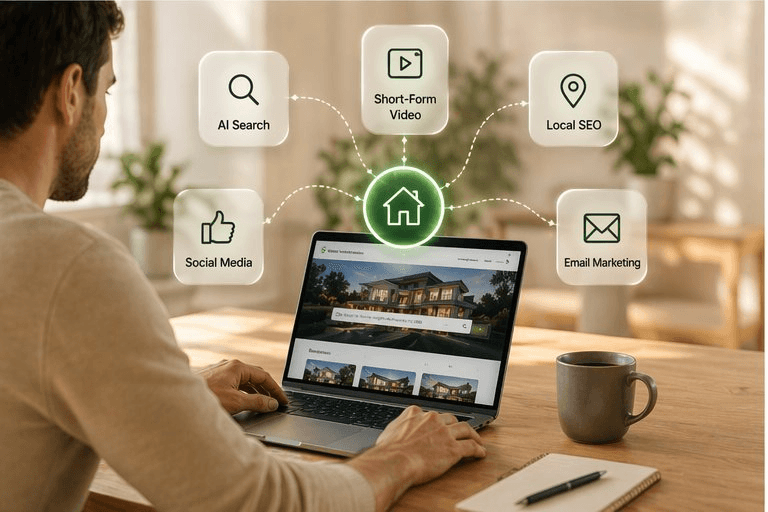
The highest-ROI marketing channels for real estate agents in 2026 are: (1) hyper-local Google Business Profile SEO, which positions you in the three-result map pack that captures the majority of mobile "realtor near me" clicks; (2) short-form video on Instagram Reels and TikTok, where sub-90-second videos retain roughly 50% of viewers and generate 22% more interactions than standard posts; (3) a weekly email newsletter to past clients and sphere-of-influence contacts, which delivers up to $42 back per $1 spent; and (4) content structured for AI citations — since only 5.8% of real estate queries currently trigger Google AI Overviews, agents who publish clear, sourced answers today face almost no competition inside AI search results. Referrals remain the single largest lead source (43% of buyers find their agent this way), so every digital channel should be designed to reinforce relationships, not replace them.
Key Takeaways
- 52% of buyers found their home online in 2025 and 70% used a mobile or tablet device during their search, per NAR's 2025 Profile of Home Buyers and Sellers — making a fast, mobile-optimized web presence non-negotiable.
- Only 5.8% of real estate search queries trigger a Google AI Overview, per Ahrefs' November 2025 industry analysis — which means agents who publish Q&A-structured content today are competing in a nearly empty field for AI citations.
- 43% of buyers found their agent through a referral and 67% of first-time buyers hired the first agent they contacted, per NAR's 2025 Profile — making speed of response as important as any marketing channel you invest in.
- Real estate email campaigns deliver up to $42 in return for every $1 spent, with the industry recording an average open rate of 37.18%, per benchmark data aggregated across major email service providers.
- Agents using five or more marketing channels reported an average GCI of $4 million, per Luxury Presence's 2024 State of Real Estate Marketing Report — but the data also shows that channel breadth without tracking produces inconsistent results.
Paige Nelson, a solo agent in Austin, Texas, closed $3.2 million in volume during Q1 2026 — without spending a dollar on Zillow Premier Agent. She generates 80% of her leads from three sources: a fully optimized Google Business Profile that ranks in the map pack for "real estate agent South Austin," a bi-weekly email to 340 past clients and referral contacts, and a Tuesday Reel series she calls "Austin Under $500K" that she films in under 20 minutes. Her cost per closed deal is $310. The average agent in her market pays $1,185 for a client from paid channels.
This article breaks down exactly what changed in 2025–2026 that made Paige's approach work, and what it means for your marketing plan. You will leave knowing which channels produce the best return at each stage of an agent's growth, how to structure content so AI search engines cite it, which video formats generate inbound calls rather than just views, and how to allocate a marketing budget by GCI percentage rather than guesswork.
What changed in 2025–2026
Three shifts happened simultaneously that broke the old playbook: buyers moved to mobile-first online search, AI started answering questions that used to send traffic to agent websites, and the National Association of Realtors settlement removed buyer agent compensation from MLS listings — forcing agents to communicate value through their own channels rather than assuming the transaction would protect their commission.
On the buyer behavior side, NAR's 2025 Profile of Home Buyers and Sellers found that 52% of buyers found their home online and 70% used a mobile or tablet device during their search. Every buyer — 100% — used the internet at some point in the process. This is not a new trend, but the implication sharpened in 2025: if your Google Business Profile is incomplete, your website loads slowly on mobile, or you have no short-form video presence, you are invisible to the majority of active buyers before they ever speak to an agent.
Stat: 88% of buyers purchased their home through a real estate agent or broker in 2025, and 85% ranked their agent as the most useful source of information throughout the search. — NAR 2025 Profile of Home Buyers and Sellers
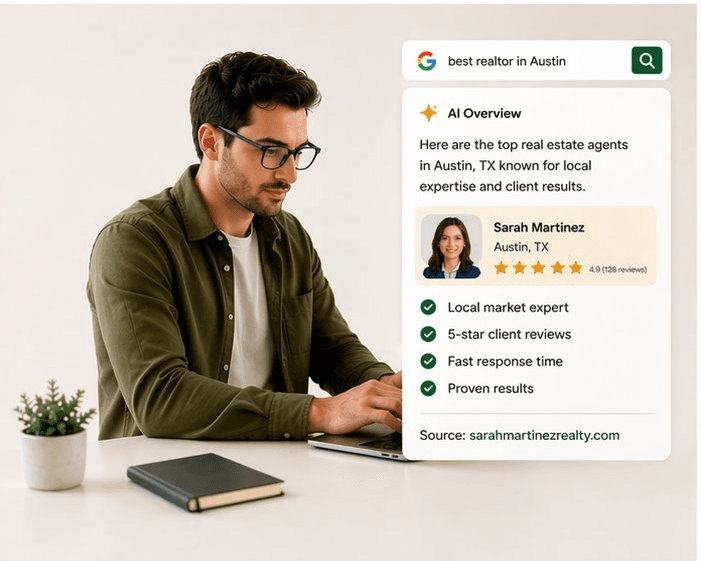
On the AI side, Google AI Overviews now appear in more than 60% of US queries, according to Advanced Web Ranking data from late 2025. But Ahrefs' analysis of 146 million search results found that real estate specifically triggers AI Overviews on only 5.8% of relevant keywords — compared to 43% for health queries. The reason: Google still defaults to its map pack and transaction-focused SERP features for property searches. The opportunity this creates is significant. Agents who publish structured, clearly attributed content now — Q&A pages, neighborhood guides, FAQ sections — are establishing citation authority inside AI systems before competitors recognize the channel exists. The agents not doing this will spend 2027 trying to catch up.
The NAR settlement's practical effect: your marketing must now do what the MLS used to handle by default. Buyers need to understand why signing a buyer representation agreement with you specifically is worth it. That case gets made through content — videos explaining your process, email sequences showing your market expertise, and Google reviews that third parties trust more than anything you say about yourself.
Marketing for AI search
Getting cited by ChatGPT, Perplexity, and Google AI Overviews requires a different approach than traditional SEO — but the foundational content is the same: clear, specific, attributable answers to real questions buyers and sellers ask. Ahrefs found that 44.2% of all LLM citations come from the first 30% of a document — which means the opening paragraphs of your neighborhood guides and FAQ pages carry disproportionate weight. If your article buries the answer inside five paragraphs of preamble, AI systems skip past it.
The structural changes that make content AI-citable are concrete. First, add a 50–70 word summary at the top of every page that answers the primary question directly — no hedging, no preamble. This is sometimes called a "QuickAnswer" block. Second, use named statistics with source attributions in prose (not just linked footnotes), because AI systems are trained to recognize and cite attributed claims. Write "According to NAR's 2025 Profile, 43% of buyers found their agent through a referral" rather than just asserting the fact. Third, build FAQ sections using actual natural-language questions your clients type into Google and ChatGPT — not the sanitized questions you wish they would ask. "Do I need a buyer's agent in [city] after the NAR settlement?" is the question; "What are buyer's agent services?" is not.
Stat: Sites with over 32,000 referring domains are 3.5x more likely to be cited by ChatGPT than sites with up to 200 referring domains — domain authority, not content length, is the strongest AI citation predictor. — SE Ranking, November 2025
For solo agents, building referring domain authority at scale is not realistic in the short term. The accessible lever is earned media distribution — getting your insights quoted in local newspaper real estate columns, contributing data to Inman or HousingWire stories, and publishing original market statistics that other sites reference. Stacker's December 2025 research found that distributing content across a range of publications increases AI citations by up to 325% compared to publishing only on your own site. One contributed piece per quarter to a local business publication produces more AI visibility than doubling your blog output.
The agents who will dominate AI search in 2027 are publishing in 2026. Every week without a clearly structured neighborhood guide, a local market update page, or a FAQ section answering common buyer questions is a week competitors gain ground in a channel that most of the industry has not yet recognized.
Short-form video strategy that generates calls
Short-form video generates inbound calls when it answers a specific question a buyer or seller in your market is already asking — not when it showcases a listing tour. NAR's 2025 data found that 58% of buyers ranked online video sites as a useful information source, putting video ahead of open house visits as a decision-making tool. The agents generating calls from video are not the ones with the most polished production. They are the ones who answer the right questions in the first three seconds.
Instagram Reels generated 22% more interactions than standard video posts in 2025, with an average reach rate of 30.81% — compared to 14.45% for carousels and 13.14% for images. Reels made up 46% of total time spent on the Instagram app in the US in 2025. Sub-90-second videos retain roughly 50% of viewers on average, and 71% of viewers decide within the first few seconds whether to keep watching. Your hook — the first sentence spoken on camera — determines whether the algorithm surfaces your video or buries it.
A format that consistently generates agent calls is the "local condition" Reel: film yourself in a neighborhood, speak directly to camera, and answer one question in under 60 seconds. Example scripts that work:
"I just had an offer rejected in Plano even though we came in at asking. Here's what's actually happening with inventory right now and what buyers need to know before their next offer." — This format works because it signals local expertise, creates urgency, and is answering a question the viewer is likely already worried about. End every Reel with a specific call to action: "DM me the word OFFER and I'll send you the three things we did differently on the next offer that got accepted."
TikTok delivers a 2.80% engagement rate versus Instagram Reels at 0.65%, but Instagram's ad infrastructure and shopping integrations make it the stronger lead-capture platform for agents. The practical framework: publish three Reels per week on Instagram (educational content, local market update, one behind-the-scenes clip), and cross-post the top-performing one to TikTok. Track which videos generate DMs, not which generate views. Views do not pay commissions; conversations do.
Hyper-local SEO for agents
46% of all Google searches carry local intent, and 76% of people who search "near me" visit or contact a related business within 24 hours. For real estate agents, this means the Google Business Profile map pack — the three results shown above organic listings — is the single highest-converting ad placement available, and it is free. Businesses with complete Google Business Profiles receive an average of 50 calls per month directly from their listing, according to Birdeye's 2025 GBP data. Most agents have a profile. Almost none have optimized one.
The five GBP optimizations that move you into the map pack, in order of ranking impact: (1) Complete every field — primary category set to "Real Estate Agent," not "Real Estate Agency"; service areas listed by neighborhood name, not just city; business hours accurate; website URL correct. (2) Upload at least 10 recent, high-quality photos — exterior listing shots, neighborhood landmarks, and one professional headshot. Latitude Park's 2025 GBP ranking study found that profiles with 100+ optimized photos receive 520% more calls. Photo recency matters as much as quantity — upload at minimum two new photos per week. (3) Post a Google Update once per week: a brief market stat, a recent sale, or a question answered. Profiles with weekly updates generate 250% more engagement than static ones. (4) Respond to every review within 24 hours — agents who do so experience a 45% higher inquiry rate, per ReviewTrackers data. (5) Maintain consistent NAP (name, address, phone) across every directory. One mismatched address suppresses your map pack rankings.
Beyond GBP, the highest-ROI content asset for local SEO is a neighborhood guide targeting a specific zip code or area name. A single well-written neighborhood guide answering questions like "What is it like to live in [neighborhood]?", "What are homes selling for in [area] right now?", and "What schools are in [neighborhood]?" can generate 15–25 inbound calls monthly from organic search alone, without any paid amplification. Pinova's IDX platform automatically populates neighborhood guides with live listing data, pulling current active inventory, median prices, and days-on-market figures into the page each time a visitor loads it — so the content stays fresh without manual updates.
Searches for "real estate agent near me" have increased 41-fold since 2015, with approximately 14,000 queries per month in the US today. The agents who rank for these searches are not the ones spending on ads — they are the ones who treated their GBP and local content as a serious lead channel 12 months ago. Start now and the compounding effect begins.
Referral marketing in the AI era
Referrals are still the dominant lead source in residential real estate, and the 2025 data makes the case more forcefully than ever. 43% of all buyers found their agent through a referral from a friend, neighbor, or relative, per NAR's 2025 Profile. On the seller side, 66% chose an agent through a referral or through a previous working relationship. More telling: 67% of first-time buyers and 76% of repeat buyers hired the first agent they contacted. If you are not the first call when someone in your network decides to buy or sell, you are almost certainly not getting the business.
The AI era changes referral marketing in one specific way: buyers now do a quick ChatGPT or Google search to validate the referral before calling you. A client refers you to their colleague, the colleague searches "Paige Nelson Austin real estate agent," and what they find in the next 30 seconds determines whether they call. If your Google reviews are sparse, your website is thin, and you have no visible content, the referral loses confidence before it converts. The job of your digital presence is not to generate the referral — it is to not lose it.
The referral system that compounds fastest combines three elements. First, a 90-day post-close touchpoint sequence: a handwritten note at closing, a call at 30 days to check in on any issues, a market update email at 90 days showing what has happened to values in their neighborhood since they bought. Second, an annual homeowner report — a one-page PDF or email showing estimated current value, equity position, and two or three relevant neighborhood sales. This is the single highest-converting piece of content for generating seller referrals. Third, a direct ask: "If you know anyone thinking about buying or selling in the next 12 months, I would love an introduction. The best clients I work with come from people like you." Agents who make this ask explicitly get 3x more referrals than those who rely on clients to volunteer them.
NAR data confirms that 91% of buyers said they would use their agent again or recommend them. The gap between that intention and an actual referral is almost always a gap in staying in contact. An agent who sends one meaningful communication per quarter to every past client will outperform a competitor spending $2,000 a month on portal leads in terms of cost per closed deal.
The agent email newsletter playbook
Email is the highest-ROI digital channel available to real estate agents, and it is consistently underused. Real estate email campaigns return up to $42 for every $1 spent, and the industry records an average open rate of 37.18% — higher than most sectors. MailerLite's 2025 benchmark data put the cross-industry average open rate at 43.46%, with real estate performing well above retail and hospitality. The agents ignoring email in favor of social media are trading a channel they own for one they rent from an algorithm.
The newsletter format that generates the most inbound contact is the monthly local market snapshot: one subject line, one key data point, one implication for buyers or sellers, and one soft call to action. An example that works:
Subject: "Homes in [Neighborhood] are sitting 12 days longer than last spring — here's what that means for sellers." Body: three short paragraphs — the data point with a source, what it means for sellers thinking about listing this quarter, and what it means for buyers who have been waiting. Close with: "If you want a quick call to talk through what this means for your specific situation, reply to this email." That reply is the inbound lead.
Segmentation dramatically improves results. Run three separate lists: past buyer clients, past seller clients, and sphere-of-influence contacts who have never transacted. Buyers want content about market conditions and investment outlook. Sellers want equity and pricing data. Sphere contacts want to feel connected, not marketed to — send them the same market data but frame it as "something I thought you'd find interesting given the market right now." Automated email sequences triggered by CRM behavior — for example, a three-email sequence triggered when a contact clicks a listing link — convert at rates 77% higher than undifferentiated broadcast campaigns.
Send frequency: weekly works if content quality stays high and messages stay short. For most solo agents, bi-weekly is the sustainable default. The agents who stop emailing because they "don't want to bother people" consistently underestimate how much their database forgets them between transactions. One contact every two weeks keeps you top of mind without triggering unsubscribes, which average only 0.22% per campaign across industries.
How to allocate your marketing budget
The industry benchmark for agent marketing spend is 7–12% of gross commission income (GCI), with growth-phase agents or those in highly competitive markets targeting 10–15%. An agent earning $150,000 in GCI should plan $10,500–$18,000 in annual marketing spend. Agents using five or more channels report significantly higher GCI, but the research also shows that channel breadth without tracking produces inconsistent returns — the goal is not to be everywhere, it is to know exactly what each dollar is generating.
The allocation framework that produces the best ROI for solo agents follows a tiered approach. Tier 1 (build this first, costs least): Email list and newsletter, Google Business Profile optimization, and referral follow-up system. Combined cost: under $100/month in tools. These three channels have the highest return per dollar and the longest compounding effect. Tier 2 (add after Tier 1 is running consistently): Short-form video on Instagram Reels — your only hard costs are time and a $15 ring light. Open houses in target neighborhoods for sphere-building. Tier 3 (add when you have data): Portal leads (Zillow, Realtor.com) at $20–$60 per raw lead with 5–7% conversion to appointments, or Google PPC at $30–$50 per lead. These channels work but require conversion systems — a CRM with follow-up sequences — to produce positive ROI.
Track one metric per channel: cost per closed deal, not cost per lead. A Zillow lead at $40 that takes 30 contacts and eight months to close is more expensive than a referral at $0 that closes in six weeks. Organic channels — SEO, email, referrals — average $660 in customer acquisition cost versus $1,185 for paid channels, per Promodo's 2025 benchmarks. Paid channels are a useful short-term supplement while organic channels build, but agents who over-index on paid early tend to create a dependency they cannot sustain through slower markets.
One allocation mistake that costs agents significantly: spending on visual assets only for listings and not for personal brand. Homes with professional photography sell 32% faster, but agents with professional profile photos, consistent headshots across all platforms, and high-quality video thumbnail images also convert more referrals and GBP viewers into calls. Budget 10–15% of your marketing spend for personal brand photography and video production on a recurring basis — not once when you join a brokerage.
| Key Statistic / Finding | Source & Year |
|---|---|
| 52% of buyers found their home online in 2025; 70% used mobile or tablet devices during their search | NAR 2025 Profile of Home Buyers and Sellers |
| Only 5.8% of real estate search queries trigger a Google AI Overview — the lowest share of any major content category | Ahrefs AI Overview Industry Research, November 2025 |
| 43% of buyers found their agent through a referral from a friend, neighbor, or relative; 67% of first-time buyers hired the first agent they contacted | NAR 2025 Profile of Home Buyers and Sellers |
| 88% of buyers purchased through a real estate agent or broker; 85% ranked their agent as the most useful information source | NAR 2025 Profile of Home Buyers and Sellers |
| Real estate email campaigns deliver up to $42 ROI per $1 spent; real estate industry average open rate is 37.18% | Email marketing benchmark aggregators (Mailchimp, Constant Contact, theemailmarketers.com), 2025 |
| Instagram Reels generate 22% more interactions than standard video posts and have an average reach rate of 30.81% | Vidico Instagram Reels Statistics 2026 |
| Businesses with complete Google Business Profiles receive an average of 50 calls per month; profiles with 100+ photos get 520% more calls | Birdeye State of Google Business Profile 2025 / Latitude Park GBP Ranking Study 2025 |
| Solo agents should invest 7–10% of GCI in marketing; top-producing agents using 5+ channels report average GCI of $4 million | Luxury Presence 2024 State of Real Estate Marketing Report |
| 44.2% of all LLM citations come from the first 30% of a document; distributing content to a wide range of publications increases AI citations by up to 325% | SE Ranking / Stacker AI Citation Research, November–December 2025 |
| Organic channels average $660 in customer acquisition cost vs $1,185 for paid channels in real estate | Promodo Real Estate Marketing Benchmarks 2025 |
| Automated email sequences triggered by CRM behavior convert at rates 77% higher than undifferentiated broadcast campaigns | ReviewTrackers / CRM behavior-trigger research cited in Callin.io Real Estate Lead Generation 2025 |
| 46% of all Google searches carry local intent; 76% of 'near me' searchers contact a business within 24 hours | Google / Backlinko Local SEO Statistics, consistently cited through 2025 |
Frequently Asked Questions
What is the best marketing strategy for a real estate agent in 2026?
The highest-ROI strategy combines three owned channels: a fully optimized Google Business Profile that ranks in the local map pack, a bi-weekly email newsletter to past clients and sphere contacts, and short-form video on Instagram Reels answering hyper-local questions. According to Luxury Presence's 2024 State of Real Estate Marketing Report, agents using five or more marketing channels report significantly higher GCI, but the consistent finding is that tracking cost per closed deal — not cost per lead — is what separates agents who scale from those who just spend.
How much should a real estate agent spend on marketing?
The industry standard is 7–10% of gross commission income (GCI) for established agents, rising to 10–15% during growth phases or in highly competitive markets. An agent earning $150,000 in GCI should plan $10,500–$18,000 annually. Most agents building from scratch should prioritize zero-cost and low-cost channels first — Google Business Profile optimization, email, and referral follow-up — before allocating budget to paid leads, which average $20–$60 per raw lead with 5–7% conversion to appointments.
Does short-form video actually generate real estate leads?
Yes, when the content answers specific buyer or seller questions rather than showcasing listings. NAR's 2025 Profile of Home Buyers and Sellers found that 58% of buyers ranked online video sites as a useful information source — ahead of open house visits. Instagram Reels generate 22% more interactions than standard video posts, with an average reach rate of 30.81%, and sub-90-second videos retain roughly 50% of viewers. The format that generates calls is a 45–60 second Reel filmed on location in a neighborhood, answering one market question directly, with a DM-based call to action.
How do I get my real estate content cited by ChatGPT and Google AI Overviews?
Structure content with a 50–70 word direct answer at the top of the page, use FAQ sections with exact natural-language questions, and attribute statistics to named sources in prose (not just linked footnotes). Ahrefs research found that 44.2% of LLM citations come from the first 30% of a document, so front-load your key claims. Distributing content to third-party publications — local business newspapers, real estate industry blogs — increases AI citations by up to 325% compared to publishing only on your own site, per Stacker's December 2025 research.
How important are referrals vs online leads for real estate agents?
Referrals remain the dominant source. NAR's 2025 Profile found that 43% of buyers found their agent through a referral, and 91% said they would use their agent again or recommend them — but the gap between intention and an actual referral is almost always a failure to stay in contact. Referred clients also close faster and at lower acquisition cost: organic and referral channels average $660 in customer acquisition cost versus $1,185 for paid channels. Digital marketing's primary job with referrals is validation — when a referred client Googles you, your GBP reviews and content need to confirm what their contact said about you.
What should I put in my real estate email newsletter to get responses?
The format that generates inbound contact consistently is a monthly local market snapshot: one subject line containing a specific data point ("Homes in [Neighborhood] sitting 12 days longer than last spring"), three short paragraphs explaining what it means for buyers or sellers in your market, and a soft call to action that invites a reply rather than a form fill. Segmenting your list — past buyers, past sellers, and sphere contacts — and tailoring the framing for each group produces significantly better open and reply rates than a single broadcast message. Real estate email open rates average 37.18%, well above the retail and hospitality sectors.
Is Google Business Profile still worth the effort for real estate agents in 2026?
Yes — it is the single highest-converting free marketing channel available to agents. 46% of all Google searches carry local intent, and 88% of smartphone users who conduct a local search visit or call a related business within a week. Businesses with complete Google Business Profiles receive an average of 50 calls per month from their listing alone. Most agents have a GBP but have completed fewer than half of the available optimization steps. Uploading two new photos per week, posting a weekly update, and responding to every review within 24 hours — which produces a 45% higher inquiry rate — takes under 30 minutes per week.
Ayushman Singh
— Co-Founder & Chief Brand & Marketing OfficerAyushman Singh is the co-founder and Chief Brand & Marketing Officer of Pinova. He shapes the narrative, builds the brand, and tells the stories the industry doesn't want to hear. He believes the real estate system was designed to extract from agents, not empower them — and he's building the counter-narrative.