Google Reviews & AI Search for Real Estate Agents: The 2026 Guide

Quick Answer
Do Google and Zillow reviews now determine whether AI tools recommend me as a real estate agent?
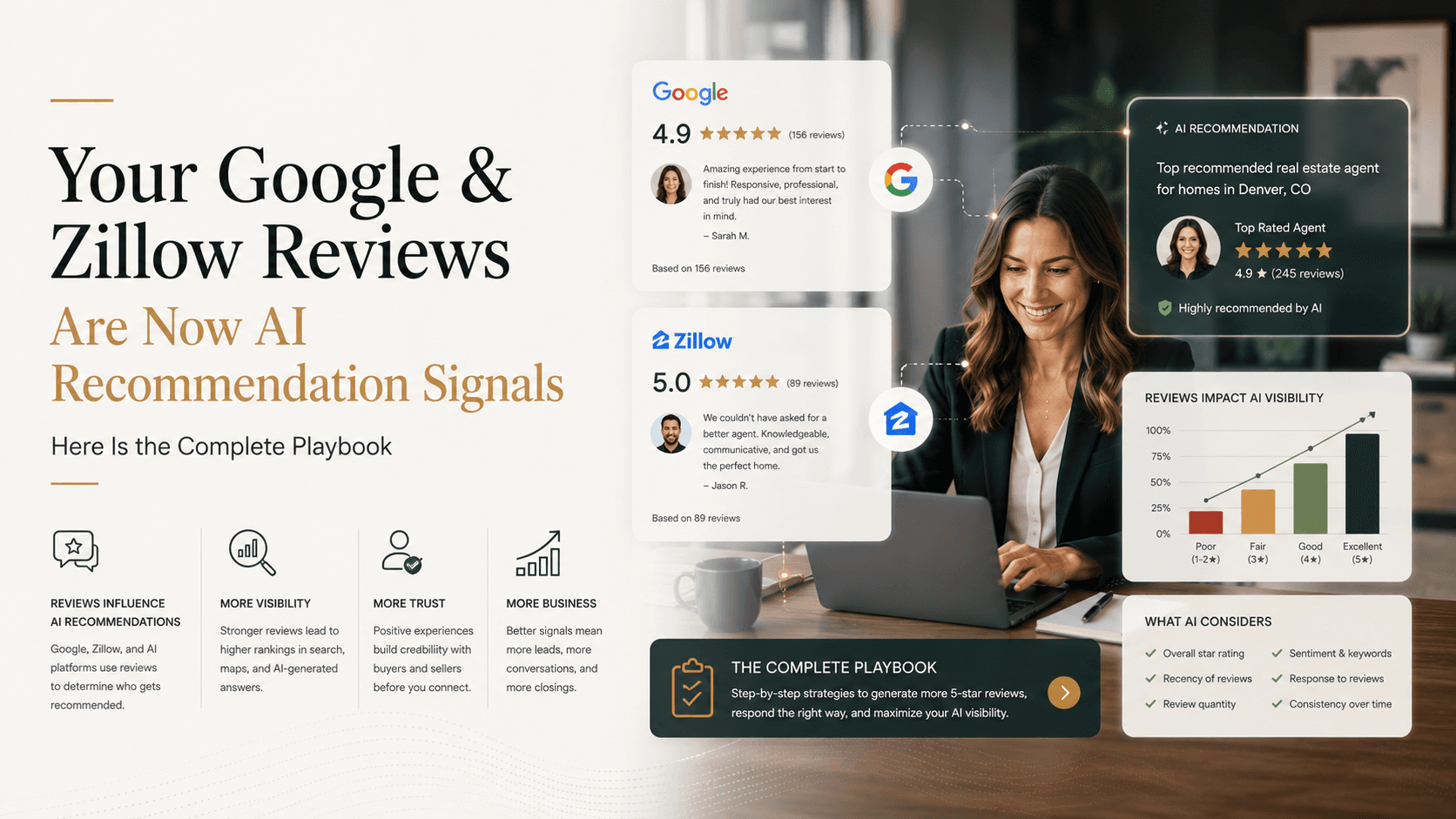
Yes — and the threshold is specific. Per Seer Interactive's May 2026 analysis of 800,000 AI responses across ChatGPT, Gemini, Perplexity, and Google AI Mode, businesses with even 1–13 reviews jump from a 1% AI citation rate to 53.5%, while actively managed profiles with 80+ reviews reach 75.3%. SOCi's 2026 Local Visibility Index adds that locations near 3.4 stars with review response rates under 5% are excluded from AI recommendations entirely — not ranked lower, but excluded. Meanwhile, 91% of real estate agents currently have no meaningful AI citation presence, per FlyDragon's 2026 State of AI SEO in Real Estate — a study spanning 12,400 AI responses and 8.2 million queries across 192 metros.
Key Takeaways
- 91% of U.S. real estate agents are invisible to AI search tools, per FlyDragon's 2026 State of AI SEO in Real Estate — a study of 12,400 AI responses and 8.2 million queries across 192 metros with a 4,180-respondent buyer survey.
- Businesses with even 1–13 reviews jump from a 1% AI citation rate to 53.5%, per Seer Interactive's May 2026 analysis of 800,000 AI responses commissioned by Trustpilot — the 52-percentage-point gain requires only a minimal review presence to unlock.
- 74% of consumers only consider reviews written in the last 90 days and 31% refuse to use any business below 4.5 stars — both up sharply from 2025 — per BrightLocal's 2026 Local Consumer Review Survey of 1,002 U.S. consumers.
- Locations near 3.4 stars with response rates under 5% are excluded from AI recommendations entirely — not demoted, but absent — while AI-recommended businesses average 4.3 stars, per SOCi's 2026 Local Visibility Index.
- In 71% of U.S. metros, no single agent yet holds more than 15% AI citation share — the dominant position remains unclaimed in three of four American markets — per FlyDragon's 2026 State of AI SEO in Real Estate.
- Agents who began building AI citation share in early 2025 now hold 5.7× the citation share of agents who started the same work 12 months later, even when the later group spent more, per FlyDragon 2026.
Marcus Reilly closed 31 transactions in the 12 months ending March 2026 without renewing his Zillow Premier Agent subscription — which he'd dropped the previous October after calculating that his $1,400-per-month spend returned leads closing at 2.4%, the Zillow-wide average for portal traffic. He spent that same month requesting 42 Google reviews from past clients via a day-of-close SMS workflow, rewriting his Zillow bio to open with "I help first-time buyers navigate competitive offers in South Tampa's Hyde Park and Palma Ceia neighbourhoods," and publishing one Google Business Profile post per week. By January 2026, when a buyer typed "who is the best real estate agent in Hyde Park Tampa for a first-time buyer" into ChatGPT, Marcus was one of three names returned. His two closest competitors — both spending $1,000–$2,500 monthly on portal leads — were not mentioned. One of them had 220 Google reviews, all from 2021.
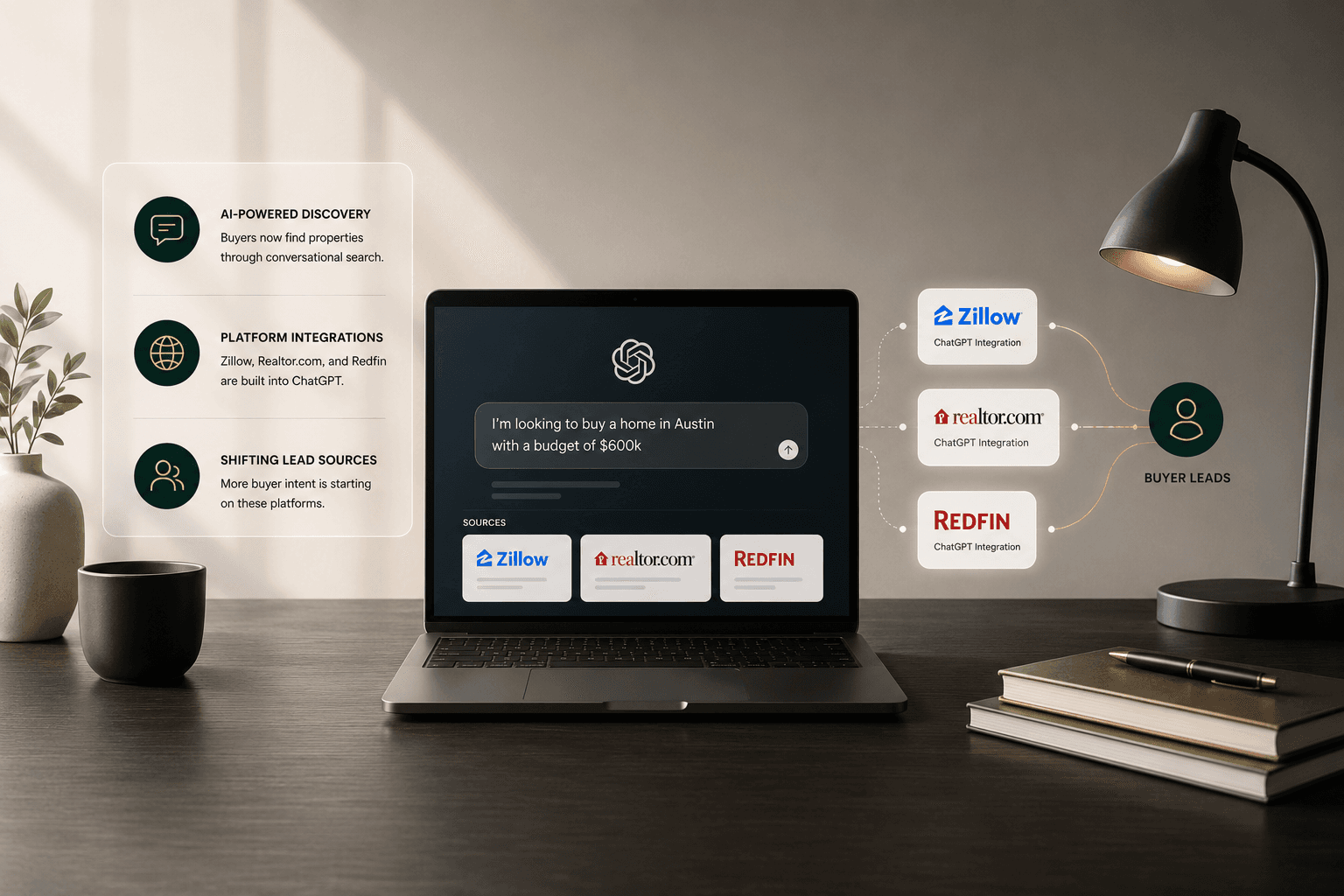
Your review profile is no longer just social proof for human readers. As of October 6, 2025 — when Zillow became the first real estate app integrated directly inside ChatGPT — your reviews on Google, Zillow, and Realtor.com are the primary data signals determining whether AI tools recommend you or your competitor. This article covers the exact rating thresholds that determine AI eligibility, the four platforms that matter in priority order, the scripts and sequences that generate consistent review velocity, and the 30-day system that builds from zero to competitive AI citation presence. Each section maps to a concrete action you can begin this week.
Why Your Google and Zillow Reviews Now Directly Affect Whether AI Recommends You
In 18 months, the share of homebuyers using ChatGPT, Perplexity, Gemini, or Google AI Overviews as their primary agent-research tool went from 17% to 67%. That figure comes from FlyDragon's 2026 State of AI SEO in Real Estate — the largest publicly published study of AI search behavior in U.S. residential real estate, spanning 12,400 AI-generated responses, 8.2 million tracked queries across 192 metros, and a 4,180-respondent buyer survey. Those buyers are not just browsing listings inside AI tools. They are asking AI which agent to hire — and AI is answering based on what it can verify from your public review profiles and portal data.
The mechanism is entity confidence. When a user asks ChatGPT "who is the best real estate agent in Austin for relocation buyers," the model executes a retrieval process — pulling from Zillow agent profiles, Google Business Profile data, Realtor.com bios, and third-party directory listings. It then uses your review count, star rating, review recency, and the specificity of your review text to assess whether it can confidently recommend you. An agent with 80 recent, specific, high-rated reviews across multiple platforms passes that confidence threshold. An agent with 12 stale reviews from 2022 does not. This is why a competitor with fewer total reviews can out-cite an agent with a larger but older review profile — the recency and specificity signals outweigh raw volume once volume exceeds a basic threshold.
Stat: 61.3% of buyer-side real estate searches now begin in an AI search engine rather than Google or Zillow. — FlyDragon 2026 State of AI SEO in Real Estate, based on 12,400 AI responses and 8.2 million queries across 192 metros
Tim Harvey, CEO and co-founder of FlyDragon, quantified the cost gap between channels directly: "A Zillow lead can cost anywhere from $25 to $80, depending on the market, and closes 2.4% of the time. An AI-cited lead, when you've earned the citation, costs effectively zero in marginal terms and closes nearly four times more often." The agents spending $1,400–$2,500 per month on portal leads while their review profiles decay are simultaneously funding a low-close-rate channel and neglecting the infrastructure that drives the higher-close channel. The review profile takes 60–90 days to build and cannot be bought with ad spend. Portal leads can be turned back on the moment they're needed.
The Timeline: How Reviews Became AI Signals in 18 Months
Three specific product launches created the current landscape. Understanding the timeline explains why agents who built strong review profiles before October 2025 hold a structural advantage — and why every additional month of delay compounds the gap. Per FlyDragon's 2026 data, agents who began AI citation-building in early 2025 now hold 5.7× the citation share of agents who started 12 months later, even when the later group spent more.
AI search begins supplementing traditional Google
ChatGPT surpasses 100M weekly users. Buyers begin asking AI real estate questions. Google Business Profile data starts being indexed by AI crawlers. Agents are not yet cited by name — AI answers generic questions without recommending specific professionals. Zillow and Realtor.com portal data is not yet being pulled systematically.
AI begins citing local businesses in "who should I hire" queries
SOCi's 2026 Local Visibility Index research identifies review count, star rating, and profile completeness as the first AI recommendation signals for local businesses. Real estate agents who appear are almost exclusively those with strong Google Business Profiles. 91% of agents remain invisible, per FlyDragon. The agents who do appear have 4.3+ stars and active response rates — the pattern SOCi will later confirm as the AI inclusion threshold.
Zillow launches the first real estate app inside ChatGPT — the inflection point
Zillow becomes the only real estate app in ChatGPT's App Store. Buyers now search for homes, view listings with photos, and connect to agents directly within ChatGPT. Agent recommendations are powered by Zillow profile data — review count, rating, specializations, and service areas. For the first time, your Zillow reviews directly influence ChatGPT recommendations. Agents with optimized Zillow profiles and 25+ reviews gain immediate AI visibility advantage over competitors with stale, incomplete profiles.
Redfin follows; Google AI Overviews expand local real estate coverage
Redfin launches a ChatGPT app integration giving buyers access to listings, market data, and its Buying Power affordability tool through natural conversation. Google AI Overviews begin appearing more frequently on local real estate queries. Google Business Profile signals — review count, recency, rating, and owner response activity — are confirmed as direct citation factors for AI Overviews. Agents who respond to all reviews within 24 hours begin appearing consistently in local AI answers.
Realtor.com ChatGPT app — every major portal is now conversational
Realtor.com launches its ChatGPT integration, completing the portal transition to conversational AI. Pre-search buyers can now explore affordability, neighborhoods, and agent options within ChatGPT before being routed to Realtor.com to connect with an agent and schedule tours. Your profile presence across all three major portals is now simultaneously a consumer-facing asset and a direct AI data signal. An incomplete Realtor.com profile now has a measurable AI cost.
Research confirms the mechanism — the data is definitive
Seer Interactive's analysis of 800,000 AI responses (commissioned by Trustpilot, May 2026) documents the 52-percentage-point jump in AI citation rates from having even a minimal review profile versus none. SOCi's Local Visibility Index confirms the 3.4-star exclusion threshold. FlyDragon's benchmark documents that 91% of agents remain invisible and that early movers hold 5.7× the citation share of agents who started the same work 12 months later, even when the later group spent more. Reviews are now recognized industry-wide as AI recommendation infrastructure, not just social proof.
The consequence of this timeline is asymmetric. Agents who built review profiles and completed GBP optimization before October 2025 had a 12-month head start while the portals were still building their ChatGPT integrations. That head start has compounded. In 71% of U.S. metros, however, no single agent yet holds more than 15% AI citation share — meaning the dominant local AI position is still unclaimed in three of four American markets. The window to claim it without competing against an entrenched incumbent is still open, but narrowing each month.
What AI Tools Actually Read From Your Review Profile
AI platforms extract three distinct types of information from your review profile: an authority signal, a specificity signal, and a recency signal. Most agents optimise only for the authority signal — star rating and total volume — without understanding that specificity and recency are the differentiating factors when two agents have similar ratings and review counts. An agent with 80 specific, recent reviews at 4.8 stars will out-cite an agent with 200 generic, stale reviews at 4.7 stars on nearly every specialisation-specific query.
Authority Signal: Rating and Volume
AI systems use your aggregate star rating and total review count as a binary trust threshold — a gate before any other signals are considered. Per SOCi's 2026 Local Visibility Index, locations near 3.4 stars with review response rates under 5% are excluded entirely from AI recommendations. Businesses recommended by ChatGPT average 4.3 stars. The minimum to enter AI recommendation eligibility is approximately 4.3 stars with at least 15–20 reviews. At 4.7+ stars with 50+ reviews, your authority signal is strong enough that specificity and recency become the tiebreakers between you and equally-rated competitors.
Below 3.4 stars = excluded from AI recommendations entirely — SOCi 2026Specificity Signal: What Reviews Say
AI platforms perform named entity recognition on review text — extracting locations, transaction types, challenges, and outcomes to understand what kind of agent you are and which queries you match. A review mentioning "helped us relocate from Detroit to Tampa's South Howard neighbourhood, competed against 4 offers, closed in 28 days" signals: relocation specialist, Tampa, SoHo, competitive-offer expertise, fast close. That single review matches five different buyer query types. A review saying "great agent, highly recommend" gives AI nothing to index against any specific query.
Specific reviews = more query types matched in AI recommendationsRecency Signal: How Fresh Your Reviews Are
74% of consumers only consider reviews written in the last 90 days, per BrightLocal's 2026 Local Consumer Review Survey — a panel of 1,002 U.S. adults surveyed via SurveyMonkey — and AI recommendation systems follow the same logic. An agent with 200 reviews from 2021 ranks below an agent with 60 reviews from the past 12 months, because recency validates that your business is currently operating at the level your aggregate rating suggests. The minimum target for 2026 AI visibility is 2–4 new reviews per month. At 10+ new reviews per month, the recency signal produces compounding citation advantage.
74% of consumers ignore reviews older than 90 days — BrightLocal 2026Response Signal: Whether You Reply
Google's algorithm for AI Overviews weights owner response activity. Agents who respond to all reviews within 24 hours show higher AI visibility than agents with identical ratings and volume who don't respond. Critically: your response is indexable text. A response mentioning your city, your neighbourhood specialty, and the transaction type — "Thank you, Sarah! As a buyer's agent specialising in Travis Heights and Hyde Park, there is nothing I love more than helping first-time buyers navigate competitive offers in Central Austin..." — adds named-entity data to your GBP with every response you publish.
100% response rate within 24 hours — Google and AI weight engagementAI CITATION RATE BY REVIEW PROFILE STATUS — Seer Interactive / Trustpilot, May 2026 · n=800,000 AI responses, 1,926 brands
The jump from zero reviews to 1–13 reviews — a 52-percentage-point gain in AI citation probability — is the single highest-ROI action for an agent currently at zero AI citation presence. This is not a gradual improvement. It is the difference between being functionally invisible to AI and being present in the majority of AI responses for relevant queries. Per BrightLocal's 2026 survey, 47% of consumers won't use a business with fewer than 20 reviews at all — the AI threshold for confidence and the human threshold for trust are converging at the same number.
Where to Build Your Review Presence: Platform-by-Platform Breakdown
Four platforms control your AI recommendation eligibility in 2026. The priority order matters more than the total effort you distribute across them. Building in the wrong order — Realtor.com before Google, or third-party directories before Zillow — produces lower returns at each stage than the correct sequence.
Google Business Profile
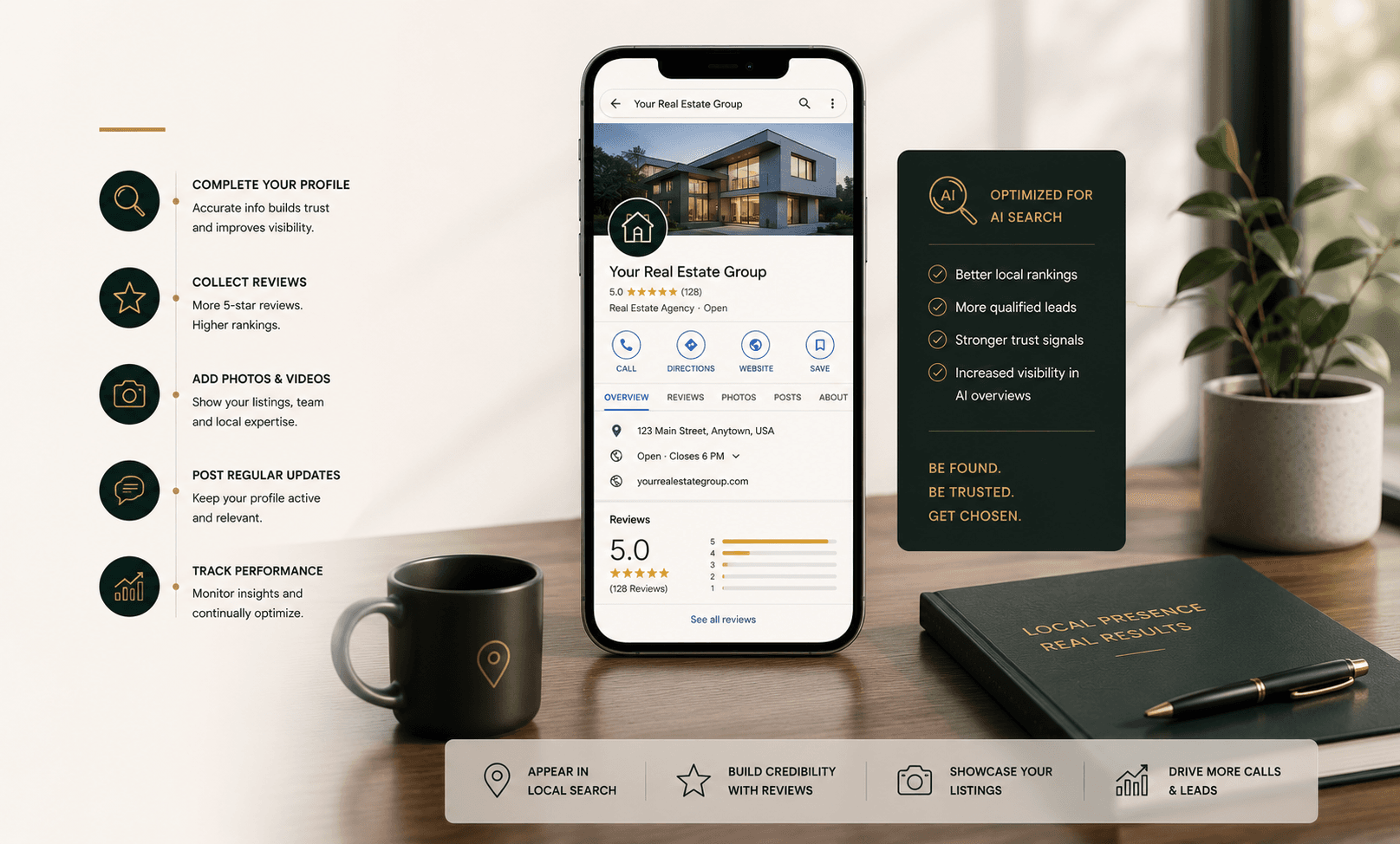
Your GBP feeds Google AI Overviews, Gemini, and Perplexity's real-time indexer — and contributes entity confidence to ChatGPT alongside your Zillow and Realtor.com profiles. The top-ranked GBPs in local search average 404 reviews, per SOCi's 2026 Local Visibility Index. Most agents have fewer than 20. Your GBP business description (750 characters), service areas at the neighbourhood level, and every review response you write are indexed as named entities. A complete, active GBP is the non-negotiable foundation before any other platform matters. Target: 4.7+ stars, 50+ reviews, 100% response rate within 24 hours, one post per week minimum.
Highest AI leverage — builds before all other platformsZillow Agent Profile
Since October 6, 2025, your Zillow profile functions as a direct data feed to ChatGPT — the most-used AI platform globally. When a ChatGPT user searches for an agent, the system reads your Zillow bio's opening sentence, specializations, neighbourhood-level service areas, recent transactions, and reviews. "I help first-time buyers navigate competitive offers in Central Austin's Hyde Park" outperforms "Licensed since 2012 with ABC Realty" for matching buyer queries. "Greater Houston Area" is AI-invisible. "Montrose, Heights, Midtown, Houston 77006" is a specific citation target. Target: 25+ Zillow reviews with specificity, complete bio with natural language, all specialisation fields filled, NAP exactly matching GBP.
Direct ChatGPT data feed since October 2025 — highest ChatGPT leverageRealtor.com Agent Profile
Since March 30, 2026, Realtor.com has its own ChatGPT integration, routing pre-search buyers — those establishing budgets and exploring neighbourhoods — to local agent profiles. Realtor.com's ChatGPT app focuses on the early "what if" phase of the buyer journey, then routes high-intent users back to Realtor.com to connect with a local agent. An incomplete Realtor.com profile means you miss this routing. Complete your bio with neighbourhood language, verify all contact information matches your GBP exactly (NAP consistency is an AI trust signal), and build Realtor.com reviews as a secondary priority after Google and Zillow are established.
ChatGPT integration launched March 30, 2026 — complete profile requiredThird-Party Directories
ChatGPT and Perplexity frequently cite "best of" lists as sources in local agent recommendations — Expertise.com and ThreeBestRated.com appear in AI responses across dozens of metros. Getting listed on these directories creates an additional citation pathway that does not require earning a review. Expertise.com accepts direct applications (free tier available). ThreeBestRated uses a 50-point inspection process including review verification — apply directly at their website. Being listed on both directories adds an additional citation layer for local "best agent" queries without any ongoing maintenance cost after the initial listing approval.
Cited by ChatGPT + Perplexity for "best agent" queries — free to pursueNAP consistency — the exact match of your name, address, and phone number — across all four platforms is an AI trust signal. When ChatGPT's retrieval process finds your name spelled differently on Google ("Marcus Reilly, Realtor") than on Zillow ("Marcus A. Reilly") or your phone number formatted inconsistently, the AI loses confidence in whether these profiles refer to the same professional and reduces recommendation probability. Audit all four platforms for exact consistency as the first step of any review campaign.
What Makes a Review AI-Visible (and What Makes It Invisible)
A generic five-star review is worth approximately one-tenth of a specific five-star review for AI visibility purposes. The mechanism is named entity recognition: AI systems extract location names, transaction types, challenges, and measurable outcomes from review text to build a query-matching profile for each agent. A review saying "great experience, highly recommend" contributes zero named entities and therefore matches zero specific buyer queries. A review that names your neighbourhood, transaction type, challenge, and outcome can match five different query types simultaneously — and each of those matches represents a different buyer finding you in a different AI search.
The five elements that make a review AI-visible: (1) Specific neighbourhood or city — "Palma Ceia in Tampa," not "Tampa area." (2) Transaction type — "relocation from Detroit," "first-time buyer," "investment property," "downsizing from a 5-bed." (3) Challenge solved — "competing offers," "difficult seller," "timeline pressure," "estate sale complexity." (4) Measurable outcome — "sold in 11 days," "4% above asking," "under asking price," "closed in 28 days." (5) Personal attribute — "always available," "explained everything," "responded at 10pm." Each element matches a different buyer query type in AI search.
How to Guide Clients Toward AI-Visible Reviews Without Scripting Them
Getting clients to write specific reviews requires one sentence at the right moment — not a script. When requesting a review, add this framing: "Feel free to mention the neighbourhood, anything specific I helped you navigate, and how the process felt — those details help future clients understand exactly what working with me is like." This prompt shifts the client from "what do I write?" to "what was specific about this experience?" The resulting review typically contains two or three named entities. That framing costs 10 seconds to say and produces a review worth ten generic reviews for AI citation purposes.
Agents who build a consistent review specificity strategy see compounding returns. Each specific review expands the set of query types you match — without requiring any additional work. An agent with 60 specific reviews across five transaction types and eight neighbourhoods will out-cite a competitor with 200 generic reviews on nearly every specialisation-specific query, because AI can confidently attach your name to a specific buyer intent in a way it cannot with generic praise.
The Automated Review Generation System: Timing, Scripts, and Sequences
The highest review request conversion window in real estate is the day of closing — the emotional peak of the transaction. BrightLocal's 2026 Local Consumer Review Survey, based on 1,002 U.S. consumers, confirms that 74% of consumers only trust reviews from the last 90 days. This means your review acquisition system needs to fire at the moment of peak client satisfaction and do so automatically — not when you remember. Three timing windows, in descending conversion order: day of closing (highest conversion), day 7 post-close (strong second), and day 30 (moderate). Requests at day 60–90 produce significantly lower conversion because the emotional connection to the transaction has faded.
REVIEW REQUEST CONVERSION RATE BY TIMING — RELATIVE TO CLOSING DATE
Optimising Your Zillow Profile for ChatGPT Recommendations: The 8-Step Checklist
Since October 6, 2025, your Zillow agent profile is a direct data feed to ChatGPT. Most agents set up their Zillow profile years ago and haven't touched it since. ChatGPT reads your bio's opening sentence first, then your service area list, then your specializations, then your recent transaction history, then your review count and rating — in roughly that priority order — when formulating an agent recommendation. A bio that opens with "I've been licensed since 2012 with ABC Realty" gives ChatGPT no geographic or specialization data to match your name to a specific buyer query. This is fixable in 30 minutes.
- ✓Professional headshot and bio with a market-specific opening sentence. "I help first-time buyers navigate competitive offers in Central Austin's Hyde Park and Travis Heights" gives ChatGPT city, neighbourhood, buyer type, and specialization in one sentence — that's all the match data the AI needs.
- ✓Service areas at neighbourhood and zip code level. "Greater Houston Area" is AI-invisible. "Montrose, Heights, Midtown, Houston 77006" is a specific citation target. List every specific neighbourhood you serve — the more granular, the more localised queries you match.
- ✓All specialization fields filled completely. Buyer's agent, listing agent, relocation, first-time buyers, luxury, new construction — use every applicable field. These are among the first signals ChatGPT uses when matching a query ("I need an agent specialising in relocation to Austin") to your profile.
- ✓Transaction history current and visible. Recent sales in a specific neighbourhood are an activity signal. Agents with visible recent transactions in a zip code rank higher for queries about that zip code than agents with similar review counts but no visible activity in that area.
- ✓25+ Zillow reviews with specificity. Below 25 Zillow-specific reviews, ChatGPT treats your Zillow profile as insufficient for a confident recommendation. Run Script 1 and Script 2 above but direct the link to your Zillow review page for a dedicated Zillow acquisition push if you're below this threshold.
- ⚠Contact information exactly matching your Google Business Profile. Your phone, website, and email on Zillow must exactly match your GBP — same format, same spelling. NAP inconsistency creates entity disambiguation failure: AI treats different listings as different businesses, splitting your citation signal instead of reinforcing it.
- ⚠Listing and past sale descriptions in natural language. MLS jargon ("LRG BK YRD") is invisible to AI. "Large, private backyard with mature oak trees, ideal for families with young children" is searchable and matches the way buyers phrase queries in ChatGPT. Every word in your listing descriptions is now read by AI to match buyers.
- ⚠Zillow profile URL cross-linked from your Google Business Profile website section. Cross-linking creates a citation chain that increases AI confidence in your identity across platforms. When profiles are consistent across Google, Zillow, and Realtor.com, AI treats your brand as more authoritative, boosting recommendation confidence across all models.
Google Business Profile: The Highest-Value AI Signal Available to Real Estate Agents
Your Google Business Profile is the single most important AI visibility asset a real estate agent controls directly. It feeds Google AI Overviews, Gemini, and is crawled by Perplexity's real-time indexer. For ChatGPT, it contributes to citation confidence alongside your Zillow and Realtor.com profiles. The top-ranked Google Business Profiles in local search average 404 reviews, according to SOCi's 2026 Local Search Top Ranking Factors. Most real estate agents have fewer than 20. The gap is enormous — and still closeable.
GBP Setup Requirements — 2026 AI Optimised
- ✓Business Name: Your name + "Real Estate Agent" (not just your name). Example: "Sarah Kim – Austin Real Estate Agent"
- ✓Primary Category: "Real estate agent" (not "real estate agency")
- ✓Service Areas: List every specific neighbourhood and city you serve
- ✓Business Description: 750 characters including your key specialisations and 2–3 specific neighbourhoods
- ✓Hours Set: Even "by appointment" hours are better than blank
- ✓Website Link: Linked to your IDX website, not a generic brokerage page
- ✓Photos: Professional headshot + 5–10 photos of listings, neighbourhood, and you working
- ✓Weekly Posts: Minimum 1 GBP post per week: market update, new listing, sold announcement, or tip
Review Response That Adds AI Keywords
"Thank you so much! I'm glad I could help. Best wishes in your new home!"
Adds zero AI keyword signals to your GBP profile.
"Thank you, Sarah! It was a true pleasure helping you find your first home in Central Austin's Hyde Park neighbourhood. As a buyer's agent specialising in Travis Heights and Hyde Park, there is nothing I love more than helping first-time homebuyers navigate competitive offers. Wishing you many happy years at your new home!"
Adds: city, neighbourhood (×2), transaction type, and specialization — all indexable by AI crawlers.
Review Velocity: The Metric That Determines Your AI Visibility Trajectory
Review velocity — the rate at which you receive new reviews per month — is the metric that separates agents whose AI visibility compounds over time from those who spike once and plateau. For real estate agents in 2026, the target benchmarks are clear: 2–4 new reviews per month is the minimum to maintain and grow AI visibility; 10+ per month is elite performance that produces compounding AI citation advantage, according to FlyDragon's 2026 State of AI SEO in Real Estate.
| New Reviews / Month | Benchmark | AI Visibility Impact | What This Requires |
|---|---|---|---|
| 0–1 | Below Minimum | AI visibility stagnates; recency signal degrades rapidly. | No review acquisition workflow. Needs a dedicated request system. |
| 2–4 | Baseline | Maintains baseline AI visibility; enables slow organic growth. | Consistent requests at closing + quarterly touchpoints to past sphere. |
| 5–9 | Competitive | Growing AI citation share; begins displacing inactive competitors. | Automated CRM review sequences + open house QR sign-in table active. |
| 10+ | Elite | Compounding AI citation presence; dominates local search recommendations. | Full automated multi-touch closing system + past sphere reactivation. |
The 90-Day Review Sprint: Going From Zero to Competitive
If your review profile is currently thin — under 20 reviews on Google or Zillow — the fastest path to competitive AI visibility is a structured 90-day sprint targeting your existing sphere. This is not about gaming the system; it is about asking everyone who has had a meaningful positive experience with your work to document it. Most past clients are happy to help — they simply haven't been asked directly.
Target: 10–15 reviews across GBP and Zillow.
Target: 5–8 new reviews this month.
Target: 30–50 reviews total, active AI citations.
How to Test Your AI Visibility Right Now (5-Minute Audit)
Before building your review strategy, benchmark where you stand today. The visibility audit protocol involves opening three tabs — ChatGPT with web search enabled, Perplexity, and Google — and running five specific query types that represent the questions your ideal clients actually ask. This audit takes 5 minutes and tells you exactly whether you currently appear, who appears instead of you, and what sources those tools are citing.
- Do you appear at all?
- Who does appear?
- What sources does the AI cite at the bottom? The citations reveal your competitors' review infrastructure — and exactly what you need to build to displace them.
| Metric | Target (Competitive) | Target (Elite) | How to Measure |
|---|---|---|---|
| Review Velocity (new/month) | 2–4 new reviews/month | 10+ new reviews/month | Google Business Profile dashboard → Reviews tab |
| Average Star Rating | 4.5+ stars | 4.8+ stars | GBP dashboard + Zillow profile average |
| Review Response Rate | 80%+ within 48 hours | 100% within 24 hours | GBP "Respond" section — count unresponded |
| AI Citation Frequency | Appears in 2–3 of 5 queries | Appears in 4–5 of 5 queries | Run 5-query audit monthly — record each result |
How Pinova's 90-Day Sequences Automate Your Review Growth
The most common reason agents have thin review profiles is not that their clients are unwilling to review them. It is that the review ask never happens — or it happens once, at the wrong time, in the wrong way. Building consistent review velocity requires a system that fires automatically at the optimal timing window without depending on the agent to remember to ask. This is exactly what Pinova's 90-Day Sequences are built for.
Automated Close-Day Review Request
Configure Pinova's 90-Day Sequences to fire an SMS and email review request on the day of closing — triggered automatically when you mark a deal as closed in the pipeline. The message includes your direct Google review link and the specificity prompt. Fires at the highest-conversion moment without requiring you to remember to send it.
Second-Touch Review Sequence
If a client hasn't reviewed within 7 days of closing, the 90-Day Sequence automatically fires the check-in email (Script 2). This second touch catches clients who intended to review but forgot. The combined day-of-close + day-7 sequence converts at 55–65% of closed deals into reviews, according to Pinova platform data across agent accounts using this configuration.
Annual Review Refresh from Past Clients
Pinova's long-term nurture sequence includes a home anniversary touch — a personalised message on the one-year anniversary of closing. This is also the optimal moment to re-request a review from clients who didn't respond at close. Fresh reviews from past clients carry strong recency signals and require zero new transactions to generate.
Email Open Triggers = Pre-Review Signals
When a past client opens three consecutive market update emails from your Pinova nurture sequence, this is a pre-seller signal — but it is also a pre-reviewer signal. An agent reaching out to re-engage a warm past client ("I noticed you've been reading the market updates — are you thinking about making a move?") has a 3–4× higher chance of also securing a review from that interaction.
Key Statistics: Agent Reviews and AI Citation Recommendations
| Key Statistic / Finding | Source & Year |
|---|---|
| 91% of U.S. real estate agents are invisible to AI search tools | FlyDragon 2026 State of AI SEO in Real Estate |
| Businesses with 1–13 reviews jump from a 1% AI citation rate to 53.5% | Seer Interactive / Trustpilot, May 2026 |
| 74% of consumers only consider reviews written in the last 90 days | BrightLocal 2026 Local Consumer Review Survey |
| Locations near 3.4 stars with response rates under 5% are excluded from AI recommendations entirely | SOCi 2026 Local Visibility Index |
| In 71% of U.S. metros, no single agent holds more than 15% AI citation share | FlyDragon 2026 State of AI SEO in Real Estate |
| Early movers hold 5.7× the citation share of agents starting 12 months later | FlyDragon 2026 State of AI SEO in Real Estate |
Common Questions About Reviews and AI Search in 2026
Do Google and Zillow reviews now determine whether AI tools recommend me as a real estate agent?
Yes. Per Seer Interactive's May 2026 analysis of 800,000 AI responses across ChatGPT, Gemini, Perplexity, and Google AI Mode, businesses with even 1–13 reviews jump from a 1% AI citation rate to 53.5%, while actively managed profiles with 80+ reviews reach 75.3%. SOCi's 2026 Local Visibility Index adds that locations near 3.4 stars with review response rates under 5% are excluded from AI recommendations entirely — not ranked lower, but excluded.
How many reviews does a real estate agent need to appear in AI search?
Research from position.digital and SOCi suggests that even 10–25 reviews produce a dramatic 52-percentage-point jump in AI citation rate compared to agents with no review profile. The competitive threshold in 2026 is approximately 25–50 reviews with a 4.7+ star average and consistent velocity of 2–4 new reviews per month. Agents below 4.3 stars face significant disadvantage regardless of volume, as rating acts as a threshold filter before volume is considered.
How does the Zillow ChatGPT integration affect real estate agents?
In October 2025, Zillow became the first real estate app integrated directly inside ChatGPT. When users search for homes or agents in ChatGPT, the system pulls live Zillow data — including agent profiles, reviews, transaction history, and specialisations. Your Zillow profile completeness, review count, and rating now directly influence whether ChatGPT surfaces you when a buyer or seller asks for an agent recommendation in your area. An incomplete or under-reviewed Zillow profile is now an AI visibility liability.
What is review velocity and why does it matter for AI visibility?
Review velocity is the number of new reviews you receive each month. AI systems weight recency heavily — 74% of consumers only trust reviews written in the last 90 days. Recency signals active business operations. For real estate agents in 2026, the target is 2–4 new reviews per month as a minimum, with 10+ per month producing compounding AI citation advantage. An agent with 200 stale reviews and a rating from three years ago will often be out-cited by a competitor with 60 recent reviews from the last year.
What makes a real estate review useful for AI visibility?
AI systems extract specificity from review text to understand what kind of agent you are. Generic reviews like "great experience, highly recommend!" give AI nothing specific to work with. A review that mentions your specific neighbourhood, the transaction type, the challenge you solved, and a measurable outcome — "sold our home in 11 days at 102% of list price" — gives AI the information to confidently match you to relevant queries. The most AI-visible reviews mention at least three of these five elements: specific location, transaction type, challenge navigated, measurable outcome, and personal attribute.
Amaan Sheikh
— Co-Founder & CEOAmaan Sheikh is the co-founder and CEO of Pinova. He sets the product direction, builds the partnerships, and personally works with every founding partner. His focus is making enterprise-grade real estate technology accessible to ambitious agents and teams — without the enterprise price tag.