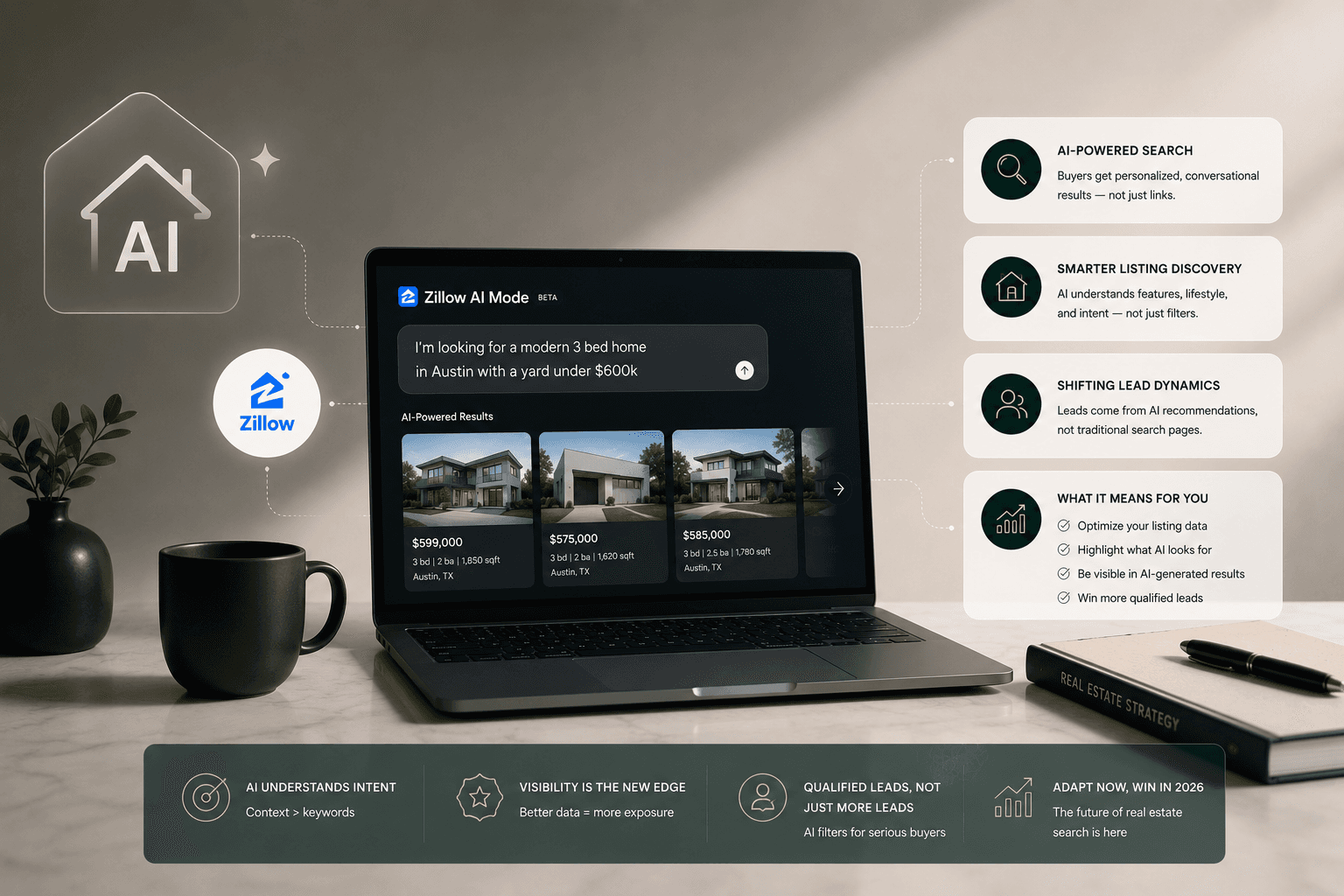
How to Dominate AI Local Search: A Step-by-Step Blueprint


Quick Answer
Does AI search actually matter for real estate, or is that hype built for other industries?
It matters, but not in the way most agents assume. Google's AI Overviews, the summary box that appears above search results, trigger on under 6% of real estate-related queries, far below healthcare (88%) or education (83%), because real estate searches tend to be transactional rather than informational. That's led some agents to conclude AI search is someone else's problem. But 45% of consumers now use conversational AI tools like ChatGPT, Gemini, or Perplexity to find local business recommendations, up from just 6% a year earlier, and when someone asks one of those tools "best real estate agent in [city]," an estimated 98.8% of local businesses are never mentioned in the answer. That's the real opportunity: not the Overview box, but being the name the assistant says out loud.
Key Takeaways
- 45% of consumers used an AI tool to find a local business recommendation in the past year, up from just 6% the year before, a 7.5x increase in twelve months (BrightLocal 2026 Local Consumer Review Survey).
- Google AI Overviews trigger on under 6% of real estate and local-services queries, compared with 88% for healthcare and 83% for education, real estate searches are too transactional to summarize, which shifts the real battleground to conversational assistants.
- An estimated 98.8% of local businesses are never recommended when someone asks ChatGPT, Gemini, or Perplexity for a local provider, only 1.2% get mentioned at all.
- Google Business Profile signals account for roughly 32% of local pack ranking weight, more than review signals (20%), on-page SEO (19%), and link signals (15%) combined.
- Only 44% of businesses even appear in the Local Pack for their primary keyword, meaning more than half of agents are invisible before AI ever enters the picture.
- AI systems increasingly evaluate businesses as "entities", verified through consistent name/address/phone data, structured markup, and cross-platform citations, not as individual web pages competing on keywords.
Up from 6% a year ago, this happened in a single year, not a decade.
Most agents haven't noticed the rules changed, because there's no dashboard alert when ChatGPT recommends someone else instead of you.
Priya Malhotra found out she was invisible by accident. A client mentioned, almost in passing, that she'd asked ChatGPT for "a good realtor in the north suburbs" before reaching out, and Priya's name hadn't come up. Neither had any of the three other agents she knew personally in her own market. Curious, she ran the same query herself, then tried Perplexity, then Gemini. Across all three, she got confident, specific answers, just never her own name, despite fifteen years in the business and a Google rating north of 4.9 stars. Nothing had gone wrong exactly. She simply hadn't done any of the specific things that make a business "readable" to an AI system, and neither had almost anyone else in her market. That gap is exactly why she went looking for a blueprint.
That story is becoming common for a reason: the shift happened faster than almost anyone's marketing plan accounted for. A tool 45% of consumers now use for local recommendations was used by just 6% of them twelve months earlier, and unlike a ranking drop you can see in Search Console, there's no notification when an AI assistant leaves you out of an answer. You only find out if you go looking, or if a client happens to mention it.
The Real Estate Paradox: Low Overview Visibility, High Chatbot Opportunity
Here's the part that trips up most agents reading about AI search for the first time: the headline statistics about Google's AI Overviews mostly don't apply to real estate directly. A large analysis of search queries found Overviews trigger far less often on transactional, local-intent categories like real estate than on informational categories.
Google AI Overview Trigger Rate by Industry
That low trigger rate is real, but it's easy to misread as "AI doesn't matter for real estate yet." It matters, the mechanism is just different. Overviews summarize informational queries ("how does escrow work"). Conversational assistants answer recommendation queries ("who should I use") directly, in a chat window, with no Overview box involved at all. BrightLocal's 2026 Local Consumer Review Survey found that 45% of consumers have now asked an AI tool for exactly that kind of recommendation, and real estate, as a high-trust, high-stakes local decision, is a natural fit for that behavior, even while it stays largely invisible in the Overview statistics.
How AI Actually Decides Which Agent to Recommend
Every major AI assistant leans on the same underlying data layer, even though they source it differently. When Gemini answers a local query, Google's "Grounding with Google Maps" system connects it to more than 250 million verified places, treating your Google Business Profile as authoritative. ChatGPT, which OpenAI powers partly through Bing's index and partners like Foursquare, draws on Bing Places, verified directories, and your website, the same structured-data ecosystem a well-maintained Google profile anchors and keeps consistent. The practical implication: these systems aren't ranking your webpage, they're evaluating whether your business is a verifiable entity, a consistent, cross-referenced set of facts about who you are and where you operate.
What Determines Local Pack & AI-Recommendation Weight
That Google Business Profile weight isn't a small edge, it's larger than reviews, on-page SEO, and backlinks combined. We've already published a complete, dedicated walkthrough of GBP optimization specifically for agents, category selection, description structure, photo cadence, review generation, in our Google Business Profile optimization checklist, so this piece won't re-cover that ground in depth. What it will cover is everything around the profile that determines whether AI systems trust it enough to cite it: consistency, structured data, and content freshness across the rest of your digital footprint.
The Five Pillars of an AI-Visible Local Presence
A complete, current Google Business Profile
The foundation everything else builds on. An incomplete or stale profile means AI has nothing reliable to recommend, regardless of how good the rest of your presence looks. See our dedicated GBP guide for the full build-out, or Pinova's SEO & GEO tools if you'd rather have the consistency checks and structured data below run automatically.
~32% of local pack ranking weightNAP consistency across every citation
Your name, address, and phone number need to match exactly across your website, GBP, Yelp, Facebook, Bing Places, and every directory you're listed in. A mismatch, even "St." vs. "Street", erodes the confidence AI systems place in your identity.
The most common, most fixable failure pointLocalBusiness and Person schema markup
JSON-LD structured data, not Microdata, not RDFa, is what every major AI engine actually parses reliably. LocalBusiness schema tied to your GBP, plus Person schema with your credentials, gives AI systems a machine-readable identity to cite.
Tier-1 schema shows a 3:1 AI citation lift over unstructured pagesReview volume, recency, and response rate
97% of consumers read reviews before choosing a local business, and AI systems weight review recency alongside raw count. Responding to every review, good or bad, is itself a trust signal AI-recommendation systems can detect.
~20% of local pack ranking weightFresh, answer-first content
Content that states a clear answer plainly, in the first sentence, is easier for an AI system to extract and cite than content that builds up to a conclusion. Weekly GBP posts and periodic blog updates signal an active, trustworthy entity.
Freshness is a distinct, measurable AI-retrieval signalAI-Invisible vs. AI-Visible: The Same Agent, Two Different Footprints
Every signal an AI system checks, completeness, consistency, structure, recency, comes back weak or contradictory. There's nothing confidently citable here, so the assistant recommends someone else.
Every signal reinforces the same identity from multiple directions. This is what "verifiable entity" looks like in practice, and it's what AI systems are actively built to reward.
Four Priorities, Ranked by Effort-to-Impact
Audit and fix NAP consistency
Pull up your website, GBP, and every directory listing side by side. Fix every discrepancy in name formatting, address, and phone number. This alone resolves the most common reason AI systems distrust an otherwise strong profile.
Implement LocalBusiness and Person schema
Add JSON-LD LocalBusiness schema matched exactly to your GBP, plus Person schema with your credentials and sameAs links to your verified profiles. Validate it, invalid schema can confuse crawlers more than having none at all.
Build a weekly content-freshness cadence
A standing weekly GBP post and a regular blog update schedule signal an active entity to AI retrieval systems, which weight freshness distinctly from raw content volume.
Systematize review generation and response
A steady flow of recent, responded-to reviews outperforms a large stockpile of old ones. Build the ask into your closing process so it happens every time, not occasionally.
Testing Your Own AI Visibility
"Who is a good real estate agent in [your city/neighborhood]?", then note whether you appear, which competitors do, and what specifically the assistant cites about them.
"What do you know about [your name], a real estate agent in [city]?", this surfaces exactly which facts about you are (or aren't) confidently in the system, and where they might be wrong or outdated.
Run your site through Google's Rich Results Test after implementing or updating schema. Passing validation doesn't guarantee citation, but failing it guarantees your structured data isn't helping at all.
Benchmarks: What Progress Actually Looks Like
| Key Statistic / Finding | Source & Year |
|---|---|
| Local Pack ranking movement</td><td className="num">30–60 days | Early signal after full GBP optimization |
| Consistent Local Pack presence</td><td className="num">6–12 months | Requires sustained, not one-time, activity |
| Schema-driven AI citation change</td><td className="num">4–12 weeks | After correct, validated implementation |
| Knowledge Graph entity recognition</td><td className="num">Several months | Builds gradually with consistent structured data |
The 90-Day AI Visibility Blueprint
Audit and stabilize the foundation
- Run the direct-recommendation: test across ChatGPT, Gemini, and Perplexity to establish your starting baseline.
- Audit and correct: every NAP inconsistency across your website and all directory listings.
- Complete or refresh: your Google Business Profile using our dedicated GBP checklist.
Build the structured-data layer
- Implement LocalBusiness schema: matched exactly to your GBP, plus Person schema with credentials and
sameAslinks. - Validate everything through: Google's Rich Results Test and fix any errors found.
- Start a weekly: GBP posting cadence.
Systematize and re-test
- Build review generation: into your standard closing process so it runs on every transaction, not occasionally.
- Re-run the direct-recommendation: test and compare against your Day-1 baseline.
- Identify which specific: gap, consistency, schema, reviews, or freshness, moved the needle most, and double down there.
How Pinova Handles This For You
Every pillar above depends on the same underlying discipline: consistency, maintained continuously, not fixed once and forgotten. Pinova's SEO & GEO service handles the technical heavy lifting — schema implementation, NAP consistency audits, GBP optimization, and structured content — so the signals AI systems use to verify and recommend you stay current and correct without you managing it manually.
Key Statistics: AI Local Search in 2026
| Key Statistic / Finding | Source & Year |
|---|---|
| 45% of consumers used AI to find a local business recommendation in the past year, up from 6% | BrightLocal 2026 Local Consumer Review Survey |
| Google AI Overviews trigger on under 6% of real estate/local-services queries vs. 88% for healthcare | NP Digital / SeoProfy analysis, 2026 |
| An estimated 98.8% of local businesses are never recommended by AI assistants; only 1.2% are cited | EvolveAMZ local business AI search guide, 2026 |
| Google Business Profile signals account for ~32% of local pack ranking weight | Whitespark 2026 Local Search Ranking Factors survey |
| Only 44% of businesses appear in the Local Pack for their primary keyword | BrightLocal 2026 data |
| ChatGPT reached ~900M weekly active users; Google AI Mode passed 1B monthly users, 93% no-click | HousingWire; SEO Sherpa AI Search Statistics 2026 |
Common Questions About AI Local Search
Does AI local search actually apply to real estate if AI Overviews barely trigger on real estate queries?
Yes, the low Overview trigger rate only describes one AI mechanism (Google's summary box on informational searches). The 45% of consumers now using conversational AI tools for local recommendations are asking a different kind of question entirely, one real estate fits naturally: "who should I use," not "how does this work." That's where the real exposure, or invisibility, is happening.
How is this different from just optimizing my Google Business Profile?
GBP optimization is the single highest-weighted factor and the necessary foundation, covered in full detail in our dedicated guide, but AI systems also check consistency and structure well beyond your GBP: your website's schema markup, NAP matching across directories, and content freshness. A perfect GBP sitting next to a mismatched website address still undermines AI confidence in your entity.
Do I need a developer to implement schema markup?
Not necessarily, many website platforms and plugins can generate basic LocalBusiness and Person JSON-LD without custom code, though validating it correctly still matters. For more complex, multi-location, or highly customized sites, a developer or specialized SEO consultant familiar with 2026 schema standards is worth the investment given how directly it feeds AI citation.
How often should I re-test my AI visibility?
Monthly for the direct-recommendation prompt test is reasonable, since AI training data and retrieval systems update on their own schedules outside your control. Quarterly is sufficient for the deeper comparison prompt, since entity recognition in the Knowledge Graph builds gradually over months rather than changing week to week.
Is it worth adding FAQ content to my website in 2026?
Genuine, useful FAQ content is still worth having for the people reading it, and can help non-Google AI platforms parse your content. What's no longer worth doing is adding FAQ sections purely to chase the old FAQ rich-result snippet in Google Search, since that specific visual feature was removed in May 2026.
Amaan Sheikh
— Co-Founder & CEOAmaan Sheikh is the co-founder and CEO of Pinova. He sets the product direction, builds the partnerships, and personally works with every founding partner. His focus is making enterprise-grade real estate technology accessible to ambitious agents and teams — without the enterprise price tag.
Keep Reading
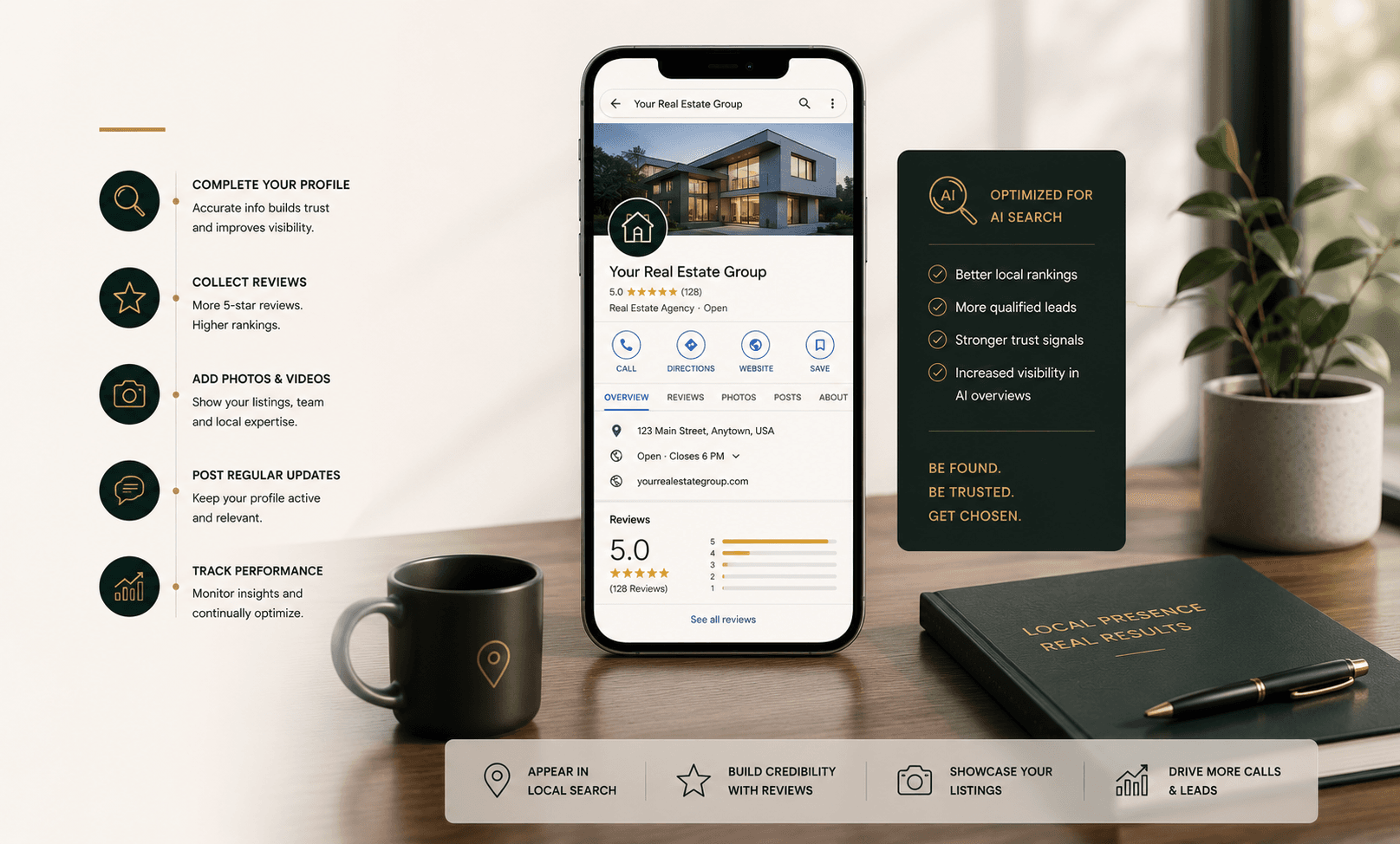
Google Business Profile Optimization for Real Estate Agents: The Complete 2026 AI-Search Checklist
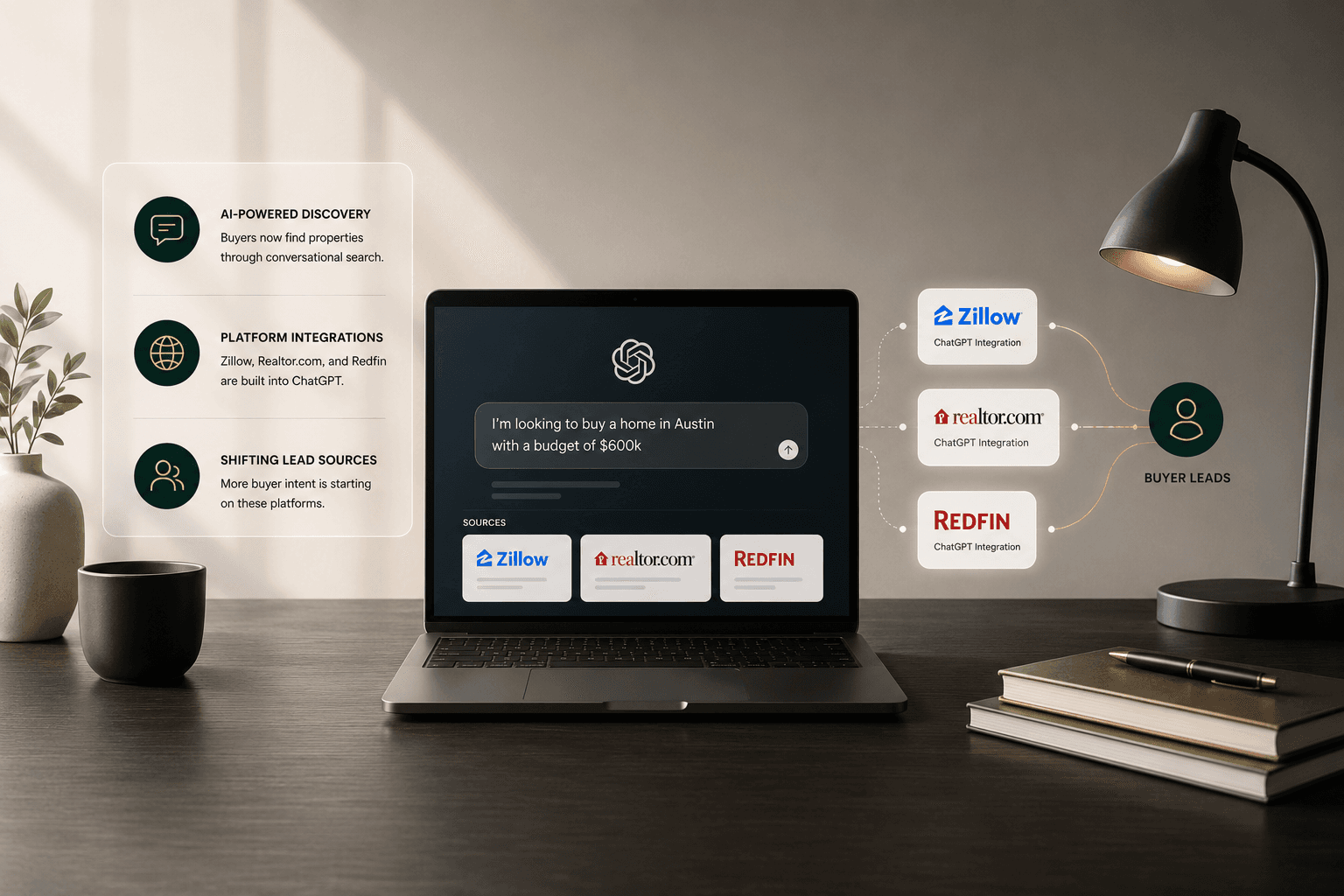
Real Estate Portals' ChatGPT Apps in 2026: How Zillow, Redfin & Realtor.com Are Redirecting Leads