Google Business Profile Optimization for Real Estate Agents: The Complete 2026 AI-Search Checklist
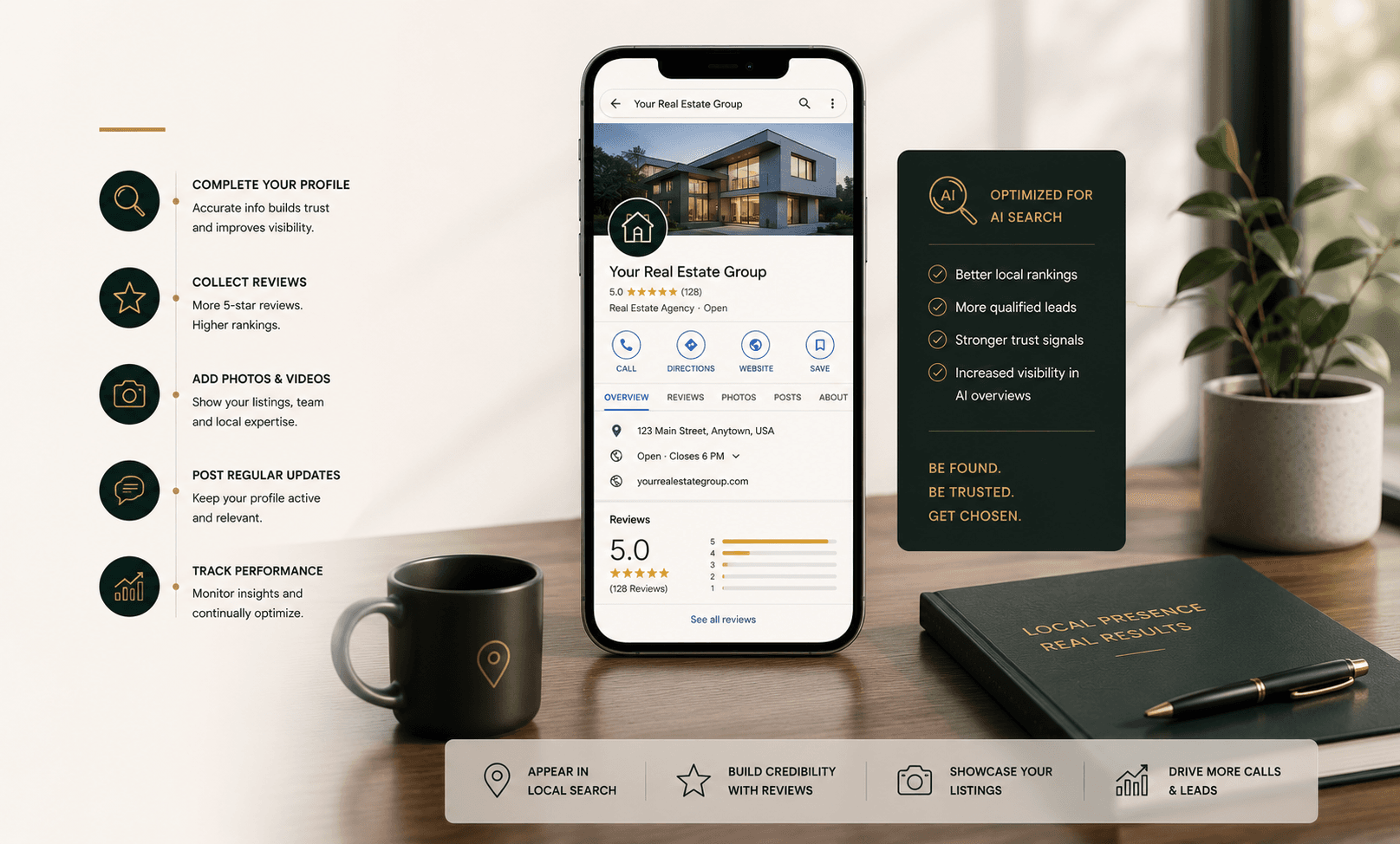

Quick Answer
How do you optimize a Google Business Profile for a real estate agent?
Optimizing a Google Business Profile (GBP) means claiming and fully verifying the listing, choosing "Real Estate Agent" (or "Real Estate Agency" for teams) as the primary category, writing a complete 750-character description with your service areas, uploading a steady stream of high-quality photos, and building a consistent flow of detailed Google reviews. This work carries more ranking weight than almost anything else agents control directly: GBP signals account for roughly 32% of local pack ranking decisions, more than review signals, on-page website SEO, and backlinks combined, according to Whitespark's 2026 Local Search Ranking Factors survey of 47 local SEO experts. The same profile now doubles as the primary data source Google AI Overviews, Gemini, and increasingly ChatGPT pull from when recommending agents to buyers and sellers — so an incomplete or stale GBP doesn't just hurt Map Pack rankings, it makes an agent invisible to AI-generated recommendations too. A properly built profile takes roughly 60–90 minutes to set up and about 15 minutes a month to maintain.
Key Takeaways
- GBP signals account for about 32% of local pack ranking weight in 2026 — more than review signals (20%), on-page SEO (19%), and link signals (15%) combined among the factors agents actually control (Whitespark 2026 survey, 47 local SEO experts).
- 97% of consumers read reviews before choosing a local business, and 47% won't consider one with fewer than 20 reviews (BrightLocal Local Consumer Review Survey 2026, 1,002 US consumers).
- Profiles with 100+ optimized photos generate 520% more calls and 1,065% more website clicks than minimally-photographed profiles (Latitude Park 2025 GBP Ranking Study).
- A controlled 9-week study tracking 441 keywords found zero direct ranking movement from GBP Posts — they still help click-through and engagement, just not rankings directly (Sterling Sky study, cited in Whitespark 2026).
- 78% of all real estate reviews happen on Google specifically, making GBP the single most concentrated reputation signal in the industry (Birdeye, State of Online Reviews, 2025).
- Google's Gemini models now ground local answers directly in Business Profile data through "Grounding with Google Maps," which reached general availability in 2026 and connects to more than 250 million verified places (HousingWire, 2026).
A note on this article
This checklist is built from Whitespark's 2026 Local Search Ranking Factors survey, BrightLocal's 2026 Local Consumer Review Survey, NAR's 2025 Profile of Home Buyers and Sellers, and reporting from HousingWire, Birdeye, and Growth Memo — cross-referenced against Pinova's own coverage of AI search in real estate. Pinova does not yet have proprietary Google Business Profile performance data of its own to report here; every figure below is attributed to its original source.
Consider an agent like Marcus, a solo agent working a mid-sized Florida market. His Google Business Profile had been claimed by his brokerage's marketing coordinator three years earlier, then never touched again: six reviews, all dated 2021, a stock brokerage logo where a photo should be, and a description copied word-for-word from the brokerage's own listing. When a buyer searched "real estate agent near me" from inside his own zip code, Marcus didn't show up in the three-listing local pack. He wasn't close.
That gap is common, and it's expensive. Google Business Profile has quietly become the highest-leverage, lowest-cost piece of digital real estate an individual agent controls — and in 2026 it's doing double duty. It still determines who shows up in the Google Maps local pack for searches like "realtor near me" or "homes for sale in [city]." But it has also become the primary structured-data source that AI systems check before recommending an agent by name. Getting the profile right is no longer just a local SEO task. It's the foundation of AI-search visibility too.
Why Your Google Business Profile Now Powers Both Google Search and AI Search
Nearly half of home buyers, 46%, start their search online before contacting anyone, and 20% begin by reaching out to an agent directly, per NAR's 2025 Profile of Home Buyers and Sellers. Even so, 88% of buyers ultimately purchase through an agent, and 43% found that agent through a referral rather than a cold search — meaning a Google Business Profile's job isn't just to generate a call. It's the credibility check a referred buyer runs before they call.
That check increasingly happens inside an AI conversation rather than a results page. Google's Gemini models now use a capability called Grounding with Google Maps, which reached general availability in 2026 and connects directly to more than 250 million verified places, treating Business Profile data as the authoritative source for local answers, per HousingWire's reporting. Google AI Overviews draw on that same structured data. This is exactly why, for the first time in the survey's history, Whitespark's 2026 report added "AI Search Visibility" as its own formal ranking category alongside Local Pack, Organic, and negative-factor rankings it has tracked since 2008.
Real estate specifically still has room to move here. Ahrefs' November 2025 analysis found Google AI Overviews currently trigger on just 5.8% of real estate-related searches, one of the lowest rates of any major consumer vertical — meaning agents who get their structured data right now face far less competition for AI citation than agents in almost any other local-services category. (Pinova has covered the website side of that opportunity in its guide to building a real estate website that ranks in Google AI Overviews.)
Key finding: Among the ranking factors real estate agents can actually control, Google Business Profile signals (32%) now outweigh review signals, on-page SEO, and link signals combined, according to Whitespark's 2026 survey of 47 local SEO experts. Proximity to the searcher still accounts for roughly 55% of the overall ranking decision, but that's the one variable no agent can optimize.
Whitespark 2026 Benchmark Data
Local Pack & AI Search Controllable Factors
Relative weight of controllable ranking factors in Google Local Pack and AI Maps grounding.
The 2026 Google Business Profile Foundation Checklist
1. Claim, verify, and pick the right business type. Most solo agents should set up as a service-area business (SAB): verify the profile using a real address, then hide that address publicly and list the specific cities and neighborhoods served instead. This protects home addresses and generally aligns with brokerage and MLS rules. Confirm first whether your brokerage already created a listing for you — claiming an existing profile is required; creating a duplicate gets both suppressed.
2. Get the primary category right — it's the single highest-leverage field on the whole profile. Most individual agents should choose "Real Estate Agent." Teams and brokerages should choose "Real Estate Agency" as primary and add "Real Estate Agent," "Real Estate Consultant," or "Property Management Company" as secondary categories where they genuinely apply. Whitespark's 2026 report lists an incorrect primary category as one of the most damaging negative ranking factors, with a meaningfully higher penalty than it carried in the 2023 edition of the same survey.
3. Write a complete, human-first description. Use all 750 characters. Name your specialties (first-time buyers, luxury, relocation, investment), the specific cities and neighborhoods served, and what differentiates you — in natural language, not a keyword list. Google has confirmed the description field itself isn't a direct ranking input, but it's often the first thing a person or an AI system reads to decide whether to trust the rest of the profile.
4. Fix the "Products" section before it embarrasses you. The most common mistake agents make here is filling it with individual property addresses — "1017 8th Street," "928 Orange Drive" — which tells Google nothing useful about actual services and wastes a section that could otherwise carry real keyword and service signals. List services instead: buyer representation, listing consultations, relocation assistance, investment sourcing — each with a description, a real photo, and a link back to the relevant page on your website.
5. Treat photos as a ranking lever, not decoration. Google Business Profile ranks profiles with more high-quality, recent photos more favorably, and the gap is larger than most agents expect: Latitude Park's 2025 GBP ranking study found profiles with 100 or more optimized photos generate 520% more calls and 1,065% more website clicks than profiles with minimal photos. Add photos on a rolling basis — every two weeks or so outperforms a quarterly dump, based on the engagement data behind Whitespark's 2026 findings.
6. Build review volume, velocity, and specificity — deliberately. BrightLocal's 2026 survey (1,002 US consumers) found 97% read reviews before choosing a local business, and 47% won't consider one with fewer than 20. Real estate leans on this more than most categories — 78% of all real estate reviews happen on Google, per Birdeye's State of Online Reviews report. A realistic floor is 25–30 reviews to be competitive, with agents at 50+ and a steady 2–4 new reviews a month typically dominating their local pack. Ask every client within 48 hours of closing, and coach them toward specifics — the neighborhood, buy or sell, what stood out — since AI systems use those details, not just the star rating, to describe an agent. Pinova's full review-generation playbook, with exact timing and scripts, is here: Google Reviews and AI search for real estate agents.
7. Don't expect Posts to move your ranking directly — but keep posting anyway. A controlled nine-week study by Sterling Sky, tracking 441 keywords and cited in Whitespark's 2026 report, found zero measurable ranking movement attributable to GBP Posts. That corrects a persistent local SEO myth. Posts still earn their keep through click-through rate and engagement, and — more relevant for 2026 — they feed fresh, structured content into the profile that AI systems can pull from when generating conversational answers about an agent's recent activity.
8. Get your business hours right and keep them current. Whitespark's 2026 survey found that showing as "open" at the moment someone searches is now the fifth most important local pack ranking factor for physical-location listings, and rankings measurably degrade in the final hour a business is listed as open. This is one of the easiest wins on this entire list.
9. Populate predefined services. When setting up services, Google suggests predefined options specific to the real estate category. Adding every one that genuinely applies produced one of the largest single-factor jumps in Whitespark's 2026 report — from the 81st most important ranking factor to the 22nd — making it a disproportionately high-value, low-effort step.
10. Lock down NAP consistency everywhere, not just on Google. Name, address (or service area), and phone number need to match exactly across your website, Zillow, Realtor.com, and every directory that lists you — because AI systems check for that consistency before trusting a profile enough to recommend it. This is part of the broader discipline of GEO (Generative Engine Optimization); Pinova's complete guide to GEO for real estate agents covers what to build beyond GBP once this foundation is set. Pinova's 2026 AI Adoption Report found most agents already use some form of AI, though far fewer see measurable impact yet — a scattered digital footprint is a common reason why.
The 15-minute monthly GBP maintenance routine
- Respond to every new review within 24–48 hours, using the client's name and one specific detail from the transaction.
- Add 3–5 new photos — recent closings, listings, or neighborhood shots — instead of letting the library go stale.
- Confirm business hours are still accurate, especially around holidays.
- Publish one short update: a new listing, a market note, or a "just closed" announcement.
- Verify your phone number, website link, and service areas still match your website and every other directory exactly.
- Check any Q&A or AI-generated conversational prompts on the profile for anything that needs a correction.
Who This Checklist Is Built For
Good Fit
Solo agents and small teams with at least a handful of closed transactions, who control their own Google Business Profile directly and want a repeatable, low-cost system for local and AI-search visibility.
Not a Fit
Brand-new agents with zero past clients yet — review velocity tactics need real transactions to work with, so closing a few deals should come first. Also not the right tool for brokerages managing dozens of individual agent profiles at once.
| Key Statistic / Finding | Source & Year |
|---|---|
| GBP signals account for ~32% of local pack ranking weight — the largest single controllable category | Whitespark, Local Search Ranking Factors 2026 (47 experts, Nov. 2025) |
| 97% of consumers read reviews before choosing a local business; 47% won't consider one with fewer than 20 reviews | BrightLocal, Local Consumer Review Survey 2026 (n=1,002 US consumers) |
| Profiles with 100+ optimized photos get 520% more calls and 1,065% more website clicks than minimally-photographed profiles | Latitude Park, 2025 GBP Ranking Study |
| 78% of all real estate reviews happen on Google specifically | Birdeye, State of Online Reviews, 2025 |
| 88% of home buyers purchased through an agent or broker; 46% started their search online | NAR, 2025 Profile of Home Buyers and Sellers |
| 44.2% of all LLM citations are pulled from the first 30% of an article's content | Growth Memo, February 2026 analysis |
Frequently Asked Questions
What is a Google Business Profile, and do real estate agents actually need one?
A Google Business Profile (GBP), formerly Google My Business, is a free listing that controls how a business appears in Google Search and Maps, including the three-listing "Local Pack" that shows above organic results for searches like "real estate agent near me." For real estate agents, a GBP is close to mandatory. Whitespark's 2026 survey of 47 local SEO experts found GBP signals account for roughly 32% of local pack ranking weight — more than any other category agents directly control. Beyond rankings, the profile has become the primary data source Google AI Overviews, Gemini, and increasingly ChatGPT pull from when answering questions like "who's a good real estate agent in [city]." Agents can set up a GBP as an individual or as part of a team or brokerage listing, and it's free to claim, verify, and maintain — the real investment is time, not money.
Should real estate agents choose Real Estate Agent or Real Estate Agency as their primary GBP category?
Most individual, solo agents should select "Real Estate Agent" as their primary category, not "Real Estate Agency," which is meant for the brokerage or team entity. Choosing the wrong primary category is consistently flagged as one of the most damaging GBP mistakes: Whitespark's 2026 report lists it as a top negative ranking factor, with a notably higher penalty than in its 2023 survey. Google allows up to 10 categories, but the primary one carries far more ranking weight than any secondary category, so it should be the single most accurate description of the core service. Teams and brokerages typically choose "Real Estate Agency" as primary and add "Real Estate Agent," "Real Estate Consultant," or "Property Management Company" as secondary categories where they genuinely apply. Adding categories that don't reflect actual services can hurt both rankings and credibility.
How many Google reviews does a real estate agent need to compete in the local pack?
There's no official Google minimum, but the data points to a practical floor. BrightLocal's 2026 survey of 1,002 US consumers found 47% won't consider a business with fewer than 20 reviews, and 31% will only use businesses rated 4.5 stars or higher — up sharply from 17% a year earlier. In practice, most competitive real estate markets require 25 to 50 reviews to be seriously considered, with agents at 50+ and a steady monthly flow of new reviews typically dominating the Map Pack. Volume alone isn't enough, though. Review velocity — two to four new reviews every month — carries more weight than a large batch of old reviews with no recent activity, since both Google's algorithm and human searchers treat recency as a trust signal. An agent with 30 reviews, five from last quarter, will typically outperform one with 80 reviews all dating back three years, because the profile signals an inactive business.
Can I use my brokerage's office address on my personal Google Business Profile?
It's technically possible but generally discouraged for individual agents, and it can hurt visibility. Google treats most solo real estate agents as service-area businesses (SABs) — professionals who travel to clients rather than seeing walk-in traffic at a fixed office. The recommended setup is to verify using a real address (often the brokerage office), then hide it publicly and list the specific cities and neighborhoods served as service areas instead. Sharing a brokerage's shared phone number or generic website URL instead of an agent's own contact details is a common compliance mistake that dilutes an individual profile and can create duplicate-listing conflicts with the brokerage's own GBP. Agents under a brokerage generally should maintain their own separate, individually branded profile rather than relying solely on the brokerage's listing.
Do Google Business Profile posts actually improve my search ranking?
Not directly, according to the best available controlled research. A nine-week study by Sterling Sky tracking 441 keywords, cited in Whitespark's 2026 report, found zero measurable ranking movement attributable to GBP Posts — a meaningful correction to a widely repeated local SEO myth. Posts still matter, just not as a direct ranking lever. They improve click-through rate, give searchers a reason to engage with a profile over a competitor's, and contribute to the broader "behavioral and engagement signals" category — clicks, calls, direction requests, photo views — that Whitespark's 2026 survey found is climbing in importance. For real estate agents, Posts are also a low-effort way to feed fresh, structured content into a profile that AI systems can pull from when generating conversational answers about an agent's recent activity.
How does my Google Business Profile affect whether ChatGPT or Google AI Overviews recommend me?
Increasingly directly. Google's Gemini models use Grounding with Google Maps, which reached general availability in 2026 and connects to more than 250 million verified places, treating GBP data as the authoritative source for local answers, per HousingWire's reporting. Google AI Overviews draw on that same structured data. ChatGPT works a bit differently — it doesn't have direct access to Google's Business Profile data, but it draws on the same structured-data ecosystem (Bing Places, verified directories, business websites) that a well-maintained, consistent Google profile helps anchor. In practice, the fields that matter for traditional Map Pack ranking — accurate categories, complete service areas, fresh and specific reviews, consistent name-address-phone data — are the same fields AI systems check before recommending an agent by name. An incomplete or inconsistent profile doesn't just rank lower; it reads as untrustworthy to AI, which tends to default to safer, more established competitors when an agent's data is thin.
How often should a real estate agent update their Google Business Profile?
At minimum, weekly attention to reviews and monthly attention to everything else. Check business hours whenever they change — Whitespark's 2026 survey found showing as "open" at the moment someone searches is now the fifth most important local pack ranking factor, with rankings measurably degrading in the final hour a listing shows as open. Add photos on a rolling basis rather than all at once; profiles that add photos roughly every two weeks tend to outperform quarterly updaters on engagement metrics. Request reviews continuously, immediately after every closing, rather than in occasional bursts. A realistic routine for a solo agent is about 15 minutes a week: responding to new reviews, confirming hours and contact details are accurate, and adding a photo or short update post.
What's the single biggest Google Business Profile mistake real estate agents make?
Treating the "Products" section like a property listing feed instead of a services showcase. A common pattern is filling it with individual home addresses — "1017 8th Street," "928 Orange Drive" — which tells Google nothing useful about actual services and wastes a section that could carry real keyword and service signals. List the services actually offered instead — buyer representation, listing consultation, relocation assistance, investment sourcing — each with a description, a real image, and a link back to the relevant page on your website. The second most common mistake is simple neglect: claiming a profile once and never returning to add reviews, photos, or updates. Given GBP signals now carry more local ranking weight than any other controllable factor, an abandoned profile isn't neutral — it's actively losing ground to competitors maintaining theirs every month.
📚 Related Reading
Amaan Sheikh
— Co-Founder & CEOAmaan Sheikh is the co-founder and CEO of Pinova. He sets the product direction, builds the partnerships, and personally works with every founding partner. His focus is making enterprise-grade real estate technology accessible to ambitious agents and teams — without the enterprise price tag.


