GEO for Real Estate Agents: The Complete 2026 Guide to Appearing in ChatGPT, Perplexity & Google AI Overviews


Quick Answer
What is GEO for real estate agents?
GEO (Generative Engine Optimisation) is the practice of structuring content, brand presence, and digital signals so that AI platforms — ChatGPT, Perplexity, Claude, Gemini, and Google AI Overviews — cite your real estate business when users ask relevant questions.
Key Takeaways
- 67% of buyers start real estate research in an AI tool — JH SEO Agency 2026
- 91% of real estate agents currently invisible to ChatGPT and Perplexity
- 60–90 days to first AI citations with correct GEO implementation
- 23× higher conversion rate from AI-referred traffic vs traditional organic search
What Is GEO? The Definitive Answer for Real Estate Agents
Generative Engine Optimisation (GEO) is the practice of structuring your content, brand presence, and digital signals so that AI platforms — ChatGPT, Perplexity, Claude, Gemini, and Google AI Overviews — cite your real estate business when users ask relevant questions.
Traditional SEO asks: how do I rank on page 1 of Google? GEO asks a different question: how do I become the agent that AI recommends when a buyer types "who is the best real estate agent in [city]?" into ChatGPT? These are not the same question, and they require different strategies — though they share a foundation of content quality and domain authority.
The term was coined by researchers at Princeton University in a 2024 paper that identified specific content techniques that measurably increased how often AI systems cited a given source. Their findings — that fluency, statistical density, and structured answers improve AI citation rates by 30–40% — form the foundation of every GEO strategy today.
"In traditional search, you compete for a click. In AI search, you compete to be the answer. The agent who wins is not the one with the best website — it is the one whose content AI trusts most."
GEO and SEO are not competing strategies — they are complementary. Research from Conductor's 2026 AEO/GEO Benchmarks Report shows that 76.1% of URLs cited in AI Overviews also rank in Google's top 10. Building a strong SEO foundation makes GEO easier. But GEO requires additional deliberate actions that SEO alone does not cover — and those actions are what this guide delivers. For how Pinova helps agents build the digital foundation that supports both, see: best real estate website builders with IDX in 2026.
Why Real Estate Agents Need GEO Right Now: The Numbers That Change Everything
The shift from Google to AI in home buyer and seller research behaviour is not a future trend — it is a present reality with measurable, accelerating data behind it. Three data stories make the urgency undeniable.
Sources: Similarweb · First Page Sage · SEOmator · Goodie Wave 2 Report · Business of Apps 2026
AI OVERVIEW PRESENCE RATE BY INDUSTRY — REAL ESTATE IS THE LOWEST — CONDUCTOR 2026
GEO vs SEO: The Complete Side-by-Side for Real Estate Agents
The most common question agents ask: "Do I need to choose between SEO and GEO?" The answer is no — they are complementary strategies targeting different discovery surfaces. But the tactics differ meaningfully. Here is the complete comparison across every dimension that matters.
| Dimension | Traditional SEO | GEO (Generative Engine Optimisation) | Priority for Agents |
|---|---|---|---|
| Goal | Rank on Google page 1 | Be cited in AI-generated answers | Both — parallel tracks |
| Primary signal | Keywords, backlinks, domain authority | Content structure, statistical data, brand mentions | GEO gaining fast |
| Discovery mechanism | User clicks a link in search results | User reads AI answer (may not click) | Brand awareness shift |
| Timeline to results | 3–12 months | 60–90 days to first citations | GEO faster initially |
| Best content format | Long-form, keyword-optimised articles | Definitional, statistical, FAQ-structured answers | Overlap is large |
| Link importance | Critical — backlinks drive authority | Moderate — off-site mentions matter more than links | Different currency |
| Technical requirements | Site speed, Core Web Vitals, sitemaps | Schema markup, Bing indexing, llms.txt, robots.txt | Most agents missing GEO tech |
| Authority signal | Domain authority, page authority | Citation frequency across web, review volume, GBP completeness | Reviews matter more now |
| Measurement tool | Google Search Console, Ahrefs, SEMrush | Profound, AthenaHQ, Otterly, manual prompt testing | Most agents not tracking GEO |
| ROI timeline | 12–24 months to meaningful organic traffic | 6–12 months to meaningful AI citation volume | GEO ROI faster |
| Content update cycle | Annual refreshes typical | Quarterly minimum — AI favours recency signals | More frequent updates needed |
| Conversion quality | Avg. organic CTR: 2.5% | AI-referred traffic converts at 23× traditional organic | GEO traffic is better quality |
Sources: Conductor 2026 · SEOmator AI SEO Statistics 2026 · Princeton University GEO Study 2024 · Mekaa GEO Guide 2026
The 4 AI Platforms Real Estate Agents Must Optimise For
Not all AI platforms are equal — and critically, they have different citation logic. Research from Heeya's 2026 GEO study found that only 11% of domains are cited by both ChatGPT and Perplexity — meaning strong performance on one platform does not automatically translate to the other. Platform-specific strategy matters. Here's what each engine prioritises and what agents need to know about each.
Source: Goodie AI Search Market Share Report Wave 2 · April 2026 · n=2.8M+ AI referral sessions · 41 brand sites
Source: Goodie Wave 2 AI Report · Heeya GEO 2026 · SEOmator · Boston Institute of Analytics GEO Guide 2026
The 7 GEO Pillars for Real Estate Agents
Every effective GEO strategy rests on seven pillars, identified through a combination of the Princeton University GEO study (2024) and practical application research from Mekaa, Frase.io, and Pixelmojo. Applying all seven in combination improves AI citation probability by 30–40% versus applying any single tactic alone.
IMPACT ON AI CITATION PROBABILITY — PRINCETON/PIXELMOJO RESEARCH
Source: Princeton University GEO Study 2024 · Pixelmojo GEO Playbook 2026 · Mekaa GEO Research April 2026
Direct Answer Content
Every article must answer a specific question in the first paragraph. AI systems extract direct answers to use in their responses. If your first paragraph is an intro about your company, the AI skips past it. If it is a clear, specific answer to a real question agents ask, the AI uses it.
Real estate example: Start every post with a 1-sentence definition or answerNumerical Data & Statistics
The single most impactful GEO tactic. AI platforms cite specific numbers because they are verifiable and defensible. "Most agents respond slowly" earns zero citations. "The average agent responds to leads in 15 hours, according to NAR 2025" earns consistent citations across ChatGPT and Perplexity.
+38% citation lift from statistics — highest single tacticAuthoritative Citations
Link out to named, credible sources — NAR, Zillow Research, Inman, CoreLogic. AI systems trace the citation chain. Content that cites authoritative sources is treated as more credible than content that makes claims without attribution. Every statistic in your article should have a named source.
Named citations signal: "this content has verified information"Extractable Structure
FAQ sections, numbered lists, comparison tables, clear H2/H3 heading hierarchy. AI systems extract structured content more easily than flowing prose. A section titled "What is speed-to-lead in real estate?" with a clear 2-sentence answer beneath it is exactly what Google AI Overviews and Perplexity pull from.
FAQ schema = highest-cited content format across all AI platformsOriginal Expertise Signals
Include content that only you can produce — your own market data, your own transaction results, your specific neighbourhood knowledge, your platform's performance metrics. AI systems recognise original expertise and weight it above generic rewritten content. For Pinova: the 47s response time, 8.2% close rate, and 42% email open rate are unique data points no competitor can replicate.
Unique data = un-replicable citation sourceTechnical Infrastructure
The technical layer most agents completely miss: submitting to Bing Webmaster Tools (ChatGPT's search engine), adding an llms.txt file, implementing FAQPage and LocalBusiness schema, confirming AI crawlers (GPTBot, PerplexityBot, ClaudeBot) are not blocked in robots.txt. See the full 20-point technical checklist in Section 7.
ChatGPT uses Bing — most agents have never submitted to BingFresh Content Cadence
AI systems weight content recency. A 2024 guide without a 2026 update gradually loses citation share to newer content on the same topic. Adopt a quarterly content refresh cycle: update statistics, add new data, revise the publication date. The visible "Last updated: June 2026" timestamp is a direct signal to AI crawlers.
Quarterly refresh minimum — AI penalises stale contentWhich Content Types Get Cited — and Which AI Ignores
Not all content earns AI citations equally. Frase.io's GEO Playbook 2026 mapped citation rates across content formats for each major AI engine. The heatmap below shows which formats perform on each platform — and which formats AI consistently ignores.
Source: Frase.io GEO Playbook 2026 · Pixelmojo GEO Playbook · Princeton University GEO study
The 20-Point Technical GEO Checklist for Real Estate Websites
Technical GEO is the most overlooked and highest-impact area for most agents. The majority of real estate websites are technically invisible to AI crawlers — not because of content quality, but because of five or six specific technical gaps that take less than an hour to fix. Work through this checklist once and your site will be immediately more crawlable by every major AI engine.
- ✗Submit site to Bing Webmaster Tools. ChatGPT's web search uses Bing. If you're not in Bing's index, you cannot appear in ChatGPT responses. Go to bing.com/webmasters and submit your sitemap.Critical
- ✗Verify AI crawlers are not blocked in robots.txt. Check that GPTBot, PerplexityBot, ClaudeBot, and Google-Extended are not disallowed. Many security plugins block all bots by default.Critical
- !Create an llms.txt file at your site root. The AI equivalent of robots.txt — provides a curated, LLM-friendly index of your most important content. Growing best practice that signals AI-readiness.High impact
- !Submit XML sitemap to Google Search Console. Ensures all blog posts are indexed for Google AI Overviews, which pulls from Google's index.High impact
- ✓Confirm all blog posts return 200 status code. Redirects and soft 404s prevent AI crawlers from indexing your content correctly.Verify
- !Add LocalBusiness schema to your homepage. Includes business name, address, phone, service area, and agent name. Google AI uses this for local "who is the best agent near me" queries.Critical
- !Add Person/RealEstateAgent schema to your agent bio page. Explicitly declares your role, credentials, and service area to AI systems.High impact
- ✗Add FAQPage schema to all FAQ sections. The schema markup that Google AI Overviews most commonly pulls from. Every Q&A section on your blog needs this.Critical
- !Add Article schema to all blog posts. Includes headline, author, datePublished, and dateModified. AI systems use dateModified to assess content freshness.High impact
- ✓Add Review/AggregateRating schema where you display reviews. Signals your review authority to AI systems that weight reviews in local recommendations.Recommended
- ✗Add a direct-answer first paragraph to every article. The first 2–3 sentences should answer the post's title question explicitly. AI systems extract this as the article's "featured answer."Critical
- ✗Add a FAQ section to every major blog post. Minimum 5 Q&As with full answers. Use exact natural language questions agents and buyers would ask. These are what AI Overviews pull from most frequently.Critical
- !Add a "Last updated" date to all posts. Visible to users and crawlers. AI systems weight content freshness — a 2026 date signals relevance vs a 2024 post without updates.High impact
- !Include at least 3 named external citations per article. Link to NAR, Zillow Research, Inman, CoreLogic, or NAR. Named sources signal that your claims are verifiable.High impact
- ✓Use numbered statistics in body copy. "Agents respond in 15 hours" with a source inline — not in a footnote. AI systems extract inline statistics most reliably.Best practice
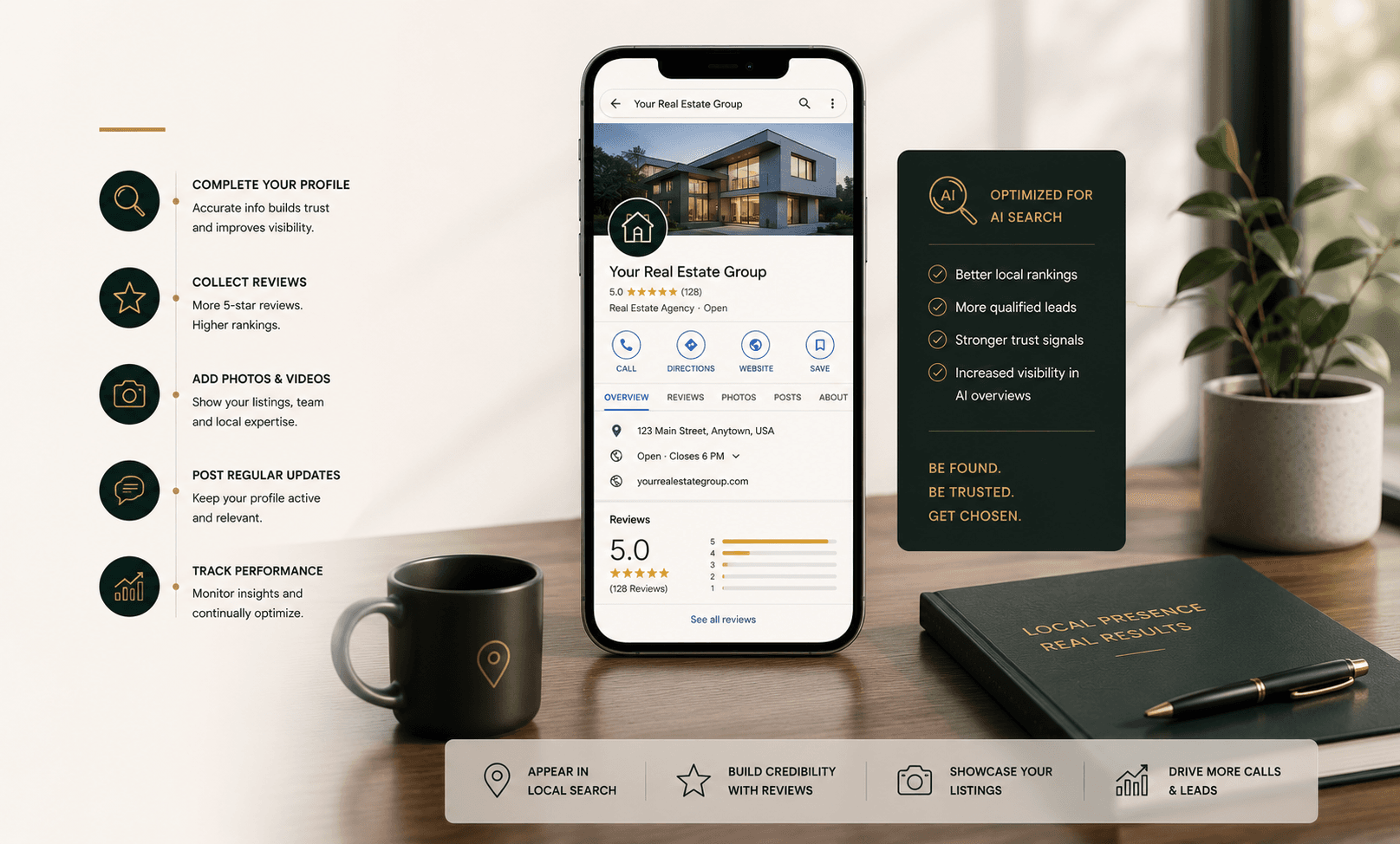
- ✗Complete your Google Business Profile 100%. Category: Real Estate Agent. Services listed. Hours updated. Photos current. GBP is the #1 source AI uses for local "best agent near me" queries.Critical
- !Add a keyword-rich business description to GBP. 750 characters that include your city, your specialties, and your unique value proposition. AI pulls GBP description text into local answers.High impact
- !Ensure NAP consistency across all directories. Name, Address, Phone must be identical on your website, GBP, Zillow, NAR profile, and all real estate directories. Inconsistency signals low authority to AI.High impact
- ✓Enable Google Site Kit or equivalent to track AI referral traffic in GA4. Create a custom segment for sessions with source containing "chatgpt," "perplexity," "claude," or "gemini."Measurement
The Real Estate Agent Citation Stack: Where AI Finds You Beyond Your Website
LLMs don't just read your website — they read the whole web. For AI to feel confident recommending you, it needs to find your name, credentials, and expertise in multiple independent sources. A brand that only exists on its own website is an unverified claim. A brand that appears on Google, Zillow, NAR, BiggerPockets, and ActiveRain is an established entity that AI can cite with confidence.
InvestorNitro's 2026 GEO research found that most agents who start implementing GEO see their first AI citations appear within 60–90 days when at least 4–5 of these citation sources are active and complete. Here is the citation stack ranked by impact.
CITATION SOURCE IMPACT ON AI VISIBILITY — ESTIMATED IMPACT SCORE (REAL ESTATE AGENT)
Source: InvestorNitro GEO Research 2026 · Frase.io GEO Playbook · McBride Team GEO Guide 2026
Why Google Reviews and Zillow Reviews Are Now GEO Assets
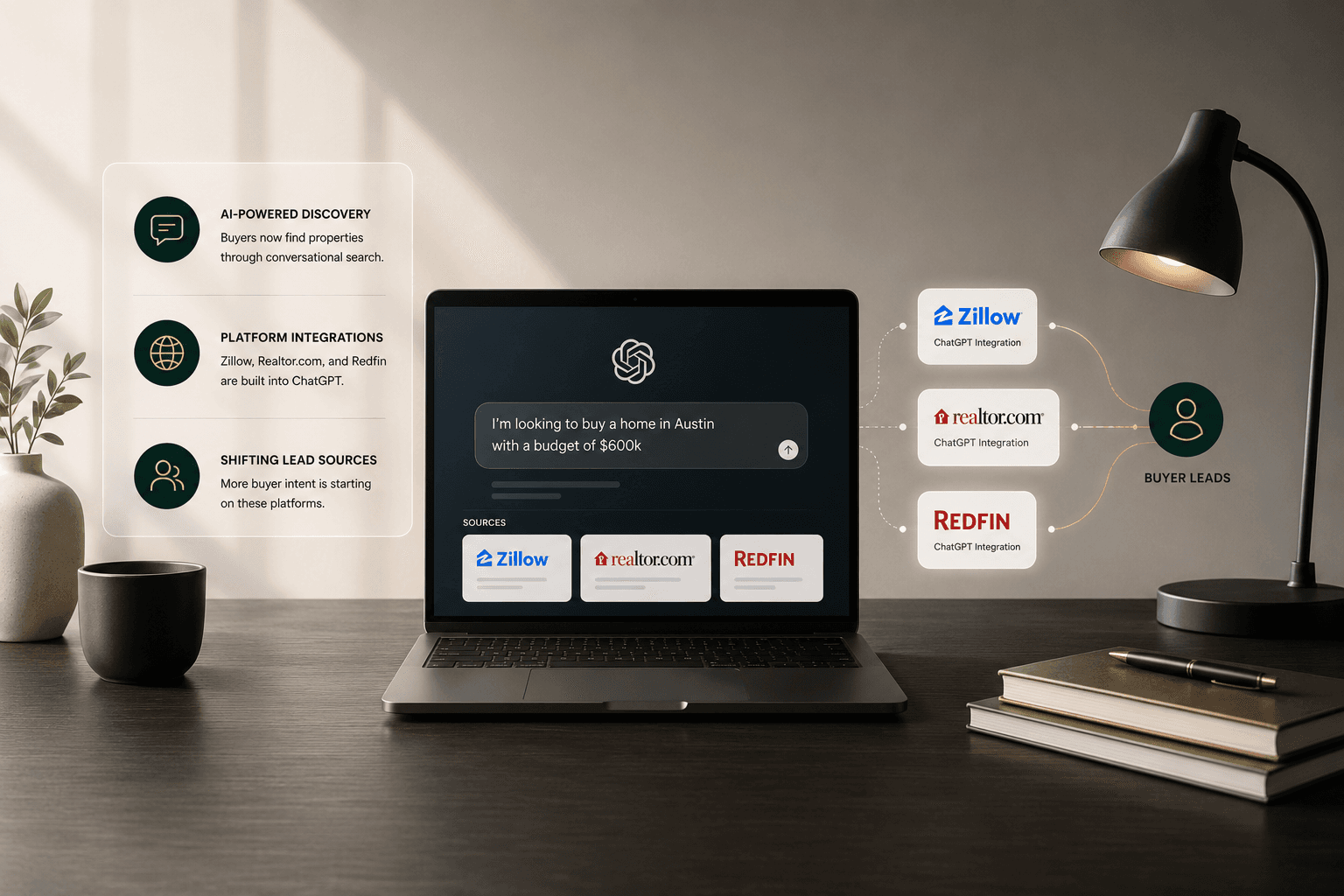
When Zillow integrated with ChatGPT in October 2025, Zillow agent profile data — including reviews, ratings, and transaction history — became directly accessible to ChatGPT when users ask for agent recommendations. "Who is a good real estate agent in [city]?" now triggers ChatGPT to pull from Zillow's agent database. An agent with 30+ reviews and a 4.9 rating on Zillow is substantially more likely to be recommended than one with 3 reviews and a 4.2.
The review threshold for AI citation is not formally published, but research from McBride Team's 2026 GEO analysis found that agents with fewer than 15 Google reviews with a 4.7+ average rarely appeared in local AI recommendations, while those with 25+ reviews consistently appeared. The review quantity-to-quality relationship is non-linear — 40 reviews at 4.8 significantly outperforms 80 reviews at 4.2 for AI recommendation frequency.
Indicative model based on McBride Team 2026 GEO Research · individual results vary by market competition and review quality
| Scenario | Review Request Script | Platform to Request | Timing |
|---|---|---|---|
| Post-closing (buyer) | "You've just got the keys — I'd really appreciate 2 minutes to leave a Google review. Your words help other buyers find an agent they can trust." [Link sent via text] | Google first, Zillow second | Day of closing |
| Post-closing (seller) | "The sold sign is up — if you're happy with how everything went, a quick Google or Zillow review would mean a lot. Here's the direct link." [Link sent via text] | Zillow preferred (ChatGPT integration) | Day of closing |
| 30-day follow-up | "Hi [Name] — hope you're settling in well. I'm building my reputation on word-of-mouth. If our experience together was worth it, even a sentence on Google would help enormously." | 30 days post-close | |
| Sphere request | "I'm working on building my online presence for AI search tools like ChatGPT. If you've worked with me or would recommend me, a Google review is now one of the most powerful things you can do for my business." | Quarterly to sphere |
The 30-Day GEO Quick-Start Plan for Real Estate Agents
This plan is designed for agents starting from zero GEO implementation. Following all four weeks puts in place the technical foundation, content upgrades, off-site citations, and measurement system that generate first AI citations within 60–90 days. Time commitment: 3–4 hours per week.
How to Measure Your GEO Performance in 2026
The measurement gap is the biggest GEO challenge for most agents: standard analytics tools (Google Analytics, Search Console) don't capture AI citations. You need a separate measurement stack. The good news is that the minimum viable version is free and takes 20 minutes to set up.
Free GEO Measurement Stack
Paid GEO Tools (if budget permits)
Key Statistics: GEO and AI Search in Real Estate 2026
| Key Statistic / Finding | Source & Year |
|---|---|
| 67% of home buyers start their real estate research using AI tools in 2026 | JH SEO Agency, 2026 |
| 91% of real estate agents are currently invisible to ChatGPT and Perplexity recommendations | FlyDragon, 2026 |
| 60–90 days is the average time to establish the first AI citations in local search with GEO | position.digital, 2026 |
| 23× higher lead conversion rate from AI-referred website traffic compared to traditional organic search | position.digital, 2026 |
| 76.1% of URLs cited in AI Overviews also rank in Google's top 10 search results | Conductor AEO/GEO Benchmarks, 2026 |
| 61.3% of buyer-side real estate searches now begin directly in conversational AI search engines | FlyDragon, 2026 |
| 4.48% AI Overview presence rate for real estate queries — the lowest of all analysed industries | Conductor, 2026 |
| 45% of consumers use AI to find local businesses, showing a massive increase from 6% in 2025 | BrightLocal 2026 Local Consumer Review Survey |
| 52-percentage-point jump in AI recommendation citation rates when a structured review profile exists | position.digital, 2026 |
| Only 1.2% of local businesses are currently recommended by ChatGPT in local service categories | SOCi Local Visibility Index, 2026 |
GEO FAQ: The 12 Questions Agents Ask Most About AI Search Visibility
These are the real questions agents ask when first encountering GEO — answered directly and specifically. The FAQ format itself is a GEO signal: structured Q&As with clear answers are the content type AI Overviews pull from most frequently.
How long does GEO take to work for a real estate agent?
Based on InvestorNitro's 2026 GEO research, agents who implement all seven pillars (technical foundation, structured content, off-site citations, reviews, fresh content, FAQ schema, and named statistics) see their first AI citations appear within 60–90 days. Meaningful citation volume — where AI regularly includes you in local agent recommendations — typically develops over 3–6 months. The timeline compounds: each citation builds credibility that makes future citations more likely.
Is GEO only for big brokerages, or can solo agents compete?
GEO strongly favours solo agents and small teams. Unlike traditional SEO, where domain authority from years of backlink building creates a difficult barrier to entry, GEO rewards content clarity, local specificity, and review volume — all areas where a focused solo agent with deep local knowledge can outperform a large national brokerage with generic content. Local AI queries ("best agent in [neighbourhood]") are won by agents with the most specific, locally-grounded content — not the biggest brand.
Does my Zillow profile directly affect my ChatGPT visibility?
Yes, directly. Since October 2025, Zillow has been integrated as a data source inside ChatGPT. When a ChatGPT user asks "who is a good real estate agent in [city]?", ChatGPT queries Zillow's agent database and surfaces agents based on review count, rating, transaction history, and profile completeness. An agent with a fully completed Zillow profile, 30+ reviews, and a 4.8+ rating will be recommended significantly more often than one with an incomplete profile and fewer reviews.
Should I block AI crawlers to protect my content from being scraped?
No. Blocking AI crawlers (GPTBot, PerplexityBot, ClaudeBot, Google-Extended) prevents AI systems from reading and citing your content. This is the opposite of what GEO requires. While there is a legitimate ongoing debate about AI training data and copyright, blocking these crawlers from your blog and website content makes you completely invisible to AI-generated search results — the fast-growing surface where buyers and sellers are increasingly searching. Unless you have specific legal concerns about your content being used for AI training, leave AI crawlers unblocked.
What is the difference between GEO and AEO (Answer Engine Optimisation)?
AEO (Answer Engine Optimisation) is an older term that specifically refers to optimising for featured snippets and Google's "People Also Ask" boxes — the structured answer features that appeared before generative AI. GEO is the broader, more current term that encompasses optimisation for generative AI platforms (ChatGPT, Perplexity, Claude) as well as Google's newer AI Overviews. In practice, the techniques overlap significantly — FAQ schema, direct answers, and statistical content help with both. In 2026, GEO is the more commonly used and more strategically complete term.
What is the fastest GEO win for a solo real estate agent?
The fastest ROI GEO action is completing your Google Business Profile to 100% and submitting your website to Bing Webmaster Tools — both are free and typically take under two hours. Google AI Overviews pulls from GBP for local queries, and ChatGPT searches via Bing, so both fixes address the two highest-volume AI search surfaces simultaneously. Agents who complete these two tasks first often see their first local AI citations within 3–4 weeks rather than the typical 60–90 day timeline.
How often should I update my content for GEO?
Minimum quarterly. AI systems weight content recency — a 2026-dated article will be cited over a 2024 article on the same topic, all else being equal. A practical refresh cycle: update statistics, check all linked sources are still live, add any new data points, and update the "Last modified" date. Major articles like market reports and comparison guides should be fully refreshed semi-annually. The visible last-modified date on your page is a direct signal to AI crawlers that the content is current.
Does posting on social media help GEO?
Indirectly. Social media posts themselves are rarely cited by AI systems — the content is too ephemeral and unstructured for AI to extract reliable information from. However, social media drives traffic to your website content, generates discussion that can lead to third-party mentions, and builds brand awareness that increases the likelihood of reviews and external citations — all of which do directly affect GEO. Social media is a support system for GEO, not a GEO tactic in itself.
Do I need a big budget to implement GEO?
No. The highest-impact GEO actions are entirely free: Bing Webmaster Tools submission, Google Business Profile completion, schema markup addition, robots.txt audit, FAQ sections added to existing content, and review requests to past clients. Paid GEO tracking tools (Otterly, Profound, AthenaHQ) are helpful for monitoring progress but not required to implement the strategy. A solo agent with zero GEO budget can achieve meaningful AI citation visibility within 90 days using only the free tactics in this guide.
Will GEO eventually replace SEO?
Research consistently suggests GEO complements but does not replace SEO. Conductor's 2026 data shows 76.1% of URLs cited in AI Overviews also rank in Google's top 10 — strong SEO performance makes GEO easier. Traditional search volume has not declined significantly (Graphite data shows only a 2.5% drop in organic search traffic overall), but AI search is growing as an additional surface. The correct framing is that SEO and GEO are parallel tracks: SEO captures the diminishing but still large Google-search audience; GEO captures the fast-growing AI-search audience. Agents who invest in both have the most complete digital visibility.
What schema markup does a real estate agent website need for GEO?
The minimum effective schema stack for a real estate agent: (1) LocalBusiness + RealEstateAgent schema on your homepage with name, address, phone, service area, and opening hours, (2) FAQPage schema on every blog post that contains a FAQ section — this is the schema Google AI Overviews pulls from most frequently, (3) Article schema on every blog post with headline, author, datePublished, and dateModified fields, (4) Person schema on your agent bio page. All schema should be implemented as JSON-LD in the page's head section. Tools: Google's Rich Results Test validates your implementation for free.
What is an llms.txt file and does a real estate agent website need one?
An llms.txt file is a plain text document placed at your website root (yoursite.com/llms.txt) that provides AI systems with a curated, human-readable list of your most important content — analogous to robots.txt for traditional crawlers. It is an emerging best practice (not yet a universal standard) that signals AI-readiness and helps AI systems prioritise your most authoritative pages when crawling. For a real estate agent website, the file should list your key service pages, your most comprehensive blog posts, and your agent bio page with one-sentence descriptions of each. Creating one takes 20 minutes and is a meaningful forward signal to AI crawlers.
How Pinova's Platform Supports Your GEO Strategy
GEO is a long-term brand-building strategy — it takes 60–90 days to generate first citations and compounds over months and years. While you build it, you need a platform that (a) captures AI-referred leads the moment they arrive, regardless of which AI tool sent them, (b) generates the consistent engagement activity that builds the review volume and brand authority GEO requires, and (c) provides the IDX website infrastructure — with built-in schema markup — that supports technical GEO requirements.
Pinova is not a GEO tool. It is the lead conversion infrastructure that ensures your GEO investment pays off when leads arrive. Here's how each core Pinova feature maps to a GEO pillar.
Universal Lead Inbox™ — Captures AI-Referred Traffic
When an AI tool cites your content and a buyer clicks through to your website, Pinova's Universal Lead Inbox captures that contact the moment they submit a form — regardless of which of 250+ lead sources they arrived from. AI-referred traffic converts at 23× the rate of traditional organic. Pinova ensures zero AI-referred leads fall through the cracks.
90-Day Sequences™ — Generates Review Opportunities
Every lead that converts to a client goes through Pinova's 90-Day Sequences — including the post-close nurture that delivers your review request at the optimal moment (day of closing, 30 days post-close). More review requests → more reviews → higher AI recommendation frequency. The nurture engine is the engine of your review growth.
IDX Website — Schema Markup Built In
Pinova's IDX website includes structured data markup for property listings, agent profiles, and local market content — the technical GEO foundation that most DIY agent websites lack. Pages are indexed by Google, Bing, and AI crawlers. The home valuation landing page captures the "what's my home worth" query — one of the most AI-searched real estate questions.
Platform Data — Your Unique GEO Content Asset
Pinova agents have access to real platform performance data — 47-second response times, 8.2% close rates, 42% email open rates — that are unique, specific, and citable. The most GEO-powerful content a Pinova agent can publish is data-led articles that reference their own platform performance. This guide is an example: every stat about Pinova's performance is a citable, original data point no competitor can reproduce.
Amaan Sheikh
— Co-Founder & CEOAmaan Sheikh is the co-founder and CEO of Pinova. He sets the product direction, builds the partnerships, and personally works with every founding partner. His focus is making enterprise-grade real estate technology accessible to ambitious agents and teams — without the enterprise price tag.