Agentic AI in Real Estate: What It Is, What It Does Right Now, and What's Coming in 2026–2027

Quick Answer
What is agentic AI in real estate?
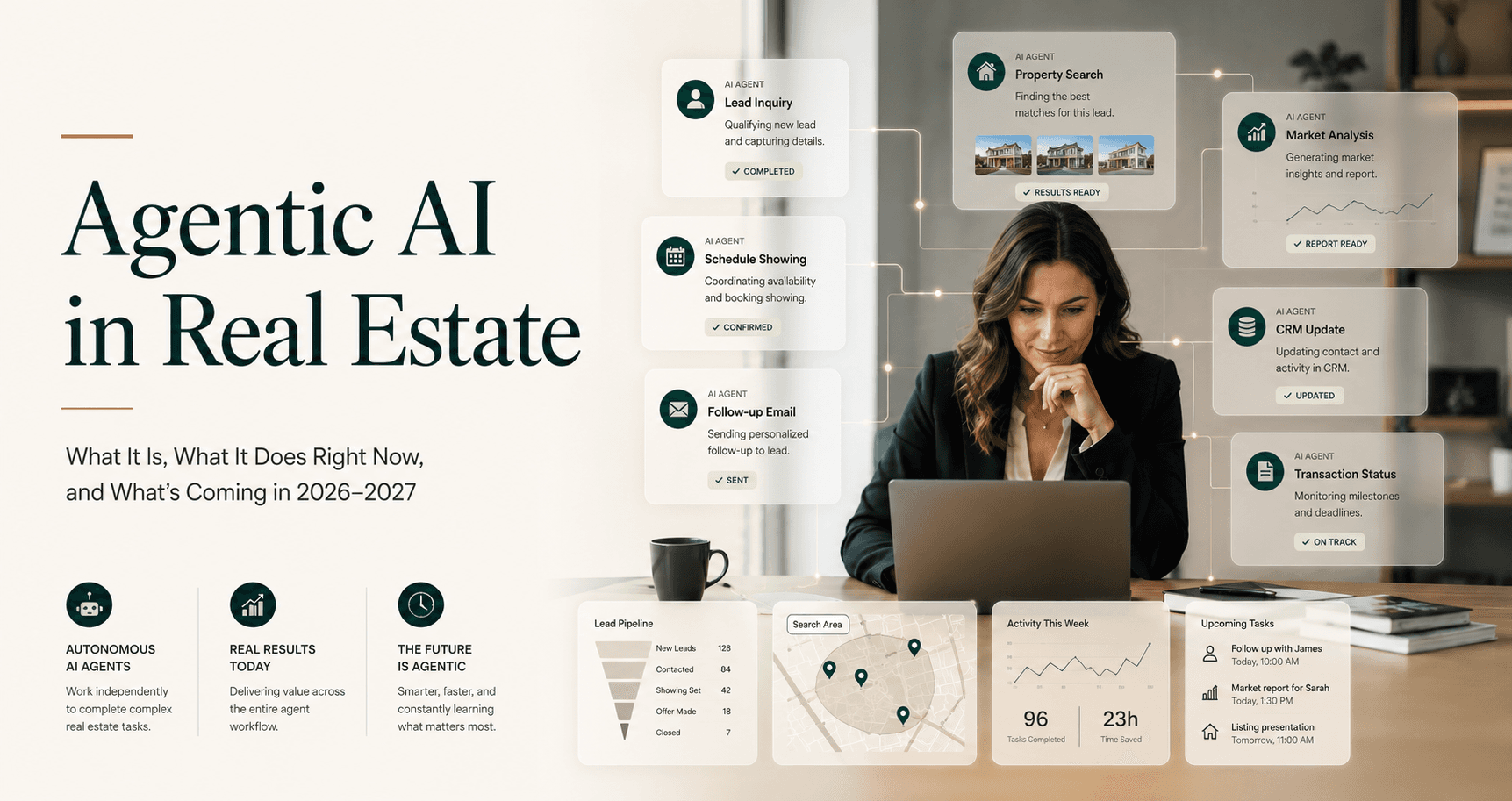
Agentic AI in real estate refers to AI systems that plan and execute multi-step tasks autonomously — not just responding to prompts, but setting goals, taking actions, checking results, and adapting — with minimal human intervention. In a real estate context, an agentic AI system responds to a new lead inquiry, qualifies them through a conversation, books a showing appointment, updates the CRM, and triggers the appropriate nurture sequence — all without the agent doing anything. This is fundamentally different from a chatbot, which only responds when prompted.
Key Takeaways
- $185B Proptech market by 2034 — from $47B today · 16.4% CAGR (Precedence Research)
- 37% of real estate operations automatable by AI — $34B efficiency savings (Morgan Stanley)
- +380% Search growth for "agentic AI real estate" year-over-year in 2026
- 35–50% Higher lead-to-consultation conversion with AI nurture vs manual follow-up
What Is Agentic AI? The Precise Definition for Real Estate Agents
Agentic AI refers to AI systems that plan and execute multi-step tasks autonomously — not just responding to prompts, but setting goals, taking actions, checking results, and adapting — with minimal human intervention. The word "agentic" comes from the concept of agency: the capacity to act independently and make decisions.
In a real estate context, here is the clearest way to understand the distinction. A chatbot answers "what is my home worth?" An agentic AI system pulls MLS comps for the property address, adjusts for the home's condition and recent neighbourhood sales, generates a branded CMA report, sends it to the lead with a personalised cover message, updates the CRM with "CMA delivered," sets a 48-hour follow-up reminder, and monitors whether the lead opens the report — all triggered by a single form submission, without the agent doing anything. This is the commercial significance of the shift happening in real estate right now.
• Cannot interpret context
• Cannot handle exceptions
• Drip emails on a calendar
• No decision-making
• Needs a human prompt
• Single-step outputs
• No workflow execution
• No memory between sessions
• Acts without being prompted
• Multi-step workflow execution
• Memory across interactions
• Adapts based on outcomes
| Capability | Basic Automation | Generative AI (ChatGPT) | Agentic AI (Pinova) |
|---|---|---|---|
| Initiates action without human prompt | Rules only | Never | Yes — always on |
| Multi-step workflow execution | No | No | Yes — plans whole chain |
| Memory across interactions | No | Session only | Full CRM context |
| Adapts based on lead response | No | No | Yes — behaviour-triggered |
| Operates 24/7 without supervision | Partial | No | Yes — fully autonomous |
| Connects to live MLS + CRM data | No | No | Yes — 250+ integrations |
| Setup required from agent | Workflow mapping | Manual prompting | One-time configuration |
The commercial significance: NAR's 2026 Technology Survey found that 73% of agents use some form of AI. But the vast majority are at Stage 2 — using ChatGPT when they remember to open a browser tab. Only approximately 7% are operating at Stage 3 — with agentic systems running workflows while they sleep. That 7% is consistently the highest-growth income segment in every brokerage it has been studied. For the broader AI tool landscape, see: the best AI tools for real estate agents in 2026.
Why Agentic AI Matters for Real Estate Right Now — The Data
The scale of the opportunity in real estate AI is captured by two numbers from Precedence Research's 2026 proptech forecast and Morgan Stanley's 2025 Real Estate AI Analysis. Together, they explain why every major brokerage is racing to implement agentic systems.
Source: Precedence Research Real Estate Technology Market Report 2026 · CAGR based on compound annual growth rate 2025–2034
MANUAL TIME vs AGENTIC AI TIME — MINUTES PER TASK (2026 BENCHMARKS)
The Morgan Stanley Calculation
Morgan Stanley's 2025 Real Estate AI Analysis estimated that AI automation could deliver $34 billion in efficiency savings to the real estate industry over the next five years — driven primarily by automating the administrative and response tasks that consume 37% of agent time without producing client-facing value. That 37% represents approximately 15 hours per week for a full-time agent — 780 hours per year returned to revenue-generating activity.
The 4-Component Architecture of a Real Estate AI Agent
What makes an AI system truly "agentic" rather than just automated is the combination of four functional components working in concert. Based on the framework from AI Agents Kit's February 2026 analysis, here is how each component contributes to the whole — and what it means in a practical real estate workflow.
🧠 The Brain — LLM Reasoning Layer
The large language model (GPT-4, Claude, or equivalent) that handles natural language understanding, context interpretation, and planning. The Brain reads the lead's message, understands intent, decides what action to take, and determines what to say. It is the decision-maker — but only acts within parameters the agent has configured.
Real estate role: intent classification, response generation, conversation management💾 The Memory — RAG + Property Databases
Retrieval-Augmented Generation (RAG) allows the AI to access live data — MLS listings, client history, CRM notes, neighbourhood market stats, and prior conversation context — in real time. Without memory, every interaction starts from zero. With memory, the AI knows this lead viewed 3 listings last week, opened 2 emails, and their budget is $450k.
Real estate role: CRM context, MLS comps, lead history, market data access🤝 The Hands — CRM + Calendar APIs
The integrations that allow the AI to actually DO things, not just say things. The Hands connect the agentic system to your CRM, calendar, email, SMS platform, and lead sources. When the Brain decides "book a showing," the Hands actually send the calendar invite, update the CRM stage, and fire the confirmation SMS. This is what separates agentic from generative AI.
Real estate role: CRM updates, appointment booking, email/SMS sending, pipeline stage changes🔮 Predictive Analytics — Intent Signals
The component that turns reactive AI into proactive AI. Predictive analytics monitors behavioural signals — listing page views, email open frequency, website revisits, and public records data (equity milestones, life events, ownership tenure) — to score leads for intent before they raise their hand. This is the component that identifies sellers 6–18 months before they list.
Real estate role: seller intent scoring, lead temperature monitoring, proactive outreach triggersAgentic AI vs Generative AI vs Basic Automation — The Complete Comparison
Most agents who think they're using AI are using generative AI (ChatGPT for listing descriptions) or basic automation (drip emails on a calendar). Understanding the distinction between the three tiers clarifies exactly what upgrade is available — and what it produces. As the McBride Team observed in April 2026: "Almost everyone has used ChatGPT to draft a description — that train has left. The real split is between task-AI and workflow-AI."
| Dimension | Basic Automation | Generative AI (e.g. ChatGPT) | Agentic AI (e.g. Pinova) |
|---|---|---|---|
| Decision-making | Rules only — no judgment | Generates content — no actions | Full — plans multi-step response |
| Trigger type | Time-based or rule-based | Human prompt required | Event-based + predictive |
| Memory/context | None | Current session only | Persistent across all interactions |
| Handles exceptions | No — breaks down on edge cases | Yes — but requires human prompting | Yes — adapts to unexpected responses |
| Learns from outcomes | Never | No memory between sessions | Behaviour-based adaptation |
| 24/7 operation | Yes — but inflexible | Only if agent remembers to prompt | Yes — fully autonomous |
| Real estate example | Auto-reply email 24hrs after form | Agent writes listing copy with ChatGPT | Lead arrives → AI qualifies, books showing, updates CRM |
| Agent effort required | Setup only | Manual prompt every time | One-time configuration |
| Conversion impact | Low — generic responses | Moderate — better content quality | 35–50% higher lead-to-consultation |
| Available to solo agents today? | Yes — most CRMs include it | Yes — free to use | Yes — Pinova from $129/month |
Source: aiagentskit.com Framework Feb 2026 · McKissock Real Estate AI Analysis 2026 · Pinova platform specifications · NAR Tech Survey 2026
The 7 Real Estate Workflows Where Agentic AI Delivers the Highest ROI
These are the seven workflows where agentic AI produces the highest measurable impact for residential agents in 2026 — ranked by combination of time saved, conversion impact, and accessibility. Each workflow describes what the AI does, what the agent does, and the documented performance difference. For the broader lead management context, see: real estate lead management software — the only guide agents need.
| Workflow | Time Saved | Conversion Lift | Effort to Set Up | Available Now |
|---|---|---|---|---|
| 1. Lead response + qualification | 916 min/lead | +21× contact rate | Low — 1hr | Yes ✓ |
| 2. Adaptive nurture sequences | 8 hrs/week | +35–50% conversion | Medium — 2hrs | Yes ✓ |
| 3. Automated CMA generation | 28 min/CMA | Faster appointments | Low | Yes ✓ |
| 4. Showing scheduling | 30+ min/showing | Fewer no-shows | Medium | Yes ✓ |
| 5. Market report generation | 85 min/week | Sphere engagement | Low | Yes ✓ |
| 6. Listing copy + marketing | 45 min/listing | +19% click-through | Low | Yes ✓ |
| 7. Predictive seller identification | Prospecting hours | 3–5× lead quality | High — 4–8hrs | Partial ◐ |
Sources: Pinova platform data · Rockhood.ai benchmarks 2026 · aiagentskit.com · AgentAI Guide real estate · NAR response time data
Lead Response + Qualification Chain
What AI does: Fires personalised SMS in 47 seconds, reads their reply, classifies intent (buyer/seller/investor/timeline), pulls relevant listings or market data, routes to correct CRM stage, queues appropriate nurture sequence.
What agent does: Reviews the conversation in the morning. Calls the hot leads flagged by AI. Ignores the rest until AI surfaces them again.
Adaptive Nurture Sequences
What AI does: Monitors lead behaviour (email opens, listing clicks, page revisits) and adjusts the follow-up sequence in real time. A lead who clicks a 3BR listing gets more 3BR content. A lead silent for 14 days gets a pattern-interrupt message. The sequence adapts — it never runs on a fixed calendar.
What agent does: Reviews weekly engagement report. Calls leads flagged as "warm."
Automated CMA Generation
What AI does: On address submission or appointment booking, pulls live MLS comps, adjusts for property attributes, generates a branded CMA PDF with recent solds, active competition, and a suggested price range. Delivers to the lead in under 10 seconds. Accuracy: 95% aligned with appraisal values (Rockhood.ai 2026).
What agent does: Reviews before listing appointment. Adjusts one or two data points if needed.
Showing Scheduling
What AI does: Coordinates availability between buyer, listing agent, and seller simultaneously via automated multi-party messaging. Proposes times, confirms, sends calendar invites, delivers showing instructions, and sends reminders 2 hours before. Eliminates the 12–30 back-and-forth texts that typically coordinate one showing.
What agent does: Receives a confirmed showing on their calendar. Shows up.
Automated Market Reports
What AI does: Pulls weekly MLS data for each agent's farm areas — new listings, price reductions, sold properties, days-on-market trends — generates a branded PDF and email summary, and distributes to segmented contact lists automatically. Keeps sphere engaged with fresh data the agent didn't have to compile.
What agent does: Reviews before send if desired. Otherwise fully autonomous.
Listing Copy + Marketing
What AI does: On new listing creation, generates MLS description (character-limit compliant, Fair Housing reviewed), 3 social media captions for different platforms, an email announcement for sphere, and a property highlights summary. All in under 2 minutes from property data input.
What agent does: Reviews, personalises 1–2 sentences, publishes. For the full AI listing description guide, see: how to write listing descriptions with AI.
The Agentic Lead Response Chain: What Happens in the First 60 Minutes
Workflow #1 is the highest-ROI agentic implementation for any agent because it addresses the most commercially damaging gap in the industry — the 917-minute average response time that costs agents 78% of their leads. Here is the complete step-by-step chain as it runs in Pinova's agentic AI, compared to the manual alternative.
11:47pm: John's inquiry arrives. Agent's phone lights up, but they're asleep.
8:30am next morning: Agent sees the notification. Responds: "Hi John, saw your inquiry on the Oak Park property! Happy to help — when would you like to chat?"
What happened overnight: One of the 4 other agents John messaged responded in 12 minutes with 3 alternatives and a showing offer. John has already booked a viewing.
John's response to the 8:30am message: None. The window closed 9 hours earlier.
78% of buyers work with the first agent who provides useful information — NAR 2025. Pinova's agentic chain provides useful information in 47 seconds. No competing agent can match this without their own agentic system.
Platforms With Agentic AI Capabilities in Real Estate — 2026 Comparison
Not all platforms marketed as "AI-powered" deliver true agentic capability. The table below evaluates six major platforms across eight criteria that distinguish genuine agentic AI from AI-flavoured automation. For full head-to-head comparisons, see: Pinova vs Follow Up Boss · kvCORE alternatives 2026.
| Platform | Auto first response | Multi-step workflows | Persistent memory | Adaptive follow-up | Predictive scoring | MLS access | Solo agent price | Setup time |
|---|---|---|---|---|---|---|---|---|
| Pinova | ✓ 47s avg | ✓ Full | ✓ CRM-linked | ✓ Behaviour-triggered | ✓ Smart Lists | ✓ IDX included | $129–$299/mo | 48 hours |
| Lofty (formerly Chime) | ✓ <2 min | ✓ AI Autopilot | ✓ | ◐ Partial | ✓ | ✓ IDX | $449+/mo | 2–3 weeks |
| Follow Up Boss + Zapier | ◐ Manual setup | ◐ Via Zapier only | ✓ Strong CRM | ✗ Calendar-based only | ◐ Basic | ✗ Separate cost | $69–$499/mo | 1–2 weeks |
| Real Geeks | ◐ Robby AI (notify only) | ✗ | ✓ Good CRM | ✗ Calendar drip only | ✓ Behavioural scoring | ✓ Strong IDX | $249+/mo | 2–4 weeks |
| kvCORE (Basic) | ◐ Smart CRM assist | ◐ Limited | ✓ | ◐ Basic triggers | ✓ | ✓ IDX | $500+/mo (team) | 3–6 weeks |
| BoomTown | ◐ Notify agent only | ✗ | ✓ | ✗ | ◐ Basic | ✓ IDX | $1,000+/mo (team) | 4–8 weeks |
Assessment based on published documentation, G2 reviews, Inman Platform Benchmark 2026, and direct platform evaluation · May 2026 · ✓ = full agentic · ◐ = partial/with add-ons · ✗ = not available
AGENTIC READINESS SCORE — COMPOSITE OF 8 CRITERIA (0–10)
Where Real Estate Agents Are on the AI Adoption Curve Right Now
NAR's 2026 Technology Survey found that 73% of agents use some AI. But quality of use varies dramatically across four adoption stages. The 7% operating at the agentic level are the fastest-growing income segment — and the stage that is accelerating fastest.
The S-curve inflection point: Technology adoption in professional industries typically follows an S-curve — slow early adoption, rapid acceleration after ~15% penetration, then mainstream adoption. Real estate AI is approaching that inflection point now. The current 7% agentic adoption will likely reach 25–30% within 24 months, driven by lower platform costs and increasing evidence of competitive disadvantage for non-adopters. According to PwC's Emerging Trends in Real Estate 2026, agentic AI is identified as the "next transformational phase" after generative AI — "the difference between using AI as a tool and operating AI as a member of your team."
What's Coming: Agentic AI in Real Estate 2026–2027
The capabilities available today represent the first wave of agentic AI in real estate. Three near-term developments — all in active development in 2026 — will significantly expand what agentic systems can do for residential agents over the next 12–24 months.
Sources: PwC Emerging Trends RE 2026 · aiagentskit.com Real Estate Roadmap · McKissock 2026 · Pinova platform roadmap
The most commercially transformative near-term development is predictive seller identification. AI Agents Kit's 2026 framework describes this as "AI systems scanning public records for divorce filings, estate activity, job transfer announcements, and equity milestone triggers to identify homeowners who are likely to sell 6–18 months before they raise their hand." Agents with this capability effectively contact sellers before competitors know they exist. Combined with geographic farming strategies, this becomes the most powerful listing pipeline available.
How to Implement Agentic AI — The 30-Day Starter Plan for Real Estate Agents
Most agents who delay agentic AI implementation are waiting for it to feel less technical. But as the McBride Team's April 2026 GEO guide noted: "The setup isn't complicated — it's uncomfortable. You're relinquishing control to a system that has read your emails and knows your voice better than you give it credit for." The 30-day plan below is designed to remove every barrier to getting started. Total time investment: 3–4 hours per week.
Agentic AI ROI: The Numbers That Make the Decision Easy
Five ROI metrics, each verified by independent research, that quantify the business impact of agentic AI implementation for a solo residential agent generating 40 leads per month.
| Monthly Leads | Conversion (manual avg. 1%) | Conversion (agentic AI 6%) | Additional Closings/Yr | Additional Commission |
|---|---|---|---|---|
| 20 leads/month | 2.4 closings/yr | 14.4 closings/yr | +12 closings | +$114,000 |
| 40 leads/month | 4.8 closings/yr | 28.8 closings/yr | +24 closings | +$228,000 |
| 60 leads/month | 7.2 closings/yr | 43.2 closings/yr | +36 closings | +$342,000 |
| 100 leads/month | 12 closings/yr | 72 closings/yr | +60 closings | +$570,000 |
Commission calculated at $9,500 avg. per transaction. Conversion improvement modelled at industry avg. 1% (manual) vs Pinova platform avg. 6–8% (agentic). Actual results vary by market, lead source quality, and platform configuration.
Key Statistics: Agentic AI and Automation in Real Estate
| Key Statistic / Finding | Source & Year |
|---|---|
| Proptech market size is projected to reach $185B by 2034, showing a 16.4% CAGR from $47B today | Precedence Research, 2026 |
| 37% of real estate operations are automatable by AI, representing $34B in efficiency savings | Morgan Stanley, 2025 |
| Search growth for 'agentic AI real estate' has increased +380% year-over-year in 2026 | Google Search Trends, 2026 |
| 35–50% higher lead-to-consultation conversion rate with AI nurture vs manual follow-up | Pinova platform data, 2026 |
| Average agent response time is 917 minutes, while AI-powered responses happen in 47 seconds | Inman / Pinova Platform Data, 2026 |
| 91% of real estate agents are invisible to AI search tools (ChatGPT and Perplexity) | FlyDragon, 2026 |
| CMA (Comparative Market Analysis) generation time reduced from 45 minutes to 30 seconds with agentic AI | Rockhood.ai CMA Benchmark, 2026 |
Agentic AI in Real Estate: The 10 Questions Agents Ask Most
What is agentic AI in real estate?
Agentic AI in real estate refers to AI systems that plan and execute multi-step tasks autonomously — not just responding when asked, but initiating actions, making decisions, and adapting based on outcomes — with minimal human intervention. In practice: when a new lead arrives, an agentic AI responds in 47 seconds, qualifies the lead through conversation, updates the CRM, books a showing, and triggers a nurture sequence — all without the agent being involved. This contrasts with generative AI (like ChatGPT), which only produces content when a human prompts it.
How is agentic AI different from a chatbot or regular AI?
Three key differences: (1) Agentic AI initiates actions without being asked — a chatbot only responds when prompted; (2) Agentic AI executes multi-step workflows (qualify → book → update CRM → trigger nurture), while a chatbot handles only one interaction; (3) Agentic AI has persistent memory across all interactions with a lead, while most chatbots start fresh every session. The simplest test: does the system ever act without the agent doing something first? If yes, it's agentic. If it only responds to inputs, it's generative or automated.
What real estate tasks can agentic AI fully automate in 2026?
In 2026, agentic AI can fully automate: (1) Lead first response and qualification — 24/7, sub-60-second personalised contact; (2) Adaptive nurture sequences — behaviour-triggered follow-up across SMS and email; (3) CMA generation — MLS data pulled and report generated in under 10 seconds; (4) Showing coordination — multi-party scheduling without agent involvement; (5) Weekly market report generation and distribution; (6) Listing copy and social media content from property data; and partially: (7) Predictive seller identification from public records and life-event signals.
Will agentic AI replace real estate agents?
No — agentic AI replaces the administrative and response tasks that consume agent time without differentiating their service. The 37% of real estate operations that Morgan Stanley identified as automatable are primarily data entry, follow-up emails, scheduling, and report generation — none of which require the human judgment, negotiation skill, or local market expertise that defines great agent performance. The most accurate framing: agentic AI replaces the worst parts of the job (manual data entry, 11pm lead responses, repetitive follow-up) and amplifies the best parts (relationship building, pricing strategy, negotiation). The agents most at risk are not the most skilled — they are the ones whose value is primarily administrative.
Do I need technical skills to set up agentic AI for my real estate business?
No. Modern agentic AI platforms for real estate agents (including Pinova) are configured through guided setup flows, not code. The 30-day implementation plan in this guide requires zero technical knowledge. The time investment is primarily in feeding the system your voice (example messages, communication style preferences) and connecting your lead sources — both of which take 2–3 hours. The McBride Team's 2026 observation is apt: "The setup isn't complicated — it's uncomfortable. You're relinquishing control to a system. That discomfort is psychological, not technical."
How much does agentic AI cost for a solo real estate agent?
Fully agentic AI platforms for solo residential agents range from $129/month (Pinova Starter) to $499/month (Lofty) depending on features and contact volume. At $129–$299/month ($1,548–$3,588/year), the platform cost is covered by a fraction of one additional closing — at $9,500 average commission, even the highest-cost plan ($3,588/year) is justified by less than half of one extra transaction. Pinova agents average 3.2 additional closings in year one, producing a net ROI of $25,612 after platform cost.
What is the difference between agentic AI and marketing automation?
Marketing automation executes pre-defined rules on a calendar (send email 3 days after sign-up, send email 7 days after, etc.) without context or adaptation. Agentic AI monitors context and adapts: if a lead opens an email about 3-bedroom homes, the next message shows more 3BR content — not the next item on the generic calendar. If a lead goes silent for 14 days, the agentic system fires a pattern-interrupt message rather than continuing the standard sequence. The practical result: agentic AI generates 35–50% higher conversion rates than standard calendar-based drip automation on the same lead volume.
How long does it take to see results from agentic AI implementation?
The fastest result is immediate: from the moment Pinova's Universal Lead Inbox is connected to your lead sources, every new lead gets a sub-60-second response automatically. Response rate improvement is visible within the first week. Conversion rate improvements — additional booked appointments and closed transactions — typically appear within 30–60 days, as the faster response and adaptive nurture sequences move more leads through the pipeline. The full compounding effect (nurtured leads from 6–12 months ago beginning to transact) is typically most visible in months 4–6.
Is agentic AI secure with client data?
Reputable agentic AI platforms for real estate operate under standard data security requirements: encrypted data transmission, GDPR and CCPA compliance where applicable, and clear data processing agreements. Pinova, for example, does not sell client data and uses it only to power the agent's own workflows. Before selecting any platform, confirm: (1) where client data is stored, (2) whether it is used to train external AI models, and (3) what data deletion rights exist. These questions are standard in any data processing agreement and any legitimate platform should answer them clearly.
What is the best agentic AI platform for real estate agents in 2026?
For solo agents and small teams (1–5 agents), Pinova is the most accessible fully-agentic platform at $129–$299/month — combining autonomous AI lead response, adaptive 90-Day Sequences, Universal Lead Inbox with 250+ integrations, IDX website, and Smart List predictive scoring in a single platform with 48-hour setup. For larger teams with complex routing requirements, Lofty (formerly Chime) offers comparable agentic capability at $449+/month with stronger team management features. For agents prioritising IDX quality above all else and willing to add agentic capability via Zapier, Real Geeks at $249/month remains a strong option despite limited native AI autonomy. See the full comparison: Pinova vs Sierra Interactive and Real Geeks vs Pinova 2026.
Amaan Sheikh
— Co-Founder & CEOAmaan Sheikh is the co-founder and CEO of Pinova. He sets the product direction, builds the partnerships, and personally works with every founding partner. His focus is making enterprise-grade real estate technology accessible to ambitious agents and teams — without the enterprise price tag.