Zillow AI Mode Explained: What It Means for Your Listings and Your Leads in 2026

Quick Answer
What does Zillow AI Mode mean for real estate agents?
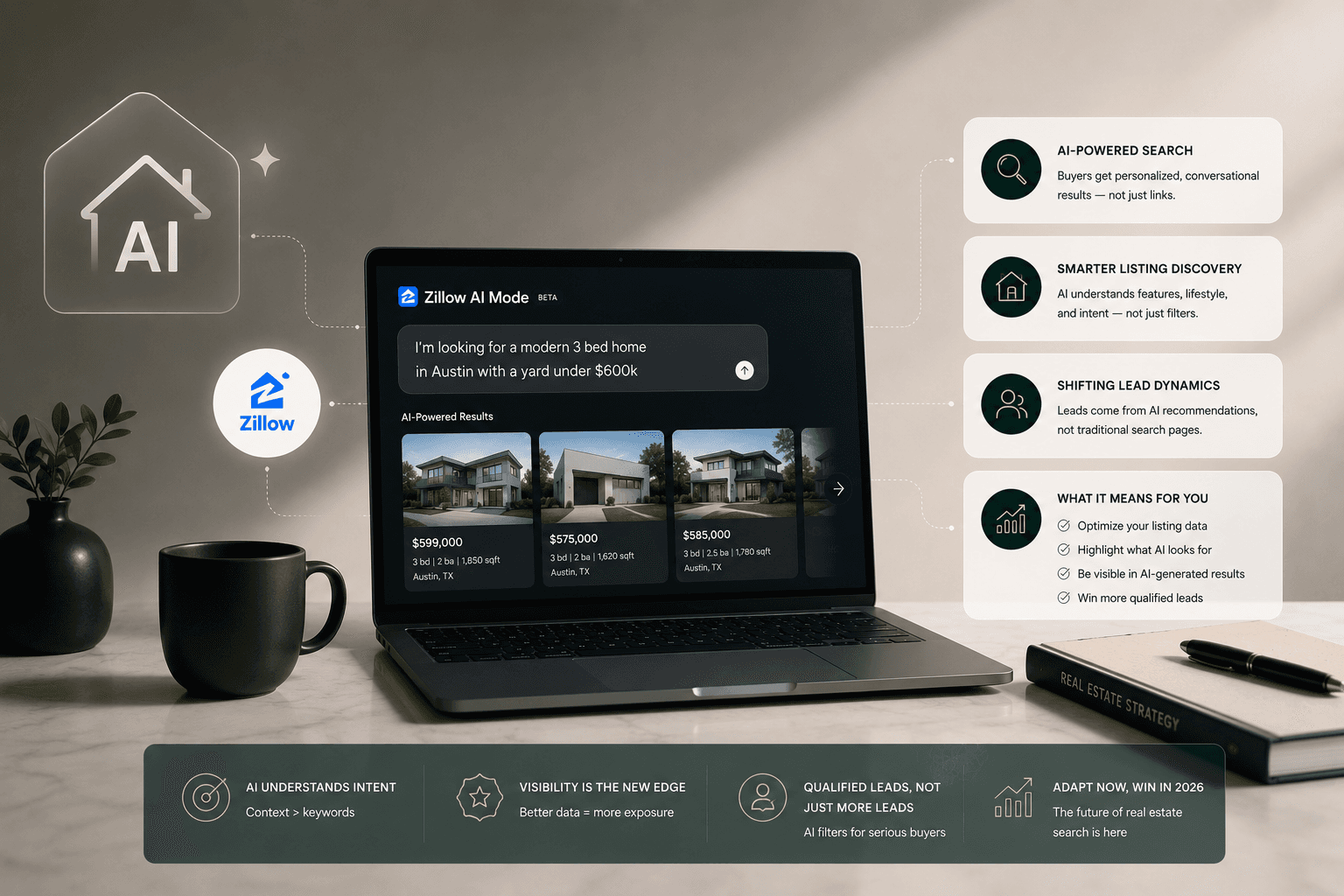
Zillow AI Mode is a conversational search layer that Zillow began rolling out in beta on March 25, 2026, letting buyers and renters ask plain-language questions about affordability, neighborhoods, offer competitiveness, and specific homes instead of setting search filters. As of Zillow's first-quarter 2026 earnings call, it was live for roughly 5% of Zillow's user base — still early, still expanding through the rest of 2026, and still just one of at least six AI search surfaces now competing for the buyer's first question (Zillow's own ChatGPT app, Redfin's native and ChatGPT experiences, Realtor.com's ChatGPT app, CoStar's Homes AI, and Google AI Mode). The practical shift for agents isn't about being replaced by a chatbot — it's three things at once: leads arriving more pre-informed, a live legal fight over whether MLS data can even flow into these tools in the first place, and a hard truth revealed by independent research this spring — real estate has the lowest AI Overview visibility of any tracked industry, meaning most agents are functionally invisible to the exact AI systems their buyers are now using first.
Key Takeaways
- Zillow AI Mode launched in beta on March 25, 2026. Per Zillow's Q1 2026 earnings call in May, it was live for approximately 5% of Zillow's audience at that point, with a phased rollout continuing through the rest of 2026.
- It's one of at least six distinct AI search surfaces agents now need to track: Zillow AI Mode, Zillow's app inside ChatGPT (October 2025), Redfin's native Sierra-built conversational search (November 2025) and its own ChatGPT app (February 2026), Realtor.com's ChatGPT app (March 30, 2026), and CoStar's Homes AI on Homes.com (February 17, 2026).
- Two different, frequently confused surveys get cited as one stat: 82% of agents use AI tools according to RPR's February 2026 survey of NAR members, while the "only 17% see significant impact, 46% see none" figure actually comes from NAR's separate July 2025 Technology Survey of 49,233 Realtors.
- Real estate has the lowest AI Overview trigger rate of any tracked industry — just 0.14% — compared to 13% for health, 4.2% for finance, and 2.1% for retail, according to a joint Haute Residence and 5WPR report published in April 2026. Near-universal agent AI adoption has not translated into AI search visibility.
- Zillow's October 2025 ChatGPT integration triggered a still-unresolved industry dispute over whether piping MLS data into a third-party AI platform complies with Internet Data Exchange (IDX) licensing rules — a fight that matters more to your listing data than AI Mode itself does.
- Buyer trust in AI for home search fell to 16% in 2026, a 14-point drop from 2025, even as usage keeps climbing — according to Cotality's AI in Housing 2026 Report.
- Zillow's Fair Housing Classifier — open-sourced and built on prompt engineering, stop lists, and a fine-tuned BERT classifier — screens both buyer questions and AI Mode's answers for discriminatory steering in real time.
- Zillow Premier Agent leads still cost most agents $20 to $60 each by third-party market estimates, while Zillow's own site cites an average cost per connection of $223 in major metros — none of Zillow's 2026 AI products reset that pricing.
A note on this article
Zillow has not published its own adoption, lead-volume, or conversion data for AI Mode as of this writing — it's roughly three months into a phased beta covering a small slice of its audience. Everything below is built from Zillow's official announcements and earnings calls, competitor press releases, court filings, and independent reporting from HousingWire, Inman, Real Estate News, RISMedia, GeekWire, and industry-research groups like RPR, Cotality, and WAV Group. Where two sources disclosed different survey methodologies for a statistic that gets casually merged elsewhere, we've called that out explicitly rather than repeat the merged version. Verify current numbers directly with each platform before making a budget decision.
Consider an agent like Priya, who lists mid-market homes in a mid-size Sun Belt metro. For years, her first call with a new Zillow lead started the same way: walking a stranger through what they could actually afford and whether they'd looked at neighborhoods outside their original search. Those first ten minutes were mostly free triage. This spring, she started noticing something different about her Zillow inquiries — buyers already knew their price range, had already compared two or three specific listings, and opened with questions about offer strategy instead of basic affordability. She hadn't changed anything about her marketing. Zillow had changed the buyer.
That shift has a name: Zillow AI Mode. On March 25, 2026, Zillow Group announced a conversational AI experience built directly into Zillow.com and its apps, accessible through an Ask Zillow chat box at the bottom of search results. Six weeks later, on its Q1 2026 earnings call, Zillow gave the first real signal of how it's actually being used: one buyer had 16 separate conversations with AI Mode over 10 days researching neighborhoods in Sonoma County, California — and ended up under contract on a home found through the tool. That's the story Zillow chose to tell investors. It's also a preview of exactly the kind of lead Priya started noticing: someone who arrives having already done the work AI Mode was built to front-load.
What Zillow AI Mode Actually Is — And How Far It's Actually Rolled Out
Zillow AI Mode is not a new app and it's not a chatbot bolted onto the side of Zillow's site — it's a conversational layer built into the existing search experience, running on what Zillow describes as its own custom AI models rather than a licensed third-party chatbot. A buyer can ask, in plain language, whether they could afford a specific apartment by a target move-in date, or ask the tool to surface similar homes within their budget that sit closer to transit. The system is also built to remember context across sessions — Zillow says it adapts to a mover's activity over time rather than starting from zero on every visit.
CEO Jeremy Wacksman has framed AI Mode as one piece of a longer-running strategy he calls a housing super app — a single digital experience meant to connect search, touring, financing, agent connections, and closing, rather than a search feature bolted on for headlines. That framing matters for agents: Zillow isn't positioning AI Mode as a standalone product to evaluate on its own, but as connective tissue between BuyAbility (its affordability and financing tool), Zillow Home Loans, tour scheduling, and its agent network. The company has applied AI to its platform for roughly two decades, starting with the Zestimate, and executives describe AI Mode as the next layer on that foundation rather than a departure from it.
The honest headline most coverage skipped: as of Zillow's Q1 2026 earnings call in May, AI Mode was live for approximately 5% of Zillow's audience. That's a meaningful detail for any agent deciding how much strategy to build around it right now. Zillow has been explicit that the March 25 debut was a limited beta and that broader rollout continues through the rest of 2026 — which means most of your current Zillow leads are still coming through the search experience you already know, not through AI Mode.
What buyers are actually asking: In Zillow's own early testing, most AI Mode questions clustered around affordability, neighborhood insights, and comparing homes by specific features — the exact ground-floor conversations agents have historically had with a new lead in the first phone call. Zillow's product materials also show the tool fielding more advanced prompts, like a buyer asking it to assess how competitive a $500,000 offer with waived contingencies would be, or asking why a specific home is priced the way it is relative to comparable sales. Those are conversations that used to happen exclusively between a buyer and their agent — AI Mode is designed to happen before that call, not instead of it.
The Compliance Layer Most Agents Have Never Looked At
Because Zillow operates AI Mode as a licensed real estate brokerage, it falls under the same Fair Housing obligations that apply to individual agents — and Zillow built a specific system to manage that risk: the Fair Housing Classifier, a real-time guardrail that evaluates both the buyer's question and the AI's answer before it's shown. Zillow open-sourced the classifier and published the engineering behind it, and it's worth understanding the mechanics, because they reveal exactly where AI in real estate gets legally dangerous. The system combines three layered strategies: prompt engineering that instructs the model to decline questions referencing protected classes, a stop-list that catches unambiguous offensive terms (deliberately used sparingly, since a word like "Indian" is legitimate in a place name like Indian Wells but discriminatory in other contexts), and a fine-tuned classifier model trained specifically to detect steering — the same violation a human agent would commit by recommending neighborhoods based on a buyer's race, national origin, familial status, or other protected characteristic.
That third layer exists because, left alone, general-purpose language models don't know real estate's rules. A generic AI asked "what's a good neighborhood for a Latino family in Seattle" might confidently answer with a list of predominantly Latino neighborhoods — which is textbook steering, the same violation whether a human or a machine produces it. This is the compliance bar every other AI search tool touching real estate now has to clear, and it's a preview of the liability question agents using AI listing-description or chatbot tools should be asking their own vendors: what's actually stopping this tool from producing a Fair Housing violation in your name?
Zillow's Wider 2026 AI Push: Showcase and Preview
AI Mode is the headline, but it launched inside a broader wave of Zillow product releases in March 2026 that agents are more likely to actually pay for. Zillow Preview, a tool letting agents and brokers list "coming soon" properties before they hit active status, launched the same week and had drawn more than 60 brokerage participants and a partnership with Realtor.com by the time of the Q1 earnings call — Wacksman told investors agent adoption had exceeded expectations. Zillow Showcase, the AI-assisted premium listing product (interactive floor plans, 3D virtual tours, elevated map placement), is the older and more directly monetized sibling: Zillow's own published data claims Showcase listings get roughly 79% more page views, 76% more saves, and 91% more shares than comparable non-Showcase listings, translating to about 30% more listings won by agents who use it on the majority of their inventory and a 2% (or roughly $7,000) higher average sale price. Zillow caps Showcase at no more than 10% of listings in a given market to preserve the premium positioning, and reported effective per-listing costs in 2026 typically run $30 to $80 for an individual agent, though Zillow does not publish a flat national price.
The strategic point for agents: none of these products are optional add-ons Zillow expects you to ignore while you wait and see about AI Mode. Preview, Showcase, and AI Mode are being built as one interlocking system — Zillow's own AI models increasingly decide what a buyer sees first, Preview and Showcase decide how good that listing looks when they see it, and Premier Agent still decides who the lead gets routed to. Evaluating AI Mode in isolation from the other two misses how Zillow is actually trying to make money from all of this.
The Real Competitive Map: Six AI Search Surfaces, Not One
Here's where a lot of agents get the picture confused: Zillow AI Mode is not the same thing as the Zillow app inside ChatGPT, and both are different from what nearly every major competitor launched in the same five-month window. Between October 2025 and March 2026, Zillow, Redfin, and Realtor.com all shipped apps inside ChatGPT; Redfin and CoStar both shipped native conversational search built into their own sites; and Google rolled its own AI Mode into real estate search. If you're only tracking Zillow, you're tracking roughly a third of where your buyers are now starting.
AI Search Landscape Matrix
6 AI Search Surfaces Compared
Native, In-Portal Conversational Search
Custom Zillow Models
Leads route to Premier Agent / Preferred zip-code share. ~5% of users live as of May 2026.
Built with Sierra AI
Users view ~2x more listings, are 47% more likely to request a tour, per Redfin.
Microsoft Azure OpenAI
"Your Listing, Your Lead" — inquiries route straight to the actual listing agent, not an ad buyer.
Portal Apps Living Inside ChatGPT
First mover, most contested
Triggered the ongoing IDX/MLS compliance dispute covered below.
Second entrant
Followed Zillow's app after IDX concerns had already surfaced publicly.
MLS-first design
Explicitly bans MLS data from model training; shows previews only, routes to Realtor.com.
Google also folded real estate results into its own AI Mode in March 2026, giving agents a seventh surface with no direct lead-routing relationship to any brokerage at all — visibility there depends entirely on how citable your content is, which is the subject of the GEO section below.
The single most important operational difference between these six surfaces isn't the AI itself — it's lead routing. CoStar built Homes AI around a "Your Listing, Your Lead" guarantee: an inquiry sparked by a conversation about your listing goes to you, the listing agent, full stop. Realtor.com's ChatGPT app was explicitly designed the same way, deliberately positioned in press coverage as a response to the controversy Zillow's earlier ChatGPT launch created — Realtor.com only shows preview details inside ChatGPT and routes every serious buyer back to Realtor.com to connect with an agent. Zillow AI Mode and Zillow's ChatGPT app both work differently: inquiries route to whichever agent has purchased zip-code ad share through Premier Agent, which may or may not be the listing agent at all. If you're the listing agent and you don't also advertise on Premier Agent in your own zip code, a buyer who found your listing through Zillow's AI can be routed to a competitor.
For a deeper look into search visibility and portal math, read our guides on Google AI Overviews in real estate search and Zillow Premier Agent's real cost and conversion data.
The Fight Over Your Listing Data That Matters More Than AI Mode Itself
Almost nobody talks to agents about this part, and it's arguably the biggest structural risk in the entire AI-in-real-estate story. When Zillow launched its app inside ChatGPT in October 2025, industry reaction wasn't celebration — it was alarm. MLS executives and consultants immediately asked whether piping MLS listing data into a third-party AI platform violated the Internet Data Exchange (IDX) rules that govern how brokers are allowed to display MLS data in the first place. NAR's IDX policy requires that all displays of IDX listings remain under the "actual and apparent control" of the listing broker. Victor Lund, co-CEO of the real estate consulting firm WAV Group, argued publicly that Zillow's license only ever covered display on Zillow.com and its own apps — not a third domain like ChatGPT — and that from a consumer's perspective, they're using ChatGPT and simply invoking Zillow as one tool inside it, not visiting a Zillow-controlled property.
NAR itself didn't take a side. It published guidance on October 21, 2025 telling individual MLSs to make their own call, based on whether data is going to an unauthorized party, whether the broker maintains real control over the display, and whether required disclosures still appear. Some MLSs, including North Carolina's Canopy MLS, said Zillow's app remained compliant with their local rules; others, including Stellar MLS, Georgia MLS, and NTREIS, said they were still investigating months later. Zillow's defense, laid out by chief industry development officer Errol Samuelson, is that the company went through what he called a painstaking process with OpenAI to ensure MLS data isn't used to train ChatGPT's underlying model, and that user prompts get relayed to Zillow, which sends a response displayed inside the Zillow app within ChatGPT — meaning, in Zillow's account, the raw data never actually passes through OpenAI's systems at all.
That dispute is exactly why Redfin's and Realtor.com's later ChatGPT apps both went out of their way to publicize MLS data protections in their launch materials — Realtor.com stated outright that model training on MLS data is strictly prohibited and that ChatGPT only ever sees preview-level listing details, with every serious inquiry routed back to Realtor.com's own platform. It's a direct, public response to the exact criticism Zillow absorbed five months earlier.
The longer-term fix the industry is converging on isn't a lawsuit — it's new infrastructure. A growing number of MLSs and vendors are building Model Context Protocol (MCP) servers: a governed, credentialed way for AI systems to query MLS data directly, with access restricted to authorized participants, usage logged for audit trails, and an explicit guarantee that the data can't be absorbed into a model's training set. Doorify MLS in North Carolina has framed its own approach around the phrase "license, not lawsuit" — defining prohibited uses clearly rather than trying to police every possible AI application after the fact. ATTOM launched an MCP server covering roughly 158 million U.S. properties in January 2026. Think of MCP as the next-generation version of IDX, built for an AI system's queries instead of a website's HTML.
Why this matters more to you than AI Mode's rollout percentage: your listing data is the raw material every one of these tools runs on, and right now the rules governing where that data is allowed to go are being written in real time, by lawyers and MLS boards, largely without agents in the room. If you're a listing agent, it's worth directly asking your MLS whether it has any policy — or any MCP infrastructure — covering AI access to your listings, rather than assuming the portals have already sorted it out.
The Adoption Stat Almost Everyone Cites Wrong
You've probably seen some version of this sentence: "82% of agents use AI, but only 17% say it's had a significant impact." It's repeated constantly, and it's built from two different surveys that measured two different things, stitched together because the numbers happen to sit in the same paragraph in a lot of secondary coverage. Getting this right matters, because the two surveys actually tell different stories.
Two Surveys, Correctly Separated
Adoption vs. Impact vs. AI Search Visibility
The RPR survey — 225 NAR members, published in February 2026 — is the source of the 82% adoption figure, and it also breaks down where AI is actually being used: 77.9% of respondents use it for writing, 47% for chatbots or assistants, 39.2% for image editing, and 38.7% for market analysis or pricing. Agents' single biggest concern about AI usage was accuracy of outputs, cited by 63% of respondents, followed by compliance or legal issues at 49% and fair housing concerns at 28%.
The 17%-significant-impact figure is a different animal entirely. It comes from NAR's July 2025 Technology Survey, a much larger random sample of 49,233 active Realtors that generated 1,241 usable responses — and it measured perceived business impact, not tool usage. That survey found AI adoption at 68% (lower than RPR's later 82%, consistent with adoption climbing over the intervening seven months), with 17% of agents reporting a significant positive impact on their business, 33% reporting a moderately positive impact, and 46% reporting no noticeable impact at all. Put the two surveys together correctly and the real picture is this: adoption climbed roughly 14 percentage points in under a year, but the share of agents who say AI is meaningfully moving their business has stayed stubbornly low the entire time. Brokerage-level adoption is even higher — a separate Delta Media survey of brokerage leaders published in January 2026 found 97% report their agents are actively using AI, up from 80% in 2024.
Why Real Estate Is Nearly Invisible in AI Search — And Why That's Your Opening
Here's the number that should actually change how you think about this entire topic. A joint report from Haute Residence and the PR firm 5WPR, published in April 2026 and built on research from the AI-visibility firm Stepps, found that real estate has the lowest Google AI Overview trigger rate of any major tracked industry — just 0.14%. For comparison, health-related queries trigger an AI Overview 13% of the time, finance 4.2%, and retail 2.1%. Real estate sits an order of magnitude below the next-lowest vertical the report tracked. That's true even though the same report confirms 82% of agents already use AI tools daily and every major portal shipped a generative AI product in the same 18-month window.
Sit with that gap for a second, because it's the actual answer to "how do I rank on LLMs." Near-universal professional AI adoption inside the industry has done almost nothing to make individual agents, brokerages, or even most listings visible to the AI systems consumers are increasingly using first. The most likely explanation is structural, not a mystery: most real estate content on the open web is syndicated MLS boilerplate — the same 100-word listing description, duplicated verbatim across dozens of portals and brokerage sites, with no distinguishing entity signals, no named-expert authorship, and no content built to be extracted and cited rather than just displayed. An AI system deciding what to cite is looking for exactly the opposite of that: a single, clearly-attributed, factually dense, non-duplicated source it can quote with confidence.
That's genuinely good news if you're one of the agents willing to do the unglamorous technical work now, while the field is this empty. A market where 82% of your competitors use AI privately in their workflow but almost none of them are structured to be found by AI publicly is a market where the bar to actually stand out is lower than it looks.
The GEO Playbook: How to Actually Get Cited by AI in 2026
Generative Engine Optimization (GEO) is the practice of structuring your content so ChatGPT, Perplexity, Claude, Gemini, and Google's AI Overviews can confidently extract and cite it — as distinct from traditional SEO, which optimizes for a click on a ranked blue link. The two disciplines overlap heavily but aren't identical, and given real estate's 0.14% visibility problem, most agents are starting from zero on the GEO half specifically. Four things move the needle, in rough order of effort-to-impact.
- Structured Data: RealEstateListing and RealEstateAgent Schema
Schema.org markup is the machine-readable layer that tells an AI system exactly what a page represents instead of forcing it to infer that from prose. For a listing page, the relevant type is RealEstateListing, wrapping the property's price, address, listing status, and physical details in a format a model can verify rather than guess at. For your own bio or agent page, RealEstateAgent and Person schema establish you as a consistent, named entity — the same kind of trust signal that helps an AI system decide whose content is authoritative enough to quote. A minimal, illustrative example for a single listing:
Use JSON-LD specifically, placed server-side so it renders without relying on JavaScript execution — that's the format Google, Bing, and AI crawlers extract most reliably, since it lives in its own script block rather than embedded inside the visible HTML. Layer FAQPage schema on any page answering common buyer or seller questions; AI systems parse FAQ markup to pull short, direct answers that match how people actually phrase questions in a chat interface.
- Entity Consistency Across Every Platform You Appear On
AI systems build confidence in a source partly by cross-referencing it against other places the same entity appears. If your name, brokerage, license number, service area, and specialties are phrased even slightly differently on Zillow, your Google Business Profile, your own site, and your brokerage roster page, you're making it measurably harder for a model to confirm you're a real, consistent, trustworthy entity worth citing. This is unglamorous work — auditing and syncing your name and details across every platform — but it's also nearly free, and most agents have never done it.
- Write to Be Extracted, Not Just Read
AI systems favor content that states the answer plainly near the top of a section, in self-contained sentences a model can lift cleanly, rather than content that builds slowly toward a conclusion the way a magazine feature does. That means leading blog posts and FAQ answers with a direct one- or two-sentence answer, then expanding underneath — the same structure this article uses in its own opening summary above. It also means keeping individual FAQ answers concise (roughly 40 to 60 words performs well for extraction) rather than sprawling.
- llms.txt: Useful Supplement, Not a Silver Bullet
An llms.txt file is an emerging, informal standard — a curated, markdown-formatted map of a site's most important pages, meant to help an AI crawler understand what you do without having to piece it together through crawling alone. Google has said explicitly that it isn't a ranking factor for standard search, though it doesn't hurt to have one. Independent testing suggests Perplexity responds more directly to it. As of early 2026, only around one in ten domains had implemented one — treat it as a low-effort, low-competition addition to a real content and schema strategy, not a replacement for one.
The Compliance Risk Hiding Inside Your Own AI Tools
It's worth closing the loop on the Fair Housing point raised earlier, because it applies to your own workflow, not just Zillow's. RPR's February 2026 survey found 28% of agents cite fair housing concerns as a top worry when using AI — and for good reason. Unlike Zillow, which built a dedicated, publicly documented classifier specifically to catch steering, most off-the-shelf AI writing and chatbot tools marketed to individual agents were never built with real estate's legal obligations in mind. In March 2026, the Realtor Association of Sarasota and Manatee published a formal warning to members that AI-generated marketing copy can produce language that violates Fair Housing law without the agent realizing it, simply because the underlying model has no domain-specific guardrail preventing it. Before you adopt any AI listing-description or lead-response tool, it's worth directly asking the vendor what — if anything — is doing the job Zillow's Fair Housing Classifier does for its own product.
Six Things to Do This Quarter
- Rewrite listing descriptions in buyer language: Swap MLS jargon for specific, noun-dense phrases AI models can match, and stop duplicating the same syndicated description across every portal.
- Add RealEstateListing and RealEstateAgent schema: Start with your highest-traffic listing and bio pages; validate with Google's Rich Results Test before rolling out further.
- Audit your response speed: A pre-informed AI Mode lead expects a faster, sharper reply — speed-to-lead is more critical than ever, not less.
- Build entity consistency: Sync name, brokerage, service area, and specialties identically across Zillow, Google, and your own site.
- Ask your MLS about MCP and AI data policy: Find out whether there's any governance over how your listings feed AI systems beyond IDX rules written before any of this existed.
- Vet AI tools for Fair Housing guardrails: Ask any AI listing or chatbot vendor directly what prevents steering language before you put their output in front of a client.
Good Fit for Acting Now
You currently pay for Zillow Premier Agent, Showcase, or Preferred leads, list actively in a market where Showcase or AI Mode adoption is visible, or get a meaningful share of inquiries through Zillow's, Redfin's, or Realtor.com's apps.
Lower Priority for Now
Your business runs almost entirely on referrals and sphere of influence with minimal portal-driven inquiries — though the GEO fundamentals above are still worth doing regardless, since they're nearly free and compound over time.
| Key Statistic / Finding | Source & Year |
|---|---|
| Zillow AI Mode launched in beta on March 25, 2026; per Zillow's Q1 2026 earnings call, it was live for roughly 5% of Zillow's audience as of May 2026, with rollout continuing through the rest of the year | Zillow Group press release; TIKR earnings analysis, May 2026 |
| Zillow reported Q1 2026 revenue of $708 million, up 18.4% year-over-year, with rentals revenue up 42% | Real Estate News, May 2026 |
| 82% of real estate agents have integrated AI tools into their business, per a survey of 225 NAR members | RPR AI Adoption Survey via HousingWire, February 2026 |
| In a separate, larger survey of 49,233 Realtors (1,241 responses), only 17% reported AI having a significant positive impact on their business, while 46% reported no noticeable impact | NAR 2025 Technology Survey via HousingWire, September 2025 |
| Real estate has the lowest Google AI Overview trigger rate of any tracked industry at 0.14%, versus 13% for health and 4.2% for finance | Haute Residence & 5WPR Luxury Real Estate AI Discovery Report, April 2026 |
| Trust in AI to help find a home fell to 16% among U.S. buyers in 2026, a 14-point drop from 2025 | Cotality AI in Housing 2026 Report via HousingWire, April 2026 |
| Redfin's conversational search users view nearly twice as many listings and are 47% more likely to request a tour than filter-based search users | Redfin press release, November 2025 |
| CoStar's Homes.com Network reached 115 million average monthly unique visitors in Q3 2025, ahead of its Homes AI launch | CoStar Group press release, February 2026 |
| Zillow Showcase listings get roughly 79% more page views, 76% more saves, and 91% more shares, with about 30% more listings won by heavy Showcase users and a 2% ($7K) average sale-price lift | Zillow Showcase Facts, updated January 2026 |
| Zillow Premier Agent leads typically run $20 to $60 each by third-party estimates; Zillow's own site cites an average cost per connection of $223 in major metros | HousingWire / Zillow Premier Agent, 2026 |
Frequently Asked Questions
What is Zillow AI Mode?
Zillow AI Mode is a conversational search feature Zillow announced on March 25, 2026, built directly into Zillow.com and its mobile apps. Instead of setting filters like price range or number of bedrooms, buyers and renters can type plain-language questions into an Ask Zillow chat box. The tool draws on Zillow's live listings data, its Zestimate valuation models, and a user's own saved homes to answer in context, using Zillow's own custom AI models rather than a third-party chatbot. As of Zillow's Q1 2026 earnings call, it was live for roughly 5% of Zillow's audience, with a phased expansion continuing through the rest of 2026.
How is Zillow AI Mode different from the Zillow app in ChatGPT?
They're two separate products. The Zillow app inside ChatGPT launched October 6, 2025, and lives inside OpenAI's chatbot — and it's also the product that triggered an ongoing industry dispute over whether displaying MLS data inside a third-party AI platform complies with IDX licensing rules. Zillow AI Mode, launched five months later, is built natively into Zillow's own site and apps. Both ultimately route a ready-to-act buyer back into Zillow's ecosystem, typically to whichever agent holds Premier Agent zip-code advertising rather than automatically to the listing agent.
Will Zillow AI Mode replace real estate agents?
Zillow's position is that AI Mode is designed to shift the agent's role, not replace it — letting AI handle research-heavy questions early on so agents can spend more time on pricing strategy, negotiation, and closing the transaction. The independent data backs a version of that story: buyer trust in AI to actually find a home fell to just 16% in 2026, even as usage climbs, suggesting consumers still want a human validating the decision. AI Mode raises the floor on what buyers already know when they call you, which means agents who lead with judgment, negotiation, and local expertise will thrive.
Does Zillow AI Mode cost real estate agents anything directly?
There's no separate fee for AI Mode itself. Zillow's monetization for agents still runs through its existing programs: Zillow Premier Agent (share of voice by zip code), Zillow Showcase (a premium listing-presentation subscription running roughly $30 to $80 per listing in 2026), and Zillow Flex/Preferred (referral fee at closing). AI Mode changes the buyer's research process before they reach you; it doesn't change Zillow's underlying pricing model.
How can I optimize my listing descriptions and website for Zillow AI Mode and other AI search tools?
Write the way buyers actually talk, not the way an MLS field is labeled — swap "updated kitchen" for "kitchen with island seating for four, quartz counters, and a walk-in pantry." Name the subdivision, school zone, and distance to specific landmarks. Beyond the prose itself, add RealEstateListing and RealEstateAgent schema markup (JSON-LD format) to your pages, keep your name and details consistent across every platform you appear on, and structure FAQ content to answer questions in a direct sentence or two near the top. Real estate currently has the lowest AI Overview visibility of any tracked industry, so this technical work carries outsized impact relative to how few agents are doing it.
Is Zillow AI Mode available in my market yet?
As of this writing, Zillow AI Mode remains a limited beta covering roughly 5% of Zillow's user base by Zillow's own May 2026 earnings-call disclosure, and Zillow has not published a public, market-by-market rollout schedule. The most reliable way to check is to look directly on Zillow.com or in the Zillow app for the Ask Zillow chat box.
How does Zillow AI Mode handle Fair Housing compliance?
Zillow built a Fair Housing Classifier directly into AI Mode — a real-time system combining prompt engineering, a narrow stop-list for unambiguous terms, and a fine-tuned classifier model trained specifically to detect discriminatory steering in both the buyer's question and the AI's answer. Zillow has open-sourced the classifier. Because Zillow operates AI Mode as a licensed real estate brokerage, it falls under the same Fair Housing obligations that apply to individual agents — which is also why RPR's 2026 survey found 28% of agents cite fair housing risk as a top concern when using less-guarded AI tools in their own business.
Is it legal for Zillow, Redfin, or Realtor.com to feed MLS data into ChatGPT?
It's genuinely contested. Zillow's October 2025 ChatGPT app prompted public criticism from consultants like WAV Group's Victor Lund and a formal (non-binding) NAR guidance statement telling individual MLSs to evaluate compliance themselves — some MLSs said the app was fine under their rules, others said they were still reviewing it months later. Zillow maintains the data displayed inside ChatGPT is never used to train the model and never passes through OpenAI's systems directly. Redfin's and Realtor.com's later ChatGPT apps were both built with more explicit, publicized MLS data protections in direct response to that controversy. The infrastructure fix many MLSs are now pursuing is Model Context Protocol (MCP) servers — a credentialed, audited way for AI systems to query MLS data without the ambiguity IDX rules never anticipated.
What's the difference between Zillow AI Mode and CoStar's Homes AI on Homes.com?
Functionally, both let buyers search and refine results through natural-language conversation — Zillow uses its own custom models, while CoStar built Homes AI on Microsoft Azure OpenAI. The meaningful difference for agents is lead routing. CoStar built Homes AI around a "Your Listing, Your Lead" commitment, where inquiries go directly to the actual listing agent. Zillow AI Mode routes inquiries to whichever agent has purchased zip-code ad share through Premier Agent, which is not always the listing agent.
Should I still invest in my own website and content if Zillow AI Mode exists?
Yes, and arguably more than before. Zillow AI Mode, the ChatGPT apps from Zillow, Redfin, and Realtor.com, CoStar's Homes AI, and Google's AI Mode are all third-party AI surfaces you don't control, with lead-routing rules that can and do change. An agent's own website, schema markup, and Google Business Profile are the one part of the ecosystem immune to a portal's next policy update — and given real estate's 0.14% AI Overview visibility rate, they're also currently the biggest untapped opportunity in the industry.
📚 Related Reading
- Zillow Premier Agent in 2026: Real Cost, Conversion Data & Alternatives
- GEO for Real Estate Agents: The Complete 2026 Guide to Appearing in ChatGPT, Perplexity & Google AI Overviews
- How Google AI Overviews Are Changing Real Estate Search
- IDX Website vs Zillow Profile: What Actually Gets Listing Appointments
Amaan Sheikh
— Co-Founder & CEOAmaan Sheikh is the co-founder and CEO of Pinova. He sets the product direction, builds the partnerships, and personally works with every founding partner. His focus is making enterprise-grade real estate technology accessible to ambitious agents and teams — without the enterprise price tag.


