How Do Real Estate Agents Get Leads in 2026: 12 Sources Ranked by ROI

Quick Answer
What is the cheapest and highest-converting way for real estate agents to get leads in 2026?
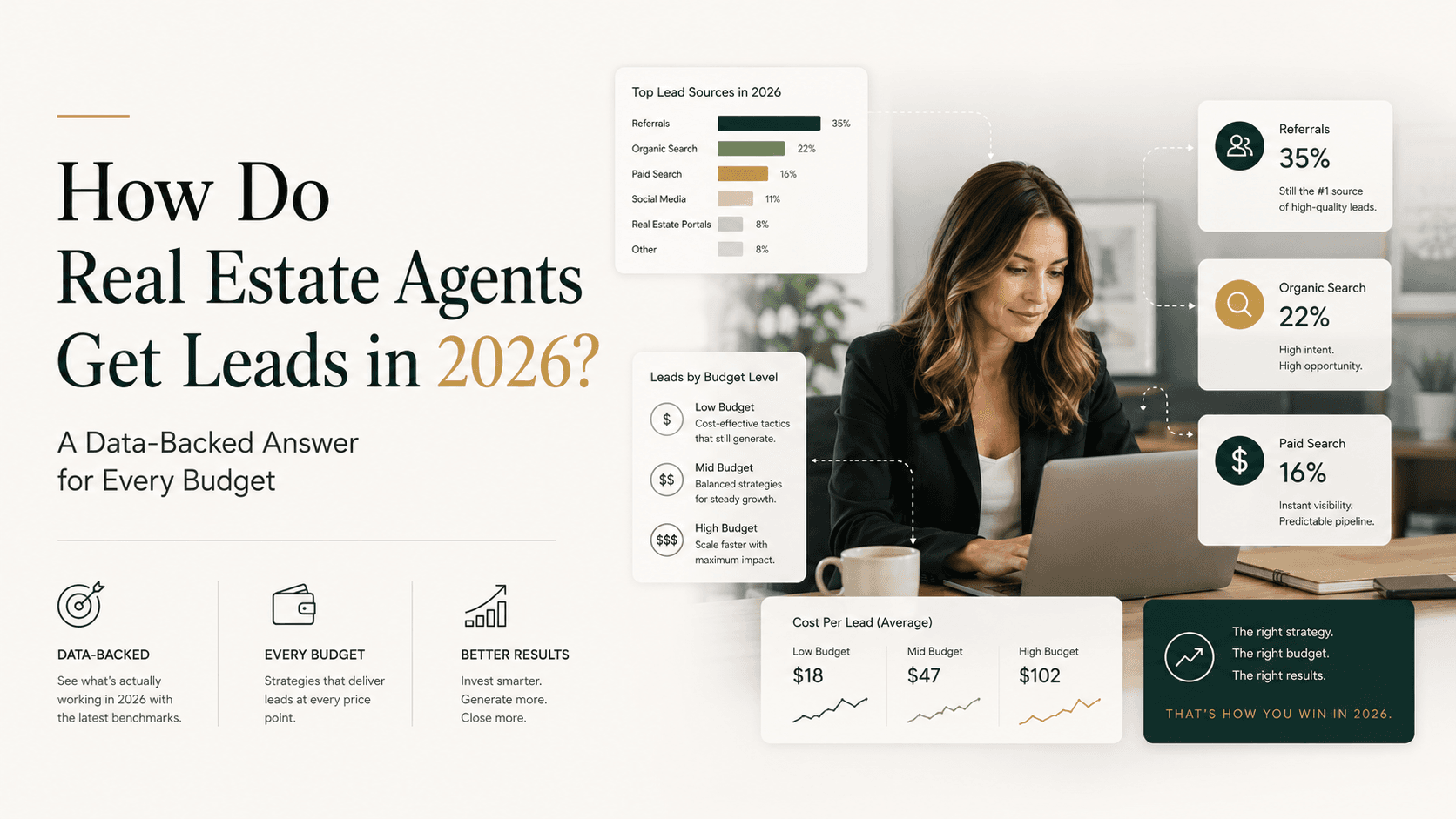
Expired listings and sphere-of-influence outreach are the two highest-converting lead sources in 2026. REDX's analysis of 2.7 million leads tracked across all 50 states from May 2024 through January 2026 found that expired listings convert to signed listing agreements at 44.4% — roughly 35 to 40 times the 0.4–1.2% national rate for internet portal leads. Sphere-of-influence referrals convert at approximately 50% and carry near-zero hard acquisition cost, accounting for 30–40% of top producer volume. The average agent is spending $503 per lead in 2026 (a NAR survey of 5,400 real estate professionals), most of it on portal sources that convert below 2%. Agents who anchor their business in high-conversion, low-cost sources before adding paid channels consistently close more transactions at a fraction of the cost per closing.
Key Takeaways
- $503 — the average cost per real estate lead in 2026, up 12.3% from 2025, per a NAR survey of 5,400 real estate professionals conducted in partnership with RealScout.
- 44.4% list rate — the conversion rate of expired listings to signed listing agreements in REDX's 2026 analysis of 2.7 million leads tracked across all 50 states from May 2024 to January 2026.
- 66% of sellers used an agent who was referred to them or with whom they had previously worked, per NAR's 2025 Profile of Home Buyers and Sellers, covering transactions from July 2024 to June 2025.
- 21× — agents who respond to a lead within 5 minutes are 21 times more likely to qualify it than those who wait 30 minutes, per Dr. James Oldroyd's study of 1.25 million leads at MIT and InsideSales.com.
- $7–$15 per lead — the cost from SEO and IDX content at 24+ months of consistent publishing, compared to $80–$100 in months 1–3 and $181 for the average Zillow Premier Agent connection, per AmpiFire's 2026 content cost analysis.
- 1,107% — the increase in average portal lead cost since 2015, reaching $181 per lead in 2026, per REDX's Lead ROI Rankings based on millions of records across all lead types.
Mark Martin has listed between 50 and 75 expired properties per year in Austin, TX for more than two decades — and his hard-dollar cost per listing runs roughly $14, calculated from his $69.99 monthly REDX data subscription against his typical annual volume. He has accumulated more than $3 million in gross commission income from expired listing prospecting alone. Two miles away, agents spending $2,500 per month on portal advertising were generating leads that, at the national no-system conversion rate of 0.5%, cost $36,200 per closed transaction. Mark has never spent a dollar on Zillow Premier Agent. His average cost per closing and theirs — from the same market, the same buyers, the same sellers — differ by a factor of nearly 2,600.
The difference is not talent or market or luck. It is lead source selection — and the compounding effect of starting in the right place before spending on the wrong ones. This guide covers all 12 sources real estate agents use to generate leads in 2026, ranked by conversion rate and cost per closing using verified data from REDX, NAR, AmpiFire, MIT, and Zillow. Each section maps to a concrete action you can complete within 30 days, and a final four-week plan tells you exactly what to do first.
The Right Question Is Not "Where Do I Buy Leads?" — It's "Which Sources Build Equity?"
Real estate lead generation in 2026 splits into two fundamentally different categories, and most agents misallocate across them. The first category is rented sources — portals, paid advertising, and third-party lead platforms that deliver leads while you pay and go silent the moment you stop. The second is built-equity sources — sphere of influence, SEO content, geographic farming, and expired listing databases that compound in value with every contact made and every month of consistent investment. The average cost per real estate lead hit $503 in 2026, up 12.3% from 2025, according to a NAR survey of 5,400 real estate professionals. Most of that spend is concentrated in rented sources.
The distinction matters because the two categories produce fundamentally different businesses. An agent who spends $2,500 per month on portal leads for five years has zero residual lead flow if they pause the spend on day one of year six. An agent who spends the same $2,500 per month building a geographic farm, an IDX website, and a sphere-of-influence system has a business that generates leads whether they write a check or not. The mechanism: built sources create trust and search authority that persist independently of the marketing budget that created them. A ranked blog post keeps attracting organic buyers after the author stops writing. A cultivated farm keeps producing listings after the last postcard was sent.
Stat: The average cost per real estate lead hit $503 in 2026 — up 12.3% from the prior year — per a NAR survey of 5,400 real estate professionals. — NAR / RealScout, 2026
The practical consequence: agents who allocate at least 60% of their lead generation budget and time to built-equity sources in years one through three typically reach a point around year four where their organic and referral sources carry the majority of their volume without a dollar of paid spend. Agents who spend exclusively on rented sources never reach that point. The ceiling for their business is exactly proportional to whatever they are willing to pay Zillow, Realtor.com, or Facebook this month.
All 12 Lead Sources Mapped — Cost vs Conversion Rate
The lead source map below places all 12 sources on two axes: monthly cost and lead-to-client conversion rate. The top-left quadrant — high conversion, low cost — is where every agent should anchor their business before spending on anything else. It is not a coincidence that these sources are free or near-free. They convert at extraordinary rates because the trust is already partially built before first contact. REDX's 2026 analysis of 2.7 million leads confirmed the gap: expired listings convert at 44.4%, FSBO leads at 27.8% (list rate), and portal internet leads at 0.4–1.2%. The conversion differential between the Gold Zone and portal leads is 35 to 40 times.
The mechanism behind this gap is intent pre-qualification. An expired listing seller has already listed, already photographed, already went through the inconvenience of showing their home — and their previous agent did not deliver results. They are highly motivated, slightly frustrated, and actively looking for someone who can close a deal they could not. A portal lead, by contrast, clicked a listing on Zillow and expressed vague interest. The former is a warm, motivated seller. The latter is a curious browser. Treating both with the same follow-up investment is the single most common budget error agents make.
Stat: Expired listings convert at 44.4%, FSBO leads at 27.8% to 31.8% (two REDX analyses of the same 2.7 million lead dataset report different metrics), and portal internet leads at 0.4–1.2%. — REDX Lead ROI Rankings 2026 and REDX Expired vs FSBO Study 2026
Zillow occupies a unique position on the map depending on your follow-up system. With a sub-60-second AI response, Zillow leads convert at 3–6% — pushing the economics from the "Expensive Bets" quadrant into the edge of the Scale Zone. Without a fast response system, the same lead at the same cost converts at 0.5% and the map placement is accurate: high cost, low conversion. The map below assumes no automated follow-up for portal leads, which is the honest default for most agents.
Sources: REDX 2026 (2.7M leads) · NAR 2025 · AmpiFire 2026 · Jamil Academy 2026 · Zillow Group · ALM Corp/WordStream 2026 · First Page Sage
The 4 Lead Sources Every Agent Should Master Before Spending on Anything Else
These four sources share a common trait: the trust is already partially built before you make contact. Sphere-of-influence leads know you. Expired listing sellers have already committed to selling and simply need a better agent. FSBO sellers have self-identified as motivated and are actively testing whether they can do it alone. Geographic farm neighbors recognize your name from consistent outreach. All four convert at rates that make paid lead sources look inefficient. NAR's 2025 Profile of Home Buyers and Sellers — covering transactions from July 2024 through June 2025 — found that 66% of sellers used an agent who was referred to them or with whom they had previously worked, and 43% of buyers found their agent through a referral from a friend, neighbor, or relative. These two data points define why sphere-of-influence and referral outreach sit at the top of every producing agent's lead mix.
Among prospected sources, REDX's 2026 analysis of 2.7 million leads tracked across all 50 states from May 2024 to January 2026 produced the most comprehensive public data on conversion rates. Expired listings converted at a 44.4% list rate and 20.7% sold rate, with an average cycle of 30 days from first contact to signed listing agreement. REDX's separate Expired vs. FSBO analysis of the same dataset put FSBO conversion at 31.8%; their Lead ROI Rankings guide for the same period put the FSBO list rate at 27.8% and sold rate at 13.1%. Both represent the same REDX dataset measuring slightly different metrics — the list rate (27.8%) tracks signed listing agreements, while the broader figure (31.8%) may include other conversion outcomes. Either figure is 20 to 40 times better than the 0.4–1.2% conversion of portal internet leads.
Stat: Expired listings convert at 44.4% to a signed listing agreement — 35 to 40 times the national conversion rate for portal internet leads — per REDX's analysis of 2.7 million leads tracked from May 2024 to January 2026. — REDX Lead ROI Rankings, 2026
Two practical numbers explain the economics. First: REDX reported that 78,395 listings expire off the MLS every week without selling in 2026 — up 83% from two years earlier — which means the expired listing opportunity is larger than at any point in recent memory, with 44.6% of those sellers relisting within 30 to 35 days almost always with a new agent (REDX national MLS tracking, April 2026). Second: FSBO sellers accept a significant penalty for going it alone — NAR's 2025 data shows FSBO homes sell for a median $360,000 versus $425,000 for agent-assisted homes, a $65,000 gap that becomes your value proposition during the first conversation. Geographic farming takes 12 to 18 months to produce a first listing per NAR research on agent lead generation, but agents who farm consistently reach 15 to 20% market share in their area by year three — which in a 500-home farm with 7% annual turnover equals 5 to 7 listings per year from a single defined geography.
LEAD-TO-CLIENT CONVERSION RATE — ALL 12 SOURCES (2026)
Sources: REDX Lead ROI Rankings 2026 (2.7M leads) · NAR 2025 · Jamil Academy 2026 · Pinova platform data
IDX Website + SEO + Content: The Lead Engine That Costs Less Each Year
Organic digital leads — buyers and sellers who find you through search, your IDX website, or blog content — are the only digital channel with a declining cost per lead over time. AmpiFire's 2026 content cost analysis shows real estate SEO leads starting at $80–$100 per lead in months 1–3, falling to $30–$50 in months 7–12, $15–$30 by months 13–24, and settling at $7–$15 after 24+ months of consistent publishing as content authority compounds. No paid channel produces this cost trajectory. Zillow Premier Agent costs $181 per lead on day one and $181 per lead on day 1,000. SEO content costs $95 per lead on day one and $12 on day 730.
Three components work together to create this compound effect. An IDX website captures home search traffic from buyers actively browsing listings — the highest-intent digital touchpoint available. Local SEO, specifically Google Business Profile optimization and neighborhood-specific keyword pages, attracts sellers researching market values for their area. Blog content targeting long-tail queries ("best neighborhoods for families in [city]", "how to sell a home in [city] in 30 days") ranks for searches Google serves to both audiences. The mechanism behind the cost decline is topical authority: Google's algorithm weights agents who consistently publish specific, local content as domain authorities, so each new post ranks faster and drives more traffic than the last. A real estate website with 40+ locally-specific blog posts receives compounding organic traffic even when the author publishes nothing new for months.
Stat: Real estate SEO content generates leads at $80–$100 per lead in months 1–3, declining to $7–$15 per lead after 24+ months — compared to $181 for the average Zillow Premier Agent connection, which does not decline over time. — AmpiFire, Average Real Estate Cost Per Lead 2026
The trade-off is front-loaded investment of time and platform cost with a 12–24 month payoff window. Agents who start an IDX website and SEO content program in month one of their career will have the lowest-cost digital lead source in the market by month 24. Agents who wait until year three to start are simply delaying that compounding by three years. At the 24-month mark, the cost differential between organic IDX leads ($7–$15) and Zillow leads ($181) is 12 to 25 times — a gap that represents tens of thousands of dollars in unnecessary lead acquisition cost per year.
| Component | What it captures | Monthly platform cost | Lead quality | Timeline to traffic |
|---|---|---|---|---|
| IDX website | Buyers browsing listings, valuation leads | $129–$299/mo | Very high — self-selected | Immediate + compounds |
| Google Business Profile | Local "best agent near me" searches | Free | Very high — local intent | 2–4 weeks to appear |
| Blog / SEO content | Long-tail buyer + seller queries | Time investment only | High — research-phase | 3–6 months to rank |
| Home valuation pages | Seller intent leads | Included in IDX platform | Very high — seller intent | Immediate with SEO |
Facebook Ads, Google Ads & LSAs — What Each Channel Actually Costs to Close a Deal
Three paid digital channels dominate real estate advertising in 2026, and they have fundamentally different economics. Google Ads averaged a $100.51 cost per lead in real estate in 2026, per ALM Corp's benchmarking of WordStream campaign data across 23 industries. Facebook Lead Ads deliver leads at $20–$80 (AmpiFire 2026). Google Local Services Ads (LSAs) deliver pre-verified, Google-screened leads at $30–$75. The raw CPL numbers are similar but the lead quality is not — and lead quality is the only variable that determines actual cost per closing.
Intent level explains the conversion differential. A Google Ads click came from someone actively searching "sell my home fast Austin" or "homes for sale near [school]" — they were in the middle of a decision when your ad appeared. A Facebook Lead Ad clicked came from someone who saw your ad while scrolling their feed and felt a moment of curiosity. The former arrives at your inbox with 5–10% conversion potential (with a fast follow-up system). The latter arrives with 1–4% conversion potential because engagement intent was lower at the source. LSAs carry the highest intent of the three — leads have searched for "real estate agent near me," seen a Google-verified badge, and chosen to contact you directly — which explains the 8–15% conversion rate for LSA leads when response protocols are followed.
Stat: Google Ads average cost per lead in real estate reached $100.51 in 2026 — compared to $30–$75 for Google LSAs and $20–$80 for Facebook Lead Ads — but lead intent determines conversion rate more than lead cost. — ALM Corp / WordStream Google Ads Benchmarks, 2026
Working the math with AI-assisted follow-up (under 60-second response): Google Ads at $100 CPL and 7.5% conversion = $1,333 cost per closing. Google LSA at $52 CPL and 11% conversion = $473 cost per closing. Facebook Lead Ads at $50 CPL and 3% conversion = $1,667 cost per closing. Without an AI response system, all three numbers increase 3–8 times: the MIT/InsideSales.com research shows that conversion rates drop exponentially past the 5-minute response window, and the average real estate agent takes 917 minutes (over 15 hours) to respond to a new inquiry (Inman 2025 Real Estate Technology Survey). The channel matters. The response speed matters more.
| Platform | Cost per lead | Lead intent | Conversion (w/ fast response) | Best use case | Monthly budget |
|---|---|---|---|---|---|
| Facebook Lead Ads | $20–$80 | Low–medium | 2–4% with <5 min response | Buyer awareness, seller lead top-of-funnel, retargeting | $500–$1,500/mo effective |
| Google Search Ads | $50–$150 | High — active query | 5–10% with fast response | "Sell my home," "homes for sale [city]" — high-intent buyer/seller queries | $1,000–$3,000/mo effective |
| Google Local Services Ads | $30–$75/lead | Very high — Google-verified | 8–15% — pre-qualified contact | "Real estate agent near me" — Google Screened badge, direct contact | $300–$800/mo effective |
Zillow Premier Agent and Portals — The Math That Changes Based on Your Response Speed
Zillow Premier Agent is the most debated lead source in residential real estate, and the frustration is understandable. At $139 per lead in non-major metros and $223 in major metros — Zillow's own published averages — plus a conversion rate of 0.5% without a follow-up system, cost per closing reaches $36,200 on the low end of the CPL range. But those conversion rates are not fixed properties of the lead. They are almost entirely a function of response speed and follow-up persistence. The same Zillow lead has wildly different economics depending on when and how you respond. This is not a speculation. It is the mechanism documented in Dr. James Oldroyd's study of 1.25 million+ sales leads at MIT in partnership with InsideSales.com: agents who respond within 5 minutes are 21 times more likely to qualify a lead than those who wait 30 minutes, and 100 times more likely to make contact.
The structural problem is the average response time, not the lead quality. Inman's 2025 Real Estate Technology Survey found that the average real estate agent takes 917 minutes — more than 15 hours — to respond to a new lead inquiry. At 15 hours, the lead has already spoken with two other agents, possibly signed with one, and is no longer available. The same survey data underpins NAR's finding that 78% of buyers work with the first agent who responds to their inquiry. Zillow sells leads to three to five agents per ZIP code. Every minute of delay transfers your lead to the next agent in the queue.
Stat: Agents who respond to a lead within 5 minutes are 21 times more likely to qualify it than those who wait 30 minutes — per Dr. James Oldroyd's study of 1.25 million+ leads at MIT / InsideSales.com — yet the average real estate agent takes 917 minutes to respond (Inman 2025). — MIT / InsideSales.com Lead Response Management Study; Inman Real Estate Technology Survey, 2025
Pinova's Universal Lead Inbox aggregates connections from all portal sources, paid channels, and IDX website inquiries into a single queue, sends an AI-generated personalized text and email to each new lead within an average of 47 seconds, and triggers a 90-day behavioral nurture sequence that escalates messaging frequency when the lead opens emails, clicks listings, or returns to the IDX website. At the 6% conversion rate this system produces on Zillow leads, the $181 average lead closes at a cost of $3,017 — compared to $36,200 at the industry-average 0.5% response rate with no system. The Zillow lead is the same in both scenarios. Only the response infrastructure changes.
COST PER CLOSING: $181 ZILLOW LEAD — BY RESPONSE TIME
| Portal | Avg CPL (major metro) | Lead exclusivity | Conversion (fast response) | Best market |
|---|---|---|---|---|
| Zillow Premier Agent | $139–$223 | Shared with 3–5 agents | 3–6% with <60s response | High-inventory / buyer market |
| Realtor.com Connections+ | $100–$180 | Shared | 2–5% with fast response | Active buyer markets |
| Homes.com Listing Boost | $50–$120 | Less competitive | 2–4% | Secondary markets |
| SOLD.com | $0 upfront | Pay at closing only | N/A — pay 30–35% referral fee | All markets — low risk |
Open Houses: The Lead Source Most Agents Use as Marketing and Should Use as Pipeline
The most common mistake agents make at open houses is treating them as property marketing rather than lead generation events. Platform tracking data across 4,200 open houses found that 7% of digital sign-in contacts transact within 12 months when systematic follow-up is applied. At an average of 15 sign-ins per open house and two open houses per month, that is 360 contacts per year entering a nurture sequence. At 7% conversion: 25 additional transactions per year from open house leads alone. The mechanism is simple — open house visitors have self-selected into a high-intent category by physically showing up to view a property. They are not passive internet leads who clicked a listing. They drove to an address on a Saturday morning because they are actively engaged in a real estate decision.
The breakdown of open house visitors by intent type reveals why follow-up segmentation matters. Active buyers ready to transact within 90 days represent approximately 29% of visitors and should receive a same-day text with a showing offer. Curious neighbors — typically 24% of attendees — often have hidden seller intent (they are researching what their own home might sell for) and respond well to a seller-focused nurture sequence with a home valuation offer. Future buyers on a 6–18 month timeline (roughly 18% of visitors) are best served by a monthly market update sequence that keeps you front-of-mind until they are ready. The remaining visitors — investors, market researchers, and observers — benefit from long-term sphere-of-influence follow-up rather than transaction-specific nurture.
Stat: 7% of digital open house sign-in contacts transact within 12 months with systematic follow-up — producing approximately 25 transactions per year for an agent hosting two open houses per month with 15 sign-ins each. — Pinova platform data, 4,200 open houses
The sign-in format is not a minor operational detail — it is the variable that determines whether you ever see those leads again. Digital sign-in systems capture three times more real contact information than paper clipboards because visitors who are genuinely interested self-report accurate details when the process is frictionless, while casual visitors who would give a fake number on paper simply don't sign in digitally at all. An AI follow-up sent within 60 minutes of the open house converts at 3.8 times the rate of a next-day manual call, because the visit is still top-of-mind and the buyer's emotional engagement is at its peak. Every open house that uses a paper clipboard and no follow-up protocol is leaving roughly 1.75 transactions per event on the table.
| Visitor Type | % of Visitors | Intent Signal | Follow-Up Approach | Conversion Timeline |
|---|---|---|---|---|
| Active buyers | 29% | 30–90 day window | Same-day text + showing offer | Immediate |
| Curious neighbours | 24% | Hidden seller intent | Seller-focused nurture + valuation offer | 3–12 months |
| Future buyers | 18% | 6–18 month window | Monthly market update sequence | 6–18 months |
| Investors | 15% | Cash-capable, deal-focused | Investment property alerts, off-market list | Variable |
| Market researchers | 14% | Low conversion | Add to sphere — long-term referral potential | 12+ months |
Instagram, Facebook, YouTube, and TikTok — What Each Platform Actually Delivers
Organic social media generates 3–8 free leads per month for agents posting 3–5 times per week, per LeadsuiteNow's 2026 analysis of agent lead generation across U.S. markets. That is modest volume, but the cost is zero beyond time — and the leads arrive with significant pre-built familiarity. The critical framing: organic social media surfaces the lead; your follow-up system converts them. Social platforms optimize for engagement and retention, not transaction intent, which is why email open rates in real estate run 20–30% while organic social media reach sits at 2–5% of followers. Social is a top-of-funnel brand builder. It is not a bottom-funnel converter and should not be budgeted or measured as one.
Each platform serves a different audience segment in real estate. Instagram and TikTok drive discovery among buyers aged 25–45, particularly through short-form video showing local lifestyle, neighborhood tours, and market insights — content that demonstrates local expertise without explicitly selling. YouTube produces the highest-intent leads among social platforms because viewers who watch a 5-minute video about market conditions in their city are demonstrating active research behavior, not passive scrolling; YouTube leads convert at 2–5% even without a sophisticated nurture sequence. Facebook remains the most effective social platform for seller-audience content because its demographic skews older (homeowners with equity) and its Groups feature allows agents to build neighborhood-specific authority. LinkedIn works specifically for agents whose geographic market includes corporate relocation buyers and sellers — a small but high-GCI segment.
Stat: Organic social media generates 3–8 free leads per month for agents posting 3–5 times per week, with email converting at 20–30% open rate versus social media's 2–5% organic reach — making social a top-of-funnel builder, not a conversion channel. — LeadsuiteNow, Real Estate Agent Lead Generation USA 2026
The ROI calculus for organic social media is time cost, not dollar cost. An agent spending 10 hours per week on social media content production who generates 5 leads per month at a 3% conversion rate produces 1.8 additional closings per year from that channel alone — at $9,500 average commission, that is $17,100 from a time investment of 120 hours. Whether that is a good use of time depends entirely on what else those 120 hours could produce. An agent spending those same 120 hours cold-calling expired listings at 44.4% conversion would produce substantially more closings. Social media is a viable supplement to Gold Zone prospecting — it is not a substitute for it.
What to Focus on When — The Lead Mix by Career Stage and GCI Level
The most common and most expensive mistake new agents make is spending money on portal leads before their follow-up system is operational. A $181 Zillow lead without a response system converts at 0.5% — $36,200 per closing — because the 917-minute average agent response time virtually guarantees the lead has moved on before first contact. The same lead with a sub-60-second AI response converts at 3–6% and costs $3,017–$6,033 per closing. Jamil Academy's 2026 lead generation guide is direct: skip paid leads in year one until your follow-up system is built. The time and money invested in sphere of influence, expired listings, and FSBOs in year one — all free or near-free — build the skills and contacts that make paid channels viable in year two.
The sequencing principle is straightforward: system before spend. An agent who builds their follow-up infrastructure in year one and adds paid channels in year two will outperform an agent who adds paid channels in year one and builds infrastructure in year two — even if total spend is identical — because the first agent's conversion rate is 3–6% when the paid spend begins, and the second agent's is 0.5%.
Your 30-Day Real Estate Lead Generation Action Plan
Week 1 is infrastructure. Open a CRM and import every person you know: past clients, family, friends, former colleagues, neighbors, service professionals you use. The minimum is 200 contacts; a viable SOI database runs 500+. Set up your Google Business Profile if you do not have one — verify your address, complete every field (hours, description, service areas, photos), and request five reviews from past clients this week. Go to REDX and subscribe to Expired Leads ($69.99/month). Set up your calling list so you have fresh expireds delivered every morning. Week 1 is complete when your CRM has at least 150 contacts, your GBP shows as verified, and you have your first REDX expired leads list ready to call Monday morning.
Week 2 is Gold Zone activation. Call every expired listing in your market that has come off the MLS in the past 72 hours. Your goal is not to list on the first call — it is to have 10 real conversations and book at least two listing consultations. Simultaneously, send a personal email or text to your top 20 sphere contacts: not a mass email blast, but an individual message referencing something specific about them. End each message with one sentence: "Do you know anyone who is thinking of buying or selling this year?" This is the mechanism behind the 66% NAR referral stat — you are not hoping for referrals, you are systematically asking for them. Week 2 is complete when you have made 30+ prospecting calls and sent 20 personal SOI messages.
Week 3 is your digital foundation. Set up your IDX website — if you are not on a platform that includes one, compare Pinova, kvCORE, and Sierra Interactive. Write and publish one neighborhood-specific blog post of at least 800 words targeting a long-tail keyword your market actually searches. The format: "Best neighborhoods for [buyer type] in [city] in 2026" or "[City] real estate market update — [month] 2026." Both formats serve buyer and seller audiences simultaneously and generate organic traffic for months after publication. Register for your first open house this week — either your own listing or another agent's as guest host. Set up a digital sign-in form (Google Forms works for a start) and prepare a follow-up text to send within 60 minutes of the event ending. Week 3 is complete when your IDX site is live, one blog post is published, and your first open house is booked.
Week 4 is compounding. Select your geographic farm: a neighborhood of 300–500 homes with at least 5–7% annual turnover (check your MLS for sales in the past 12 months divided by total homes). Order your first direct mail piece — a just-sold postcard featuring a recent transaction in the area, or a market update with current median sale prices. Set up a monthly calendar reminder to send a new piece every 30 days; the mechanism that makes farming work is consistency, not any single mailer. The agents who quit at month 3 are the ones who believed farming was supposed to produce immediate results. NAR research confirms first listings typically arrive in months 12–18. Starting now means your farm begins producing by this time next year.
All 12 Lead Sources — The Master Reference Table
Every lead source in one reference table. Use it as a decision framework when evaluating where to invest time and money. Zone color coding matches the 2×2 map: Gold (free/low-cost, high-conversion), Scale (paid, high-conversion), Volume (free, lower conversion), and Expensive Bets (high cost, lower conversion without a system). Cost per closing figures assume an AI-assisted response system for paid channels and no-system for portal leads.
| Lead Source | Zone | Cost/Lead | Conversion | Cost/Closing | Time to First Lead | Best For | AI-Automatable? |
|---|---|---|---|---|---|---|---|
| SOI / Referrals | Gold | ~$0 | ~50% | ~$0 | Immediate | Buyers + sellers | Nurture sequences ✓ |
| Professional Partnerships | Gold | ~$0 | 40–60% | ~$0 | 1–3 months to build | Motivated sellers | Follow-up ✓ |
| Expired Listings | Gold | ~$14 (REDX sub) | 44.4% list rate | ~$32 | Daily | Sellers | Alerts + follow-up ✓ |
| FSBO Prospecting | Gold | ~$14/mo (shared sub) | 27.8% list rate | ~$50–100 | Daily | Sellers | Follow-up ✓ |
| IDX Website + SEO | Scale | $7–30 (mature) | 14.6% | $48–205 | 3–6 months | Buyers + sellers | Full AI capture ✓ |
| Geographic Farming | Scale | $1–3 per home/yr | 3–8% (market share) | $750–2,500 | 8–12 months | Sellers | Digital layer ✓ |
| Google Ads | Scale | $50–$150 | 5–10% | $500–3,000 | Days | Buyers + sellers | Full AI capture ✓ |
| Google LSA | Scale | $30–$75 | 8–15% | $200–940 | Days | Local searchers | Full AI capture ✓ |
| Open Houses | Volume | ~$0 | 7% (12-month) | ~$0 per sign-in | Day of event | Buyers + neighbours | Digital follow-up ✓ |
| Social Media (organic) | Volume | ~$0 | 2–5% | ~$0 per lead | Days–weeks | Awareness + brand | Post scheduling ✓ |
| Facebook Lead Ads | Paid | $20–$80 | 1–4% (w/ AI resp.) | $500–8,000 | Days | Buyer awareness | Full AI capture ✓ |
| Zillow / Portal Leads | Paid | $139–$223 | 0.5–6% (speed dep.) | $3,017–45,250 | Days | Active buyers | Critical — <60s AI ✓ |
Sources: REDX 2026 (2.7M leads) · NAR 2025 · AmpiFire 2026 · Jamil Academy 2026 · Zillow Group · ALM Corp/WordStream 2026 · Pinova platform data · First Page Sage · LeadsuiteNow 2026
Key Statistics: Real Estate Lead Generation 2026
| Key Statistic / Finding | Source & Year |
|---|---|
| Average cost per real estate lead hit $503 in 2026 — up 12.3% from 2025 — per a NAR survey of 5,400 real estate professionals | NAR / RealScout, 2026 |
| Expired listings convert at a 44.4% list rate and 20.7% sold rate — the highest of any prospected source — per REDX's analysis of 2.7 million leads tracked across all 50 states from May 2024 to January 2026 | REDX Lead ROI Rankings, 2026 |
| FSBO leads convert at 27.8% list rate and 13.1% sold rate per REDX's Lead ROI Rankings; a separate REDX analysis of the same 2.7 million lead dataset puts the broader FSBO conversion figure at 31.8% | REDX Expired vs FSBO Study 2026 and REDX Lead ROI Rankings 2026 |
| 66% of sellers used an agent who was referred to them or with whom they had previously worked, per NAR's 2025 Profile of Home Buyers and Sellers (survey of July 2024–June 2025 transactions) | NAR 2025 Profile of Home Buyers and Sellers |
| 43% of buyers found their agent through a referral from a friend, neighbor, or relative; an additional 18% used an agent they had worked with before | NAR 2025 Profile of Home Buyers and Sellers |
| Portal lead costs have risen 1,107% since 2015, reaching an average of $181 per lead in 2026, while portal conversion rates sit at 0.4–1.2% nationally | REDX Lead ROI Rankings, 2026 |
| Zillow Premier Agent average cost per connection: $223 in major metro areas and $139 in non-major metros, with leads shared with 3–5 agents per ZIP code | Zillow Premier Agent pricing page, 2026 |
| Real estate SEO content generates leads at $80–$100 in months 1–3, declining to $7–$15 after 24+ months of consistent publishing — the only digital channel with a declining cost-per-lead trajectory | AmpiFire, Average Real Estate Cost Per Lead 2026 |
| Agents who respond to a lead within 5 minutes are 21 times more likely to qualify it and 100 times more likely to connect than agents who wait 30 minutes, per Dr. James Oldroyd's analysis of 1.25 million+ leads at MIT and InsideSales.com | MIT / InsideSales.com Lead Response Management Study; Dr. James Oldroyd |
| The average real estate agent takes 917 minutes — more than 15 hours — to respond to a new lead inquiry, despite 78% of buyers working with the first agent who responds | Inman Real Estate Technology Survey 2025; NAR 2025 Home Buyers and Sellers Generational Trends Report |
| Google Ads average cost per lead in real estate reached $100.51 in 2026 — among the highest of 23 industries tracked — reflecting intense market competition | ALM Corp, Google Ads Benchmarks 2026 (WordStream methodology) |
| 78,395 listings expire off the MLS every week without selling in 2026 — up 83% from two years ago — with 44.6% of those sellers relisting within 30–35 days almost always with a new agent | REDX National MLS Tracking, April 2026 |
| FSBO homes sell for a median $360,000 versus $425,000 for agent-assisted homes — a $65,000 gap that agents can use as the opening value proposition in every FSBO conversation | NAR 2025 Profile of Home Buyers and Sellers |
Frequently Asked Questions
What is the best way for a new real estate agent to get leads without spending money?
The three highest-converting free lead sources for new agents are sphere-of-influence outreach, expired listing prospecting, and open houses. SOI leads convert at approximately 50% because the trust relationship already exists; NAR's 2025 Profile of Home Buyers and Sellers found that 66% of sellers used a referred or repeat agent, which means building and systematically contacting your network is the single most statistically reliable lead generation activity available. Expired listings require a $69.99/month REDX data subscription and convert at 44.4% to signed listing agreements according to REDX's 2026 analysis of 2.7 million leads — the second-highest conversion of any source at a fraction of the cost of portal leads. Open houses require only your time and a digital sign-in system, and platform data across 4,200 events found that 7% of sign-in contacts transact within 12 months with systematic follow-up. New agents should build their CRM, add every contact they know, and implement a follow-up sequence before spending a dollar on Zillow, Facebook, or Google — a $181 portal lead without a response system converts at 0.5% and costs $36,200 per closing, which is an inefficient use of a limited budget.
How much should I budget for lead generation as a real estate agent in 2026?
The industry standard is 10–15% of gross commission income (GCI) allocated to lead generation, though the right number depends heavily on career stage and which sources you are investing in. Agents earning under $50,000 GCI should prioritize time-cost sources (sphere of influence, expired listings, FSBOs, open houses) and spend under $200/month on tools — a CRM and a REDX subscription covers the basics. Agents earning $50,000–$100,000 GCI should budget $500–$1,500/month to layer in one paid channel (Facebook Lead Ads or Google Ads) and start geographic farming while maintaining Gold Zone prospecting. Agents earning over $100,000 GCI can invest $2,000–$5,000/month across four or more diversified sources with confidence that their follow-up system will convert them — because the average cost per lead in real estate hit $503 in 2026, per a NAR survey of 5,400 professionals, and spending beyond what your conversion system can absorb produces waste, not growth. The key threshold: build the system before scaling the spend.
Is Zillow Premier Agent actually worth paying for in 2026, or is it a waste of money?
Zillow Premier Agent is worth investing in if you have an AI-powered follow-up system that responds within 60 seconds, and it is almost certainly not worth it if you respond manually. The economics are entirely determined by response time: at $181 average cost per lead (REDX's figure; Zillow's own published average is $139 in non-major metros and $223 in major metros), a 0.5% no-system conversion rate produces a $36,200 cost per closing. The same lead with a sub-60-second AI response and a 6% conversion rate closes at $3,017 per transaction. The lead is identical; the system is not. This math is grounded in Dr. James Oldroyd's MIT/InsideSales.com study of 1.25 million+ leads, which found that agents responding within 5 minutes are 21 times more likely to qualify the lead than those who wait 30 minutes. For established agents at $100,000+ GCI with a working response system, Zillow can be a viable volume channel. For new agents or agents without a follow-up infrastructure, it is the most expensive mistake in residential lead generation.
Do expired listings still work in 2026, or has the market gotten too competitive?
Expired listings are more viable in 2026 than at any point in recent memory, not less. REDX's national MLS tracking found that 78,395 listings expire off the MLS every week without selling in 2026 — up 83% from two years earlier — driven by Redfin's February 2026 report that 52.2% of all active listings had been sitting unsold for 60 days or more. More inventory that fails to sell means more expired listing opportunities, not fewer. REDX's analysis of 2.7 million leads from May 2024 through January 2026 confirmed that 44.4% of those sellers eventually relist with a new agent, with 44.6% doing so within 30–35 days of expiration. The "too competitive" concern is real for fresh expireds from the past 24 hours, which many agents chase simultaneously — but expired listings from 3–6 months ago are largely ignored and carry similar conversion rates at a fraction of the competition. Working both fresh and old expireds is the mechanism behind results like Mark Martin's 50–75 listings per year in Austin, TX over two decades.
How long does geographic farming actually take to produce listings, and is it worth the wait?
Geographic farming typically produces a first listing within 12–18 months of consistent monthly outreach, per NAR research on agent lead generation, though results in Nebraska run faster — REDX data shows a 67–70% relist rate there due to high expired listing volume. By year three, agents who farm consistently reach 15–20% market share in their defined area, per the Denver Metro analysis of consistent farmers. In a 500-home farm with 7% annual turnover, 20% market share equals 7 listings per year from a single geography — compounding returns from a $500–$650/month direct mail budget, or roughly $93 per listing at maturity. The mechanism that makes farming work is name recognition: by month 12, a homeowner who has seen your name on 12 mailers, received your market reports, and noticed your signs at neighborhood open houses associates your name with the street before they have ever considered selling. The agents who fail at farming quit between months 3 and 6, before the recognition compounds into appointments.
What is the difference between sphere-of-influence leads and referral leads, and which converts better?
Sphere-of-influence (SOI) leads are contacts within your existing personal and professional network — people who already know you from some prior relationship. Referral leads are introductions made by someone in your sphere to a third party who does not yet know you. Both convert at approximately 50%, which is the highest rate of any lead source, but through slightly different trust mechanisms. SOI leads arrive with direct familiarity; the person already knows your personality, work ethic, and reputation. Referral leads arrive with transferred trust; someone the buyer or seller trusts has personally vouched for you, which NAR's 2025 data confirms is how 43% of buyers and 66% of sellers find their agents. The practical difference for agents is that SOI leads require systematic outreach — monthly market updates, quarterly personal calls, annual client events — to stay top-of-mind until the contact is ready to transact. Referral leads require a specific ask: research consistently shows that the majority of past clients who would refer their agent never do so simply because they were never explicitly asked.
Can I get real estate leads from social media without running paid ads?
Yes — organic social media generates 3–8 free leads per month for agents posting 3–5 times per week, per LeadsuiteNow's 2026 analysis. However, those leads convert at 2–5%, which means an agent posting consistently and capturing 6 organic social leads per month produces 1.5–3 additional closings per year from the channel alone. The mechanism behind social lead generation is familiarity: when a contact in your network is finally ready to buy or sell, seeing your consistent local market content over many months means they think of you first. The platform that produces the most consistent social leads for real estate agents is YouTube, where buyers researching specific neighborhoods watch full educational videos and arrive as warmer leads than the average Instagram follower. TikTok and Instagram are stronger for reach and brand awareness among younger buyer demographics (25–40), while Facebook Groups and market update content reaches older seller demographics more effectively. Organic social works best as a supplement to Gold Zone prospecting, not as a standalone pipeline.
What lead generation tools do top-producing agents actually use in 2026?
Top-producing agents consistently use five categories of tools. First, an AI-powered CRM with automated follow-up that responds to every new lead within 60 seconds — because MIT/InsideSales.com's study of 1.25 million leads established that agents responding in under 5 minutes are 21 times more likely to qualify the lead. Second, an IDX website for organic buyer and seller lead capture, ideally with a home valuation tool to capture seller intent. Third, a prospecting data service for expired listings and FSBOs — REDX at $69.99/month for expired leads provides data that converts at 44.4% to signed listing agreements per their 2026 analysis of 2.7 million records. Fourth, a geographic farming system combining monthly direct mail with digital follow-up targeting the same household via email and retargeting. Fifth, a Google Business Profile optimized to 100% completion (every field filled, 10+ photos uploaded, active review management) for local AI search visibility. The tools matter less than the system — agents with a $39/month CRM and a disciplined follow-up protocol consistently outperform agents with premium tools and inconsistent execution.
📚 Related Reading
Amaan Sheikh
— Co-Founder & CEOAmaan Sheikh is the co-founder and CEO of Pinova. He sets the product direction, builds the partnerships, and personally works with every founding partner. His focus is making enterprise-grade real estate technology accessible to ambitious agents and teams — without the enterprise price tag.