How Kevin Saved $2,000 a Year by Replacing Three Tools With One


Quick Answer
How much money can a real estate agent save by consolidating their CRM, website, and email tools into one platform?
A solo agent running a separate CRM ($69–$149/month), IDX website ($100–$150/month), and email marketing tool ($30–$80/month) typically spends $200–$380/month on tools that don't share data. Consolidating those three into a single integrated platform — typically priced at $99–$399/month — saves most agents $1,200–$2,400 per year while eliminating the manual re-entry and sync errors that come from stitching separate tools together. The financial saving is real, but agents consistently report the bigger gain is time: fewer logins, no broken integrations, and lead data that flows automatically from website visit through follow-up sequence without manual intervention.
Key Takeaways
- The largest share of agents — 34% — spend between $50 and $250 per month on technology tools, but 24% spend over $500 per month, per NAR's 2025 Technology Survey. Many of those high spenders are paying for overlapping tools that duplicate each other's core functions.
- The median Realtor's total annual business expenses were $8,010 in 2024, per NAR's 2025 Member Profile. A fragmented three-tool stack at $350–$520/month burns through $4,200–$6,240 of that budget on software alone — before marketing, licensing, or vehicle costs.
- Knowledge workers lose an average of 44 hours per year to tool-switching fatigue, per Lokalise's 2026 Tool Fatigue Productivity Report — and agents toggling between a CRM, a website dashboard, and an email platform face that same drain on every single lead follow-up cycle.
- A solo agent tech stack built from separate best-of-breed tools typically costs $200–$500/month, per iHomeFinder's 2026 real estate tech stack guide. An integrated platform covering the same functions typically starts at $99–$399/month, with no third-party sync fees.
- Agents who consolidate to a single platform eliminate the most common source of lead drop-off: the gap between a website inquiry and a CRM entry. When those two functions live in separate systems, manual re-entry delays response time — and speed-to-lead is the single biggest driver of conversion.
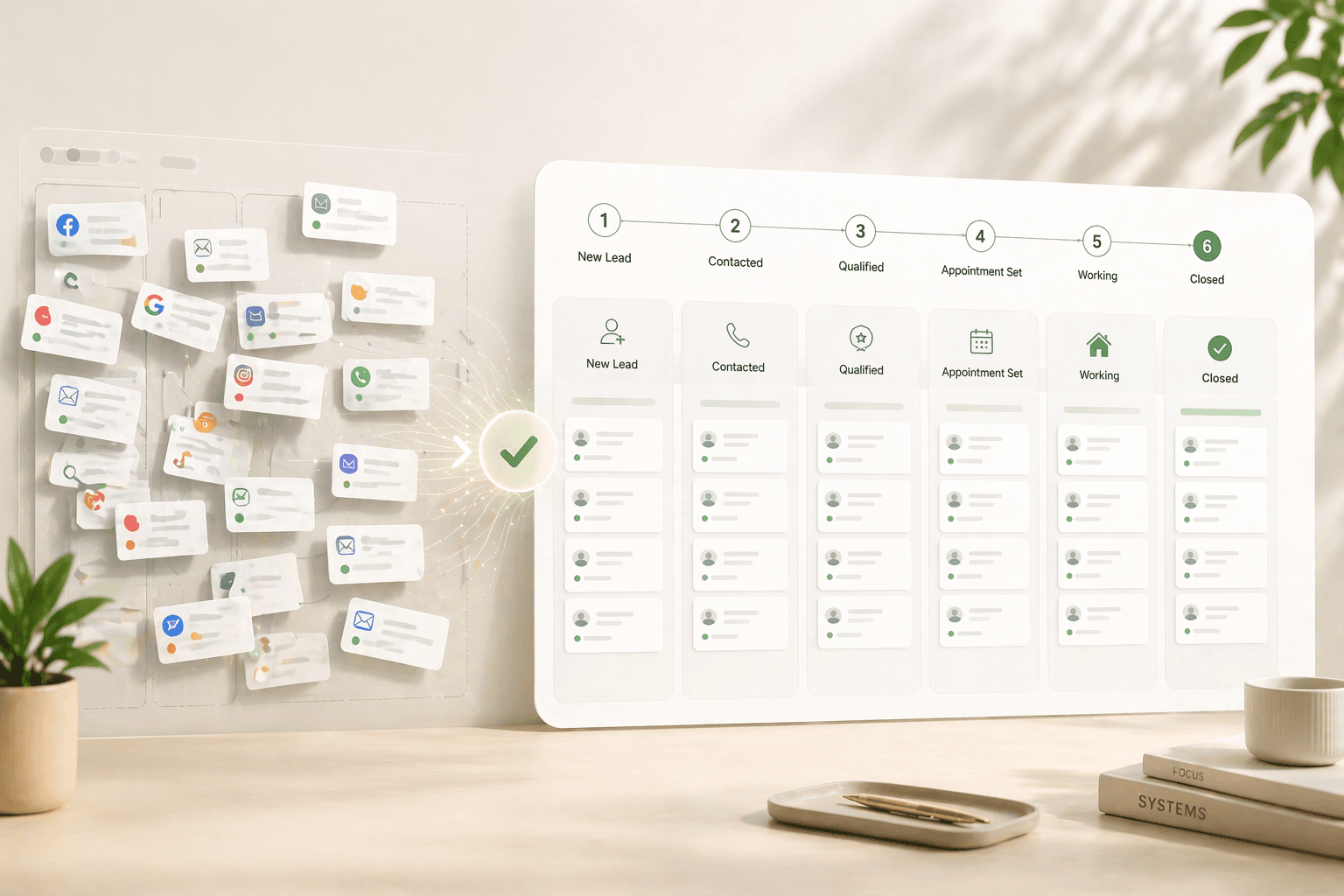
Kevin L., a solo agent in Sacramento, California, was running his business on three separate tools: a CRM at $149/month, an IDX website platform at $250/month, and an email marketing tool at $121/month. That came to $520 every month — $6,240 per year — just to keep the lights on. The CRM and the website didn't share data natively, so every new lead from the IDX search form required manual copy-paste into the CRM before any drip sequence could start. He was spending roughly 40 minutes per day on data re-entry and integration troubleshooting. When Kevin ran his first proper stack audit in late 2025, the math was immediately uncomfortable: 40 minutes a day multiplied across 250 working days is more than 166 hours per year spent bridging the gaps between tools — not selling.
This article breaks down Kevin's audit process step by step so you can replicate it on your own stack. You'll learn how to calculate your true monthly software cost (including hidden sync and add-on fees), identify which tool functions overlap, evaluate whether consolidation saves you money, and run a clean migration without losing contacts or active campaigns. By the end, you'll have a specific number — your annual overspend — and a repeatable process for cutting it.
Kevin's setup before: three tools, three bills
The most expensive real estate tech stack isn't the one with the highest single price tag — it's the one where three tools each do 60% of what you need, with a 20% overlap that nobody notices until you're paying for it twice. Kevin's setup was a textbook version of this problem. His CRM was Follow Up Boss at $149/month per user. His website was a mid-tier IDX platform at $250/month, a figure that included the base hosting fee, IDX data access, and a lead-capture layer. His email marketing tool — a standalone platform for drip sequences — added $121/month. Total: $520/month.
The 2025 NAR Technology Survey, which gathered responses from 1,241 active Realtors, found that 24% of agents spend over $500 per month on technology tools — a category Kevin sat firmly inside. That same survey found 34% of agents spend $50–$250/month, suggesting a wide split in how agents approach their tech budgets. The agents spending $500+ are usually not running an objectively better stack; they're running a more fragmented one. Each tool solved a real problem at the moment of purchase, but nobody audited whether the combined system was worth the combined price.
Stat: 24% of Realtors spend over $500 per month on technology tools for their business, while 34% spend between $50 and $250 per month. — NAR 2025 Technology Survey
Kevin's specific pain point was data fragmentation. When a buyer registered on his IDX website to save a search, that lead's contact information, browsing behavior, and listing preferences sat inside the website platform's proprietary database — not in Follow Up Boss. To get that lead into an active follow-up sequence, Kevin had to manually export a CSV, clean the columns to match Follow Up Boss's import format, upload it, and manually assign a drip campaign. On average, this took 8–12 minutes per lead. At 15–20 new IDX registrations per week during his busy season, that's up to four hours of purely administrative work every week that generated zero commission.
His email platform added another layer of duplication. The IDX platform had a built-in automated email for new listing alerts. Follow Up Boss also sent automated emails on a drip schedule. And the standalone email tool sent a monthly newsletter. Some leads were receiving three separate email touchpoints from three separate senders on the same day — with no visibility across platforms to know it was happening. This isn't a Kevin-specific failure; it's what fragmented stacks produce by default.
The breaking point: audit your own stack
The decision to audit wasn't strategic — it was a billing shock. Kevin's IDX platform increased its monthly rate by $30 in October 2025 with two weeks' notice, bringing his total to $550/month. That increase prompted his first real look at what he was paying across all three tools. The audit process took 45 minutes and produced four pieces of information that changed his decision-making: his true monthly cost, his true annual cost, the number of overlapping features he was paying for twice, and the number of manual hours those overlaps were generating.
To run the same audit on your stack, open your last three months of credit card statements and identify every software charge. List each tool, its monthly cost, and its primary function. Then list every feature each tool offers — not just the ones you use, but all of them. The average solo agent tech stack built from separate tools costs $200–$500/month, per iHomeFinder's 2026 real estate tech stack guide. Once you have your list, mark every function that appears in more than one tool with a red flag. Duplicate functions are the clearest signal of consolidation opportunity.
Kevin's audit turned up seven red flags: contact database (CRM and email platform both maintained separate contact lists), drip email sequences (CRM and email platform both ran them), lead capture forms (IDX site and CRM both had them), automated listing alerts (IDX site and CRM both sent them), reporting dashboards (all three tools had one), mobile app (CRM and IDX site both had standalone apps), and email open tracking (CRM and email platform both tracked it separately). Seven overlapping features across three tools. He was paying for the same functionality twice — or three times — in most of the areas that mattered most to lead conversion.
Stat: Knowledge workers lose an average of 51 minutes per week — over 44 hours per year — to tool-switching fatigue and platform fragmentation. — Lokalise Tool Fatigue Productivity Report, 2026
The time cost is where the audit gets genuinely uncomfortable. A 2026 Lokalise study of 1,000 knowledge workers across 11 industries found the average worker loses 51 minutes per week just to platform-switching fatigue — time spent logging into different tools, re-orienting between interfaces, and manually transferring data that should flow automatically. For real estate agents, the switching cost is front-loaded onto the highest-value activity in the business: responding to new leads. Every minute a new inquiry sits unrouted because the IDX platform and the CRM aren't talking to each other is a minute of response-time advantage surrendering to a competing agent.
The audit framework is a three-column spreadsheet: Column 1 is the tool name and monthly cost. Column 2 is a list of every feature you actually use. Column 3 is whether that feature exists in any other tool in your stack. Any feature appearing in Column 3 for two or more tools is a consolidation candidate. Any tool where Column 2 contains fewer than five unique features not covered elsewhere is a strong candidate for elimination.
The consolidation: what Kevin moved to Pinova
After completing the audit, Kevin evaluated three all-in-one options: Real Geeks at $399/month, Sierra Interactive starting at $499/month, and Pinova at $399/month. The evaluation criteria were straightforward: native IDX integration (no third-party sync required), a built-in CRM that captures and routes IDX registrations automatically, automated email and SMS follow-up sequences, and a single login for everything. Real Geeks and Sierra Interactive both met the feature requirements. The differentiator for Kevin was migration support: he had 847 contacts in Follow Up Boss, 12 active drip sequences, and four years of IDX lead history he didn't want to lose.
Pinova's CRM + IDX platform stores all lead data — contact information, listing search history, saved favorites, open rates, and follow-up history — in a single database. When a buyer registers on an agent's IDX website, the contact is created in the CRM automatically, the lead source is tagged, and a configured follow-up sequence starts without any manual action. This is the specific function that eliminated Kevin's 8–12 minute manual routing process for every new IDX registration.
The financial comparison was direct. Kevin's three-tool stack: $520/month ($6,240/year). Pinova: $399/month ($4,788/year). Annual saving: $1,452. That figure doesn't include the $30/month rate increase that triggered the audit in the first place — which pushes the comparison to $550/month old stack versus $399/month new, a $1,812 annual saving. And it doesn't include the value of the time reclaimed. At a conservative estimate of $50/hour for a solo agent's productive time (a fraction of a typical commission), recovering 166 hours of annual data-entry work is worth over $8,000 in theoretical opportunity cost.
The NAR 2025 Member Profile reports that the median Realtor's total annual business expenses were $8,010 in 2024. A three-tool stack at $520/month consumes $6,240 of that — 78% of the median agent's entire annual expense budget — before vehicle costs, licensing fees, MLS dues, or marketing spend. Consolidating to a single platform at $399/month brings that software line down to $4,788/year, freeing up $1,452 for lead generation, professional development, or simply margin.
The migration process
The fear that stops most agents from consolidating isn't cost — it's the migration. Losing contacts, breaking active campaigns, or going dark on follow-up sequences for even two weeks during a transition can mean real deals falling through. Kevin ran his migration in 11 days across three phases, without losing a single active contact or campaign.
Phase 1 — Export and clean (Days 1–3): Export every contact from your current CRM as a CSV. Open it in a spreadsheet and standardize the columns: first name, last name, phone, email, lead source, lead status, last contact date, and any custom tags. Delete duplicates. Agents who skip this step import the same chaos into the new system. Kevin's 847 contacts cleaned down to 731 unique, actionable records after removing duplicates, test entries, and unsubscribed contacts.
Phase 2 — Rebuild sequences before import (Days 4–7): Before importing any contacts, rebuild your most important drip sequences in the new platform. Kevin had 12 sequences; he rebuilt the seven that had produced at least one contact in the past six months, and archived the other five. Rebuilding sequences before import means no contact sits in a gap between the old sequence ending and the new one starting. This is the single most important step in a zero-loss migration.
Phase 3 — Import and parallel run (Days 8–11): Import the cleaned contact list into the new platform and assign each contact to the appropriate sequence. For the first week, keep both platforms active — do not cancel the old tools yet. Use the overlap period to verify that sequences are firing correctly, that IDX leads are routing automatically, and that email open tracking is working. Kevin found one sequence error during the parallel run: a follow-up timing had defaulted to 0 days instead of 3 days. Catching it in parallel cost nothing. Catching it after cancelling the old tools would have meant a gap in follow-up for 34 active leads.
Cancel the old tools only after you've confirmed the new platform is running cleanly. Kevin cancelled Follow Up Boss and his email marketing tool on day 12, and cancelled his IDX website platform on day 18 (after confirming his new IDX URL was indexed and the old domain was properly redirected). The overlap period cost him two weeks of double-billing — about $130 — which he calculated as a worthwhile insurance premium against a failed migration.
After 90 days: what changed
Ninety days after completing the migration, Kevin tracked four metrics against the same 90-day period in 2025: monthly software spend, time spent on admin per day, new lead response time, and number of active contacts in a follow-up sequence.
Software spend dropped from $520/month to $399/month — a confirmed $121/month saving, on track for $1,452 annually. Admin time dropped from 40 minutes per day to 12 minutes per day. The 28-minute daily saving came almost entirely from eliminating the manual CSV-export-and-import cycle for IDX leads. At 250 working days per year, that's 116 hours returned to revenue-generating activity.
Lead response time — measured from the moment of IDX registration to the first automated follow-up — dropped from an average of 4.7 hours to under 3 minutes. This matters because research from Harvard Business Review found that the average digital worker toggles between applications nearly 1,200 times per day, and each switch carries a cognitive reorientation cost. When Kevin's CRM and IDX platform were separate tools, a new lead notification arriving in the CRM while he was working in the IDX dashboard (or vice versa) routinely got lost in that switching noise. With a single platform, new leads surface in the same interface where he manages everything else.
Stat: The average digital worker toggles between different applications and websites nearly 1,200 times per day, costing roughly four hours of productive time per week. — Harvard Business Review, 2022
The number of contacts in an active follow-up sequence increased from 214 to 389. This was the most surprising result — not because new contacts were added, but because the automated IDX-to-CRM routing was consistently enrolling new registrations into sequences that previously would have sat unrouted for days. Kevin estimated that under his old system, roughly 30–40% of IDX registrations never made it into a CRM sequence at all — not through any deliberate decision, but simply because the manual transfer step got skipped on busy days.
How to run your own consolidation audit
The consolidation audit Kevin ran is a 45-minute process any agent can repeat. Here is the exact sequence, adapted from his notes.
Step 1 — Pull every software charge from the last 90 days. Check your credit card statements and PayPal/bank records for recurring charges you may have forgotten. List every tool and its monthly cost. Include annual subscriptions divided by 12. Include MLS pass-through fees that appear as line items on your IDX platform bill.
Step 2 — List every feature in every tool. Log into each platform and open its feature list or settings menu. Write down every functional capability, not just the ones you use daily. This step typically takes 5–10 minutes per tool.
Step 3 — Identify overlapping functions. Place your feature lists side by side and mark duplicates. Pay particular attention to: contact database, email sequences, lead capture forms, listing alerts, mobile app, and reporting. These six functions appear in almost every agent's fragmented stack and are the most common sources of duplicate spend.
Step 4 — Calculate your overlap cost. For each tool with significant overlap, estimate what percentage of its monthly cost you're paying purely for features you already have elsewhere. If 60% of a $150/month tool's functionality duplicates what your CRM already does, you're spending $90/month for that overlap. Add up the overlap costs across your entire stack.
Step 5 — Model the consolidation math. Look up the monthly cost of one or two integrated platforms that cover all your required functions natively. Calculate: (current monthly spend) minus (integrated platform cost) equals your monthly saving. Multiply by 12 for the annual figure. The median solo agent tech stack costs $200–$500/month according to iHomeFinder's 2026 guide; most integrated platforms that replace a three-tool stack fall in the $99–$399/month range.
Step 6 — Decide based on consolidation saving AND integration quality, not price alone. A cheaper platform that requires manual data transfers between its own modules isn't meaningfully better than three separate tools. The test is: when a new lead registers on your website, does that contact appear in your CRM and enter a follow-up sequence with zero manual action from you? If yes, the integration is real. If no, you've paid for a bundled price but not a bundled workflow.
Kevin's final step — and the one he recommends most strongly — is to run the parallel migration for a minimum of 7 days before cancelling anything. The cost of running both systems for one week is trivial compared to the cost of a lost lead or a broken sequence discovered after you've already cancelled the old tool.
| Key Statistic / Finding | Source & Year |
|---|---|
| 24% of Realtors spend over $500 per month on technology tools for their business; 34% spend between $50 and $250 per month | NAR 2025 Technology Survey — National Association of Realtors, September 2025 |
| Median total annual business expenses for Realtors were $8,010 in 2024, down from $8,450 in 2023 | NAR 2025 Member Profile — National Association of Realtors, August 2025 |
| Median gross income for Realtors rose to $58,100 in 2024; agents with 2 or fewer years of experience earned a median of $8,100 | NAR 2025 Member Profile — National Association of Realtors, August 2025 |
| Solo agent tech stack costs typically range from $200–$500 per month when built from separate CRM, IDX website, and marketing tools | iHomeFinder Real Estate Tech Stack Guide, 2026 |
| Workers lose an average of 51 minutes per week — over 44 hours per year — to tool-switching fatigue; 22% lose 2 or more hours per week | Lokalise Tool Fatigue Productivity Report, 2026 |
| The average digital worker toggles between different applications and websites nearly 1,200 times per day, costing roughly four hours of productive time per week | Harvard Business Review, 2022 |
| Most full-featured real estate CRMs start at $50/month and climb to $300+ per month, with enterprise plans surpassing $1,000 monthly | AgentiveAIQ Real Estate CRM Cost Guide, 2025 |
| IDX website subscriptions for a single real estate agent typically cost $50–$150+ per month before MLS board pass-through fees | Avenue HQ — What Is IDX? A Real Estate Agent's Guide, 2025 |
| 45% of workers say toggling between too many apps makes them less productive; 43% say it is mentally exhausting to constantly switch between tools | Qatalog Tool Fatigue Survey via Conclude.io, updated 2025 |
Frequently Asked Questions
How much does a typical real estate agent spend on software tools per month?
According to NAR's 2025 Technology Survey, 34% of agents spend between $50 and $250 per month on technology tools, while 24% spend over $500 per month. A solo agent running separate tools for CRM, IDX website, and email marketing typically lands in the $200–$520/month range. Agents who consolidate those three functions into a single integrated platform usually reduce that figure to $99–$399/month, depending on the platform and feature tier they choose.
What is the best way to audit your real estate tech stack for waste?
Pull every software charge from your last three months of statements and list each tool with its monthly cost and feature set. Place the feature lists side by side and mark every function that appears in more than one tool — contact database, email sequences, lead capture forms, listing alerts, and reporting are the most common overlaps. Any tool where the majority of features duplicate something you already pay for elsewhere is a strong consolidation candidate. The audit itself takes about 45 minutes and typically reveals $100–$200/month in overlapping spend.
Can you lose contacts or active campaigns when migrating from a CRM to a new platform?
You can avoid losing contacts or campaigns by running a parallel migration: keep both platforms active for 7–14 days after importing your contacts and rebuilding your sequences in the new system. Export your contacts as a clean CSV from the old CRM first, removing duplicates and unsubscribed entries before importing. Rebuild your most important drip sequences in the new platform before you import any contacts, so there is no gap between the old sequence ending and the new one starting. Cancel the old tools only after confirming that new leads are routing automatically and sequences are firing correctly.
What is the difference between an IDX platform and an all-in-one real estate platform?
An IDX-only platform connects your website to your MLS so visitors can search live listings, but contact data, follow-up, and email sequences typically live in a separate CRM. An all-in-one platform integrates the IDX search, lead capture, CRM contact management, and follow-up sequences in a single database. The practical difference is automation: when a buyer registers on an all-in-one platform, the contact is created in the CRM and enrolled in a follow-up sequence automatically, with no manual export or import required. With separate tools, that routing step is almost always manual.
How much time does the average agent waste on manual data entry between disconnected tools?
Agents running separate CRM and IDX platforms typically spend 8–12 minutes per new lead on manual data transfer — exporting from the IDX platform and importing into the CRM. At 15–20 new IDX registrations per week during a busy season, that adds up to 2–4 hours of purely administrative work every week. A 2026 Lokalise study found that workers across industries lose an average of 51 minutes per week to tool-switching fatigue alone, before counting manual data entry. For agents, the combination of switching overhead and manual lead routing can consume 3–5 hours of productive time weekly.
Is it worth paying more for an all-in-one real estate platform versus cheaper separate tools?
The comparison isn't always as clear as the marketing suggests. A lower per-tool price across three separate platforms can look cheaper on paper, but the true cost includes the time spent on manual data transfers, the leads that fall through the gaps during that process, and the cognitive overhead of operating three different interfaces. If a $399/month integrated platform eliminates $120/month in overlapping tool costs and recovers 3 hours per week of admin time, the total value proposition is strongly positive even when the sticker price is higher than the cheapest alternative.
What should real estate agents look for when evaluating an all-in-one CRM and IDX platform?
The single most important test is whether a new lead from your IDX website appears in your CRM and enters a follow-up sequence automatically, with zero manual action. If that workflow requires any manual step, the integration is incomplete regardless of how it's marketed. Beyond that, look for a native IDX feed from your specific MLS (not a third-party widget embedded in an iframe), a mobile app that surfaces new leads and allows one-tap follow-up, and a migration process that includes contact import support and drip sequence rebuilding assistance. Price matters, but the quality of the IDX-to-CRM automation matters more.
Ayushman Singh
— Co-Founder & Chief Brand & Marketing OfficerAyushman Singh is the co-founder and Chief Brand & Marketing Officer of Pinova. He shapes the narrative, builds the brand, and tells the stories the industry doesn't want to hear. He believes the real estate system was designed to extract from agents, not empower them — and he's building the counter-narrative.