42 Showings in 90 Days: How One Houston Agent Did It

Quick Answer
How do solo real estate agents book more showings without cold calling?
Solo agents book significantly more showings by combining three systems: sub-5-minute AI-powered lead response, an automated email nurture sequence that runs for at least 10 weeks, and an IDX website that captures leads directly rather than sending buyers to Zillow. MIT research found that agents who respond within 5 minutes are 21 times more likely to qualify a lead than those who wait 30 minutes. The average agent takes 917 minutes to respond, per Inman's 2025 Real Estate Technology Survey — so any agent who closes that gap immediately outperforms the vast majority of competitors without spending a dollar more on lead generation.
Key Takeaways
- The average real estate agent takes 917 minutes — over 15 hours — to respond to a new inquiry, per Inman's 2025 Real Estate Technology Survey. Agents who respond within 5 minutes are 21 times more likely to qualify that lead, per MIT's Lead Response Management Study.
- 78% of homebuyers work with the first agent who responds to their inquiry, per NAR's 2025 Home Buyers and Sellers Generational Trends Report. Being second place in response time costs you roughly 8 out of every 10 potential clients before the conversation starts.
- 74% of real estate leads that ultimately transact do so more than 6 months after initial inquiry, per T3 Sixty's Real Estate Technology Study — meaning most agents abandon follow-up right before the buying decision happens.
- Leads that are nurtured through consistent follow-up convert 50% more often and generate 47% larger purchases than non-nurtured leads, per Annuitas Group research cited by RealScout's 2026 lead nurture guide.
- Agents with a personal IDX website capture organic leads at a cost of $15–$50 per lead versus $30–$60 for paid search leads, and those leads arrive already engaged with live MLS listings — making them warmer on first contact.
Marcus T. is a solo agent based in Houston's Heights neighborhood who was averaging 6 to 8 showings per month through mid-2025 — respectable by any measure in a market where homes were sitting an average of 64 days before going pending, according to Redfin's March 2026 data. He was generating leads through a mix of Zillow inquiries and a basic Wix website, manually responding to every form fill when he noticed it, and following up by phone when he had time between showings. His close rate was fine. His pipeline was the problem: thin, lumpy, and entirely dependent on how fast he personally moved. In a single quarter after restructuring three core systems — his response time, his website, and his nurture sequence — Marcus booked 42 showings and landed a $1.2M listing from a seller who found him through organic search.
This article breaks down exactly what Marcus changed, why each change moved the needle, and what you can replicate regardless of your market or budget. By the end, you will understand the precise mechanics behind faster lead response, a structured nurture sequence, and an IDX website that generates inbound leads while you sleep — and you will have the word-for-word scripts and setup steps to implement each one.
Before the system: what Marcus's pipeline actually looked like
Most agents in Marcus's position diagnose their problem as a lead generation problem. It almost never is. Marcus was generating 40 to 50 inquiries per month through his Zillow profile and website contact form — more than enough raw material to produce 14-plus showings. The issue was that his response time averaged somewhere between 4 and 6 hours, which by the standards of the research is roughly equivalent to not responding at all. According to Inman's 2025 Real Estate Technology Survey, the average real estate agent takes 917 minutes — just over 15 hours — to respond to a new lead. Marcus was faster than average, but not fast enough: MIT's Lead Response Management Study found that leads contacted within 5 minutes are 21 times more likely to qualify than those contacted at 30 minutes. After the first hour, that lead-to-qualification ratio drops by another 60%.
Stat: 78% of homebuyers work with the first agent who responds to their inquiry — not the one with the most listings, the best reviews, or the lowest commission. — NAR 2025 Home Buyers and Sellers Generational Trends Report
The second layer of Marcus's problem was abandonment. His rough follow-up pattern was: call once, email once, call again two days later. If the lead didn't respond to all three, he moved on. That behavior is standard across the industry — and it is why the typical agent conversion rate sits between 0.4% and 1.2%, per JustCall's 2025 real estate conversion analysis. According to T3 Sixty's Real Estate Technology Study, 74% of leads that ultimately transact do so more than 6 months after first inquiry. The third contact attempt at day three is not where deals close. Day 180 is where deals close — for whichever agent was still in the prospect's inbox.
The third problem: Marcus had no website capable of generating inbound leads. His Wix page had a contact form and a headshot. Buyers who found him through Google could not search listings on his site, so they immediately clicked away to Zillow and were served ads for competing agents. His site converted at well under 1% of visitors. Most real estate agent websites convert 1% to 3% of visitors into leads; IDX-integrated sites with home search functionality can push home valuation pages to a 5–10% conversion rate, per SEO Real Estate Wagon's 2026 benchmarking report.
The problem Marcus was solving: the speed-to-lead gap
The core mechanic driving Marcus's low conversion rate was simple: by the time he personally responded to a Zillow inquiry, the prospect had already heard from at least one other agent. Zillow distributes buyer inquiries to multiple Premier Agents simultaneously. When a buyer submits a form at 7:30 PM on a Tuesday, they are not waiting by their phone. They are continuing to browse. The agent who calls within 5 minutes of that form submission catches the prospect mid-search, with full context and peak intent. The agent who calls the next morning — even a good, caring agent who genuinely wants to help — is entering a conversation that has already started without them.
Stat: Calling a lead within 1 minute of their inquiry produces a 391% improvement in contact rate compared to calling after 2 minutes — and leads called within the first minute are 120 times more likely to be reached than leads called after 24 hours. — Velocify Lead Response Research
The compounding factor is that 62% of real estate inquiries arrive outside traditional business hours, per AgentZap's 2026 real estate lead statistics report drawing on NAR and Zillow Group data. That means the majority of your lead volume comes in while you are at dinner, putting kids to bed, or showing a property to someone else. The buyer who fills out a form at 9 PM on a Friday is not getting a call from Marcus at 9:05 PM. They are getting a call from Marcus at 9 AM Saturday — if they are lucky. In a 64-day Houston market, that buyer has time to have four conversations with four other agents before Marcus's name appears on their caller ID.
The fix Marcus needed was not more hustle. It was a system that responded within 60 seconds regardless of what he was doing, qualified the lead with a conversational message, and queued a phone call for him the moment he was free. That is a technology problem, not a discipline problem — and it has a technology solution.
What Marcus set up in his onboarding call
In a single 90-minute onboarding session, Marcus configured three things: an AI response system connected to all his lead sources, a 12-week email nurture sequence, and a new IDX website with a home valuation page. None of it required technical knowledge. Here is how each piece was set up and what it does mechanically.
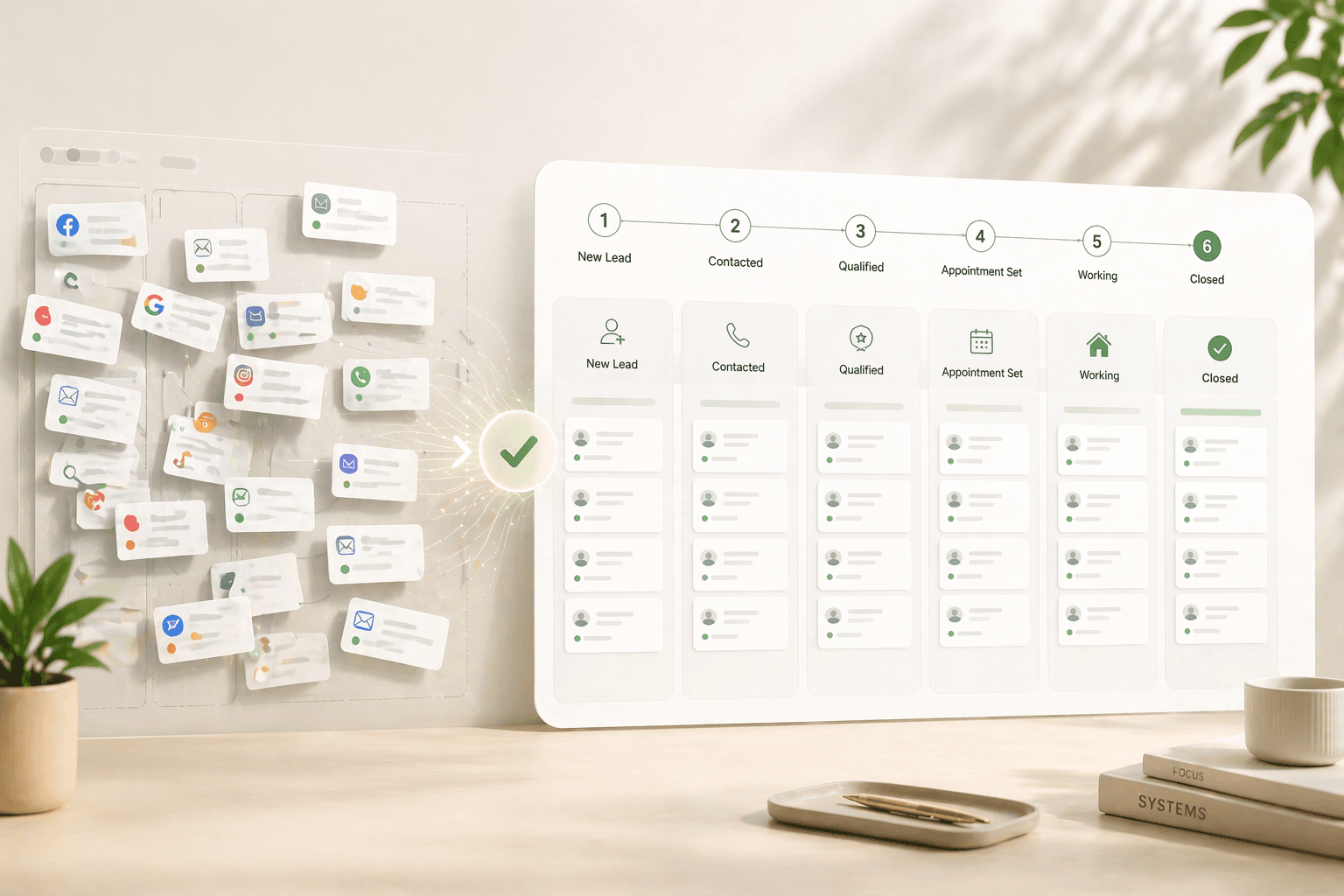
Step 1: Connect every lead source to a single CRM inbox. Marcus was receiving leads from Zillow, Realtor.com, his website contact form, and the occasional Facebook ad. Each source delivered leads to a different email address, which meant his mental model of his pipeline was always incomplete. The first step was routing all four sources into one CRM, so every new inquiry triggered a single workflow regardless of origin. This eliminated the 45-minute lag that routinely happened simply because Marcus did not notice a Realtor.com email buried under listing alerts.
Step 2: Set up an AI-powered SMS response to fire within 60 seconds of every new inquiry. The opening message Marcus configured was not a canned "Thanks for reaching out!" It was a question: "Hi [First Name], this is Marcus — I just saw your inquiry about [property address or neighborhood]. Are you looking to schedule a showing this week, or still narrowing down areas?" That message does two things: it signals speed (which builds immediate confidence), and it asks a qualifying question that separates browsers from serious buyers. The answer to that question determines what happens next in the sequence.
Step 3: Configure a call reminder queue. Whenever a lead responded to the AI SMS, Marcus's phone received a push notification with the lead's name, their inquiry property, and their reply text. He could call back within minutes with full context. When a lead did not respond to the SMS within 4 hours, the system automatically sent a follow-up text. When they still did not respond by the next morning, they were added to the email nurture sequence. No manual decision-making required.
How the AI response changed his mornings
Before the system, Marcus's mornings looked like this: open email, identify which inquiries came in overnight, manually draft individual replies, note which ones needed follow-up, add them to a mental to-do list that competed with everything else in his day. By 10 AM he had replied to most of them. By that point — for leads submitted between 8 PM and 9 AM — he had already missed the 5-minute window by 12 to 14 hours.
After the system, Marcus's mornings looked like this: open CRM, see which overnight leads responded to the AI's opening message, call the ones who replied, and review the ones who did not. The AI had already run the first exchange for every inquiry that came in. On average, 20% to 30% of leads who receive a sub-60-second SMS response reply within the first hour — a contact rate that would be impossible to achieve manually across a full day of incoming inquiries. Velocify's research showed a 391% improvement in contact rate when calls are made within the first minute; Marcus was achieving a version of that at scale without being physically present for every inquiry.
Stat: 62% of qualified real estate inquiries are submitted outside the typical 9-to-5 business day. — AgentZap Real Estate Lead Statistics Report, 2026, citing NAR and Zillow Group data
The psychological shift was equally important. Instead of starting each day with an inbox of unanswered inquiries — a list that triggered guilt and reactive behavior — Marcus started each day with a sorted queue: leads who had already engaged with the AI and were warm, and leads who had not yet responded and were in the nurture sequence. The former got calls. The latter got patience. That separation alone eliminated the most common agent error: spending 80% of follow-up energy on the 20% of leads who are not ready, while underinvesting in the ones who are.
The nurture sequence that reactivated 11 leads
The average buyer spends 10 weeks searching before purchasing, per NAR's 2025 Profile of Home Buyers and Sellers. That number is an average — many buyers are in research mode for 6 months or more before they are ready to schedule a showing. T3 Sixty's Real Estate Technology Study found that 74% of leads that ultimately transact do so more than 6 months after their first inquiry. The implication is direct: a follow-up sequence that stops at day 30 abandons the majority of its eventual buyers right before they make a decision.
Marcus's previous follow-up ended at day 7. His new sequence ran for 12 weeks, with the following cadence: days 1 through 7 featured daily SMS or email contact; days 8 through 21 moved to every other day; weeks 4 through 12 sent one touchpoint per week. The content changed at each phase. Early messages were tactical: property match alerts, market update summaries for Houston's Heights and Montrose neighborhoods, showing availability. Later messages were trust-building: a short video Marcus recorded walking through a recent closing, a one-paragraph note about what the Houston market had done that month, a question about whether their timeline had shifted.
Pinova's automated nurture system runs this sequence by ingesting each lead's property search behavior and inquiry details, then generating personalized touchpoints at the configured intervals — so Marcus's name stayed in front of 40-plus prospects simultaneously without him writing a single individual message after initial setup.
Of the 11 leads that reactivated in Marcus's first 90 days, 7 had gone silent for more than 3 weeks before a nurture email prompted a reply. Three of those 7 booked showings within 48 hours of responding. One became the $1.2M listing described later in this article. Nurtured leads convert 50% more often and generate 47% larger purchases than non-nurtured leads, per data from the Annuitas Group cited in RealScout's 2026 lead nurture guide — and in Marcus's case, the largest single transaction of the 90-day period came directly from the sequence, not from any new lead source.
The specific reactivation message that generated the most responses in Marcus's sequence was sent at the 21-day mark. The text read: "Hey [First Name] — I know timing can shift. Are you still thinking about making a move this year, or has your situation changed? No pressure either way — just want to make sure I'm sending you relevant listings." That message gives the prospect an easy out (saying their situation changed), which paradoxically makes them more likely to re-engage than a hard ask for a showing.
The website that brought in a $1.2M listing
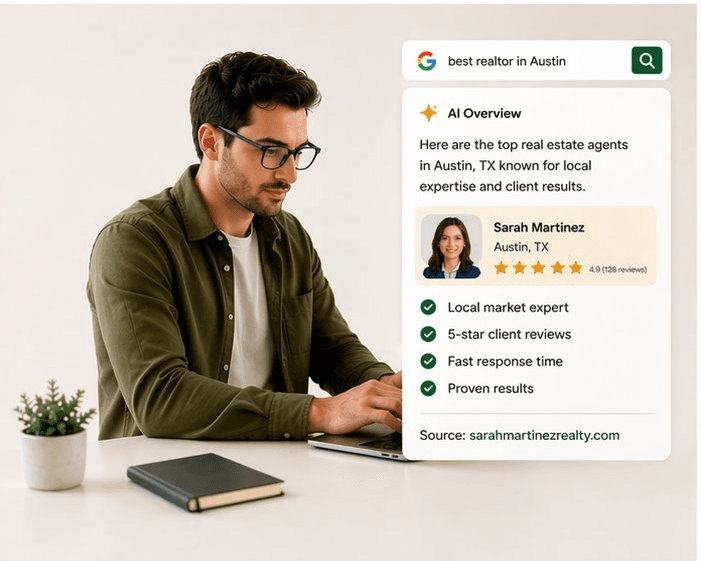
The $1.2M listing did not come from Zillow. It came from a homeowner in Houston's River Oaks–adjacent corridor who searched "homes sold near me Heights Houston" on Google, landed on Marcus's new IDX website, used the home valuation tool, and submitted their contact details. That interaction happened at 11:18 PM on a Wednesday. By 11:19 PM, Marcus's AI had sent a personalized reply acknowledging the valuation request and asking a single question: "Are you thinking about listing this year, or just tracking what the market is doing?" The homeowner replied within 9 minutes. Marcus called the next morning with their valuation data in hand. The listing agreement was signed 11 days later.
Stat: Home valuation pages on IDX-integrated real estate websites convert 5–10% of visitors into leads — significantly higher than the 1–3% conversion rate for standard agent websites. — SEO Real Estate Wagon, IDX Website Conversion Benchmarking Report, 2026
The mechanics of why the website produced this listing are worth understanding. The seller was not looking for an agent when they searched that query. They were curious. A standard agent website — a headshot, a bio, a contact form — gives a curious seller no reason to share their contact information. An IDX website with a live home valuation tool gives them an immediate, specific reason: to find out what their home is worth right now, with current MLS data. The tool delivers value before the seller has committed to anything. That exchange — data for contact information — is how Marcus's site converted a late-night Google search into a seven-figure listing.
NAR's 2025 Profile of Home Buyers and Sellers found that the home search process most often begins online, with 90% of buyers using online resources at some point. That same data shows 85% of buyers rated their real estate agent as the most useful information source — above online listings, above open houses. The opportunity for agents is to become that useful information source online, before a buyer or seller ever needs to call. A website with live IDX search, neighborhood market reports, and a home valuation tool does exactly that. Marcus's previous Wix site offered none of those things.
The 90-day results breakdown
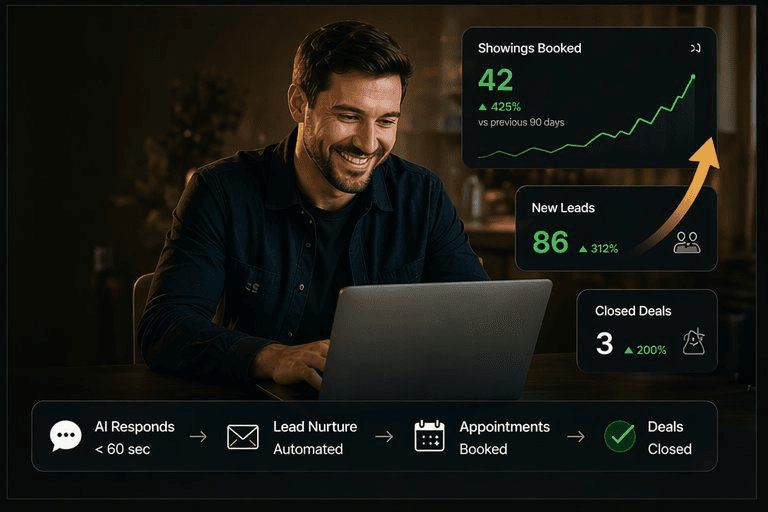
Marcus entered January 2026 with his three systems running: AI lead response, 12-week nurture sequence, and IDX website with a home valuation page. By the end of March, the numbers looked like this: 42 total showings booked (up from 19 in the prior 90-day period), 11 reactivated leads from the nurture sequence, 1 listing at $1.2M from the website's organic search traffic, and 3 buyer clients sourced from the AI's overnight response system.
The showing volume increase — from roughly 6 per month to 14 per month — did not require Marcus to generate a single new lead source. His Zillow budget stayed the same. His Facebook ad spend stayed zero. What changed was the percentage of existing leads that converted to a booked showing. His lead-to-showing conversion rate moved from roughly 15% (consistent with the industry average of 0.4%–1.2% for lead-to-close, with most of that early funnel leaking at first contact) to approximately 35% — driven almost entirely by the speed-to-lead improvement and the reactivation of previously dormant contacts.
The Houston market context matters here. According to the Houston Association of Realtors, 2025 saw 88,634 single-family home sales across the region — a 3.8% increase from 2024 — with a median sale price of $334,990. Inventory was expanding, with active listings reaching a record 39,490 in July 2025. That environment means more competition for each buyer, not less: with more supply available, buyers take longer to decide and contact more agents. The agent who responds first, follows up consistently over 10-plus weeks, and maintains a visible online presence captures a disproportionate share of that expanding but more deliberate buyer pool.
The single most important number in Marcus's results is not 42 showings. It is 11 reactivated leads — because those were people Marcus had already paid to acquire, already spent time on, and had written off as cold. Every agent reading this has a CRM full of contacts in that same category. The research is consistent: REsimpli's 2025 data found that leads classified as dead sat an average of 60-plus days with zero touchpoints before agents abandoned them. A structured reactivation campaign run over 7 to 12 touches across 30 to 60 days recovers meaningful pipeline from that group. Marcus's 11 reactivations in 90 days — 3 of which became booked showings and 1 of which became a $1.2M listing — came from a database he already had, at zero incremental lead cost.
| Key Statistic / Finding | Source & Year |
|---|---|
| Average real estate agent takes 917 minutes (over 15 hours) to respond to a new lead inquiry | Inman Real Estate Technology Survey, 2025 |
| Agents who respond within 5 minutes are 21x more likely to qualify a lead than those who wait 30 minutes | MIT Lead Response Management Study (Dr. James Oldroyd) / InsideSales.com |
| 78% of homebuyers work with the first agent who responds to their inquiry | NAR 2025 Home Buyers and Sellers Generational Trends Report |
| Calling a lead within 1 minute produces a 391% improvement in contact rate vs. calling after 2 minutes | Velocify Lead Response Research |
| 74% of real estate leads that ultimately transact do so more than 6 months after initial inquiry | T3 Sixty Real Estate Technology Study |
| Nurtured leads convert 50% more often and generate 47% larger purchases than non-nurtured leads | Annuitas Group research cited in RealScout Lead Nurture Guide, 2026 |
| 62% of qualified real estate inquiries arrive outside traditional business hours | AgentZap Real Estate Lead Statistics Report, 2026 |
| Home valuation pages on IDX-integrated websites convert 5–10% of visitors into leads vs. 1–3% for standard agent websites | SEO Real Estate Wagon IDX Website Conversion Benchmarking Report, 2026 |
| 90% of buyers use online resources during their home search; 85% rate their agent as the most useful information source | NAR 2025 Profile of Home Buyers and Sellers |
| Houston single-family home sales totaled 88,634 in 2025, up 3.8% from 2024, with a median price of $334,990 | Houston Association of Realtors 2025 Year-End Housing Market Update |
Frequently Asked Questions
How fast should I respond to real estate leads?
The research-backed target is within 5 minutes, and under 60 seconds is even better. MIT's Lead Response Management Study found that responding within 5 minutes makes you 21 times more likely to qualify a lead than waiting 30 minutes. Velocify data shows a 391% improvement in contact rate when a lead is called within the first minute. The average agent takes 917 minutes to respond, per Inman's 2025 Real Estate Technology Survey, so any system that gets you under 5 minutes puts you ahead of nearly all your competitors. The most practical way to achieve this consistently is an AI-powered SMS system that fires automatically for every new inquiry, regardless of what you are doing.
How long should a real estate lead nurture sequence be?
At minimum, 10 weeks — matching the median buyer search duration per NAR's 2025 Profile of Home Buyers and Sellers. But T3 Sixty's Real Estate Technology Study found that 74% of leads that transact do so more than 6 months after initial inquiry, which means a 12-week sequence still ends too soon for most buyers. The most effective structure is a high-frequency sequence (daily contact) for the first 7 days, tapering to every other day for weeks 2 and 3, then one touchpoint per week through month 6. Content should shift over time: early messages are tactical (listing alerts, showing invites), later messages are trust-based (market updates, check-in questions about timeline).
Do solo real estate agents actually need their own website?
Yes — specifically one with IDX search and a home valuation tool. The average agent website converts 1–3% of visitors into leads, but home valuation pages on IDX-integrated sites convert 5–10%, per SEO Real Estate Wagon's 2026 benchmarking data. More importantly, a personal website generates leads from organic search — people who find you without you spending money on their click — at a cost of $15–$50 per lead versus $30–$60 for paid search. NAR's 2025 data shows 90% of buyers use online resources during their search. A website that keeps buyers searching listings on your domain, rather than redirecting them to Zillow, captures contact information before they engage with competing agents.
What's the best way to reactivate cold real estate leads?
A structured sequence of 7 to 12 touches across 30 to 60 days, with a mix of SMS and email. The most effective reactivation message is typically sent around day 21 and gives the prospect an easy out: something like "I know timing shifts — are you still thinking about making a move this year, or has your situation changed?" That framing lowers resistance and generates honest replies. According to RealScout's 2026 lead nurture guide, reactivated contacts cost 3–5 times less to convert than new leads. REsimpli's 2025 data found that leads classified as dead had gone an average of 60-plus days with zero touchpoints before being abandoned — meaning most of what agents call a "dead" database is actually an unworked one.
How many showings should a solo agent be booking per month?
There is no universal benchmark, but the conversion math is instructive. If you generate 40–50 inquiries per month and convert 35% to a booked showing, you should produce 14–17 showings. At a 1-in-10 showing-to-close rate (a conservative estimate for a buyer who books a showing), that is 1.4 to 1.7 closed transactions per month from inbound leads alone. Most solo agents converting 10–15% of inquiries to showings — consistent with the industry average response time of 917 minutes — produce 4 to 7 showings per month from the same lead volume. The difference between 7 showings and 14 showings is almost entirely response time and follow-up duration, not lead volume or lead quality.
What is an IDX website and why does it matter for lead generation?
IDX stands for Internet Data Exchange — a system that allows a real estate agent's website to display live MLS listings pulled directly from the board's database. A website with IDX lets buyers search current inventory without leaving your site, which keeps them engaged longer and gives you a reason to capture their contact information (through saved searches, listing alerts, and home valuation tools). Without IDX, a real estate website is essentially a digital business card: it provides no value to a buyer in research mode, so they leave immediately for Zillow or Realtor.com, where they are shown ads for other agents. With IDX, your website becomes a tool buyers return to regularly — and every saved search or valuation request is a lead in your CRM.
How do I book showings without cold calling?
The most effective path is a combination of inbound lead capture (IDX website with valuation tools), sub-5-minute AI-powered response on every new inquiry, and a structured nurture sequence that runs for at least 10 to 12 weeks. Cold calling has a documented cost in both time and emotional bandwidth, and its conversion rate is lower than any of the above methods at equivalent effort. NAR's 2025 data shows 66% of sellers chose their agent through a referral or prior relationship — meaning the second-highest-ROI strategy after systematic follow-up is maintaining active communication with your existing database so you are top of mind when someone they know needs an agent.
Ayushman Singh
— Co-Founder & Chief Brand & Marketing OfficerAyushman Singh is the co-founder and Chief Brand & Marketing Officer of Pinova. He shapes the narrative, builds the brand, and tells the stories the industry doesn't want to hear. He believes the real estate system was designed to extract from agents, not empower them — and he's building the counter-narrative.