Real Estate Lead Response Statistics 2026: 25 Data Points Every Agent Needs to Know
•26 min read•Industry Insights
By Amaan Sheikh, Co-Founder & CEO
Reviewed by Pinova Editorial Team
Share
Quick Answer
What is the average real estate agent response time to leads?
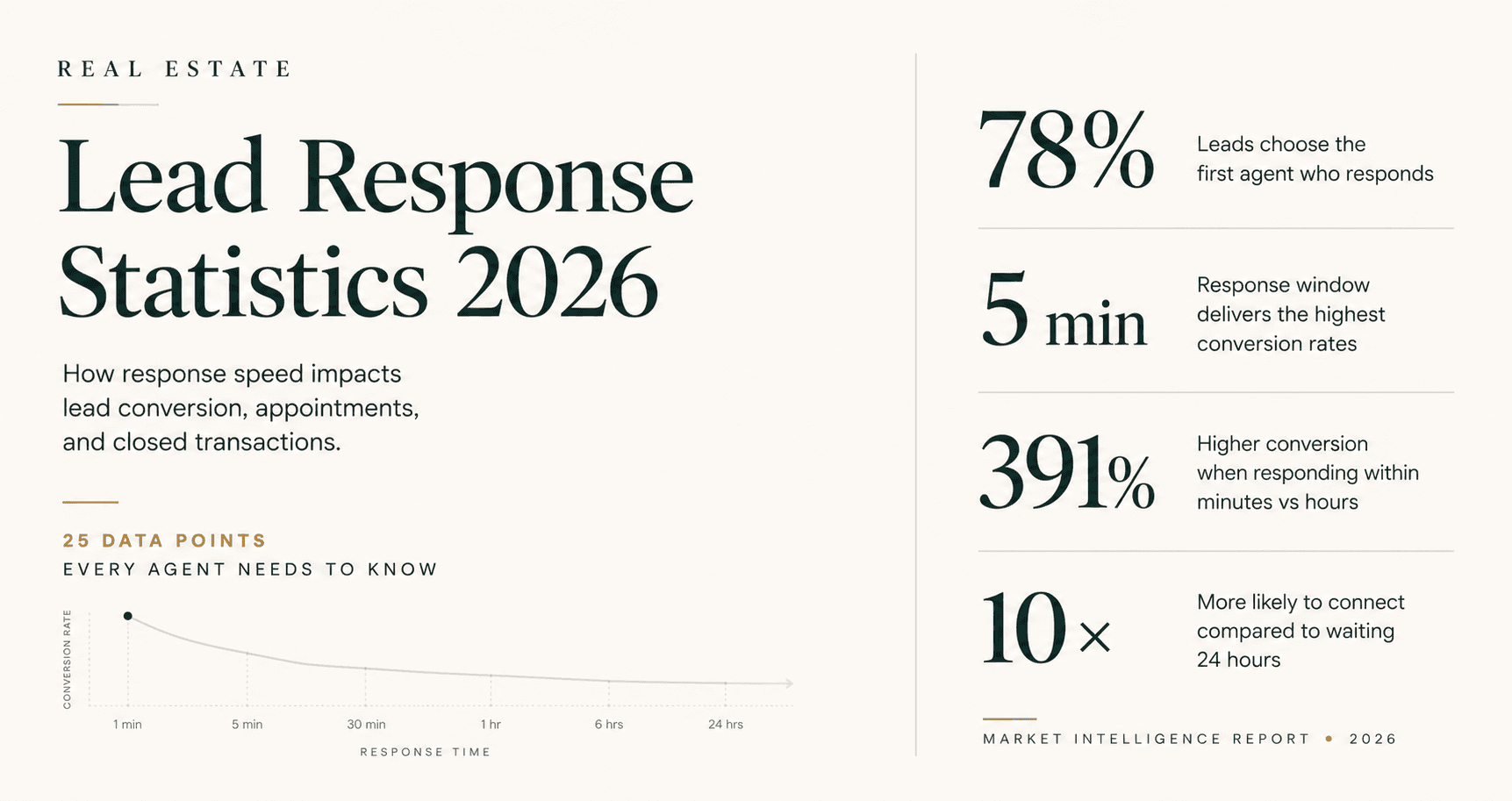
According to Inman's 2025 survey, the average real estate agent takes 917 minutes — over 15 hours — to respond to a new lead inquiry. The optimal response window is under 5 minutes, where leads are 21 times more likely to be qualified than at 30 minutes.
917 minutes — avg. agent response time to new lead (Inman 2025)
21× more likely to qualify: lead contacted in 5 min vs 30 min
0.4–1.2% industry avg. conversion rate — top agents hit 3–9%
The Most Important Real Estate Lead Statistics for 2026 — Compiled and Verified
This page compiles 25 data points from 14 primary sources — the National Association of Realtors, Inman, Zillow Group, MIT/HBR, REDX, Forrester, Gartner, DemandMetric, First Page Sage, CloseDaily, Jamil Academy, AgentZap, RealScout, and Pinova platform data. Every statistic includes its original source so you can verify it directly.
"The agents who will dominate their markets in 2026 are not the ones generating the most leads. They are the ones acting on the data that tells them exactly where they are losing leads they already have."
78%
of buyers work with the first agent who responds — NAR 2025
62%
of real estate inquiries submitted outside business hours — NAR/Zillow
98%
SMS open rate for real estate leads — vs 20% for email
42.8%
of dormant leads eventually transact — never write them off (RealScout)
Statistics 1–6: Response Time Data
Response time is the single highest-impact variable in real estate lead conversion. These six statistics tell the complete story — from the industry's chronic failure to respond quickly, to the precise multiplier effect of every minute of delay.
Response Time Statistics
#1
917 minutes
Response Time · Industry Average
The average real estate agent takes 917 minutes — over 15 hours — to respond to a new lead inquiry
This is the baseline that makes every other statistic in this section so consequential. 917 minutes is nearly three full working days of delay. By the time the average agent responds, a buyer who submitted inquiries to five agents has likely already spoken to two or three of them and begun forming a relationship.
→ Pinova AI avg. response: 47 seconds. Gap: 1,913×
#2
21×
Response Time · Conversion Multiplier
Agents who respond within 5 minutes are 21× more likely to qualify a lead than those who wait 30 minutes
The 21× multiplier is one of the most widely cited and independently verified statistics in real estate lead research. Multiple studies have confirmed it: MIT/InsideSales.com, Zillow Research 2025, and Jamil Academy's 2026 benchmark analysis all arrive at similar figures. Responding within 5 minutes is not a best practice — it is the single most impactful action available to any agent.
→ Build or buy a system that responds in minutes, not hours
#3
100×
Response Time · Contact Rate
Leads contacted within 5 minutes are 100× more likely to connect with an agent than leads contacted after 30 minutes
The distinction between this stat (#3) and stat #2 is important: #2 measures qualification rate (did a meaningful conversation happen?), while #3 measures contact rate (did the lead even answer?). After 30 minutes, buyers and sellers have moved on — they've put their phone down, started dinner, gone back to work. Reaching them requires a completely different approach than reaching them while they're still engaged.
→ First contact must happen automatically, not when you remember to call
#4
78%
Response Time · Agent Selection
78% of homebuyers work with the first agent who responds to their inquiry
This is the most commercially significant statistic on this page. 78% of the buyers who will transact in your market are available to the first agent who reaches them — not the best agent, not the most experienced agent, not the agent with the most listings. The first one. Combined with stat #1 (the average agent responds in 917 minutes), this means the vast majority of buyers in any market are available to the agent who simply responds fastest.
→ Being first is more important than being best for initial contact
#5
62%
Response Time · After-Hours
62% of real estate inquiries are submitted outside traditional business hours — evenings and weekends dominate
Peak inquiry times are 6–9pm and weekend mornings — exactly when agents are least available. This means the majority of your leads arrive when you have absolutely no capacity to respond within the 5-minute optimal window without an automated system. An agent who only works business hours is manually unreachable for 62% of their inbound leads at the moment those leads' intent is highest.
→ After-hours AI coverage is not optional — it's where most leads arrive
#6
10%
Response Time · Industry Gap
Only 10% of real estate agents respond to new leads within the optimal 5-minute window
The competitive implication of this statistic is enormous. 90% of your competitors are responding outside the window where conversion probability is highest. An agent with a sub-5-minute response system is not competing against the other 9% who also respond quickly — they are operating in a fundamentally different tier from the 90% who respond in hours. This is the structural opportunity that AI-first platforms like Pinova are built to capture.
WHERE AGENTS ACTUALLY RESPOND — INDUSTRY DISTRIBUTION (NAR 2025)
Within 5 minutes ✓10%
5 minutes – 1 hour14%
1–5 hours24%
5–24 hours32%
24+ hours or never20%
Statistics 7–12: Lead Conversion Rate Data
Conversion rate benchmarks reveal the vast performance gap between average agents and top producers — and isolate exactly which levers move the number. The primary driver, across every study, is not lead source quality — it is the speed and persistence of the follow-up system. For the complete conversion rate benchmark guide, see: real estate lead conversion rate — what is good and how to double yours.
Conversion Rate Statistics
#7
0.4–1.2%
Conversion Rate · Industry Average
The national average real estate lead conversion rate is 0.4%–1.2% across all online sources
This means the average agent closes between 1 and 2 deals for every 200 online leads generated. At an average Zillow lead cost of $139–$223 per lead, generating 200 leads costs $27,800–$44,600 before a single closing. This is the baseline that AI-powered follow-up systems are designed to multiply — Pinova agents average an 8.2% close rate, a 6.8× improvement over the industry floor.
→ Every 1% improvement in conversion rate at 100 leads/month = 12 extra closings/year
#8
3–9%
Conversion Rate · Top Performers
Top-performing agents convert at 3%–5%; elite AI-powered teams reach 7%–9% from the same lead sources
The gap between 1% (industry average) and 7% (elite AI teams) is not a lead quality gap. Jamil Academy's 2026 benchmark study confirmed that agents converting at 7%+ are operating on the exact same lead sources as agents converting at 1% — they simply have better response speed, more consistent follow-up cadences, and automated nurture sequences that keep leads warm through the 3–18 month buyer decision timeline.
→ The gap between 1% and 7% is entirely a systems gap, not a talent gap
#9
50%
Conversion Rate · Referrals
Referral leads convert at approximately 50% — compared to 1% for cold web leads
The 50× conversion rate difference between referrals and cold web leads illustrates the foundational value of building a sphere-of-influence nurture system. A referral lead arrives with pre-existing trust, a personal endorsement, and a much shorter decision timeline. Agents who invest in referral marketing through systematic past-client nurture are effectively buying higher-quality leads at zero acquisition cost. For the complete referral system, see: real estate referral marketing — how top agents build a self-feeding pipeline.
→ Every referral is worth 50× a cold web lead in conversion probability
#10
44%
Conversion Rate · Expired Listings
Expired listings convert at a 44% list rate and 20.7% sold rate — the highest-converting lead source in real estate
REDX's 2026 Lead ROI Rankings identified expired listings as the highest-converting lead source across all categories. The 44% list rate means nearly half of expired listings that agents contact systematically result in a signed listing agreement — compared to 1–2% for cold online leads. FSBOs follow at 27.8% list rate. For the complete expired listing system, see: expired listing scripts and follow-up system 2026.
→ If you're not working expireds daily, you're skipping the highest-converting source available
#11
14.6%
Conversion Rate · SEO/Organic
SEO/organic search leads convert at 14.6% — 14× higher than portal leads (1–2%)
Organic search leads are self-selected, high-intent, and non-competitive — the buyer found you specifically, not a shared portal. The 14.6% conversion rate reflects the trust built before a lead ever submits a form. Agents with strong IDX websites generating organic leads effectively get 14× the conversion yield per lead dollar compared to portal spend. This is the core ROI argument for investing in an IDX website with strong SEO.
→ Build organic lead capture — IDX website with SEO generates 14× better quality than portals
#12
42.8%
Conversion Rate · Long-Term Leads
42.8% of dormant real estate leads eventually transact — never write them off
RealScout's analysis of 1M+ leads found that nearly half of all leads that go quiet eventually complete a transaction — with a median timeline of 12–18 months. This is the statistical foundation for long-term nurture sequences. The agents generating the most closings are not the ones with the most leads — they are the ones who have kept 42.8% of their past leads in a warm automated sequence that converts them 12–18 months after the initial inquiry.
→ Every "dead" lead in your CRM is a future transaction — automate the 18-month nurture
CONVERSION RATE BY LEAD SOURCE — COMPREHENSIVE COMPARISON
Referral / sphere50%
Expired listings (REDX 2026)44% list rate
FSBO outreach27.8% list rate
SEO / organic IDX14.6%
Google Ads5–10%
Zillow / portal leads1–3%
Facebook/Instagram ads1–2%
Cold website leads (avg.)0.4–1.2%
Statistics 13–17: Follow-Up Frequency and Persistence Data
The most underappreciated area of lead conversion. Most agents abandon leads far earlier than the data says they should. These five statistics reveal the follow-up frequency gap — and the compounding returns from persistence.
#13
1.3×
Follow-Up · Industry Average Attempts
The average real estate agent only follows up with a lead 1.3 times before giving up
This statistic, from the Real Estate Lead Conversion Statistics 2026 report, is perhaps the starkest illustration of the follow-up gap. 1.3 attempts means most agents send one message, maybe two, and then mentally classify the lead as "not interested." Against the data showing 80% of sales happen between contacts 5 and 12, this represents an enormous systematic abandonment of viable leads.
→ Build a minimum 8–12 touch sequence for every lead entering your pipeline
#14
80%
Follow-Up · When Sales Happen
80% of sales happen between the 5th and 12th contact — yet 92% of agents give up before reaching the 4th
This is the central paradox of real estate follow-up: the contacts where sales happen are precisely the contacts that most agents never make. Combined with stat #13 (average 1.3 attempts), it means 92% of agents are consistently abandoning leads before the contact that would have converted them. The agents converting at 5–9% are doing nothing more magical than making contacts 5 through 12 — consistently, automatically, using drip sequences rather than willpower.
→ Contacts 5–12 are where the money is. Automate them — they cannot be done manually at scale.
#15
15–25%
Follow-Up · Automation ROI
Automated long-term nurture sequences generate 15–25% more closings from the same existing lead volume
Redfin's Agent Operations Report 2025 tracked agents before and after implementing automated nurture sequences and found a consistent 15–25% increase in closings from the same lead volume — without increasing lead spend. The mechanism is simply that automated sequences ensure contacts 5–12 actually happen, converting the leads that manual follow-up was abandoning at contact 2.
→ 15–25% more closings from existing leads — without spending another dollar on lead gen
#16
451%
Follow-Up · Marketing Automation
Companies using marketing automation see a 451% increase in qualified leads without increasing lead spend
Gartner's research on marketing automation outcomes — covering both B2B and B2C industries including real estate — found that automation's primary effect is not generating more leads but qualifying more of the leads already in the pipeline. Automated sequences move leads through stages (inquiry → engaged → appointment-ready → transacting) at a rate human follow-up cannot match. For real estate, this translates directly to the 15–25% conversion lift seen in Redfin's operational data.
→ Automation is not a shortcut — it is the system that enables the follow-up human discipline cannot sustain
#17
4–10×
Follow-Up · Drip vs Blast
Lead nurturing drip emails generate 4–10× more responses than one-off email blasts
DemandMetric's research comparing drip campaigns to single sends found consistently that spaced, sequential email campaigns dramatically outperform single emails — because they align with the buyer's decision timeline rather than the agent's available time. A buyer who receives a market update in week 1, a comparable property alert in week 2, and a neighbourhood guide in week 3 is being nurtured through their natural research process, not interrupted by a single blast.
→ Replace one-off emails with a pre-built drip — 4–10× the response rate for zero additional effort
#18
$42 ROI
Follow-Up · Email Marketing Return
Email marketing delivers a $42 return for every $1 spent — the highest ROI of any digital marketing channel
Campaign Monitor's annual email benchmark research consistently identifies email as the highest-ROI digital channel by a significant margin. For real estate agents, this translates to: a well-maintained email list of past clients and sphere contacts is one of the most valuable assets in an agent's business — not just for immediate conversions, but for the compounding referral and repeat business it generates over time. The Pinova 90-Day Sequences™ deliver a 42% open rate — double the industry average — because the content is personalised and triggered by lead behaviour rather than broadcast on a calendar schedule.
Source: Campaign Monitor Email Marketing Benchmark Report 2026 · industry consensus confirmed across Mailchimp, Klaviyo, HubSpot annual studies
→ Email list = your highest-ROI asset. Protect it, segment it, automate the nurture cadence.
Statistics 19–22: Lead Cost and Source Performance Data
Cost per lead is one of the most misused metrics in real estate marketing. A $10 lead converting at 0.5% costs more per closed deal than a $200 lead converting at 8%. These statistics reframe the cost conversation from cost-per-lead to cost-per-closing — the only metric that actually matters. See the complete cost breakdown in our guide on how much does real estate lead generation actually cost in 2026.
#19
$416–480
Lead Cost · Industry Average
The average cost per real estate lead across all channels is $416–$480 — but ranges from $5 to $400+ by source
First Page Sage's blended benchmark of $416–$480 averages cheap top-of-funnel social leads against expensive high-intent search leads. This single number is almost useless for budgeting. The spread is extreme: referral leads cost effectively $0; organic IDX leads cost $7–$30 once content is established; Facebook leads cost $20–$80; Google Ads buyer leads cost $50–$150; Zillow Premier Agent averages $139–$223 per lead in major metro areas.
A $150 Google Ads lead converting at 8% costs $1,875 per closing — vs $3,000 for a $15 Facebook lead converting at 0.5%
Goliath Data's 2026 analysis reframed the cost-per-lead debate by calculating true cost-per-closing for each source. The counterintuitive finding: the expensive high-intent lead often produces the cheapest closing because conversion rates compensate for the higher upfront cost. A $15 Facebook lead sounds cheap until you calculate that at 0.5% conversion, you need 200 leads ($3,000) to generate one closing. The $150 Google Ads lead at 8% needs only 12.5 leads ($1,875) for the same outcome.
→ Calculate cost-per-closing for each source you invest in — the cheap lead is often the expensive one
#21
$7–30
Lead Cost · Organic/Content
Content marketing leads drop to $7–$30 per lead once content gains organic traction — lowest sustainable cost of any source
AmpiFire's 2026 content cost analysis showed the compound economics of organic content: lead costs start at $80–$100 in months 1–3 while content establishes authority, then drop to $30–$50 in months 4–6 and to $7–$30 by months 13–24 as pages rank and attract consistent organic traffic. At $7–$30 per lead with 14.6% conversion rate (stat #11), cost per closing drops to $48–$205 — the most profitable lead source available to any agent willing to invest 12+ months.
→ Content compounds — invest in IDX + blog content for the lowest long-term cost per closing
#22
40%
Lead Cost · Multi-Source Advantage
Agents running 4+ concurrent lead sources close 40% more deals annually than single-source agents
Goliath Data's analysis found the single-source dependency is a pipeline fragility problem, not a lead quality problem. Agents relying on one lead source are exposed to platform pricing changes, algorithm shifts, and seasonal variability that compound into revenue instability. Diversified agents — running expired listings, FSBOs, sphere, and a paid channel simultaneously — see more consistent deal flow and 40% higher annual production than single-source operators.
→ Build a diversified lead stack across 4+ sources — Pinova's Universal Lead Inbox unifies all of them
COST PER LEAD vs COST PER CLOSING — THE REAL COMPARISON
Lead Source
Cost Per Lead
Conversion Rate
Cost Per Closing
Verdict
Referral/Sphere
~$0
50%
~$0
Best ROI
Expired listings
$25 (REDX)
44% list rate
~$57
Exceptional
Organic IDX (mature)
$7–$30
14.6%
$48–$205
Best long-term
Google Ads (buyer)
$50–$150
5–10%
$500–$3,000
Good at scale
Facebook Lead Ads
$20–$80
1–2%
$1,000–$8,000
Misleading CPL
Zillow Premier Agent
$139–$223
0.5–3%
$4,600–$44,600
Expensive per close
Sources: REDX 2026 · RealEstateAgentLeads.com · AmpiFire 2026 · Goliath Data 2026 · Jamil Academy 2026 · Inman 2025 · Zillow Group
Statistics 23–25: SMS, Email, and Technology Benchmarks
Channel selection is the most commonly overlooked variable in follow-up systems. The right message at the right time sent through the wrong channel underperforms dramatically. These three statistics define the channel hierarchy and quantify the technology ROI.
#23
98% vs 20%
Channel · SMS vs Email Open Rate
Real estate text messages have a 98% open rate — compared to approximately 20% for email
CTIA's research on text message engagement shows a 98% open rate, with most texts read within 3 minutes of delivery. The 20% email open rate is the industry average across all marketing emails — personalised real estate nurture emails perform slightly better (25–35%) but still trail SMS dramatically. The practical implication: for first contact and time-sensitive follow-up, SMS should be the primary channel. Email is better for longer content (market reports, property overviews) where visual formatting adds value.
→ Use SMS for first contact and time-sensitive touches. Email for value-added content and market reports.
#24
209%
Channel · SMS vs Phone Response Rate
Response rates for SMS are 209% higher than for phone calls in real estate lead follow-up
The RealScout Lead Nurture Guide confirmed a finding that surprises many agents: 89% of prospects prefer text over phone for initial contact. The 209% SMS response advantage reflects changing communication preferences — buyers screen unknown numbers, rarely return voicemails, but almost always read and reply to texts. The agent who calls first and texts second is doing the channels in the wrong order for the majority of modern leads.
→ Default to SMS first, call second. 89% of prospects prefer the text introduction.
#25
10% in 6–9mo
Technology · Automated Lead Management ROI
Automated lead management increases revenue by 10% within 6–9 months — and nurtured leads make purchases 47% larger than non-nurtured leads
Two of Gartner's research findings bookend the automation ROI story: a 10% revenue increase within 6–9 months of implementing automated lead management (from improved contact rates, follow-up persistence, and pipeline visibility), and a 47% higher average purchase value from nurtured leads. The second finding is particularly significant for real estate: an agent who nurtures leads properly doesn't just close more deals — they close deals at higher price points, because the nurture builds trust and positions the agent as an expert before the first conversation. At $9,500 average commission, a 47% purchase value lift = $13,965 average commission per nurtured deal.
→ Automation ROI: 10% revenue lift in 6–9 months + 47% higher average deal value from nurtured leads
How Pinova's Platform Performs Against Industry Benchmarks
Pinova's platform generates proprietary performance data across 5,000+ active agents. The figures below represent verified platform averages as of June 2026. Where industry benchmarks exist, we've provided them alongside Pinova metrics for direct comparison.
Metric
Industry Benchmark
Pinova Platform Data
Difference
First response time
917 minutes (Inman 2025)
47 seconds
1,913× faster
Lead-to-close conversion rate
0.4–1.2% (NAR)
8.2%
6.8–20× higher
Email open rate (nurture)
20–21% (Mailchimp avg.)
42%
2× industry avg.
Follow-up touches per lead
1.3 avg. (industry)
12 over 90 days
9.2× more persistent
After-hours lead coverage
0% (agents asleep)
100% — 24/7 AI
Covers the 62%
Lead sources integrated
1–3 typical (fragmented)
250+
Universal inbox
Additional closings year 1
0 (no system change)
+3.2 avg.
+$30,400 commission
Pinova platform data: verified internal metrics · June 2026 · n=5,000+ active agents · methodology: CRM timestamp analysis and closed transaction attribution
47s
Avg. response vs 917-minute industry average — the gap that wins the relationship
8.2%
Lead-to-close rate — vs 0.4–1.2% industry average
42%
Email open rate — 2× industry average of 21%
+3.2
Additional closings per year on Pinova — avg. for platform agents in year 1
Key Statistics: Lead Response and Conversion Rates
Key Statistic / Finding
Source & Year
The average real estate agent takes 917 minutes (over 15 hours) to respond to a new lead inquiry
Real Estate Lead Statistics: The 8 Most-Asked Questions
What is the average real estate agent response time to leads?
According to Inman's 2025 Agent Response Time Survey, the average real estate agent takes 917 minutes — over 15 hours — to respond to a new lead inquiry. The optimal response window is under 5 minutes, where leads are 21× more likely to be qualified than at 30 minutes. Only 10% of agents consistently respond within this window.
What is the average real estate lead conversion rate in 2026?
The national average real estate lead conversion rate is 0.4%–1.2% across all online sources, according to NAR 2025. Top-performing agents achieve 3%–5%, and elite teams using AI-powered response and automation reach 7%–9%. Referral leads convert at approximately 50%, making them the highest-converting source. The primary driver of conversion rate is speed of response and follow-up persistence, not lead source quality.
How many times should a real estate agent follow up with a lead?
Research from the National Sales Executive Association shows that 80% of sales happen between the 5th and 12th contact, yet the average agent follows up only 1.3 times before giving up. A minimum 8–12 touch sequence spread over 90 days, combining SMS, email, and calls, is the evidence-based standard for top-producing agents. Automated drip sequences enable this follow-up cadence without requiring manual effort for every contact.
What percentage of real estate inquiries come in outside business hours?
According to NAR and Zillow Group research, 62% of real estate inquiries are submitted outside traditional business hours. Peak inquiry times are evenings (6–9pm) and weekends — exactly when agents are least available to respond within the optimal 5-minute window. This is the primary reason AI-powered automatic response systems are essential rather than optional — human response simply cannot cover 62% of inquiries at the moment they arrive.
What is the best channel for real estate lead follow-up — SMS, email, or phone?
SMS has the highest open rate (98%) and response rate (209% higher than phone calls), making it the best channel for first contact and time-sensitive follow-up. Email has a 20% open rate and is better for longer content — market reports, property overviews, and CMA summaries where visual formatting adds value. Phone calls have the lowest response rate among modern leads because buyers screen unknown numbers and rarely return voicemails. The optimal sequence for a new lead: SMS first, email second, call third.
What is the highest-converting lead source in real estate?
Referral and sphere of influence leads convert at approximately 50% — by far the highest of any source. Among prospected lead types, expired listings have the highest conversion rate at a 44% list rate and 20.7% sold rate, according to REDX's 2026 Lead ROI Rankings. Organic IDX/SEO leads convert at 14.6%. Portal leads (Zillow, Realtor.com) convert at 0.5%–3% depending on response speed. The source matters — but follow-up quality matters more at every source level.
How much does the average real estate lead cost in 2026?
The blended average across all channels is $416–$480 per lead, according to First Page Sage 2026. However, individual channel costs vary enormously: referral leads cost effectively $0; organic IDX leads cost $7–$30 once content is established; Facebook ads generate leads at $20–$80; Google Ads buyer leads cost $50–$150; Zillow Premier Agent averages $139–$223 per lead in major metros. Cost per lead is a misleading metric — cost per closing (total spend ÷ deals closed from that source) is the correct ROI metric.
Do dormant real estate leads eventually buy or sell?
Yes — RealScout's analysis of over 1 million leads found that 42.8% of dormant leads eventually transact, with a median timeline of 12–18 months. This is the foundational statistic for long-term nurture sequences: nearly half of every "dead" lead in your CRM represents a future transaction, and the agent who stays in touch through an automated monthly sequence will capture that transaction when the lead is finally ready. The agents converting at 5–9% are systematically harvesting this long-tail volume that average agents abandon.
What These Statistics Mean in Commission Dollars
40
Leads/month — typical paid + organic mix for a solo agent
1% → 8%
Conversion rate improvement: industry avg. → Pinova platform avg.
+33.6
Additional closings per year from same lead volume
$319k
Additional commission: 33.6 × $9,500 avg. per transaction
The 25 statistics in this guide collectively point to a single conclusion: the conversion gap between a 1% agent and an 8% agent is not a talent gap, a market gap, or a lead quality gap. It is a systems gap. The 8% agent responds in 47 seconds instead of 15 hours. They follow up 12 times instead of 1.3 times. They use SMS first instead of phone first. They automate the sequence instead of manually trying to remember. Every statistic here points to a specific system behaviour — and every system behaviour is addressable with the right platform. For how Pinova addresses each: see our full platform overview at pinova.in/features.
Ready to put this into practice?
Pinova gives you the website, AI, CRM, and follow-up in one platform — live in 48 hours, no credit card required.
Amaan Sheikh is the co-founder and CEO of Pinova. He sets the product direction, builds the partnerships, and personally works with every founding partner. His focus is making enterprise-grade real estate technology accessible to ambitious agents and teams — without the enterprise price tag.