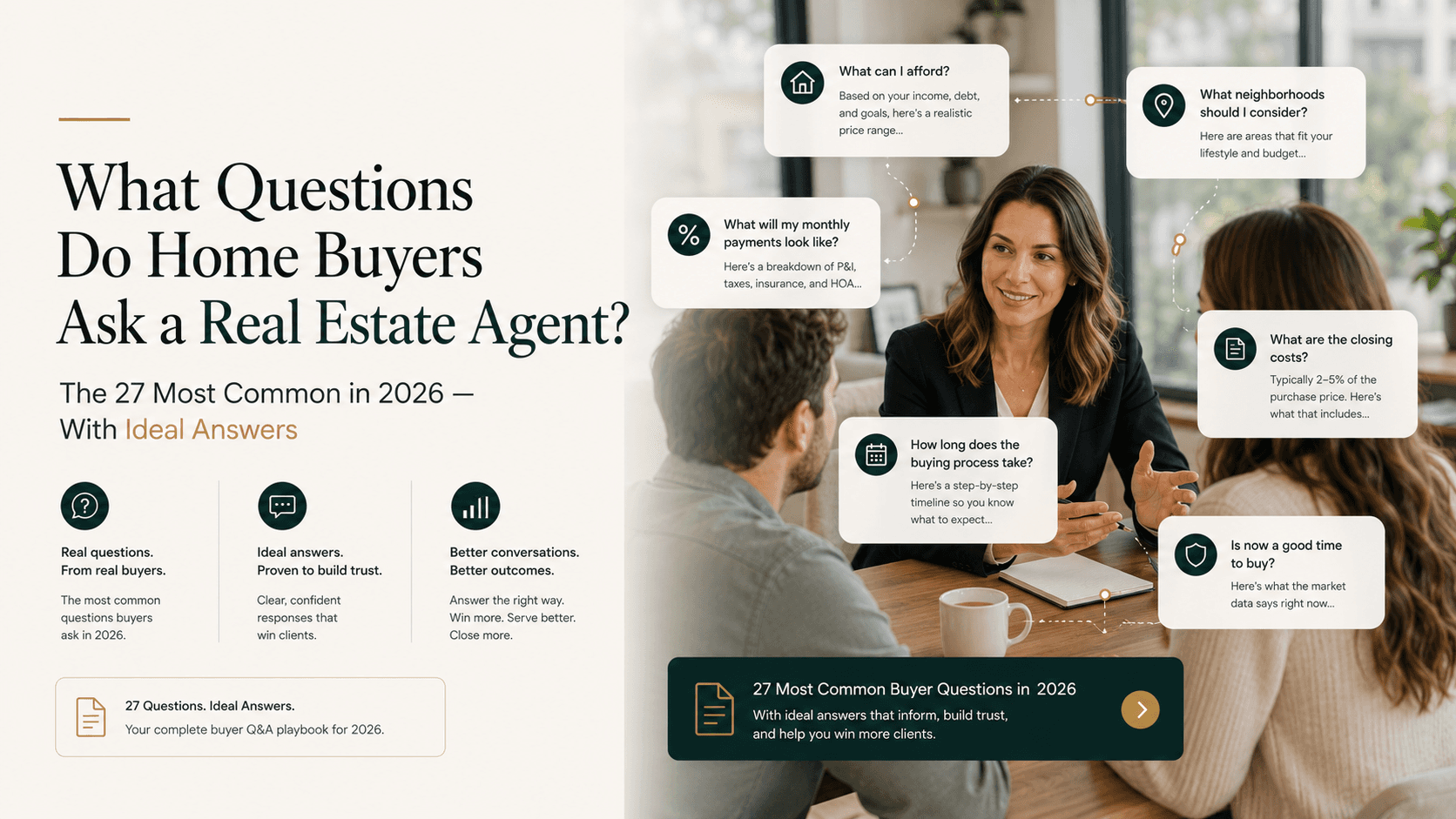
27 Questions Home Buyers Ask Real Estate Agents in 2026 — With Ideal Answers
•44 min read•Client Experience
By Amaan Sheikh, Co-Founder & CEO
Reviewed by Pinova Editorial Team
Share
Quick Answer
What questions should I ask a real estate agent before hiring them as a buyer?
The six most important questions: how many buyer transactions did you close last year in my price range; how many active buyers are you currently working with; what is your exact compensation and how is it paid; what is your typical search-to-close timeline; have you run buyer consultations since the August 2024 rule changes; and what happens if I want to end our agreement early. NAR's 2025 Profile of Home Buyers and Sellers, a survey of 3,800+ transactions from July 2024 to June 2025, found that 76% of first-time buyers credited their agent with helping them understand the process — which means most buyers who asked good questions up front got better outcomes. These six questions cover experience, capacity, cost, timeline, compliance, and exit rights — the criteria that predict whether a buyer-agent relationship will close or collapse.
Key Takeaways
First-time buyers fell to 21% of all U.S. home purchasers in 2025 — the lowest share since NAR began tracking in 1981 — per the 2025 Profile of Home Buyers and Sellers, a survey of 3,800+ transactions from July 2024 to June 2025.
88% of buyers purchased their home through a real estate agent or broker in 2025, making professional representation the dominant transaction model despite 45 years of predictions otherwise — NAR 2025 Profile.
NAR settlement rules effective August 17, 2024 require all MLS participants to obtain a signed written buyer agreement — with compensation clearly stated — before showing any home, live or virtual.
86% of home inspections identify at least one issue requiring attention, per Porch.com's survey of 998 homebuyers; buyers who use inspection findings to negotiate save an average of $14,000 off the sale price.
44.4% of U.S. home-sale transactions included seller concessions in Q1 2025 — approaching the record high of 45.1% set in early 2023 — per Redfin's analysis of closed transactions.
82% of Americans used AI tools for real estate insights as of October 2025, per a Realtor.com survey of 1,000 U.S. adults, with ChatGPT (67%) and Gemini (54%) as the leading platforms — yet 66% of those same respondents said real estate agents remain their most trusted source.
Jennifer Caldwell closed 23 buyer-side transactions in Arvada, Colorado in 2025 without a single Zillow lead. Her median search timeline — first call to keys — was 64 days. The national median search duration was 10 weeks, per NAR's 2025 Profile, meaning Jennifer's buyers were in their homes 6 days faster than average despite a competitive Denver-area market with average mortgage rates of 6.69%. The difference wasn't a better zip code or a lower price range. It was that every buyer who called her received the same 20-minute consultation before a single property address was discussed: six questions on timeline, motivation, pre-approval status, must-haves, representation history, and communication preference. The agent at her brokerage who skipped that call and moved buyers directly to MLS alerts averaged a 14-week search timeline — and lost nearly one in three active buyers to competitor agents during that extended search period, because unqualified buyers with no structured expectations are easy to poach.
This guide serves two audiences simultaneously. For buyers: the 27 questions you should ask — in the sequence you'll encounter them across the buying journey — with exactly what a strong agent's answer sounds like, and the specific red flags that signal a wrong fit. For agents: the complete question framework for running a buyer consultation that converts, with the ideal answers to every question your clients will bring. Each of the 27 questions maps to one of five stages — agent vetting, process and timeline, financial, property evaluation, and offers — so you can jump directly to the category most relevant to where you are today.
The Questions That Separate Good Buyers From Great Ones — and Good Agents From Great Ones
Buying a home is the largest financial transaction most people will execute in their lifetime — yet most buyers walk into the first agent conversation without a single prepared question, relying entirely on the agent to direct the process. The evidence on what that costs them is accumulating. NAR's 2025 Profile of Home Buyers and Sellers found that 76% of first-time buyers credited their agent with helping them understand the buying process — a stat that reads positively until you consider what it implies for the 24% whose agent apparently did not. Highnote's 2026 Buyer Consultation Guide, citing Buffini & Company data, found that buyers who engage in a formal, structured consultation with their agent are 67% more likely to close within 90 days and report significantly higher satisfaction scores. The questions — both the ones buyers ask agents and the ones agents ask buyers — make the difference.
This guide serves two audiences at once. For buyers: 27 specific questions you should ask before and during your home purchase, with what a great agent's answer looks like — and the red flags that signal a wrong fit. For agents: the complete buyer consultation framework, with the ideal answers to every question your clients will bring to the first meeting.
"The best real estate agents don't just show homes — they ask the right questions before a single showing is scheduled. A well-run buyer consultation is the difference between a client who goes under contract in 3 weeks and one who tours 40 homes over 9 months and walks away frustrated."
— Highnote Buyer Consultation Guide 2026, citing Buffini & Company data
10
Median weeks buyers searched before going under contract — NAR 2025 Profile
86%
of home inspections reveal at least one issue — Porch.com survey of 998 homebuyers
2–5%
Total closing costs as a percentage of purchase price — LodeStar 2025, 620k+ quotes
21%
of 2025 home buyers were first-time buyers — historic low since NAR tracking began in 1981
Why Buyer Questions Matter More Now Than Ever Before
Two specific changes in 2024–2026 have made the buyer-agent conversation more consequential than at any previous point in modern real estate history.
Change 1 — August 17, 2024
Buyer agreements are now required before the first showing
The NAR settlement rules took effect August 17, 2024. MLS participants must have a signed written buyer representation agreement — with compensation clearly stated — before showing any home, live or virtual. The agent selection conversation is now a legal and commercial negotiation. Buyers need to know what to ask before they sign.
Change 2 — 2025–2026 Buyer Profile
82% of buyers research using AI tools before speaking to an agent
A Realtor.com survey of 1,000 U.S. adults in August 2025 found that 82% use AI tools for real estate insights — led by ChatGPT (67%) and Gemini (54%). Today's buyer has explored affordability, neighborhoods, and price trends in AI tools before they call an agent. They arrive with specific, informed questions — and they can tell instantly if the agent's answer is shallow.
WHEN EACH QUESTION CATEGORY COMES UP IN THE BUYER JOURNEY
Stage 1
Agent Interview
Category 1: Agent Vetting Questions (Q1–Q6) Experience, transaction volume, communication style, cost, specialisation. Decide whether this is the right agent before signing anything.
Stage 2
Consultation
Category 2 + 3: Process/Timeline + Financial Questions (Q7–Q17) Timeline expectations, buyer agreement, closing costs, pre-approval, commission structure, earnest money. Set expectations before the search starts.
Stage 3
Active Search
Category 4: Property & Neighbourhood Questions (Q18–Q22) Pricing evaluation, home tour observations, inspection scope, neighbourhood analysis, resale potential. Evaluate each property before committing.
Stage 4
Offer + Close
Category 5: Offer, Negotiation & Closing Questions (Q23–Q27) Offer pricing strategy, contingencies, bidding wars, appraisal gaps, final walkthrough. Win the home and close without surprises.
The 5-Category Framework — 27 Questions Organised for Clarity
The 27 questions below are organised into five categories that mirror the stages of the buyer journey. Use this framework as a navigation guide — jump to the category most relevant to where you are in the process.
6
Category 1 — Agent Vetting
Who is this agent, are they the right fit, what will working with them cost? Ask these before signing anything.
Q1 – Q6 · Ask at agent interview
5
Category 2 — Process & Timeline
How does buying a home actually work? What should I expect and how long will it take? Set expectations early.
Q7 – Q11 · Ask at consultation
6
Category 3 — Financial
What will this really cost? Beyond the purchase price — closing costs, inspection fees, commission, concessions.
Q12 – Q17 · Ask at consultation
5
Category 4 — Property & Neighbourhood
How do I evaluate what I'm buying? Is this home priced right? What should I look for at a showing?
Q18 – Q22 · Ask during search
5
Category 5 — Offers, Negotiation & Closing
How do I price my offer? What contingencies protect me? What happens if there are multiple offers? What do I check at the final walkthrough?
Q23 – Q27 · Ask at offer stage
HOW FREQUENTLY EACH CATEGORY IS RAISED — AGENT SURVEY DATA (HIGHNOTE 2026)
Financial questionsAsked by 94% of buyers at consultation
Process & timeline questionsAsked by 88% of buyers
Agent vetting questionsAsked by 78% — more common post-settlement
Offer & negotiation questionsAsked by 76% — most first-time buyer anxiety here
Property & neighbourhood questionsAsked by 68% — often arises during active search
Questions 1–6: Choosing the Right Agent
These six questions should be asked before signing a buyer representation agreement. Post-NAR settlement — effective August 17, 2024 — the agent interview is a legal and commercial negotiation: you are agreeing to work together exclusively for a stated period at a stated compensation rate before you've seen a single home. NAR's 2025 Profile found that 43% of buyers found their agent through a personal referral, and 18% used an agent they'd worked with previously — but even a referred agent deserves to answer these questions before you commit to a transaction that will typically involve more than $400,000 of your money.
Q1
"How long have you been in real estate, and how many transactions did you close last year?"
Why buyers ask this
Experience signals competence, but years alone can mislead — a 10-year agent who closes 3 transactions a year has less transactional experience than a 2-year agent who closes 25. Transaction volume is the more useful number.
Ideal agent answer
A strong answer names specific numbers: "I've been in real estate for [X] years and closed [Y] transactions last year, of which [Z] were buyers in [target area]." NAR 2025 data: the average agent closes 10–12 transactions per year. Full-time agents consistently closing 20+ are top performers. New agents (<2 years) are not automatically poor choices — they often have more time for each client and are hungry to prove themselves — but they should have a supervising broker and mentor relationship.
🚩 Red flag: "I've been in real estate 15 years" without specifying volume, or visible discomfort with the volume question.
✓ Green flag: Specific numbers + a mention of transactions in your price range + acknowledgment of current client load.
Q2
"How many active buyers are you currently working with?"
Why buyers ask this
Capacity matters. An agent managing 12 active buyers simultaneously cannot give the same attention to each as an agent with 3–4. You're asking whether you'll be a priority or a number.
Ideal agent answer
"I'm currently working with [X] active buyers. My typical capacity is [Y] buyers simultaneously before I start compromising service — I manage my pipeline deliberately for that reason." There is no perfect number, but an agent who has no buyers may have a business development problem, and an agent with 15+ active buyers will struggle to be responsive during the competitive moments that matter most: a new listing alert, a counter-offer deadline, a same-day showing window.
✓ Green flag: A specific number + an honest acknowledgment of their capacity limit.
Q3
"What does working with you cost me as a buyer — and how does your compensation work?"
Why buyers ask this
Post-August 2024, the buyer agent compensation conversation must happen before any showing. Buyers need to understand what they've potentially agreed to pay — and when.
Ideal agent answer
"My buyer agent fee is [X]%. Here's how it works: in many transactions, the seller will offer to cover buyer agent compensation through the purchase contract — if their offer meets or exceeds my fee, your out-of-pocket is zero. If they offer less or nothing, you'd owe the difference, or we could negotiate a seller concession to cover it. Everything is laid out in the buyer agreement before you sign. The fee is negotiable." For context: Clever Real Estate's February 2026 survey of 533 agents put the national average buyer agent commission at 2.82%; Redfin's Q2 2025 analysis of actual closed transactions put it at 2.43%. The range depends on price point, market, and negotiation.
🚩 Red flag: "The commission is standard and non-negotiable." Per NAR policy, compensation is always negotiable. This claim is either uninformed or deliberately misleading.
Q4
"What is your communication style, and what is your typical response time?"
Why buyers ask this
In competitive markets, a listing can attract multiple offers within hours of going live. An agent whose response time to your inquiry is 24 hours is not an agent who will get your offer in front of a listing agent's desk that same afternoon.
Ideal agent answer
"My response time for existing clients is [X] hours for texts, [Y] hours for emails, and I'm available by phone from [hours]. During active offer situations, I prioritise all incoming messages from my buyers above everything else. Tell me how you prefer to communicate and I'll adapt to your preference — not the other way around." Communication mismatch is the number-one source of client dissatisfaction in real estate transactions. Asking this question at the start establishes the expectation explicitly.
✓ Green flag: The agent asks you how you prefer to communicate, not just tells you their own preference.
Q5
"What is your experience in my target neighbourhoods and price range?"
Why buyers ask this
An agent who is active in your specific target market knows things that no data source can provide: which streets are more desirable within the same zip code, which listing agents are known for aggressive counter-offers, which micro-neighbourhoods are quietly gentrifying.
Ideal agent answer
"In [target neighborhood], I've closed [X] transactions in the past 12 months in the [$Y–$Z] price range. I know [specific street or development] well, and I can tell you specifically how the market has moved there in Q1 2026." An agent without specific neighbourhood experience is not automatically disqualified — but they should acknowledge the gap and have a plan to close it (partnering with a local specialist, doing intensive research). What disqualifies them is claiming local expertise without specifics to back it up.
Q6
"Are you a full-time agent?"
Why buyers ask this
Part-time agents are not always lower quality, but availability is a practical constraint. A home purchase involves showing scheduling, same-day offer submissions, inspection deadlines, and counter-offer windows — all of which require real-time availability that a part-time agent may not be able to guarantee.
Ideal agent answer
"Yes, real estate is my only job. I'm available [hours]. During active searches and under-contract periods, I treat my buyers as my primary professional priority." A part-time agent who is honest about their constraints and has a system (a trusted partner agent who covers for them, for example) is preferable to a full-time agent who makes promises about availability and then disappears.
🚩 Red flag: Defensive response to the question, or a vague "I'm very dedicated to my clients" without addressing the actual availability question.
Questions 7–11: The Home Buying Process, Start to Finish
These five questions calibrate timeline expectations and establish what the post-offer process looks like in practice. The median home search in 2025 ran 10 weeks according to NAR's annual Profile — but that figure covers everything from buyers who found their home in week two to buyers who toured 35 properties over six months. A good agent sets realistic expectations at the first meeting rather than after the fourth showing falls through. Two of the five process questions (Q7 and Q8) also carry post-settlement significance: buyers who don't understand the buyer agreement before seeing homes are starting a legal contract without the knowledge required to negotiate it.
THE 6 STEPS FROM PRE-APPROVAL TO KEYS — REALISTIC TIMELINE
Step 1
Pre-Approval
3–7 days
Mortgage lender reviews income, credit, and assets Get pre-approved — not just pre-qualified. Pre-approval involves actual document verification; pre-qualification is a self-reported estimate. Most competitive listings require a pre-approval letter, not a pre-qualification letter.
Step 2
Sign Agreement
Day 1
Sign buyer representation agreement before first showing Required since August 17, 2024. The agreement states your agent's fee, the duration of your working relationship, and the geographic area covered. Read every line before signing — everything is negotiable.
Step 3
Active Search
2–10+ weeks
Tour properties, evaluate neighborhoods, apply CMA analysis The most variable phase. NAR 2025 median is 10 weeks. In low-inventory markets, buyers may lose 3–5 competitive offers before going under contract, which extends this phase significantly.
Step 4
Make Offer
1–3 days
Submit written offer with contingencies, price, and earnest money Agent drafts offer based on CMA analysis. May involve counter-offers and negotiation. Earnest money deposit (1–3%) demonstrates seriousness.
Step 5
Under Contract
30–45 days
Inspection, appraisal, mortgage processing, title work The most complex phase. Multiple simultaneous deadlines. Agent coordinates between buyer, seller, lender, inspector, appraiser, and title company.
"How long does the home buying process take from start to finish?"
Ideal agent answer
"From pre-approval to keys, the typical timeline is 60–120 days depending on how quickly you find a home and how competitive your target market is. NAR's 2025 data shows the median search was 10 weeks, but that average covers significant variation. The search phase is the most unpredictable — buyers in low-inventory markets may need to submit 3–5 offers before going under contract, which extends the timeline. Once you're under contract, the close window is typically 30–45 days. I'll set specific expectations at each stage so nothing comes as a surprise."
Q8
"What is a buyer representation agreement and why do I need to sign one?"
Ideal agent answer
"Since August 2024, I'm required to have a written agreement in place before I can show you homes — it's one of the rule changes from the NAR settlement. The agreement formalises our working relationship: it states what services I'll provide, how I get paid, and the duration we'll work together. Think of it as a mutual commitment — you agree to work with me exclusively for a set period, and I commit to representing your interests exclusively. You can ask me to explain every line before you sign. The duration is negotiable, the compensation is negotiable, and if things aren't working out, we can discuss ending the agreement early."
🚩 Red flag: An agent who suggests you can skip signing, or who produces the agreement at the showing without giving you time to read it.
Q9
"How many homes should I expect to see before making an offer?"
Ideal agent answer
"The national average is 10 homes toured before a buyer makes an offer, per NAR's 2025 data. But that average covers everything from buyers who knew exactly what they wanted to buyers who took 9 months to find it. The most useful thing I can do at the start is really understand your must-haves vs. nice-to-haves — buyers with clear priorities typically need fewer showings. I'll also tell you honestly when I think a home won't meet your needs before we spend time on a showing."
Q10
"What happens after my offer is accepted?"
Ideal agent answer
"Once your offer is accepted, a clock starts on multiple simultaneous deadlines. Within the first 5–7 days: your earnest money goes into escrow and the inspection contingency window opens. Days 7–14: inspection happens and you decide whether to request repairs, credits, or proceed as-is. Simultaneously, your lender processes the loan and orders the appraisal (typically days 10–21). Weeks 3–5: mortgage underwriting, title search, and insurance binding. Days before closing: final walkthrough. Closing day: you sign loan documents, pay closing costs, and receive keys. I manage all of these deadlines — you won't miss one with me coordinating."
Q11
"What is an earnest money deposit and how much should I put down?"
Ideal agent answer
"Earnest money is a good-faith deposit that goes into escrow when your offer is accepted — it shows the seller you're serious. NAR guidance puts the typical range at 1–3% of the purchase price, though in competitive markets 3–5% can strengthen an offer. The critical thing to understand: your earnest money is protected by contingencies. If you back out because the inspection reveals major issues, or because your loan falls through, you get it back under those contingencies. If you back out without a valid contingency reason after the contingency windows close, you typically forfeit it to the seller. With 44.4% of Q1 2025 transactions including seller concessions (Redfin data), buyers today have more leverage than at most points in the past two years — which means a strong earnest money deposit can signal seriousness without sacrificing your negotiating position on price."
Questions 12–17: The Complete Financial Picture
Financial questions surface in 94% of buyer consultations, per Highnote's 2026 agent survey data. The anxiety they produce is proportional to the stakes: the median existing-home sale price was $429,300 in May 2026 (NAR), and the costs beyond the purchase price — closing costs, inspection fees, first-year maintenance reserves — typically add $20,000 to $50,000 to the total financial requirement depending on down payment size and location. LodeStar Software Solutions' 2025 report, covering 620,000+ purchase quotes, found that closing costs for lender and title fees alone average $4,528 nationally, with the total climbing to 2–5% of purchase price once transfer taxes and prepaid items are included. An agent who answers these questions precisely eliminates the surprises that kill deals at the closing table.
EVERY COST A BUYER ENCOUNTERS — FROM OFFER TO CLOSING · $429,000 EXAMPLE HOME
UPFRONT COSTS (Before offer accepted)
Cost Item
Typical Amount
Notes
Mortgage application fee
$300–$500
Some lenders waive this
Pre-approval credit pull
~$30
Usually included in application
Buyer agent compensation
$0 if seller pays / ~$10,400 if buyer pays
~2.43–2.82% of $429k — often covered by seller concession
INSPECTION & DUE DILIGENCE (After offer accepted)
Cost Item
Typical Amount
Notes
General home inspection
$300–$500
National average $343 (Porch.com 2025 data) — essential
Radon test (if applicable)
$150–$250
Recommended in most markets
Sewer scope
$150–$300
Highly recommended for homes 20+ years old
Appraisal
$500–$800
Required by lender for financed purchases
CLOSING COSTS (Day of closing — typically 2–5% of purchase price)
Cost Item
Typical Amount on $429k
Notes
Loan origination fee
$1,000–$4,000
Negotiable with lender
Title insurance (owner + lender)
$1,500–$3,000
One-time fee, protects ownership
Property taxes (prorated)
Varies by state
Pay from close date to year-end
Homeowners insurance (1st year)
$1,200–$2,400
Required at closing, varies by location
Escrow/closing fee
$300–$800
Title/escrow company fee
HOA dues (if applicable)
$0–$3,000
Often prorated at closing
Total closing costs estimate
$8,580–$21,450
2–5% of purchase price (LodeStar 2025)
POST-CLOSING COSTS (Year 1 — budget separately)
Cost Item
Typical Amount
Notes
Moving costs
$1,000–$5,000
Local vs. long-distance varies dramatically
Initial repairs / updates
$0–$20,000+
Budget 1% of purchase price annually for maintenance
"What are closing costs and how much should I budget?"
Ideal agent answer
"Closing costs are all the fees and expenses required to complete the purchase beyond the down payment. LodeStar's 2025 analysis of 620,000+ purchase quotes puts the national average at $4,528 for lender and title fees alone — but the total, including transfer taxes and prepaid items, runs 2–5% of your purchase price. On a $429,000 home, that's $8,580 to $21,450. Your lender will give you a formal Loan Estimate within 3 business days of application, itemising every closing cost. One strategy worth knowing: you can ask the seller to contribute to your closing costs as part of the offer — seller concessions were included in 44.4% of Q1 2025 transactions nationally, per Redfin."
Q13
"Do I need to be pre-approved before I start looking at homes?"
Ideal agent answer
"Yes — and in most competitive markets you'll need a pre-approval letter to even tour homes, let alone make offers. Pre-approval is meaningfully different from pre-qualification: pre-qualification is a rough estimate based on self-reported information; pre-approval involves the lender actually verifying your income, assets, and credit. A step further — pre-underwriting — means an underwriter has reviewed your complete file, and only the property appraisal stands between you and final loan approval. In multiple-offer situations, a fully underwritten approval signals near-certainty of financing to the seller, which is a competitive advantage worth getting before your search starts."
✓ Practical tip: Ask your lender specifically for a 'fully underwritten pre-approval' rather than a standard pre-approval — the distinction matters in competitive offers.
Q14
"How does the buyer agent commission work now with the new rules?"
Ideal agent answer
"Here's the plain-language version of what changed in August 2024: I charge [X]% for representing you as a buyer. In most transactions, the seller still offers to cover buyer agent compensation through the purchase contract because it attracts more buyers to their listing. If the seller offers it at or above my fee, your out-of-pocket is zero. If the seller offers less or nothing, you'd pay the difference, or we could negotiate a seller concession to cover it, or potentially roll it into your financing. Before we start, I'll show you my exact compensation in the buyer agreement. And yes — it is always negotiable. For context: the national average buyer agent commission ranges from 2.43% (Redfin's Q2 2025 analysis of closed sales) to 2.82% (Clever Real Estate's survey of 533 agents, February 2026), depending on methodology and price point."
Q15
"What other costs should I expect beyond the purchase price?"
Ideal agent answer
"Beyond the purchase price, plan for: (1) Down payment — typically 3–20% depending on loan type; (2) Closing costs — 2–5% of purchase price as covered above; (3) Home inspection — national average $343, per Porch.com's 2025 survey; (4) Appraisal — $500–$800, usually paid to lender during the process; (5) Moving costs — $1,000–$5,000; (6) First-year home maintenance — budget 1% of purchase price annually. On a $429,000 home, total out-of-pocket before you're settled — beyond the down payment — can run $22,000–$55,000. This is the number most first-time buyers significantly underestimate."
Q16
"How do I know how much home I can actually afford?"
Ideal agent answer
"Affordability has two layers: what the bank will lend you (your pre-approval amount), and what you can comfortably carry month-to-month. The bank's number is based on your debt-to-income ratio — total monthly debts including the new mortgage should typically be under 43% of gross monthly income. But just because a bank will lend you $500,000 doesn't mean you should spend that. At a 6.33% rate (the April 2026 average per NAR's April report), a $385,000 mortgage with 10% down costs approximately $2,660/month before taxes and insurance. Model your actual monthly payment against your income before setting a search budget, not just the total purchase price."
Q17
"Can I ask the seller to cover my closing costs?"
Ideal agent answer
"Yes — and the market conditions in 2025–2026 make this more viable than it has been in years. Redfin's Q1 2025 analysis found that 44.4% of U.S. home-sale transactions included seller concessions — approaching the record of 45.1% set in early 2023. The mechanics: you offer a slightly higher price and ask the seller to contribute a set dollar amount toward your closing costs. The seller nets roughly the same after the concession, and you need less cash at closing. In competitive markets, asking for concessions may weaken your offer position, so I'll advise on timing and amount based on the specific property's days on market and the current local concession rate. There are limits — Fannie Mae/Freddie Mac loans cap seller concessions at 3–6% of the purchase price depending on down payment size."
Questions 18–22: Evaluating What You're Buying
These questions help buyers avoid the two most common purchase regrets: overpaying for a property and buying in a neighborhood that doesn't fit long-term. The stakes are measurable. Porch.com's survey of 998 homebuyers found that 86% of inspections identify at least one issue, and buyers who use those findings to negotiate save an average of $14,000 off the purchase price. The gap between buyers who ask these questions and those who don't is a $14,000 median outcome difference. A great agent's answers here demonstrate genuine local expertise — and a capacity for honest assessment when a home has problems.
12 THINGS TO NOTICE AT EVERY HOME SHOWING — THE AGENT'S WALK-THROUGH GUIDE
🔍
Roof age and condition — ask when it was last replaced. Roofs cost $8,000–$25,000 to replace.
💧
Water stains on ceilings/walls — discolouration indicates current or past water intrusion.
🌡️
HVAC age — systems 15+ years old will likely need replacement. Ask for service history.
⚡
Electrical panel — Federal Pacific or Zinsco panels are known safety issues. Look for breakers vs. fuses.
🏗️
Foundation — check basement walls for cracks wider than a credit card, bowing, or efflorescence.
🚰
Water pressure — run multiple taps. Low pressure can signal plumbing issues or galvanised pipes.
🪟
Window condition — condensation between panes means seal failure. Single-pane windows = poor energy efficiency.
📐
Uneven floors/doors that don't latch — can indicate foundation settling or structural movement.
🌿
Grading around foundation — ground should slope away from the house, not toward it.
🔊
Noise levels — visit at different times of day. Traffic, trains, and neighbours aren't on the listing sheet.
Visit at different times, talk to neighbours if possible, check community groups. The vibe cannot be Googled.
Q18
"How do I know if a home is priced fairly?"
Ideal agent answer
"I'll pull a Comparative Market Analysis — a CMA — that shows what similar homes in the neighbourhood sold for in the last 90 days. We look at price per square foot, days on market, price reductions, and the list-to-sale ratio (what percentage of asking price homes actually sold for). A home that's been sitting 45+ days with price reductions is telling you something. A home with multiple offers in its first week is telling you the opposite. I'll give you my honest assessment of fair value before you decide what to offer — not an emotional guess."
Q19
"What should I look for during a home tour that might not be obvious?"
Ideal agent answer
"I'll walk you through the 12-point checklist above, but the things buyers miss most often: water intrusion signs at ceiling corners and under sinks, HVAC and water heater age (look for the date stamps on the units), electrical panel type (Federal Pacific panels are a known fire risk), and grading around the foundation. I'll also check the listing history — a home that's been relisted after a failed contract usually carries a story worth investigating before you submit an offer."
Q20
"How important is the home inspection and what exactly does it cover?"
Ideal agent answer
"The home inspection is non-negotiable — Porch.com's survey of 998 homebuyers found that 86% of inspections reveal at least one issue requiring attention, and buyers who use those findings to negotiate save an average of $14,000 off the purchase price. A general inspection covers structure, roof, foundation, electrical, plumbing, HVAC, insulation, and windows. It does NOT cover: septic systems (separate inspection), wells (separate), pools (separate), mould (separate), or underground oil tanks (separate). In older homes, I recommend adding a sewer scope — a $150–$300 investment can save you $5,000–$50,000. The inspection gives you the information to request repairs, negotiate credits, or walk away with your earnest money intact."
Q21
"How do I evaluate whether a neighbourhood is right for me long-term?"
Ideal agent answer
"Use the 5-factor framework above — schools (even if you don't have children, school ratings affect resale), walkability, flood zone status, growth trajectory, and community feel. Data you can check online: GreatSchools, Walk Score, FEMA flood maps, and local permit activity. Data you can't check online: what the neighbourhood actually sounds like at 7pm on a Wednesday, whether the HOA is functional or dysfunctional, whether neighbours maintain their properties. I'll give you my honest read as someone who knows this market — and I recommend visiting at different times of day before you commit."
Q22
"What is the resale potential of this home, and should I think about that now?"
Ideal agent answer
"Yes — always. A home is simultaneously a place to live and your largest financial asset. The features that consistently support strong resale: school district quality, lot size (land appreciates; structures depreciate), location on the street, bedroom and bathroom count relative to neighbourhood norms, and a functional floor plan. Features that can limit resale: highly unusual layouts, backing directly to commercial property, or being the most expensive home on the street. I'll tell you specifically about any resale concerns on a home you're seriously considering."
Questions 23–27: Winning the Home and Closing Without Surprises
The offer and negotiation phase is where experienced agents earn their fee. Redfin's Q1 2025 data shows that 44.4% of U.S. home sales included some form of seller concession — approaching the record of 45.1% set in early 2023 — which means buyers today have more structured leverage than at most points in the post-pandemic market. Whether that leverage flows into closing cost credits, rate buydowns, or repair credits depends almost entirely on how well the buyer's agent structures the offer strategy. These five questions reveal whether an agent can execute that strategy or whether they're defaulting to generic advice.
Competitive / Seller's Market
When there are multiple offers
Price strategyAt or above list — use escalation clause
Escalation clauseOffer $X over highest competing offer up to $Y max
ContingenciesKeep inspection — waiving is high risk
CONTINGENCY DECISION MATRIX — USE / CONSIDER WAIVING / NEVER WAIVE
Contingency
What it protects
Competitive market
Buyer's market
Risk if waived
Inspection contingency
Right to inspect and renegotiate or exit based on findings
Consider keeping
Always keep
You buy the home as-is — all repair costs yours
Financing contingency
Earnest money returned if loan falls through
Sometimes waived
Always keep
Lose earnest money if financing fails
Appraisal contingency
Exit if appraisal comes in below purchase price
Sometimes waived with cash reserves
Always keep
Pay above appraised value or lose earnest money
Sale of current home
Out if you can't sell your existing home
Rarely accepted
Sometimes acceptable
Own two properties simultaneously
Q23
"How should I price my offer — and how do you decide what to recommend?"
Ideal agent answer
"I base offer price on data, not intuition. I'll pull recent comparable sales within the last 90 days, look at the list-to-sale ratio for this neighbourhood (what percentage of asking price homes have been receiving), check how many days this specific home has been on market, and look at whether it's had price reductions. In a hot market where comps are selling at 103% of list, I'll tell you clearly that a list-price offer will likely lose. In a slow market where a home has been sitting 60 days, I'll tell you there's room to negotiate. My job is to give you the real market picture — not tell you what you want to hear."
Q24
"What contingencies should I include — and are there any I can waive?"
Ideal agent answer
"The three standard contingencies are inspection, financing, and appraisal. In competitive markets, buyers sometimes waive the appraisal contingency (if they have cash reserves to cover a gap) or the financing contingency (if they are fully pre-underwritten, not just pre-approved). I strongly advise against waiving the inspection contingency — Porch.com's survey of 998 homebuyers found that 86% of inspections identify issues, and buying a home as-is means you own every problem it has. The contingency decision is risk management: I'll tell you specifically what each contingency is worth keeping given the current market conditions, this specific property's listing history, and your financial position."
Q25
"What happens if there are multiple offers — how do we win?"
Ideal agent answer
"Your tools in a multiple-offer situation: (1) Escalation clause — automatically bid $[X] above the highest competing offer up to your maximum; (2) Fully underwritten approval letter — stronger than a standard pre-approval; (3) Clean offer — fewer contingencies signal commitment; (4) Match the seller's preferred closing date exactly; (5) Larger earnest money — 3%+ shows serious intent. On price: I'll tell you honestly when a home is likely to go above asking and by how much — based on comparable homes and current local demand, not guesswork. My job is to help you win, not just participate in the process."
Q26
"What is the appraisal and what happens if it comes in below the purchase price?"
Ideal agent answer
"The appraisal is an independent assessment of the home's market value ordered by your lender — they won't lend more than the appraised value. If the appraisal comes in below your purchase price, you have four options: (1) Renegotiate with the seller — ask them to reduce the price to the appraised value; (2) Pay the gap in cash — the difference between appraised value and purchase price (this is 'appraisal gap coverage,' which you can indicate in your offer up to a stated dollar limit); (3) Challenge the appraisal — if it appears to be wrong, request a rebuttal with supporting comps; (4) Walk away — if you have an appraisal contingency and the gap is too large to cover, you can exit and recover your earnest money."
Q27
"What do I check at the final walkthrough?"
Ideal agent answer
"The final walkthrough is your last chance to confirm the property is in the agreed condition before you sign anything. Check: (1) All agreed repairs have been completed — bring the repair addendum; (2) All included appliances and fixtures are present and working; (3) No new damage since your inspection (move-out damage, water intrusion); (4) Nothing has been removed that was included in the sale (light fixtures, built-ins); (5) Utilities are still on. If you find issues during the walkthrough, you have options — request a closing credit, delay closing until repairs are made, or in serious cases exercise a right to terminate. Never rush the final walkthrough to accommodate anyone else's schedule."
🚩 Red flag: An agent who says "the walkthrough is just a formality." It is not — every walkthrough has the potential to reveal a change in property condition that occurred after inspection.
The 5 Red Flag Answers — What Should Make Buyers Pause
Not all agents answer these questions well. The five red flags below represent answers that signal misaligned incentives, insufficient experience, or inadequate knowledge of the current regulatory environment. Each is paired with what the right answer sounds like.
🚩 Red Flag 1
"You don't need to sign a buyer agreement yet — let's just see a few homes first."
Since August 2024, showing homes without a signed buyer agreement violates NAR rules for MLS participants. An agent who suggests skipping it is either uninformed about their own obligations or deliberately avoiding the compensation conversation. The right answer acknowledges the requirement and offers to walk you through every line of the agreement before you sign.
🚩 Red Flag 2
"I wouldn't bother with the inspection in this market — it might cost you the deal."
86% of home inspections identify issues requiring attention, per Porch.com's survey of 998 homebuyers, and buyers who use inspection findings to negotiate save an average of $14,000. Any agent who discourages inspection is prioritising closing speed over your financial protection. There is never a market condition that makes waiving knowledge of a major purchase a good idea.
🚩 Red Flag 3
"Just offer full asking price to be safe."
Without a CMA, "offer full price" is not a strategy — it is a guess. An agent who cannot explain why full price is appropriate based on comparable sales data is not doing the analytical work that justifies their compensation. In buyer-friendly markets where 44.4% of transactions include seller concessions, full price without a concession request may also be leaving money on the table.
🚩 Red Flag 4
"Commission is standard — you have to pay X%."
NAR explicitly states that compensation is always negotiable, and has always been so. The August 2024 settlement was specifically designed to make that negotiability more visible to consumers. Clever Real Estate's February 2026 survey found the national average at 2.82%; Redfin's Q2 2025 transaction analysis put it at 2.43%. The range exists because it is negotiated. An agent who claims otherwise is either uninformed or declining to engage.
🚩 Red Flag 5
"I don't really need to ask you many questions — I know what buyers want."
Highnote's 2026 Buyer Consultation Guide, citing Buffini & Company data, found that formal buyer consultations — where agents ask specific qualifying questions about timeline, motivation, budget, and priorities — convert 67% more leads into closed clients. An agent who skips these questions cannot tailor the search to your actual needs. And practically: an agent who doesn't ask about your timeline or motivation doesn't know when to push hard on an offer or when patience is the right strategy.
How Agents Use These Questions to Run a Consultation That Converts 67% More Leads
The buyer questions above are also the questions agents should be asking buyers first. The best consultations are a structured exchange — the agent learns what the buyer needs, and the buyer learns what the agent provides. Highnote's 2026 Buyer Consultation Guide, citing Buffini & Company data, found that agents who run formal structured consultations close 67% more leads than those who skip the process and move straight to showings. The six-question framework below mirrors what every agent should run before the first property is toured — with the mechanism behind why each question matters.
1
"What's your timeline — when do you hope to be in your new home?"
Segments the buyer immediately: 30-day buyer (hot), 3–6 month buyer (active), 12+ month buyer (future). Determines the urgency of the search and the appropriate follow-up intensity. An agent who doesn't ask this question will apply the same effort to a buyer who is ready now and one who isn't going to move for a year.
2
"Have you been pre-approved, or is that something we should get started?"
Determines readiness to offer. A buyer without pre-approval cannot act when the right home appears. Offering a trusted lender referral here simultaneously builds the professional network relationship and advances the transaction timeline.
3
"What's driving the move — is there anything time-sensitive about this decision?"
Reveals motivation depth. Lease expiration, job relocation, school start date — these create urgency that changes the entire strategy. An unmotivated buyer needs a different approach than a motivated one, and confusing the two wastes time for both parties.
4
"What are your absolute must-haves vs. things that would be nice but aren't dealbreakers?"
The must-have / nice-to-have split is the most efficient listing filter available. Agents who skip this question waste showings on homes that don't meet unstated requirements. Buyers who can articulate this split go under contract faster and with fewer showings.
5
"Have you worked with any other agents, or is this your first conversation?"
Identifies representation status. A critical post-settlement question — an agent who shows homes to a buyer already under an exclusive agreement with another agent is violating NAR rules. This question surfaces that conflict professionally, without confrontation, at the start of the relationship.
6
"How do you prefer to communicate — text, email, or phone? How often do you want updates?"
Communication alignment prevents the most common source of client dissatisfaction in real estate. An agent who defaults to their own preference rather than adapting to the client's will consistently generate friction at exactly the moments when fast, clear communication matters most.
BUYER CONSULTATION CONVERSION IMPACT — HIGHNOTE 2026, CITING BUFFINI & COMPANY DATA
Formal consultation (6+ structured questions)67% more likely to close in 90 days
Partial consultation (2–3 qualifying questions)Moderate improvement over no consultation
No consultation — jump directly to showingsBaseline: lower conversion, longer timelines
How Pinova fits into the buyer consultation: When a new buyer lead arrives through any of Pinova's 250+ integrations, the platform's AI first-response sends a qualifying message — asking about timeline and motivation — before the agent has seen the lead. The buyer's reply is processed to segment them into a Smart List (Hot Buyer: 0–90 days; Active Buyer: 3–6 months; Future Buyer: 12+ months), and the agent receives an alert with the buyer's stated timeline, motivation level, and communication preference already collected. The six-question consultation framework starts before the first phone call. For implementation details on the full automated qualification workflow, see the related article on agentic AI in real estate linked below.
Every Question Buyers Have About Signing a Buyer Representation Agreement
No single document creates more confusion in 2026 than the buyer representation agreement. Under the NAR settlement terms effective August 17, 2024, MLS participants must have a signed written agreement before showing any home — live or virtual — with compensation stated as an objectively ascertainable, non-open-ended amount. For buyers encountering this document for the first time, it can read like a commitment to something they haven't yet agreed to want. These seven questions cover every concern buyers consistently raise about the agreement and what an honest agent's answer to each looks like.
What is a buyer representation agreement?
A written contract between you and a buyer's agent that specifies the services they will provide, their compensation (as a specific percentage or flat dollar amount, not open-ended), the duration of the agreement, and the geographic areas or properties it covers. It formalises the working relationship and ensures both parties understand their obligations. Post-NAR settlement (August 17, 2024), agents who are MLS participants must have a signed agreement before showing any home — live or virtual.
Do I have to sign one, or can I look at homes without it?
In most U.S. markets, yes — you must sign a buyer agreement before being shown homes by an agent who is a member of a local MLS. This applies to live tours and virtual tours. Buyers may typically view open houses without an agreement (because open houses are publicly accessible), but dedicated agent representation requires one. You are not required to sign with any specific agent — interview multiple agents before committing.
What if I decide I don't like my agent after signing?
Most buyer agreements include termination provisions. You can typically request to end the agreement if the relationship isn't working — ask to see and negotiate the termination clause before signing. A good agent will not make you feel trapped. The agreement protects both parties, but it is not meant to hold buyers in a relationship that isn't serving them.
Can I work with multiple agents at the same time?
Not under most exclusive agreements. Most buyer representation agreements are exclusive — you agree to work with one agent for a specified period and geographic area. Working with multiple agents while each has an exclusive agreement is a breach of contract. If you want to evaluate multiple agents, interview them first and sign only with the one you've chosen. Interviewing is not the same as signing.
What does the agreement say about how much I owe the agent?
The agreement must clearly state the agent's compensation — either as a percentage of purchase price or a flat dollar amount. Under the NAR settlement, this amount must be objectively ascertainable and not open-ended. If the seller offers buyer-agent compensation at or above the agreed amount, you owe nothing extra. If the seller offers less or nothing, you are responsible for the difference. Read the compensation section carefully before signing — know exactly what you've committed to.
Is the compensation amount in the agreement negotiable?
Yes — explicitly. NAR policy states that compensation is always negotiable. Clever Real Estate's February 2026 survey of 533 agents found the national average buyer agent commission at 2.82%; Redfin's Q2 2025 analysis of closed transactions put it at 2.43%. The range exists because it is negotiated. Whatever you agree to, confirm it's clearly written before signing.
How long does a typical buyer agreement last?
Duration varies — 30 days to 12 months is the typical range. For most active buyers, 90 days is a reasonable starting point. If you're not ready to search actively, ask for a shorter initial agreement (30–60 days) that you can renew if the relationship is working. Don't sign a 12-month exclusive agreement with an agent you've just met before seeing them perform on a showing or in a negotiation.
43%
of buyers found their agent through a personal referral — NAR 2025 Profile of Home Buyers and Sellers
76%
of first-time buyers credited their agent with helping them understand the process — NAR 2025
44.4%
of Q1 2025 U.S. home sales included seller concessions — Redfin, near record high
$14,000
average savings when buyers use inspection findings to negotiate — Porch.com survey of 998 buyers
Your 30-Day Buyer Consultation Action Plan
Week 1 is about agent selection — completing the vetting process before signing anything. Use the six questions from Category 1 to interview at least two agents. Write down the specific numbers each gives you: annual transaction volume in your price range, their average days-from-first-call-to-keys, and their exact compensation rate. Notice which agent asks you qualifying questions in return — asking about your timeline, motivation, and pre-approval status is the clearest indicator that the agent runs a structured consultation process rather than jumping straight to listings. The measurable signal that week 1 is complete: you've signed a buyer representation agreement with the agent whose answers were most specific and whose questions about you were most thorough. You've read every line of the agreement, including the compensation amount and the termination clause.
Week 2 is about financial infrastructure. Get pre-approved — not pre-qualified — for a mortgage from a lender your new agent recommends or one you've independently vetted. The pre-approval must include a credit pull and income documentation review. Within 3 business days of application, your lender is legally required to provide a Loan Estimate itemising every closing cost. Use that document to build your full cash requirement map: down payment plus closing costs (budget 2–5% of target purchase price, using LodeStar's 2025 national average of $4,528 in lender/title fees as a floor) plus 3% earnest money reserve plus first-year maintenance reserve (1% of purchase price annually). On a $429,000 median-priced home with 10% down, that total cash requirement typically runs $70,000–$95,000 before move-in. The signal that week 2 is complete: you have a pre-approval letter and a written budget covering every cost category in the table above.
Week 3 is active search setup. Work with your agent to run Comparative Market Analyses on two or three specific neighbourhoods within your budget range. For each neighbourhood, apply the five-factor evaluation framework: school ratings, walkability, flood zone status, growth trajectory, and community character. Attend three to five showings using the 12-point walk-through checklist — specifically tracking roof age, HVAC age, electrical panel type, and grading around the foundation. Ask your agent to pull the listing history on any property you tour for more than one visit. The signal that week 3 is complete: you have written must-have and nice-to-have criteria that your agent has reviewed and confirmed are workable in your target market, and you've seen at least one CMA run on a property you're actively considering.
Week 4 is offer readiness. Finalise your contingency strategy using the matrix in the Q23–Q27 section: which of the three standard contingencies you'll keep in a competitive offer, and under what market conditions you'd consider modifying any. Have your earnest money liquid and know the wire transfer procedure your agent uses — bank-to-escrow wires typically require 24-hour notice. Ask your agent to pull Redfin's current seller concession data for your specific target market: in Q1 2025, the national rate was 44.4%, but the rate in your market may be higher or lower, and that number directly affects your negotiating position on closing cost credits. The signal that week 4 is complete: you can write the key terms of a complete offer from memory in under five minutes — purchase price, earnest money percentage, contingencies to keep, preferred closing date, and any concession request. You are ready to move the same day the right property appears.
Key Statistics: Home Buyer Consultations and the 2026 Market
Key Statistic / Finding
Source & Year
First-time buyers represented only 21% of all U.S. home purchases in 2025 — the lowest share since NAR began tracking in 1981, per the 2025 Profile of Home Buyers and Sellers (survey of July 2024 to June 2025)
88% of U.S. buyers purchased their home through a real estate agent or broker in 2025; 91% of sellers used an agent — matching the highest percentage on record
43% of buyers found their agent through a referral from a friend, neighbour, or relative; 18% used an agent they had previously worked with — per the NAR 2025 Profile
76% of first-time buyers in 2025 credited their agent with helping them understand the home buying process; 54% of all buyers said their agent pointed out issues they might have missed
Effective August 17, 2024, NAR settlement rules require all MLS participants to obtain a signed written buyer representation agreement — with compensation objectively stated — before showing any home
86% of home inspections identify at least one issue requiring attention, per Porch.com's survey of 998 homebuyers; buyers who negotiate based on findings save an average of $14,000 off the sale price
44.4% of U.S. home-sale transactions in Q1 2025 included seller concessions — up from 39.3% a year earlier and approaching the record of 45.1% set in early 2023
Average buyer's agent commission reached 2.82% in February 2026, per Clever Real Estate's survey of 533 agents — a 5.62% relative increase from 2.67% in March 2025
Redfin's Q2 2025 analysis of closed home sales put the average buyer's agent commission at 2.43% — up from 2.36% when the NAR settlement rules took effect in Q3 2024
Closing costs for a purchase mortgage averaged $4,528 nationally in 2025 for lender and title fees, per LodeStar Software Solutions' analysis of 620,000+ purchase quotes — representing 1.04% of the average sales price
82% of Americans used AI tools for real estate insights as of October 2025, led by ChatGPT (67%) and Gemini (54%) — yet 66% still named real estate agents as the most trusted and accurate information source
Median home search duration in 2025 was 10 weeks; median age of all home buyers reached a record 59; median age of first-time buyers reached a record 40
Median existing-home sale price reached $429,300 in May 2026, the 34th consecutive month of year-over-year price increases, per NAR's Existing-Home Sales report
Buyers who engage in a formal structured consultation with their agent are 67% more likely to close within 90 days and report significantly higher satisfaction scores
26% of all U.S. buyers in 2025 paid all-cash for their home — an all-time record — while first-time buyers' median down payment rose to 10%, the highest since 1989
Do I still need a buyer's agent now that I can research homes on Zillow and ask ChatGPT everything about the market?
82% of Americans used AI tools for real estate insights by October 2025, per a Realtor.com survey of 1,000 U.S. adults — but 66% of those same respondents said real estate agents remain their most trusted source of accurate information. The access problem (finding listings, understanding price history) has largely shifted to portals and AI. What hasn't shifted: the negotiation problem, the contract management problem, and the judgment problem that requires local pattern recognition. An agent who knows a specific inspector writes alarmist reports, that a listing agent in your target neighborhood won't negotiate below 3%, or that a particular street has deferred infrastructure work in the queue — that agent's value is hyper-local knowledge that no AI currently replicates. NAR's 2025 Profile found that 54% of buyers said their agent pointed out issues they hadn't noticed, and 76% of first-time buyers credited their agent with understanding the process. Those figures suggest the agent's value is highest in specificity, not in general information access.
If the seller is usually paying the buyer agent commission, what do I actually lose by going unrepresented?
The data consistently shows that going unrepresented does not save buyers the commission amount. Since August 2024, sellers who previously paid buyer agent commissions through the MLS can still offer that compensation through the purchase contract — and a listing agent representing the seller is unlikely to voluntarily reduce the purchase price by the absent buyer agent commission, because their fiduciary duty runs to the seller. Porch.com's survey of 998 homebuyers found that buyers who used inspection findings to negotiate saved an average of $14,000 — savings that evaporate without an agent coordinating the inspection, interpreting the report, and executing the negotiation. Redfin's Q1 2025 data shows 44.4% of transactions included seller concessions that buyers can negotiate; navigating those negotiations without professional representation is the skill being exchanged. The total value of inspection negotiation plus offer strategy plus contingency management typically exceeds the commission amount on most transactions.
What's the real difference between a pre-qualification and a pre-approval — and does it matter which one I get before touring homes?
It matters considerably, and the difference is document verification. Pre-qualification is a rough estimate based entirely on self-reported income, assets, and debt — the lender has verified nothing. Pre-approval means the lender has pulled your credit report, verified your income documents, and confirmed your employment. In most competitive markets, a pre-approval letter is the minimum threshold for an offer to be taken seriously; sellers know a pre-qualification means nothing has been verified. A step further — fully underwritten pre-approval — means an underwriter has reviewed your complete file and only the property appraisal stands between you and final loan approval. In multiple-offer situations, a fully underwritten approval signals near-certainty of financing, which is a meaningful competitive advantage. Ask your lender specifically for a fully underwritten pre-approval rather than a standard one — the difference takes a few extra days but is worth it in a competitive market.
Should I waive the home inspection to win a competitive offer — my agent is suggesting it?
Rarely, and only after understanding the full financial exposure. Porch.com's survey of 998 homebuyers found that 86% of inspections identify at least one issue, and buyers who use those findings negotiate an average of $14,000 off the sale price. Waiving the inspection means you own every issue — known and unknown — from day one with no negotiating leverage and no exit right. There are legitimate alternatives to outright waiving: a shortened inspection window (5 days instead of 10), limiting negotiation to major structural and safety issues only, or ordering a pre-offer inspection before submitting. These preserve your rights while signaling commitment to the seller. The only scenario where waiving inspection has genuine merit is a newly constructed home with a builder's warranty in place and a detailed builder disclosure. If your agent is recommending a full waiver without these conditions, Red Flag 2 in this guide applies directly to that conversation.
How do I know if my buyer agent's commission is actually negotiable or if they're telling me it's fixed?
NAR's own policy, stated explicitly, is that compensation is always negotiable. The August 2024 settlement was specifically designed to make that negotiability visible to buyers by removing blanket compensation offers from MLS listings and requiring that compensation be agreed to in writing before any showing. Clever Real Estate's February 2026 survey of 533 agents found the national average buyer agent commission at 2.82%; Redfin's Q2 2025 analysis of actual closed transactions put it at 2.43%. These two figures reflect different methodologies — agent surveys versus actual transaction data — but both show a meaningful range that exists precisely because rates are negotiated. If an agent tells you the rate is "fixed" or "standard," ask them to show you where that is written. It is not written anywhere. A good agent will explain why their rate is appropriate rather than claiming it cannot change.
How long should my buyer representation agreement be, and what happens if the agent isn't performing after I sign?
Duration is fully negotiable before signing, and the termination clause is the most important section to review. The typical range is 30 days to 12 months, with 90 days as a common starting point for active buyers. Most agreements include a termination provision — typically allowing either party to end the relationship with written notice if the agent isn't performing. Before signing, ask specifically: what is the termination process; how many days' notice is required; and what obligations survive termination (some agreements specify that if you buy a home the agent showed you within a set period after termination, the fee still applies). Don't sign a 12-month exclusive agreement with an agent you've met once. Start with 60–90 days, confirm the relationship is working, and renew if needed. NAR's 2025 data shows that 43% of buyers found their agent through a referral — which still doesn't eliminate the need to read the agreement carefully before committing.
Is it better to ask for a lower purchase price or seller concessions toward closing costs?
The optimal structure depends on your specific cash position and mortgage constraints. A lower purchase price reduces your loan balance, lowers monthly payments, and reduces transfer taxes in some states — it's permanently better for your long-term cost of ownership. Seller concessions reduce your immediate cash requirement at closing without changing the loan principal, which is useful if you have enough monthly cash flow but limited liquid cash for closing. Redfin's Q1 2025 data found that 44.4% of U.S. home sales included concessions — meaning the market currently supports the ask in most geographies. For Fannie Mae and Freddie Mac loans, seller concession limits are 3–6% of the purchase price depending on your down payment size; going above that limit requires the excess to be credited differently or isn't available. Your agent should run the math on both structures for your specific loan type and cash position — the answer isn't universal.
What's the right number of agents to interview before choosing one — and what if the first agent seems good?
NAR's own recommendation is to interview 2–3 agents before deciding. The quality of the interview matters more than the count — using the six vetting questions in Category 1 with each agent produces more useful comparative information than interviewing five agents with vague questions. If the first interview produces an agent with specific transaction numbers in your price range, clear answers on compensation, a concrete communication commitment, and genuine qualifying questions about your situation — that is a strong result and worth acting on. What's worth resisting is the pressure to sign immediately at the end of a first meeting before you've had time to verify the specific claims made. Ask for 24 hours to review the buyer agreement, check the agent's MLS transaction history, and confirm their volume numbers are accurate. NAR's 2025 data shows that 43% of buyers find their agent through a referral — meaning most go in with a trust baseline already established, which shortens the interview process appropriately.
Amaan Sheikh is the co-founder and CEO of Pinova. He sets the product direction, builds the partnerships, and personally works with every founding partner. His focus is making enterprise-grade real estate technology accessible to ambitious agents and teams — without the enterprise price tag.