What Buyers and Sellers Search Before Choosing an Agent (2025 Data)

Quick Answer
What do home buyers and sellers search online before choosing a real estate agent?
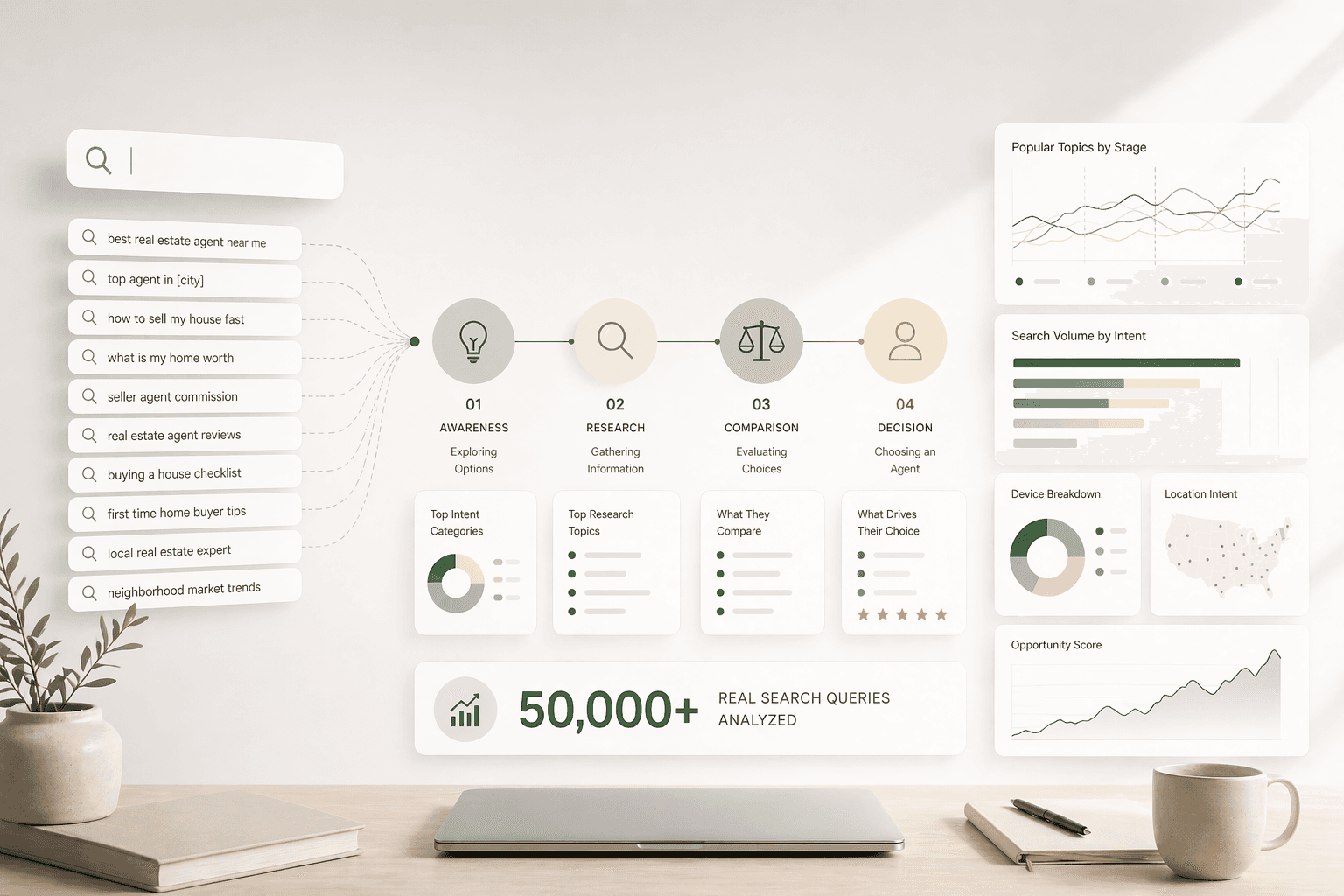
According to NAR's 2025 Profile of Home Buyers and Sellers, 46% of buyers begin their home search online before contacting any agent, and agents ranked as the most useful information source for 85% of buyers after the fact. Buyers progress through four search stages — informational ("how does buying a home work"), market exploration ("homes for sale in [city]"), agent evaluation ("best real estate agent near me"), and validation ("reviews for [agent name]"). Sellers follow a parallel but price-anchored track that starts with "how much is my home worth" and moves through "what does a listing agent do" to "top-rated listing agents in [city]." Agents whose websites answer Stage 1 and Stage 2 questions capture prospects 6–8 weeks before they are ready to commit — a window that most agents leave entirely uncontested.
Key Takeaways
- 46% of buyers started their home search online before contacting any agent, per NAR's 2025 Profile of Home Buyers and Sellers — the highest share since NAR began tracking this metric.
- 71% of buyers interviewed only one agent before choosing who to work with, per NAR's 2024 Profile of Home Buyers and Sellers — which means the agent who shows up first in search, and whose website answers the right questions, wins the client before any competitors know the prospect exists.
- 66% of sellers found their agent through a referral or a prior relationship, per NAR's 2025 Profile of Home Buyers and Sellers — but the 34% who searched online are disproportionately valuable leads, often without an existing agent relationship to default to.
- Seller search queries are price-anchored: "how much is my home worth" draws an estimated 201,000 monthly US searches, per Placester keyword data, making it the highest-volume entry point for seller leads in organic search.
- Agents who publish content answering Stage 1 informational queries (process, costs, timelines) capture prospects an average of 10 weeks before closing — the median buyer search duration documented in NAR's 2025 Profile — giving them relationship-building time competitors who rely solely on portal leads never get.
Marcus Webb, a solo agent in Charlotte, was spending $1,400 a month on Zillow Premier Agent leads when a client told him something that changed how he thought about his business: "I found you on Google three months ago when I was researching how to sell while still paying a mortgage. I read your article, bookmarked it, and when I was ready to call someone, you were the only agent I contacted." That client closed an $870,000 transaction. Marcus had no idea she existed during those three months of online research. The Zillow lead he'd been nurturing the same week went cold.
What buyers and sellers search before they talk to any agent is one of the most commercially important questions in real estate — and the answer is hiding in plain sight inside NAR's annual research. This article maps the four-stage search journey using NAR's 2025 data, breaks down the specific query types buyers and sellers use at each stage, identifies the content gaps most agents leave wide open, and explains exactly which pages and posts capture leads before they ever reach a portal.
The Study: What NAR's Data Actually Shows
The foundational data for understanding consumer search behaviour before an agent relationship begins comes from two NAR sources: the annual Profile of Home Buyers and Sellers, and the Generational Trends Report. NAR's 2025 Profile, based on surveys of 5,390 households who completed a transaction between July 2024 and June 2025, found that 46% of buyers started their home search online — the most common first step, ahead of contacting an agent (20%) or speaking to a lender (11%). Over the same period, 85% of buyers rated real estate agents as the most useful information source in their purchase process. Those two numbers together tell the key story: most buyers start without an agent and end up relying on one — and the agent who shows up during that self-directed research phase earns the relationship.
Keyword research tools from Placester, Virtuance, and Luxury Presence, combined with NAR's consumer behaviour data, allow us to map what specifically those online searches contain. Buyer search queries fall into four recognisable stages that mirror the emotional and informational arc of a home purchase: understanding the process, exploring the market, evaluating agents, and validating a specific choice. Sellers follow a parallel track with a distinctive emphasis on pricing and speed. Understanding this sequence — and which queries belong to which stage — is how an agent's website becomes a lead generation engine rather than a digital business card.
Stat: 46% of buyers started their home search online in 2025 — the most common first step — while real estate agents were rated the most useful information source by 85% of buyers overall. — NAR 2025 Profile of Home Buyers and Sellers
The practical implication is significant. NAR's 2025 data shows buyers spent a median of 10 weeks searching before purchasing. An agent whose website captures a buyer in week one — when they're searching "how much does it cost to buy a house" or "best neighborhoods in [city] for families" — has 9 weeks to build a relationship before any competing agent is even aware that prospect exists. Agents whose entire digital presence consists of a portal profile and a Zillow bio enter the conversation only when the prospect is ready to call someone, which NAR's data shows comes after most of the research is already done.
The 4-Stage Search Journey
Buyers and sellers don't arrive at a decision to hire an agent from a single search. They move through four distinct stages, each with a different query type, a different emotional state, and a different type of content that answers their need.
Stage 1 — Process education (weeks 1–4). The prospect knows they will eventually buy or sell but doesn't know how the process works. Queries here are informational and often question-based: "how does buying a home work," "what credit score do I need to buy a house," "how long does it take to sell a house," "what is escrow," "how much are closing costs." These searches have no commercial intent — the person isn't yet looking for an agent — but they generate enormous monthly search volume. "How much house can I afford" attracts an estimated 201,000 monthly US searches according to Placester keyword data. An agent whose blog post ranks for that query gets in front of 10 to 15 weeks before that buyer will contact anyone. The content that wins here: clear, jargon-free explanations that go one level deeper than the portals.
Stage 2 — Market exploration (weeks 2–8). The prospect has decided they're moving and begins researching specific locations, prices, and property types. Queries become location-specific and property-specific: "3-bedroom homes for sale in [neighborhood]," "average home price in [city] 2025," "best neighborhoods in [city] for families," "condos near downtown [city] under $400k." This is where hyperlocal content wins. National portals dominate "homes for sale [city]" because of their domain authority, but individual agents can rank for long-tail variants like "homes with finished basement in [suburb]" or "schools near homes for sale in [neighborhood]." NAR's 2025 Generational Trends Report found that first-time buyers listed finding the right property as the single hardest step — content that helps them narrow down neighborhoods and understand tradeoffs directly addresses their most urgent problem.
Stage 3 — Agent evaluation (weeks 6–10). The prospect is now ready to work with someone and is comparing options. Queries become commercial: "best real estate agent in [city]," "top-rated buyer's agent near me," "real estate agent specialising in [neighborhood]," "how to choose a real estate agent," "questions to ask a real estate agent." NAR's 2024 Profile of Home Buyers and Sellers found that 71% of buyers interviewed only one agent before deciding — meaning the agent they find first through search, whose website answers these evaluation questions confidently, wins by default. This is the stage where agent review profiles, "About" pages, and testimonials pages do their work.
Stage 4 — Validation (weeks 9–10). The prospect has identified one or two agents and is verifying their choice. Queries include "[agent name] reviews," "[agent name] Zillow," "[brokerage name] complaints," and Google searches for the agent's direct website. At this stage the decision is already largely made — Stage 4 searches are either confirming confidence or surfacing a dealbreaker. An agent with no Google Business Profile, an outdated website, or no reviews visible loses clients here who made the decision to call in Stage 3. The fix is simple but requires consistent effort: reviews on Google Business Profile and a website that loads fast and answers the validation questions immediately.
What Sellers Specifically Search
Seller search behaviour differs meaningfully from buyer behaviour. Where buyers start with process questions, sellers start with valuation. The prospect who is considering listing a home already owns the asset — their first questions are about what it's worth and what it costs to sell. This shapes a seller search journey that begins at Stage 1 with price-anchored queries and converges with the buyer journey at Stage 3 when they evaluate agents.
Seller Stage 1 — Valuation and cost queries. The most common seller entry points are: "how much is my home worth," "free home valuation online," "what is my house worth in [city]," "home value estimator," "how much equity do I have in my home," and "how much does it cost to sell a house." "How much is my home worth" alone draws an estimated 201,000 monthly US searches, per Placester data — making it the single highest-volume organic entry point for seller leads. Agents who publish a neighbourhood-specific home value guide, or who embed a simple CMA request form with educational content explaining how pricing works, capture sellers at the earliest moment of intent. The agent who ranks for "what is my home worth in [neighbourhood]" has a structural advantage over every agent who only advertises on portals.
Stat: 66% of sellers found their agent through a referral or used an agent they had worked with in the past — meaning 34% actively searched for or evaluated an agent they didn't already know. — NAR 2025 Profile of Home Buyers and Sellers
Seller Stage 2 — Timing and preparation queries. Once sellers understand their home's approximate value, they research the selling process: "best time to sell a house in [city]," "how long does it take to sell a house," "how to prepare my home for sale," "should I renovate before selling," "what repairs are required before selling," "how to price my home to sell fast." These queries reveal a seller who is committed to selling but still gathering information before choosing an agent. Content that answers "best time to sell in [market]" with locally specific data — not national averages — ranks well because it satisfies Google's preference for locally useful content while portals and national sites can't match its specificity.
Seller Stage 3 — Agent selection queries. Sellers then narrow to agent evaluation: "listing agent vs seller's agent," "how to choose a listing agent," "questions to ask a real estate agent before selling," "top listing agents in [city]," "do I need a real estate agent to sell my house." NAR's 2025 data shows that agent reputation was the deciding factor for 35% of sellers — the single most cited criterion — ahead of an agent's honesty and trustworthiness (21%). An agent's website that demonstrates specific local market knowledge, shows recent listing results, and provides direct answers to these pre-hire questions signals the competence sellers are evaluating for. Sellers who interview agents rather than defaulting to a referral are often looking for evidence of expertise — and they find it (or fail to) on the first page they land on.
What Buyers Specifically Search
Buyer search behaviour is more varied than seller behaviour because the buyer journey spans a longer period of uncertainty. A seller usually knows they own a specific property and needs to sell it — the variables are price, timing, and agent selection. A buyer may not know the city, neighbourhood, price range, or property type they want when they begin. That uncertainty drives a longer and more exploratory search sequence, which creates more content opportunities for agents.
Buyer Stage 1 — Process and finance queries. The most searched buyer entry points are: "how to buy a house step by step," "how much do I need to buy a house," "what credit score is needed to buy a house," "what is a mortgage pre-approval," "first-time home buyer tips," "how much are closing costs," "what is the home buying process." NAR's 2025 data found that 38% of first-time buyers said understanding the steps and the process was their biggest challenge — and first-time buyer share, though at a historic low of 21%, represents buyers who most need this guidance and who are most likely to form lasting relationships with agents who provide it early. An agent whose website includes a clear "first-time buyer guide" ranking for "[city] first-time home buyer" captures a relationship-ready audience with no prior agent loyalty.
Buyer Stage 2 — Location and lifestyle queries. Once buyers understand the process and their budget, they research where to live. These are the queries that reveal the most about buyer priorities in 2025: "best neighborhoods in [city] for families," "safest neighborhoods in [city] 2025," "homes in top-rated school districts in [area]," "walkable neighborhoods in [city]," "homes near downtown [city]," "3 bedroom homes for sale in [suburb] under $500k." NAR's 2025 Generational Trends Report found that neighbourhood quality and proximity to friends and family have now overtaken job proximity as buyers' top location priorities. An agent who publishes neighbourhood comparison guides — "Roswell vs. Alpharetta for families" or "Westlake vs. Barton Hills for first-time buyers in Seattle" — answers exactly the questions buyers are typing into Google at this stage, months before they call anyone.
Buyer Stage 3 — Agent search queries. When buyers are ready to work with an agent, their searches are specific and high-intent: "buyer's agent in [city]," "real estate agent for first-time buyers near me," "best realtor in [neighborhood]," "how to find a buyer's agent," "buyer's agent vs realtor what's the difference." The BAM analysis of NAR's 2025 data found that 43% of buyers found their agent through a personal referral — but the remaining 57% used other methods, and a meaningful share began with a Google search. Since 71% of buyers contacted only one agent, the agent they find through search often faces no competition.
Content Opportunities Most Agents Miss
Three content gaps appear consistently across agent websites that are otherwise professionally built and maintained. Each represents a genuine opportunity because the searches are common, the intent is clear, and the competition from large portals is weak.
Gap 1: Seller cost and net-proceeds content. "How much does it cost to sell a house" and "what are typical real estate commissions in [state]" are high-intent seller queries that most agent websites do not answer. Sellers want to know what they'll actually net before they commit to anything. An agent who publishes a clear, local breakdown — commission structure, typical closing costs, staging estimates, net proceeds calculator — captures sellers at the exact moment they're deciding whether selling makes financial sense. The agent who answers this question directly is the one who gets the call, not the one who posts monthly market updates.
Gap 2: Neighbourhood comparison content. Portals rank for "homes for sale in [city]" because of domain authority, but no portal will ever publish "Malviya Nagar vs. Vasant Kunj: which is better for families in 2025" or "South End vs. Plaza Midwood: what you get at $450k in Charlotte." These comparison queries have moderate search volume, clear commercial intent (the searcher is narrowing their shortlist), and almost zero competition from large sites. An agent who publishes 10 to 15 neighbourhood comparison guides targeting the specific areas they serve creates a cluster of content that captures Stage 2 buyers — the largest and most sustained part of the search funnel — for years.
Gap 3: Post-search validation content. Once a prospect has identified an agent through search, they verify the choice by searching "[agent name] + reviews," "[agent name] + recent sales," or simply the agent's name. Many agents have no owned web presence at this validation stage — only a Zillow profile or Realtor.com page that they don't control. An agent with a strong "About" page, a "Recent Sales" page showing specific transactions with addresses and results, and Google Business Profile reviews answers validation queries before competitors can intercept them. NAR's 2025 data shows that 52% of buyers found the home they purchased through an online search — the relationship didn't start with a portal lead, it started with a search result.
Gap 4: The "considering selling" content cluster. Most seller-focused content targets people who have already decided to sell. But many homeowners are 6 to 18 months before a decision, asking questions like "is now a good time to sell in [city]," "what happens to my mortgage if I sell," "can I buy a new house before selling mine," and "should I sell or rent my house." This audience is not yet ready to list, but they are forming an impression of which agents understand their situation. The agent who publishes content answering these questions builds a reputation as the local expert before any competing agent is in the picture. When those homeowners are ready to act, the agent they've been reading is the one they call.
How to Capture This Traffic
Knowing what buyers and sellers search is only useful if it translates into a content strategy that an agent can actually execute. The practical approach is a three-layer architecture: an IDX-integrated website that handles Stage 2 property searches, a content library that handles Stage 1 and Stage 2 informational queries, and a reputation layer that handles Stage 4 validation.
Layer 1: IDX property pages. Your website needs IDX integration so that property search queries — "3-bedroom homes for sale in [neighborhood]," "condos under $400k near [transit stop]" — resolve to pages on your domain, not just a portal link. Agents without IDX on their own site lose Stage 2 traffic entirely to Zillow and Realtor.com, because those sites have listings and agents' sites don't. The Luxury Presence 2026 keyword analysis found that long-tail property queries like "homes for sale in [neighborhood] under [price]" have lower difficulty scores than broad terms and higher conversion rates because the searcher has already specified location, type, and budget — three of the four criteria needed to schedule a showing.
Layer 2: Topical blog and guide content. One blog post per week, targeted at specific Stage 1 and Stage 2 queries for your market, compounds over 12 to 18 months into a substantial organic lead channel. The targeting approach: identify the 20 to 30 questions buyers and sellers in your specific market are asking (use Google's "People Also Ask" for your area), then write one definitive post per question. Each post should include locally specific data, not national averages — "average days on market in [neighborhood] in Q1 2026" outranks "average days on market in the US" because it's more useful to the specific searcher. Pinova's IDX-integrated agent websites include a built-in blog and automatically populate neighbourhood market data into content templates, so agents can publish locally specific posts without pulling MLS data manually each time.
Layer 3: Reputation and validation infrastructure. This layer requires the least ongoing effort but most agents neglect it entirely. A verified Google Business Profile with consistent NAP (name, address, phone), a minimum of 15 to 20 Google reviews from past clients, a "Recent Sales" page showing the last 12 to 24 months of closed transactions, and a professional "About" page with a clear photo and credentials. Together, these assets answer every Stage 4 validation search before a competitor can intercept the prospect. NAR's 2025 data showed that agent reputation was the top selection criterion for 35% of sellers — reputation that is invisible online is reputation that doesn't convert.
The agents winning organic lead generation in 2026 are not those with the largest advertising budgets. They are the agents with the most useful content at each stage of the search journey — content that answers the specific questions buyers and sellers are typing before they talk to anyone. NAR's 2025 research confirms the audience is already searching. The only question is whether it's your website that answers them, or a competitor's.
| Key Statistic / Finding | Source & Year |
|---|---|
| 46% of buyers started their home search online — the most common first step — while 20% began by contacting an agent | NAR 2025 Profile of Home Buyers and Sellers |
| 85% of buyers rated real estate agents as the most useful information source during their home search | NAR 2025 Profile of Home Buyers and Sellers, via Virginia REALTORS |
| 71% of buyers interviewed only one agent before deciding who to work with | NAR 2024 Profile of Home Buyers and Sellers, via Pennsylvania Association of Realtors |
| 66% of sellers found their agent through a referral or used an agent they had worked with in the past | NAR 2025 Profile of Home Buyers and Sellers, via Virginia REALTORS |
| Agent reputation was the deciding factor in agent selection for 35% of sellers — the top criterion | NAR 2025 Profile of Home Buyers and Sellers, via Virginia REALTORS |
| Buyers spent a median of 10 weeks searching for a home before purchasing | NAR 2025 Profile of Home Buyers and Sellers |
| 38% of first-time buyers said understanding the steps and process was their biggest challenge | NAR 2025 Profile of Home Buyers and Sellers, via Virginia REALTORS |
| 52% of buyers found the home they purchased through an online search | NAR 2025 Profile of Home Buyers and Sellers, via Placester |
| 'How much is my home worth' attracts an estimated 201,000 monthly US searches | Placester real estate keyword data, 2025 |
| Neighbourhood quality and proximity to friends and family surpassed job proximity as buyers' top location priorities in 2025 | NAR 2025 Home Buyers and Sellers Generational Trends Report |
Frequently Asked Questions
What do most home buyers search for before contacting a real estate agent?
Most buyers begin with process and finance questions — "how to buy a house," "what credit score do I need," "how much are closing costs" — before moving to location research like "best neighborhoods in [city] for families." According to NAR's 2025 Profile of Home Buyers and Sellers, 46% of buyers started their search online, and the median search duration before purchase was 10 weeks. Only about 20% of buyers contacted an agent as their first step. This means the majority of the buyer journey takes place before any agent is involved, which is why content that answers Stage 1 process questions captures prospects weeks before they are ready to call anyone.
What do home sellers search before choosing a listing agent?
Sellers typically begin with valuation queries: "how much is my home worth," "free home valuation in [city]," "how much does it cost to sell a house." They then move to timing and preparation ("best time to sell in [market]," "should I renovate before selling") and finally to agent evaluation ("best listing agent in [city]," "questions to ask before hiring a real estate agent"). According to NAR's 2025 Profile of Home Buyers and Sellers, agent reputation was the top selection criterion for 35% of sellers. Agents who publish locally specific pricing guides and market timing content capture sellers 2 to 4 months before a competing agent who relies solely on referrals or portal leads is even aware the prospect exists.
How many real estate agents do buyers and sellers interview before choosing one?
The majority choose quickly and without extensive comparison shopping. NAR's 2024 Profile of Home Buyers and Sellers found that 71% of buyers interviewed only one agent before deciding who to work with. On the seller side, NAR's multi-year data shows that 70–80% of sellers also contacted only one agent before hiring. This single-agent behaviour means being the first agent a prospect finds through search — and having a website that builds confidence immediately — is more important than any subsequent comparison. The "competition" most agents worry about rarely happens because most buyers and sellers stop at the first agent who demonstrates credibility.
Can individual real estate agents compete with Zillow and Realtor.com in Google search?
Not for generic broad terms, but yes for hyperlocal long-tail queries. Portals dominate "homes for sale in [city]" because of domain authority and inventory. Individual agents cannot win those terms organically. However, agents can rank well for specific long-tail queries that portals don't create dedicated content for: "homes with finished basement in [suburb]," "best neighborhoods in [city] for young professionals," "average home price in [specific neighborhood] 2025," "sell my house fast in [specific zip code]." According to keyword data from Luxury Presence and Placester, these hyperlocal terms have lower competition scores, attract higher-intent searchers (who have already specified what they want), and convert at higher rates into leads than broad traffic.
What content should a real estate agent publish to attract seller leads from Google?
Three content types consistently attract seller leads at each stage of the seller journey. For Stage 1, publish a local home valuation guide that explains how CMAs work and what factors affect pricing in your specific market — this captures "how much is my home worth" searches. For Stage 2, publish a "best time to sell in [city/neighborhood]" post updated quarterly with local days-on-market and absorption rate data. For Stage 3, publish a "how to choose a listing agent" guide that positions your specific process and results — and ensure your Google Business Profile shows recent reviews. NAR's 2025 Profile found that 35% of sellers chose their agent based on reputation, which means reputation that is searchable and visible is your most valuable content asset.
How long before buying a home do buyers typically start searching online?
According to NAR's 2025 Profile of Home Buyers and Sellers, the median buyer searched for 10 weeks before purchasing. However, Stage 1 research often begins much earlier — agents who monitor site analytics frequently see first sessions on their educational content 3 to 6 months before a lead submits a contact form. NAR's Generational Trends data shows that first-time buyers (median age 40 in 2025) often face extended timelines due to affordability challenges and saving for a down payment, meaning their research horizon is longer than repeat buyers. An agent whose site captured that buyer's first visit when they were researching "how to save for a down payment" has a substantial head start on any competitor who entered the picture when the buyer was ready to schedule showings.
Why does agent reputation matter so much in real estate search?
Because most buyers and sellers interview only one agent, the perception of credibility formed through online research — Google reviews, website content quality, visible transaction history — determines the outcome before any human conversation takes place. NAR's 2025 Profile found that 35% of sellers cited agent reputation as their top selection criterion, and NAR's 2024 data found that 71% of buyers used only one agent. When a prospect finds an agent through a Google search for "top listing agent in [neighborhood]," lands on a website with detailed local market data and 30+ verified Google reviews, and sees recent transactions in their target area, the hiring decision is largely made before the first call. Agents who treat their online reputation as optional are competing with both hands tied behind their back against agents who treat it as infrastructure.
What is the difference between buyer search intent and seller search intent?
Buyers search with exploration intent — they're looking to understand options, costs, and locations, often before they've committed to a timeline or a specific property. Their queries span months and move from general ("how does buying a home work") to specific ("3-bed homes near [school] under $600k"). Sellers search with evaluation intent — they already own an asset and are assessing whether and when to act. Seller queries are more price-anchored and decision-proximate from the start: "how much can I get for my house," "is now a good time to sell in [city]," "what does a listing agent do." Content strategy for buyers should prioritise breadth and the long funnel; content for sellers should prioritise specificity and local market authority. NAR's 2025 data confirms that sellers value agent expertise and reputation over agent availability — which means deep, credible content converts them better than high-volume visibility.
📚 Related Reading
- How Google AI Overviews are changing real estate search — and which agents will win
- The $27,000 question: what one additional closing per year is actually worth to your business
- Solo agent vs team: a data-backed look at which model earns more per hour worked
- The real estate tech stack audit: what the top 1% of agents actually use in 2026
Ayushman Singh
— Co-Founder & Chief Brand & Marketing OfficerAyushman Singh is the co-founder and Chief Brand & Marketing Officer of Pinova. He shapes the narrative, builds the brand, and tells the stories the industry doesn't want to hear. He believes the real estate system was designed to extract from agents, not empower them — and he's building the counter-narrative.